Our readers keep the lights on and my smoothie glass nicely filled. As an Amazon Associate, I earn from qualifying purchases.
If you are making jerky in serious volume — for a small business, hunting camp, or a large family — the biggest frustration is uneven drying: some strips come out bone-dry while others are still tacky. A commercial dehydrator solves that by combining high wattage (1000W to 2500W), large tray counts (10 to 22 trays), and horizontal airflow that hits every tray equally, so your whole batch finishes at the same time.
I’m Mohammad Maruf — the co-founder and writer behind WellFizz. This guide is built by comparing the manufacturers’ published specifications and the patterns across verified customer reviews, so you get each pick’s real strengths and trade-offs instead of marketing spin.
Whether you need to process 50 pounds of venison a week or just want to stop buying overpriced store jerky, this breakdown of the best commercial dehydrator for jerky will show you which machine actually delivers consistent results without costing a fortune in electricity or frustration.
How To Choose The Best Commercial Dehydrator For Jerky
Picking the right machine for jerky comes down to four non-negotiable factors: airflow design, temperature range, tray material, and wattage. Here is what each one means in plain language.
Airflow: Horizontal vs. Vertical (Stackable)
Horizontal airflow (fan mounted in the back) pushes warm air across every tray from one side to the other. This is the gold standard for jerky because meat juices drip down, and vertical units can let that moisture pool and cause uneven drying or bacterial growth. All the picks on this list use horizontal airflow.
Temperature Range and JERKY SAFE Heat
The USDA recommends heating whole-muscle meat to 160°F and ground meat or poultry to 165°F before dehydrating to kill pathogens like Salmonella and E. coli. A commercial jerky dehydrator must reach and hold at least 165°F reliably. Some machines top out at 165°F — others go to 190°F or 194°F, giving you headroom for thicker cuts or faster drying.
Tray Material: 304 vs. 316 Stainless Steel
All commercial-grade models use stainless steel trays. Standard is 304 stainless, which is food-safe and corrosion-resistant. Premium units use 316 stainless, which adds molybdenum for even better resistance to heat, acid (from fruit), and salt (from marinades). If you are dehydrating highly acidic or salty jerky recipes daily, 316 is worth the upgrade.
Wattage and Batch Size
More watts mean the heating element recovers temperature faster when you open the door or load cold meat. For 10 trays, 1000W-1200W is adequate. For 16 to 22 trays, look for 1500W or higher. Going too low on wattage with a large tray count leads to long drying times and inconsistent results.
Quick Comparison
On smaller screens, swipe sideways to see the full table.
| Model | Category | Best For | Key Spec | Amazon |
|---|---|---|---|---|
| Cercker 16 Tray | Best Overall | High-volume jerky & versatility | 1,500W / 27.28ft² / 316 SS | Amazon |
| Septree 10 Tray | Best Value | Solid, quiet starter unit | 1,000W / 24.65ft² / 304 SS | Amazon |
| Ausegia 12 Tray | Best Mid-Range | Balanced capacity & extras | 1,200W / 22.67ft² / 304 SS | Amazon |
| STX Dehydra 1200W | Top Performer | USDA-safe jerky assurance | 1,200W / 10 trays / 304 SS | Amazon |
| Septree Rotary 16 Tray | Most Innovative | Even drying without rotating racks | 1,500W / 16 trays / 304 SS | Amazon |
| Cercker 22 Tray | Max Capacity | Production-scale batches | 2,500W / 37.5ft² / 316 SS | Amazon |
| NutriChef 20 Layer | Premium Pick | Quiet, precise, long runs | 2,000W / 20 trays / 304 SS | Amazon |
In‑Depth Reviews
1. Cercker Commercial Food-Dehydrator Machine 16 Trays
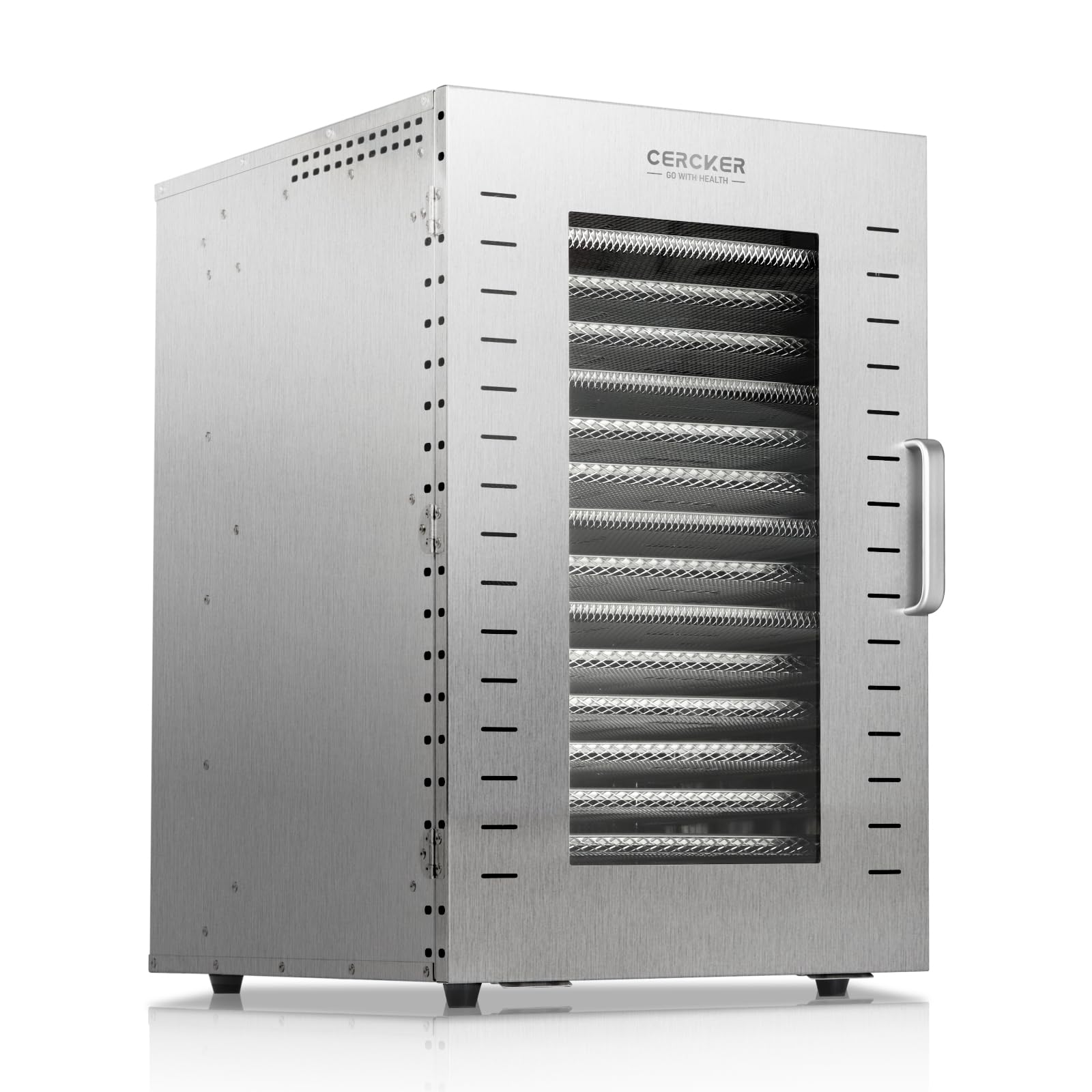
The 27.28ft² of drying space on the Cercker 16-tray makes it the top pick for serious jerky makers processing 20+ pounds of meat per week who want a professional-grade unit. It uses 316 stainless steel trays (superior to standard 304 for resisting acidic marinades and salty brine) and runs on 1,500W.
Buyers report it “works well for jerky, apple slices, kale chips” and that the dual fans deliver even drying across all 16 trays — something cheaper single-fan units struggle with. It has a 70°F to 190°F temperature range, so you can go well above the 165°F USDA jerky-safe threshold for faster cycles, and the 0.5–24 hour timer lets you set an overnight run without babysitting. At 53.54 pounds, it is not light, but the heavy build also means stable heat retention.
The honest trade-off is that it only includes 4 silicone liners — enough for a few batches, but you will probably want to buy more if you are making fruit leathers or sticky jerky glazes regularly. For the price and performance, this is the best all-rounder on the list.
Why it’s great
- 316 stainless trays resist corrosion from salty jerky brine better than 304
- 1,500W with dual fans for fast, even drying across all 16 trays
- 27.28ft² capacity — 20% more usable area than the 12-tray Ausegia
Good to know
- No dishwasher-safe trays (hand-wash only)
- Comes with only 4 silicone sheets; you may need more for sticky foods
- Weighs 53.54 pounds — definitely not a countertop unit you move around
2. Septree Commercial 10 Trays Food Dehydrator Machine

Compared to the Cercker 16-tray, the Septree 10-tray costs less but still delivers a genuine commercial build: all 304 stainless steel trays, a glass front door, and a rear-mounted fan that pushes air horizontally. It runs at 1,000W — 50% less wattage than the Cercker 16 — so drying a full load of jerky will take a few hours longer, but for smaller batches (up to 10 trays at a time) the difference is manageable.
Buyers specifically mention setting it “at 165°F for 8 hours auto-shutoff” and getting “dry, crunchy jerky” — proof it holds the USDA-recommended meat-safety temperature consistently. The back electric box separates from the main dryer body, letting you rinse the front section with a garden hose, and all trays plus the drip tray are dishwasher-safe. At 33.06 pounds, it is 62% lighter than the Cercker 16, making it far easier to slide onto a shelf or move after use.
If you are just starting a jerky operation or you only run one or two batches a week, this machine gives you commercial-grade stainless construction and reliable temperature control without the weight or wattage of a larger unit. Choose this over the top pick if you prioritize a lighter, lower-wattage machine for smaller batches and easier cleanup over the faster drying speed of the Cercker 16.
Where it shines
- All stainless steel and glass construction — no plastic contact with food
- Back panel detaches for easy cleaning; trays are dishwasher-safe
- Quiet operation at 45-50dB, quiet enough for overnight use
Worth noting
- 1,000W means longer drying times compared to 1,500W+ machines
- Only includes 2 silicone sheets — you may want extra for fruit leathers
- Temperature range tops out at 194°F, which is fine for jerky but less headroom than some competitors
3. Ausegia Commercial Large 12 Trays Food Dehydrator

Imagine you have a small jerky business and need to churn out 13–14 pounds of finished jerky per batch, every batch coming out at the same doneness. The Ausegia 12-tray is built for that exact scenario: owners mention it “holds ~13-14 lbs jerky, cooks uniformly” across its 22.67ft² usable area, thanks to the horizontal airflow system and 1,200W heating element.
The digital control panel lets you dial in temperatures from 70°F to 190°F in 5° increments and set a timer from 30 minutes to 24 hours. One minute before the timer ends, it auto-starts a cool-down fan cycle — a nice safety touch that also keeps the machine from radiating heat after the cycle finishes. It comes with 12 stainless steel trays, 6 silicone pads, a non-stick sheet, and a hanger with hooks for hanging jerky strips vertically.
Buyers consistently note it runs quieter than their old tower-style dehydrators.
What stands out
- 12 trays with 22.67ft² capacity — real commercial throughput for jerky
- Comes with 6 silicone pads, a hanging rack, and 12 hooks — strong accessory kit
- Digital timer with cool-down auto-shutoff adds safety and convenience
The trade-offs
- Shelves are slightly undersized per some reviews — measure your trays before loading large cuts
- Temperature range is 190°F max, which is adequate for jerky but less headroom than 194°F+ units
- Controls are on the top back, which can be awkward to reach if the unit is on a high counter
4. STX International Dehydra 1200W-XLS

The single number that matters most for jerky safety is 165°F — the USDA’s recommended internal temperature for ground meat and poultry before dehydration. The STX Dehydra hits that mark with a 97°F to 165°F range and features 7 preset temperatures, making it one of the few machines explicitly marketed as “JERKY SAFE.” Buyers confirm it reaches 165°F in about 20 minutes and holds it steady across the 10 stainless steel trays.
The catch is that its max temperature is capped at 165°F — you cannot crank it higher for faster drying like you can with 190°F+ machines. Also, the tray grid has 3/8″ x 3/8″ holes, which means smaller items like chopped herbs or banana slices can fall through unless you use the included silicone mats. Some long-term users note that after hundreds of pounds of jerky over 5 years, the unit is still running strong, and the company replaced trays free of charge when they upgraded the mesh size.
At 40 pounds with a 15-hour timer and dishwasher-safe trays (the racks, not the main body), it is a workhorse that prioritizes food safety above all else — a smart pick if you sell jerky or want absolute peace of mind about pathogen kill steps.
The upsides
- USDA-aligned JERKY SAFE temp range (97°F–165°F) with 7 presets
- Rear-mounted 7-inch fan provides true horizontal airflow
- 3-year warranty and strong customer service reputation for replacement parts
Keep in mind
- Max temp is 165°F — no headroom for faster drying above meat-safety guidelines
- Large tray grid allows small items to fall through without silicone mats
- 15-hour timer is shorter than the 24-hour timers on most competitors
5. Septree Rotary Food Dehydrator 16 Trays

At this price point, what you actually get is a rotating-tray system that eliminates the need to swap shelves mid-cycle — the trays rotate continuously so every layer spends equal time in the hottest airflow. This is a clever solution if you have ever opened a dehydrator halfway through to find the bottom trays done while the top ones are still raw. It runs on 1,500W with dual 7-inch fans and includes 16 round 304 stainless steel trays plus 16 non-stick silicone sheets.
What you give up: the rotating mechanism adds mechanical complexity. A few customers note a “click every time the racks rotate” and one reported a “creek and rattle” after several uses, which raises the question of long-term durability compared to a fixed-tray unit. At 57.32 pounds and 31.3 inches tall, it is also the tallest machine on this list — make sure your counter or cart has vertical clearance.
This is the perfect choice if you dehydrate a very wide variety of foods (jerky, fruit, herbs, dog treats) and want the most even drying possible without manual tray rotation, and you are comfortable with a slightly higher risk of mechanical noise over time.
Why we’d pick it
- Rotating trays ensure every batch dries evenly without manual shelf swapping
- Comes with 16 silicone sheets — enough for every tray right out of the box
- 3-year warranty and lifetime after-sales support
A few caveats
- Rotating mechanism can develop clicking or rattling sounds over time
- Tallest unit on the list at 31.3 inches — check your vertical clearance
- No interior light to check progress without opening the door
6. Cercker Commercial Food-Dehydrator Machine 22 Trays
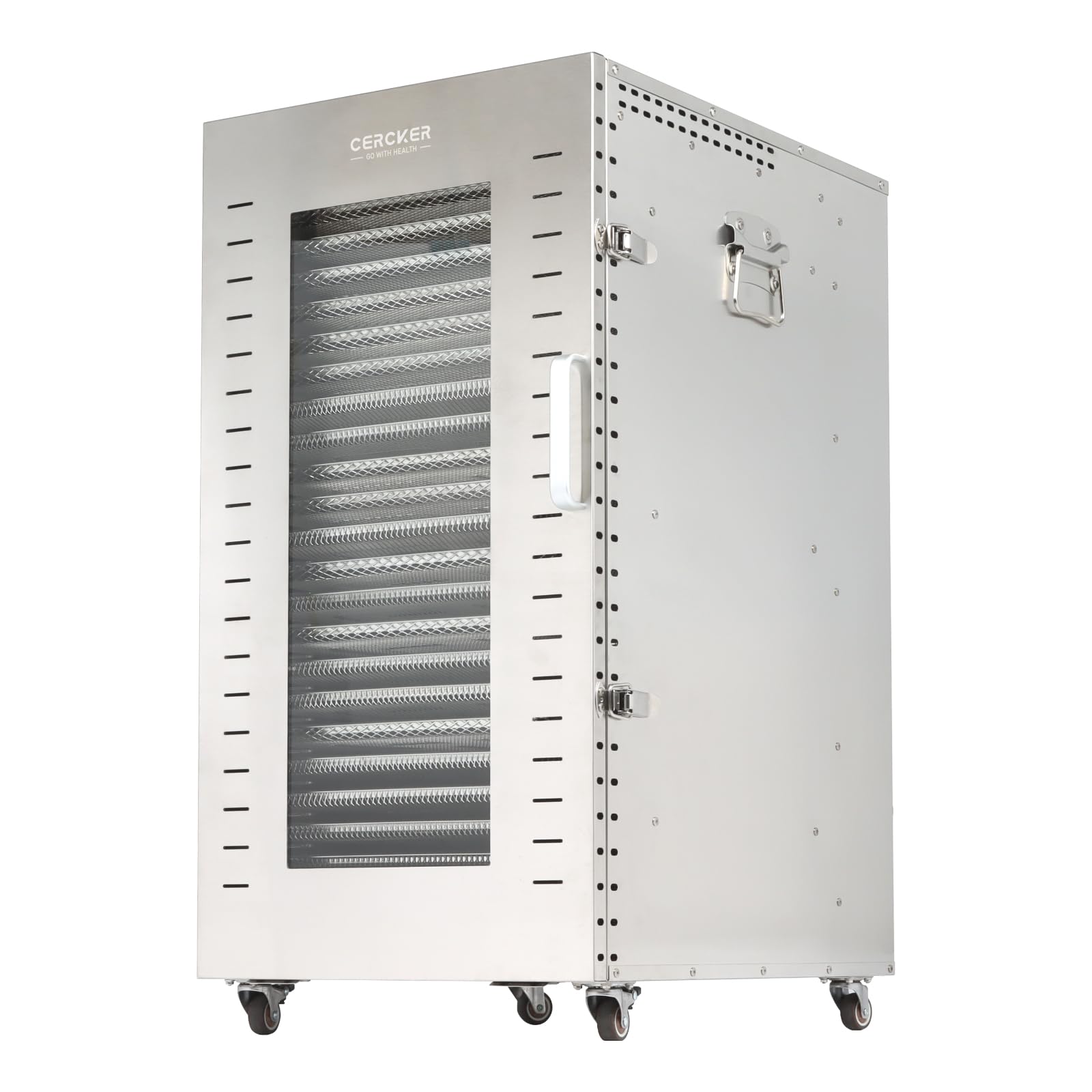
If you need production-scale volume — think a dog treat business or a hunting club processing dozens of pounds of venison per week — the Cercker 22-tray is the clear choice. It offers 37.5ft² of drying space (nearly double the 10-tray units) and an eye-opening 2,500W of power delivered through three fans, which reviewers point out can handle “close to 30lbs of jerky meat” in a single load. The 316 stainless steel trays resist corrosion from heavy marinade use better than standard 304.
The feature that serves the high-volume buyer best is the dual-plug system: one plug for standard 110V or two plugs for 220V operation. This means you can run it on a normal household circuit for smaller batches, then switch to a dedicated 220V line when you need maximum heat recovery on a full load. All 22 trays are dishwasher-safe, and the thickened viewing window lets you monitor progress without losing heat by opening the door.
The honest limit is that at 53.54 pounds with dimensions of 33.8 inches tall, this is a floor-standing machine, not a countertop toy. It also costs more than double what the 10-tray Septree costs, so only spring for it if you are running consistent high-volume production, not occasional weekend batches.
Strong points
- 37.5ft² drying area — the largest capacity on this list by far
- 2,500W with three fans for rapid, even dehydration of massive loads
- Dual-plug system supports both 110V and 220V operation
Before you buy
- Large footprint and 53.54 lb weight mean it needs a permanent floor spot
- Substantial upfront investment — best for commercial or near-commercial use
- WARNING: never plug both cords into the same outlet
7. NutriChef 20 Layer Commercial Food Dehydrator Machine

The NutriChef 20-tray sits at the top end of the price spectrum but brings a 2000W U-shaped heating tube with 360° hot air circulation, along with a touch-control LED display that manages temperature from 86°F to 194°F and a timer up to 24 hours. Compared to the other premium units, the NutriChef adds a magnetic door switch that automatically shuts off the machine if the door opens — a practical safety feature if you have kids or pets in the kitchen.
What that money actually gets you: 20 full-size 304 stainless steel trays, a crumb tray at the bottom, and very quiet operation that buyers describe as “quiet enough to run 24/7.” The temperature accuracy is excellent — one reviewer noted the “outstanding consistent performance” for long-duration runs. It requires a 220-volt power supply, so it is not a plug-and-play for every household; confirm your outlet type before buying.
The one clear reason to choose the NutriChef over any other pick is if you need the quietest, most precise long-duration machine for running overnight or even multi-day dehydration cycles, and you have a 220V outlet ready.
What we like
- 2000W U-shaped heating tube with 360° airflow for fast, even drying
- Magnetic door safety shutoff and automatic overheat protection
- Touch-control LED display with precise 86°F–194°F range
The downsides
- Requires a 220V power supply — not compatible with standard US 110V outlets
- Weighs 73.5 pounds — one of the heaviest units on the market
- Trays are not dishwasher-safe (hand-wash recommended)
Understanding the Specs
Tray Material: 304 vs. 316 Stainless Steel
Most commercial dehydrators use 304 stainless steel — it is food-safe, resists rust, and handles typical jerky marinades well. 316 stainless steel adds molybdenum, which makes it significantly more resistant to corrosion from salt, acid, and high heat. If you use very acidic or salty marinades daily, or you plan to keep the machine for 5+ years, the upgrade to 316 is worth the extra cost.
Horizontal Airflow (Rear Fan)
Horizontal airflow means the fan is mounted on the back of the unit, pushing warm air forward across every tray at the same speed. This is essential for jerky because it prevents moisture from dripping down and pooling on lower trays (a problem with vertical stackable dehydrators). Look for “rear-mounted motor” or “horizontal airflow” in the product description.
JERKY SAFE Temperature (165°F)
The USDA recommends heating whole-muscle meat to 160°F and ground meat or poultry to 165°F before dehydrating to kill bacteria like Salmonella and E. coli. A “JERKY SAFE” machine must reach and maintain at least 165°F. Some machines cap out at 165°F; others go to 190°F–194°F, giving you the option to run hotter for faster drying or for thicker cuts.
Wattage and Drying Speed
Wattage measures how much electrical power the heating element uses. Higher wattage (1500W+) means the element recovers temperature faster after you open the door or load cold meat. For 10–12 trays, 1000W–1200W is sufficient. For 16–22 trays, 1500W–2500W prevents long cycle times and inconsistent results. A low-wattage unit with many trays will struggle to maintain even heat.
FAQ
Can I use a commercial dehydrator on a standard household outlet?
How many pounds of jerky can a 16-tray dehydrator hold per batch?
Is 316 stainless steel worth paying extra for jerky dehydration?
Do I need to preheat my meat before putting it in the dehydrator?
Why is horizontal airflow better than vertical (stackable) airflow for jerky?
Final Thoughts: The Verdict
If you want one dependable pick, the best commercial dehydrator for jerky winner is the Cercker 16-tray because it combines 316 stainless steel trays, 1,500W of power, and 27.28ft² of space at a price that undercuts larger premium units while still feeling built for commercial use. If you want the most even drying possible without manual tray rotation, grab the Septree Rotary 16-tray. And for production-scale volume where every square inch counts, the standout is the Cercker 22-tray with its 37.5ft² of space and 2,500W of heating power.

Mo Maruf
I created WellFizz to bridge the gap between vague wellness advice and actionable solutions. My mission is simple: to decode the research and give you practical tools you can actually use.
Beyond the data, I am a passionate traveler. I believe that stepping away from the screen to explore new environments is essential for mental clarity and physical vitality.