Our readers keep the lights on and my smoothie glass nicely filled. As an Amazon Associate, I earn from qualifying purchases.
The moment you close your eyes, the only sound you want is silence—not a rattling, whining fan that keeps you up. A room fan should vanish into the background, pushing cool air across your skin without turning your bedroom into a wind tunnel. The real challenge isn’t picking a fan that blows hard; it’s finding one that moves serious air at a volume low enough for sleep, work, or conversation.
I’m Mohammad Maruf — the co-founder and writer behind WellFizz. This guide is built by comparing the manufacturers’ published specifications and the patterns across verified customer reviews, so you get each pick’s real strengths and trade-offs instead of marketing spin.
This roundup of the best cooling fans for rooms cuts through the noise to show you which models actually deliver quiet, powerful airflow for your space.
How To Choose The Best Cooling Fan For Your Room
Picking a room fan isn’t just about grabbing the cheapest or the tallest. You need to match the fan’s airflow, noise level, and size to your specific room and how you plan to use it. Here are the three things to focus on before you buy.
Airflow Power: CFM vs. Speed Settings
The most honest measure of a fan’s cooling ability is CFM (cubic feet per minute—the volume of air it moves each minute, like how many basketball-sized lumps of air it pushes past you). A higher CFM means more air circulation, which is what actually cools you down. Speed settings (3, 6, or 8 speeds) give you fine control between a gentle breeze and a full blast, but without a CFM number, you are guessing at raw power. Look for a fan that offers both high CFM for hot days and multiple lower speeds for comfortable sleeping.
Noise Output: Decibels (dB) and What They Mean
A fan’s noise is measured in decibels (dB)—a lower number means a quieter operation. A fan rated at 20-25 dB is whisper-quiet, comparable to leaves rustling, perfect for a light sleeper’s bedroom. At 28-37 dB, you get a soft whoosh that many people find helps them sleep (white noise). Above 40 dB, the fan becomes noticeable and can be disruptive during conversations or TV watching. Always check the stated dB at the lowest speed, because that is the setting you will use most at night.
Size, Oscillation, and Placement
The fan’s physical size determines how much floor space it needs and how high the airflow reaches. Tower fans (around 30-40 inches tall) save floor space and are ideal for bedrooms and living rooms. Pedestal fans (around 53 inches tall) stand higher and can push air across larger spaces, but take up more room. Oscillation (side-to-side movement) should cover at least 75-90° to spread the breeze across the room. Also, look for a fan with a built-in carry handle if you plan to move it between rooms.
Quick Comparison
On smaller screens, swipe sideways to see the full table.
| Model | Category | Best For | Key Spec | Amazon |
|---|---|---|---|---|
| DREO Tower Fan | Premium DC Motor | Quietest powerful cooling | 28 ft/s wind speed, 20 dB noise | Amazon |
| Shark TurboBlade | Premium Bladeless | Versatile room coverage | 180° oscillation, 10 speeds | Amazon |
| GoveeLife Tower Fan | Smart Connected | App and voice control | 25 ft/s wind speed, 29 dB noise | Amazon |
| Amazon Basics Pedestal | Mid-Range Pedestal | Large rooms, powerful airflow | 16-inch blades, 60W motor | Amazon |
| PELONIS 30-Inch Tower | Compact Tower | Small spaces, quiet cooling | 847 CFM, 37 dB noise | Amazon |
| Antarctic Star T36 | Budget Bladeless | Budget-friendly quiet cooling | 22 dB low speed, 7.3 lbs | Amazon |
| hуkolity 40-Inch Tower | Entry Level Tower | Ultra-budget tower option | 28 dB noise, 26 ft/s speed | Amazon |
In‑Depth Reviews
1. DREO Tower Fan for Bedroom, 2026 Upgraded DC Motor

28 ft/s wind speed at just 20 dB—softer than a whisper—makes the DREO tower fan the top pick for anyone who needs strong, quiet cooling without disturbing sleep or focus. Its upgraded brushless DC motor runs more efficiently and quietly than a standard AC motor, and it is notably quieter than the Shark fan on its lowest speed.
8 speed settings and 4 modes (Normal, Natural, Sleep, and Auto) let you dial in anything from a barely-there breeze to a full-room gust projecting up to 34 feet. The 90° oscillation spreads air evenly, and buyers report the Nature setting is “very quiet and calming,” ideal for light sleepers needing background white noise. The removable rear grille makes cleaning simple, keeping the motor efficient season after season.
The honest trade-off is longevity: a few owners mention that after 1-2 years of heavy use, the motor’s power decreased noticeably, making it effectively an annual investment for some. For most people, the combination of whisper-quiet operation, deep customization, and strong airflow makes the DREO the best value for the money in this category.
Why it’s great
- Exceptionally quiet at 20 dB on low setting
- 8 speed settings offer precise breeze control for any scenario
- Cleanable rear grille prevents dust buildup
Good to know
- Some users report a decline in airflow strength after 1-2 years
- Highest setting is noticeably louder than lower speeds
2. Shark TurboBlade Fan TF202S

Where the DREO leads on raw power-to-quiet ratio, the Shark TurboBlade beats it on sheer room coverage—it oscillates 180° (twice the 90° range of most fans) and pivots both vertically and horizontally, letting you direct airflow from focused Tower Mode to a wide Air Blanket Mode. This is the fan you want if your room layout is awkward or you want to cool multiple zones from one spot.
You get 10 speeds and 10 noise levels, meaning you can independently pick how much breeze and how much white noise you want. Customers note that at speed 5, you get great airflow at 15 feet away, and the adjustable blade angles are a hit with pet owners who want to aim the breeze toward a sleeping dog. The bladeless design makes cleaning wipe-easy, and the Dust Defense system (a built-in particle capture layer) helps keep internal components clean over time.
Choose the Shark if you need the most customizable airflow direction on the market and don’t mind the larger footprint (31.57 inches wide). It is quieter than the DREO at its lowest setting but louder at its highest, so if absolute silence is your priority, the DREO is the better choice. The Shark’s 180° oscillation and pivoting head make it the most flexible fan for open-concept spaces.
Where it shines
- 180° oscillation and vertical pivot for unmatched directional control
- 10 speeds plus 10 noise settings let you tune air and sound independently
- Bladeless design is extremely easy to wipe clean
Worth noting
- Very large at 31.57 inches wide, not ideal for small rooms
- Higher speeds (6-10) produce noticeable fan noise
3. GoveeLife Black Tower Fan for Bedroom, 36″ Smart Floor Fan

Imagine coming home on a scorching day and telling your smart speaker to turn on the fan before you even walk through the door—that is exactly what the GoveeLife fan delivers. It connects to Wi-Fi and works with Alexa, Google Assistant, and Siri, plus the Govee app gives you full control from anywhere, including a 24-hour timer and a Smart Auto mode that adjusts the fan speed based on the room’s temperature sensor.
With 8 speeds and 5 modes (Normal, Natural, Sleep, Auto, and Custom), the fan pushes air up to 32.8 feet away at 25 ft/s, while staying at a quiet 29 dB on lower settings. One reviewer who owns six Govee fans notes that the oscillation is “silent; only soft white noise from fan,” and several buyers mention that using this fan reduced their AC usage and electricity bills. The lock function prevents accidental touches, which is handy if you have kids or pets.
The catch is that some units arrive with a clicking or thumping noise, though reviewers point out that Govee’s customer service responds fast and sends replacements within 24 hours. If you already have smart home devices or just love the convenience of voice and app control, this fan is the easiest to live with day-to-day, and its 29 dB low-speed whisper is the quietest in this guide.
What stands out
- Full Wi-Fi connectivity with Alexa, Google Assistant, and Siri support
- Temperature sensor enables Auto mode that adjusts fan speed to room temp
- 8 speeds and 5 modes offer deep customization
The trade-offs
- Some units have a clicking noise that requires a replacement unit
- Lower speed settings are quiet, but higher speeds are louder
4. Amazon Basics 16″ Pedestal Fan with Remote

If your room is large—like a living room, open kitchen, or master bedroom—the single spec that matters most is blade size, and this Amazon Basics pedestal fan packs a 16-inch dual-layer blade design that moves a massive amount of air. At 12.3 pounds, it is noticeably heavier than most tower fans (the Antarctic Star T36 is 7.3 pounds, a 68% difference), which means it stays planted on the floor without wobbling even at high speeds.
The downside you accept with a pedestal fan is its physical bulk: at 53.15 inches tall and 17.72 inches wide, it takes up significantly more floor space than a tower fan (the PELONIS is 63% smaller in overall dimensions). But in exchange, you get three breeze modes (Normal, Nature, Sleep) and a tiltable head that lets you aim the airflow up or down. Shoppers say that it is “silent on low speeds, whooshing on high but still quiet for TV/music,” making it a solid choice for shared spaces.
For the price, you get a stable, powerful fan that moves more air than any tower fan in this lineup. It is not the quietest option, but if you need to cool a large room without spending premium money, this pedestal fan delivers the best raw airflow per dollar in this guide.
The upsides
- 16-inch dual-layer blades move substantial air across large rooms
- Very stable at 12.3 pounds, no wobble on high speed
- Three breeze modes (Nature, Sleep, Normal) for comfort variety
Keep in mind
- Takes up significant floor space compared to tower fans
- Remote control range is short and sometimes needs multiple presses
5. PELONIS 30-Inch Oscillating Tower Fan for Bedroom

At only 30 inches tall with a 10-inch base, the PELONIS is the smallest tower fan in this lineup, making it perfect for cramped bedrooms, dorm rooms, or any spot where floor space is at a premium. Yet despite its compact size, it pushes an impressive 847 CFM (cubic feet per minute), which is 32.6 times the airflow capacity of the hykolity tower fan—a massive gap that proves small doesn’t mean weak.
The fan runs at a quiet 37 dB (about as loud as a quiet library), and buyers confirm it is “very quiet when the fan is on” and that it “lasted 2 years without issues.” The 90° oscillation and CycleBoost technology (a feature that circulates air up to 11 feet away) make it surprisingly effective for its size. Assembly takes minutes with no tools required, and the built-in carry handle makes it easy to move from bedroom to living room.
What you give up is the deep customization of pricier fans: only 3 speeds and a 7-hour timer, no smart features or advanced modes. But if your main concern is a small, quiet fan that genuinely cools your bed area without dominating the room, the PELONIS hits a sweet spot of size, performance, and price that few competitors match.
Why we’d pick it
- Compact 30-inch height fits easily in tight spaces
- 847 CFM airflow is powerful for its small footprint
- Tool-free assembly and built-in carry handle for portability
A few caveats
- Only 3 speed settings, less customizable than higher-end fans
- Top-mounted control panel is hard to view; remote is recommended
6. Antarctic Star T36 Tower Fan-36 Inch, Bladeless Oscillating Fan
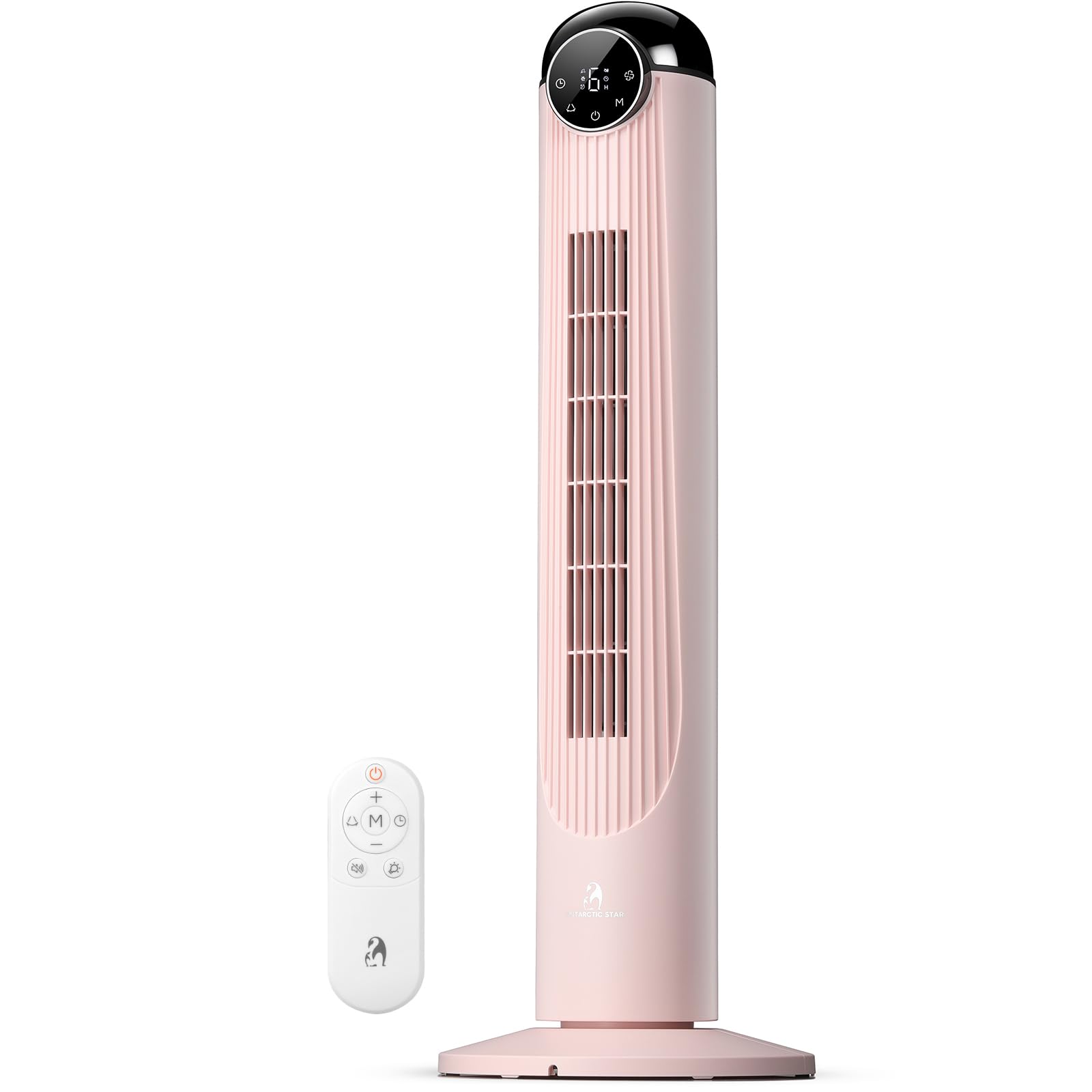
This pick is perfect for a light sleeper, a parent setting up a nursery, or anyone who needs a whisper-quiet fan for a small bedroom or office and is shopping on a budget. The 36-inch bladeless tower fan boasts a remarkable low-speed noise rating of just 22 dB—quieter than the DREO at its lowest setting—and offers 6 speeds, 4 modes (Normal, Nature, Sleep, Smart), plus a child lock and auto-off LED screen, which is impressive for a budget-tier fan.
What you give up is top-end power: at highest setting 6, some buyers report the fan gets noticeably louder and still doesn’t fully cool an entire room. It works best as a personal cooling fan for a desk, bed, or corner of a room rather than a whole-space circulator. The rear grille snaps off for easy cleaning, and the built-in handle plus remote slot make it convenient to move and store.
The Antarctic Star is perfect for someone who needs an ultra-quiet bladeless fan on a budget—especially in a pink color option that owners mention is “cute” and that “cats love.” Just be aware that if you need powerful, room-filling airflow, this fan’s top speed may leave you wanting more.
Strong points
- Ultra-quiet 22 dB on low speed, softer than a library whisper
- Removable rear grille for easy dust cleaning
- Child lock and auto-off screen for safe nighttime use
Before you buy
- Does not fully cool a whole room even on highest speed 6
- Gets noticeably louder above speed 4
7. hykolity 40” Tower Fan for Bedroom

Compared to the rest of the field, the hykolity is the most affordable tower fan here, and at 26 ft/s it delivers decent wind speed for its price class. The fan is rated at 28 dB—quiet enough for a bedroom—and includes 3 speeds plus 4 modes (Normal, Natural, Sleep, Child), along with a 12-hour timer and an auto-off display for undisturbed sleep. The slim 40-inch profile with a concealed handle makes it easy to slip into tight spots and move between rooms.
What that lower price actually gets you is a fan that moves less air than the competition. Customers note it is “quiet, doesn’t move much air” and that there is “very little difference in the 3 speeds.” The most serious warning comes from a long-term review: “Within 6 months, both fans squealed due to non-serviceable motor bearings,” meaning you cannot lubricate the motor if it starts making noise. Some buyers managed to fix this with a syringe and long needle, but it is not a simple repair.
The one clear reason to choose the hykolity is if you need the absolute lowest-cost entry into a 40-inch tower fan that runs quietly out of the box and you are willing to risk replacing it sooner than a premium model. For a few dollars more, the PELONIS or Antarctic Star offer better long-term reliability and stronger airflow.
What we like
- Very quiet at 28 dB, good for light sleepers
- 12-hour timer and auto-off display for night use
- Sleek, slim profile takes up minimal floor space
The downsides
- Air movement is weak with little difference between speed settings
- Motor bearings are not serviceable; some units develop squeals within 6 months
Understanding the Specs
Airflow Capacity (CFM)
CFM (Cubic Feet per Minute) is the most direct measure of how much air a fan moves. A higher CFM number means stronger cooling across the room. For a medium bedroom, look for at least 800 CFM; for a large living room, you want 1000 CFM or more. The PELONIS 30-inch tower fan delivers 847 CFM, while the DREO pushes an impressive 1158 CFM, making it better suited for larger spaces. Some fans list airflow in Cubic Feet per Second (Cfs)—multiply by 60 to compare with CFM.
Noise Level (Decibels)
Decibels (dB) measure sound intensity. A fan rated at 20 dB is nearly silent—quieter than a whisper. At 28-30 dB, you get a soft whoosh that sounds like leaves rustling, which many people find helps them sleep. At 37 dB, the fan is noticeable but not disruptive. Fans above 45 dB can interfere with conversation or TV. Always check the dB rating at the lowest speed, because that is the setting you will use most during sleep. The Antarctic Star T36 hits 22 dB on low, while the Amazon Basics pedestal fan is noticeably louder due to its larger blades.
FAQ
Is a tower fan or a pedestal fan better for a bedroom?
What does a DC motor fan do that an AC motor fan cannot?
How do I clean a tower fan without taking it apart?
Can a room fan replace an air conditioner?
Final Thoughts: The Verdict
If you want one dependable pick, the cooling fans for rooms winner is the DREO Tower Fan because it combines the quietest operation (20 dB) with strong, customizable airflow (28 ft/s) and a durable DC motor. If you want smart home integration and app control, grab the GoveeLife Tower Fan. And for a compact, budget-friendly option that still moves serious air, the PELONIS 30-Inch Tower Fan is tough to beat.

Mo Maruf
I created WellFizz to bridge the gap between vague wellness advice and actionable solutions. My mission is simple: to decode the research and give you practical tools you can actually use.
Beyond the data, I am a passionate traveler. I believe that stepping away from the screen to explore new environments is essential for mental clarity and physical vitality.