Our readers keep the lights on and my smoothie glass nicely filled. As an Amazon Associate, I earn from qualifying purchases.
Speaker cable is a commodity, but the wrong gauge or conductor material will quietly eat the dynamics out of your music or home theater system. Many budget rolls skimp on copper content and strand count, leaving you with audible resistance long before the amplifier sees the speaker.
I’m Mohammad Maruf — the founder and writer behind WellFizz. I have spent hundreds of hours analyzing wire specifications, copper-clad aluminum versus oxygen-free copper arguments, and real-world gauge recommendations to build this guide on real measurable specs instead of marketing noise.
Whether you are wiring a garage setup, connecting a subwoofer, or running new lines through a home theater, the right roll of cheap speaker cable should deliver clean signal without draining your wallet.
How To Choose The Best Cheap Speaker Cable
Choosing speaker cable on price alone is a trap. A cable that is too thin for the run length introduces resistance that robs volume and muddies sound. You need to match the gauge to the distance and the conductor type to your power requirements before you even think about price. Cheap does not have to mean underspec’d.
Prioritize Gauge Over Brand
AWG (American Wire Gauge) is the spec that defines how much current the wire can carry without significant loss. For runs under 50 feet to an 8-ohm speaker, 16 AWG is acceptable. For longer runs or 4-ohm speakers that draw more current, step up to 14 AWG or even 12 AWG. A generic 14 AWG cable will outperform any audiophile-branded 18 AWG cable when the distance exceeds 30 feet.
Understand CCA Versus Pure Copper
Copper-clad aluminum (CCA) costs less than oxygen-free copper (OFC) but conducts less efficiently and runs hotter under high load. For a subwoofer or a low-power bookshelf speaker at standard listening levels, CCA is perfectly fine and keeps the budget low. For high-power amplifiers or long, hidden in-wall runs, OFC is the safer long-term choice because aluminum can oxidize and become brittle over time.
Check the Jacket and Polarity Markings
A flexible PVC jacket makes routing behind furniture or through car door panels dramatically easier. Stiff insulation fights you at every bend. Polarity markings — a color stripe, a printed line, or a ridge on one conductor — are essential for consistent phase alignment across all channels. A single reversed polarity connection destroys bass response and collapses the soundstage, regardless of cable cost.
Quick Comparison
On smaller screens, swipe sideways to see the full table.
| Model | Category | Best For | Key Spec | Amazon |
|---|---|---|---|---|
| Amazon Basics 16-Gauge | Mid-Range | Budget home theater & stereo | 16 AWG, 100 ft, pure copper | Amazon |
| InstallGear 14 Gauge | Premium | Long runs & car audio | 14 AWG, 100 ft, CCA | Amazon |
| Kinter 14-Gauge | Premium | Large home theater systems | 14 AWG, 100 ft, 117-strand | Amazon |
| Cableague 14AWG | Mid-Range | Short, tidy installations | 14 AWG, 50 ft, CCA | Amazon |
| DS18 SW-16GA-100RB | Budget | Entry-level car audio & DIY | 16 AWG, 100 ft, CCA | Amazon |
In‑Depth Reviews
1. Amazon Basics 16-Gauge Speaker Wire Cable

The Amazon Basics 16-gauge wire is the simplest value proposition in the category — full copper conductors at a price that undercuts nearly everything in the same gauge. The 100-foot length is enough to wire a standard 5.1 system with leftover slack for rear channels. A molded plastic spool keeps the cable from tangling while you pull off short runs.
The black polarity line printed along one side of the clear PVC jacket makes installation straightforward. No guessing which conductor is positive. The 16 AWG thickness is appropriate for runs up to 50 feet to 8-ohm speakers, which covers the vast majority of living-room and garage setups.
A few user reports note that the gauge is genuine — the advertised dimension matches reality, which is not always true with bargain wire. For someone who needs a reliable 100-foot roll without overpaying for exotic metallurgy, this is the anchor choice in the cheap speaker cable segment.
Why it’s great
- Full copper conductors deliver lower resistance than CCA alternatives
- Clear jacket with a polarity stripe simplifies installation
- 100-foot length on a dispenser spool prevents kinks
Good to know
- 16 AWG is not ideal for runs over 50 feet or 4-ohm loads
- No soft-touch jacket; stiffness is average for the price tier
2. InstallGear 14 Gauge Speaker Wire 100 ft

The InstallGear 14 AWG cable stands apart from the pack because of its soft-touch PVC jacket. The insulation has a low-friction, flexible feel that bends around corners and through tight panels without snapping back or deforming — a genuine quality-of-life upgrade when you are routing wire through a car door or behind baseboards.
The two-color jacket (frosted blue and black) makes polarity identification instant, even when you are working in dim light. At 100 feet of 14 AWG CCA, it handles moderate to long runs without audible signal drop. The CCA construction keeps the price accessible, while the thicker gauge reduces resistance compared to 16 AWG options on the shelf.
Multiple users confirmed that the gauge is accurate and the jacket strips cleanly with standard wire strippers. The main trade-off is that CCA will never match pure copper for very high-power subwoofer applications, but for most home theater and car audio systems running under 200 watts per channel, the difference is invisible.
Why it’s great
- Soft-touch jacket is noticeably easier to route than standard PVC
- Clear two-color polarity marking prevents wiring mistakes
- 14 AWG is thick enough for 50-foot-plus runs to 8-ohm speakers
Good to know
- CCA conductor material, not pure copper
- Not rated for in-wall installation per electrical code
3. Kinter 100ft 14-Gauge Audio Stereo Speaker Wire
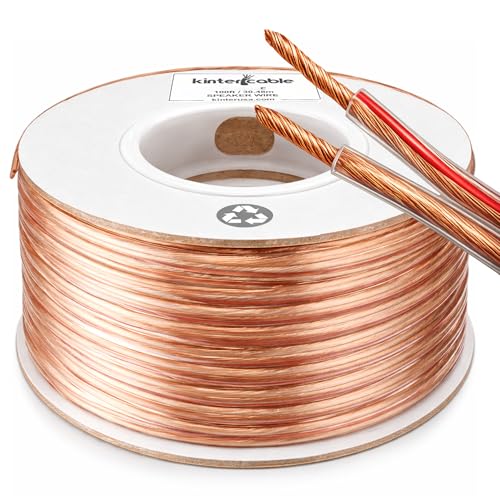
The Kinter cable uses 117 individually stranded conductors in a 14 AWG configuration. A higher strand count like this makes the wire noticeably more flexible than solid-core or low-strand-count cable of the same gauge. This matters when you are routing wire through tight corners in home theater cabinets or along car door sills where inflexible cable fights you.
The red polarity stripe runs the full length of one conductor, giving you a quick visual reference at both ends. The PVC jacket has a durable feel that resists cuts from sharp metal edges, though it is not as soft as the InstallGear soft-touch material. At 100 feet of 14 AWG CCA, it is built for workhorse duty in moderate-to-long runs.
Users consistently describe the thickness as accurate and the insulation as sturdy. The recyclable spool box packaging is a practical detail — it keeps the cable contained during storage and prevents unraveling. If you need a flexible 14 AWG spool that can handle the abuse of daily installation, this is the pick.
Why it’s great
- 117-strand construction provides excellent flexibility for routing
- 14 AWG thickness suits long runs and 4-ohm speaker loads
- Durable PVC jacket resists abrasion during installation
Good to know
- CCA conductor material rather than pure copper
- Jacket is stiffer than soft-touch alternatives
4. Cableague 14AWG Speaker Wire 50 Feet

At only 50 feet, the Cableague roll is shorter than the 100-foot standard, which makes it a good fit for single-pair installations like a stereo setup or a single surround channel. The 14 AWG gauge is thicker than the entry-level 16 AWG options, giving you lower resistance even on shorter runs, which is beneficial when driving 4-ohm speakers.
The CCA conductors are individually insulated with clear PVC and a red stripe for polarity identification. The temperature rating of -20°C to +75°C and RoHS compliance are printed on the spec sheet. One limitation worth noting: this cable is explicitly not rated for in-wall use, so keep it surface-run behind furniture or inside entertainment center channels.
Buyers have noted that the insulation is less flexible than some premium brands, but the stiffness has a silver lining — the wire holds its shape once bent, which helps keep cable management neat. The 50-foot length is a deliberate choice for those who do not want to deal with a giant spool leftover after a small project.
Why it’s great
- 14 AWG in a manageable 50-foot roll for small projects
- Clear jacket with red polarity stripe for quick identification
- RoHS compliant and rated for -20°C to +75°C environments
Good to know
- Not rated for in-wall installation
- PVC jacket is stiffer than soft-touch cables
5. DS18 SW-16GA-100RB 16-GA Ultra Flex Speaker Wire

The DS18 16-gauge wire is marketed toward car audio enthusiasts who need a flexible, low-cost cable for door speakers and subwoofer connections in a vehicle. The CCA construction keeps the price at the floor of the market, and the ultra-flex jacket earns its name — the cable bends easily without kinking, which is essential when working inside a car door cavity or dashboard.
With a 100-foot length and 18 AWG actual measured gauge, this is a budget-first offering. It is best suited for short, low-power runs. Users have reported that the cable strips cleanly and the red-and-black color scheme makes polarity obvious without squinting at a printed line. The jacket has good impact resistance for the price.
Where it falls short is power handling and long-distance performance. For a 50-foot run to a 4-ohm speaker, 18 AWG CCA will start to introduce measurable resistance. This cable works great for connecting a pair of rear speakers that sit within a few feet of the amplifier, but it is not the wire to choose for main left-right channels in a larger listening room.
Why it’s great
- Ultra-flexible jacket routes easily through car door panels
- Red and black color coding for instant polarity alignment
- Budget-friendly pricing for a full 100-foot spool
Good to know
- 18 AWG gauge limits run length and power capacity
- CCA conductor material, not suitable for high-wattage systems
FAQ
Can I use cheap CCA speaker wire for my subwoofer?
Is 16 AWG speaker wire good enough for home theater?
Does a 117-strand cable sound better than a 40-strand cable?
What tools do I need to cut and strip speaker wire?
How do I tell which side is positive on cheap speaker cable?
Final Thoughts: The Verdict
For most users, the cheap speaker cable winner is the Amazon Basics 16-Gauge because it offers true copper conductors at a price that beats CCA competitors while giving you a full 100 feet on a practical spool. If you need extra flexibility for tight routing jobs, grab the InstallGear 14 Gauge with its soft-touch jacket. And for a compact single-room install where a 100-foot spool is overkill, nothing beats the Cableague 14 AWG at 50 feet.

Mo Maruf
I created WellFizz to bridge the gap between vague wellness advice and actionable solutions. My mission is simple: to decode the research and give you practical tools you can actually use.
Beyond the data, I am a passionate traveler. I believe that stepping away from the screen to explore new environments is essential for mental clarity and physical vitality.