Our readers keep the lights on and my smoothie glass nicely filled. As an Amazon Associate, I earn from qualifying purchases.
A vlogging camera that slips into a jacket pocket needs to do more than just shoot video—it needs a gimbal that kills shakiness, a sensor that handles dim café lighting, and a wide enough lens that your face and background both fit. The current crop of compact vloggers has evolved from basic point-and-shoots into sophisticated pocket studios, with features like subject tracking and built-in audio designed for creators who shoot on the move.
I’m Mohammad Maruf — the founder and writer behind WellFizz. My research dives into sensor sizes, gimbal stabilization accuracy, battery endurance real-world figures, and how each camera handles the specific stress of daily vlogging workflows.
After comparing their 4K frame rates, low-light performance, and hands-free mounting options, I’ve broken down exactly which model delivers real value. Keep reading for the definitive guide to the best compact camera for vlogging.
How To Choose The Best Compact Camera For Vlogging
Buying a compact vlogging camera means balancing portability with image quality. You want a body that fits in a bag but still delivers 4K footage that doesn’t look like a smartphone clip. The first spec to check is the sensor size—a 1-inch CMOS sensor, for instance, lets in more light than a 1/2.3-inch sensor, giving you cleaner footage in dim environments. Next, look at stabilization: a 3-axis mechanical gimbal inside the body (like the DJI Osmo Pocket 3) produces far smoother walking shots than any electronic stabilization alone. Frame rate also matters—4K/60fps is the minimum for smooth motion, but 120fps lets you create slow-motion inserts. Audio is equally critical; a built-in directional microphone with a windscreen or a jack for an external lavalier can elevate your sound quality dramatically. Finally, check the lens focal length—an 18mm equivalent (or wider) ensures your face plus some background stays in the selfie frame.
Sensor Size and Low-Light Performance
A larger sensor captures more light per pixel. That translates directly to cleaner 4K video when you’re vlogging indoors, at golden hour, or under overcast skies. Among compact options, a 1-inch CMOS sensor (found in the DJI Osmo Pocket 3, Sony ZV-1 II, and Canon PowerShot V1) gives you significantly better dynamic range and less noise than the 1/1.3- and 1/1.28-inch sensors used in action-cam-style vloggers. If you frequently shoot in controlled indoor light, a 1-inch sensor is the threshold for reliable quality without needing to turn up ISO and introduce grain.
Stabilization: Gimbal vs. Electronic
Mechanical gimbal stabilization uses physical motors to keep the camera steady, which eliminates micro-jitters better than any software crop. Cameras like the DJI Osmo Pocket 3 and Xtra Muse feature a full 3-axis gimbal inside the chassis, making walking shots buttery smooth. Electronic image stabilization (EIS) works by cropping the frame and aligning frames; it can handle gentle hand tremor but will show a wobble effect on fast-motion clips. For vloggers who move—walking through a market, chasing a pet, or filming a travel day—a built-in gimbal is a must-have feature. For stationary desk or tripod vlogs, solid EIS can suffice.
Battery Life for Real-World Recording
Manufacturer quoted runtimes are often measured in ideal conditions (1080p, no stabilization, screen at minimum brightness). Real-world battery life for a compact vlogger usually sits between 60 and 120 minutes of continuous 4K recording. Models that support USB-C power delivery (like the DJI Osmo Pocket 3 with the Battery Handle or the Insta360 GO Ultra with the Action Pod) let you extend shooting time by plugging into an external power bank. If you plan one-hour-plus shoots without access to charging, look for cameras that include an extended battery pack or a Vision Dock that doubles as a power source.
Audio Quality and Microphone Support
Built-in microphones on compact cameras are a compromise between size and sound fidelity. Directional three-capsule mics (like the Sony ZV-1 II’s or the Panasonic LUMIX G100’s) do a decent job of focusing on the speaker’s voice while rejecting ambient noise. For higher quality, you want a 3.5mm microphone jack or wireless support (DJI’s OsmoAudio protocol, for example). Even a basic lavalier mic or mini shotgun mic boosts clarity over the built-in mic, and a windscreen is essential for outdoor vlogs. If audio is secondary to you and you plan to record voiceovers in post, a camera’s standard internal mic may be sufficient.
Lens Width and Flexibility
For a selfie-style vlog, the lens needs to be wide enough to show your face and the surroundings without your arm stretching to the full length. A 19mm to 20mm equivalent focal length (like the Canon PowerShot V10’s fixed 19mm) works for tight spaces. A zoom lens such as the 18-50mm on the Sony ZV-1 II gives you flexibility to punch in for detail shots, but note that optical zoom is rare in pocket-sized bodies—most use digital zoom, which lowers quality. Check the widest focal length your chosen camera offers because you cannot “step back” into a wider view when holding it at arm’s length.
Quick Comparison
On smaller screens, swipe sideways to see the full table.
| Model | Category | Best For | Key Spec | Amazon |
|---|---|---|---|---|
| DJI Osmo Pocket 3 Creator Combo | Gimbal Pocket Cam | Walking vlogs & travel | 1″ CMOS / 4K/120fps / 3-axis gimbal | Amazon |
| Sony ZV-1 II | Premium Point & Shoot | Selfie vlogging with zoom | 1″ CMOS / 18-50mm zoom / 4K/30fps | Amazon |
| Canon PowerShot V1 | Pro Hybrid | High-end 4K & live streaming | 1.4-type / 22.3MP / 16-50mm zoom / CLog3 | Amazon |
| Sony ZV-E10 Bundle | Mirrorless Starter | Interchangeable lens vlogging | APS-C 24.2MP / 4K/30fps / vari-angle screen | Amazon |
| Sony ZV-1F Ultimate Kit | Content Creator Kit | All-in-one beginner setup | 1″ CMOS / 4K/30fps / eye AF / bundle extras | Amazon |
| Panasonic LUMIX G100 | Compact Mirrorless | Audio-first & skills growth | Micro 4/3 / 4K/30fps / OZO Audio mic | Amazon |
| DJI Osmo Nano Standard Combo | Wearable POV Cam | Hands-free POV vlogging | 1/1.3″ / 4K/60fps / 200-min total / waterproof | Amazon |
| Insta360 GO Ultra Creator Bundle | Mini Wearable | Ultra-light magnetic POV | 1/1.28″ / 4K/60fps / 53g / 200-min / IPX8 | Amazon |
| Xtra Muse Pocket Gimbal | Gimbal Action Cam | Budget gimbal vlogging | 1″ CMOS / 4K/120fps / 3-axis gimbal | Amazon |
| Canon PowerShot V10 | Pocket Vlog Cam | Ultra-compact fixed-lens vlogs | 1″ CMOS / 19mm f/2.8 / flip screen / stand | Amazon |
| Xtra Atto Wearable 4K Action | Budget Wearable | Budget POV & first-person | 1/1.3″ / 4K/60fps / 128GB built-in / 54g | Amazon |
In‑Depth Reviews
1. DJI Osmo Pocket 3 Creator Combo
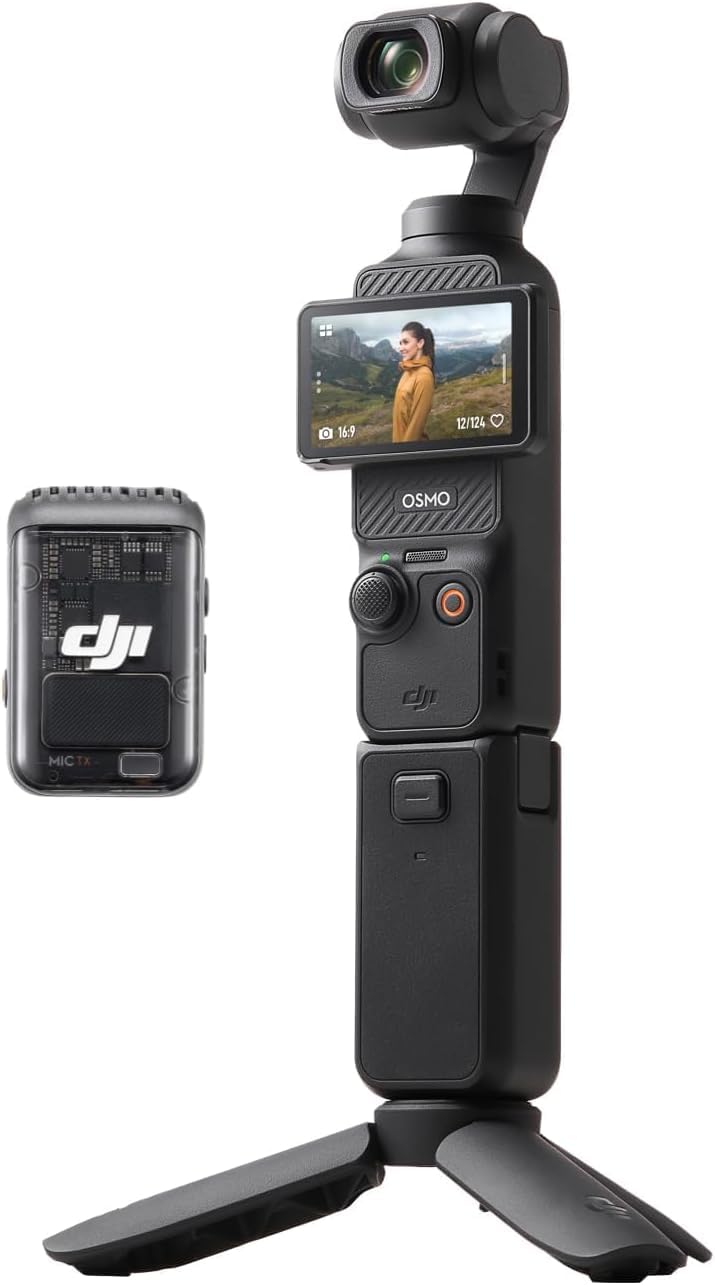
The DJI Osmo Pocket 3 sets the benchmark for pocket-sized vlogging with its 1-inch CMOS sensor and built-in 3-axis mechanical gimbal. That combination delivers rock-steady 4K footage at up to 120fps, meaning you can walk down a stairwell, spin around in a crowd, or track a moving subject and still get smooth, cinema-like clips. The 2-inch rotatable touchscreen flips from horizontal to vertical in one motion, which saves time when editing for different platforms.
Its ActiveTrack 6.0 locks onto a face or object and keeps you centered even if you move around the frame—perfect for solo vloggers who shoot on a tripod. The Creator Combo includes the DJI Mic 2 transmitter, a wide-angle lens attachment, a battery handle, and a mini tripod, turning the camera into a full production kit that fits inside a small bag. DJI’s OsmoAudio support lets you pair two wireless mics directly for clean audio without adapters.
The 4K/120fps capability means you can shoot and then slow down clips by 4x for dramatic B-roll moments. Battery life hits around 166 minutes in standard conditions, but the included Battery Handle adds substantial extra runtime via USB-C PD. For vloggers who want the most reliable gimbal, sensor, and audio bundle in one compact body, this is the definitive choice.
Why it’s great
- 1-inch sensor for excellent low-light 4K
- 3-axis mechanical gimbal eliminates walk shake
- ActiveTrack 6.0 for solo tripod vlogging
- Includes DJI Mic 2 for pro audio out of the box
Good to know
- No built-in zoom; requires wide-angle lens add-on
- Battery handle adds bulk when attached
- Microphone jack is proprietary (needs DJI mics for wireless)
2. Sony ZV-1 II Vlog Camera

The Sony ZV-1 II is built for the vlogger who needs optical zoom in a compact body. Its 18-50mm equivalent f/1.8-4.0 lens gives you a true ultra-wide selfie view at 18mm and the option to zoom in to 50mm for detail shots or a tighter composition, all without cropping into the sensor. The 1-inch stacked CMOS sensor produces clean 4K/30fps footage with realistic skin tones and Sony’s famous Real-time Eye AF locks onto eyes reliably even when you move around.
The directional 3-capsule microphone includes a windscreen in the box, and the camera uses AI to prioritize the sound source at the front or rear of the frame. That makes it excellent for interview-style vlogs where you turn the camera toward a subject and want their voice highlighted. The USB-C port supports live streaming in UVC/UAC mode, so you can plug directly into a laptop for high-quality streams without extra gear.
One notable change from the original ZV-1 is the removal of Optical SteadyShot in favor of electronic stabilization; you’ll see a slight crop during walking shots. Battery life is average, so carrying a power bank or spare battery is wise for longer shoots. For creators who need both a wide selfie lens and optical reach in a pocket camera, the ZV-1 II is unmatched at this size.
Why it’s great
- True optical zoom (18-50mm) for flexibility
- Real-time Eye AF locks focus instantly
- Directional mic with windscreen for clear audio
- USB-C streaming without capture card
Good to know
- Electronic stabilization only, no OIS
- Battery life moderate for 4K recording
- No earphone monitoring jack
3. Canon PowerShot V1

Canon’s PowerShot V1 steps up the sensor game with a 1.4-type CMOS that delivers 22.3MP for stills and 18.7MP for video—essentially a Micro Four Thirds-class sensor squeezed into a compact body. Combined with the 16-50mm F2.8-4.5 built-in zoom lens, the V1 produces sharp 4K footage with very good dynamic range and Canon’s characteristic color science. The inclusion of a cooling fan inside the chassis allows extended high-resolution recording without thermal shutdown, a crucial detail for event vloggers or live streamers who shoot for hours.
Canon Log 3 recording at 10-bit color depth gives video editors significant latitude for color grading, letting you pull detail from shadows and highlights that would be lost on 8-bit cameras. The hybrid autofocus system uses 100 AF points and reliably tracks faces and eyes, even in tricky backlight. The body is larger than a pocket cam, but the grip makes one-handed operation comfortable and the cooling fan makes it one of the most reliable continuous recorders in its class.
The lack of in-body image stabilization means you’ll rely on lens-based optical IS plus electronic stabilization, which works well for gentle handheld pans but won’t eliminate heavy walking shakes. The battery door placement interferes with quick-release plates, and there’s no built-in flash. For content creators who prioritize image quality, color grading flexibility, and reliable cooling over extreme pocketability, the PowerShot V1 is a powerful hybrid tool.
Why it’s great
- Large 1.4-type sensor for excellent dynamic range
- 10-bit CLog3 for serious color grading
- Internal cooling fan prevents overheating
- Fast hybrid AF with 100 points
Good to know
- No in-body stabilization; walk shake visible
- Larger body than typical pocket cameras
- SD slot shares battery compartment door
4. Sony ZV-E10 Mirrorless Camera Bundle

The Sony ZV-E10 brings a true interchangeable lens system to the vlogging market, pairing a 24.2MP APS-C Exmor CMOS sensor with the compact E PZ 16-50mm f/3.5-5.6 OSS power zoom lens. This kit gives you the flexibility to swap lenses (like a wide-angle prime or a telephoto) when your vlogging style evolves, something no fixed-lens compact can offer. The oversampled 4K/30fps video captures plenty of detail, and the vari-angle touchscreen makes selfie framing straightforward.
Advanced gamma options including HLG and S-Log give you room to color grade in post, while the built-in three-capsule mic captures decent audio for quick clips. The bundle from Amazon includes a 64GB Extreme PRO memory card, a soft carry bag, a card reader, a mini tripod, and cleaning tools, so you can start shooting immediately. USB-C streaming support turns the camera into a high-quality webcam for live shows without extra hardware.
The biggest tradeoff is the lens: the 16-50mm kit lens has a variable aperture that reduces light at the telephoto end, and the 8-bit internal recording limits color grading compared to 10-bit options. The NP-FW50 battery offers modest endurance, and you’ll want spares for day-long shoots. For creators who want an affordable entry into mirrorless vlogging with room to grow, this bundle is a smart foundation.
Why it’s great
- APS-C sensor for beautiful bokeh and low noise
- Interchangeable lenses for future upgrades
- Includes beginner-friendly accessory bundle
- USB-C direct streaming for live content
Good to know
- Kit lens aperture narrows at zoom end
- 8-bit internal recording limits grading
- Battery life requires spares for full-day shoots
5. Sony ZV-1F Content Creator’s Ultimate Kit

The ZV-1F takes the core of Sony’s vlogging line—a 1-inch 15.2MP back-illuminated CMOS sensor—and pairs it with a fixed 19mm wide-angle lens that’s ideal for standard arm’s-length selfies. The 4K/30fps video is oversampled from the full sensor width, giving you sharp footage with minimal rolling shutter. The Product Showcase Setting automatically racks focus to items you hold near the lens, making it a powerful tool for unboxing, cooking, or review vlogs.
The Ultimate Kit ships with a 128GB Extreme Pro memory card, an external condenser microphone, a U-grip handle, a tabletop tripod, a UV filter, and Movavi editing software. This one-box solution eliminates the need to buy separate accessories, which streamlines the setup process for new creators. Active Mode image stabilization helps reduce handheld shake, though you’ll still see some wobble during fast movement.
The fixed lens means no zoom whatsoever, and the battery life is average for the class. The built-in stereo mic includes a windscreen, but the included external mic stays inside the bag for upgraded audio. For a vlogger who wants a ready-to-go kit that delivers the fundamental Sony 1-inch image quality with very little assembly required, the ZV-1F bundle is a strong entry point.
Why it’s great
- Fixed 19mm wide lens ideal for selfie vlogs
- Product Showcase Setting for review content
- Full accessory bundle (mic, tripod, memory, editing software)
- Sony Real-time Eye AF for sharp focus
Good to know
- No optical zoom; digital zoom reduces quality
- Battery life moderate for long recording sessions
- Active Mode IS crops frame noticeably
6. Panasonic LUMIX G100 4K Mirrorless Camera

The LUMIX G100 stands out for its integrated Nokia OZO Audio technology, which uses a built-in microphone array to track sound sources and automatically adjust the direction of audio capture. When you pan the camera, the mic shifts focus to match the scene—perfect for documentary-style vlogs or group interviews where sound source changes. The Micro Four Thirds interchangeable lens mount gives you access to a broad library of compact lenses, and the included 12-32mm retractable zoom covers wide selfie to mid-telephoto range.
The camera supports 4K/30fps video with 5-axis Hybrid I.S., which compensates for both camera shake and lens movement, giving you reasonably smooth handheld footage. The iA (intelligent auto) mode handles exposure and focus decisions for beginners, while manual controls let experienced users dial in exposure compensation and aperture. The G100 can also serve as a high-quality webcam via USB, which adds live-streaming functionality.
The main limitation is a very strict 4K recording time limit that stops at the standard 29:59 mark; for longer continuous takes you’d need to restart. The contrast-detect autofocus is slower than phase-detect systems found in Sony and Canon cameras, making it less reliable for fast-moving subjects. For vloggers who prioritize advanced audio directionality and the flexibility of an interchangeable lens system on a budget, the G100 brings unique value.
Why it’s great
- OZO Audio tracking mic for adaptive audio capture
- Micro Four Thirds lens mount with wide lens library
- 5-axis Hybrid I.S. for steady handheld clips
- iA mode perfect for beginners
Good to know
- 4K video stops at 29:59; manual restart needed
- Contrast-detect AF slower for action shots
- Built-in lens retracts; must extend before shooting
7. DJI Osmo Nano Standard Combo (128GB)
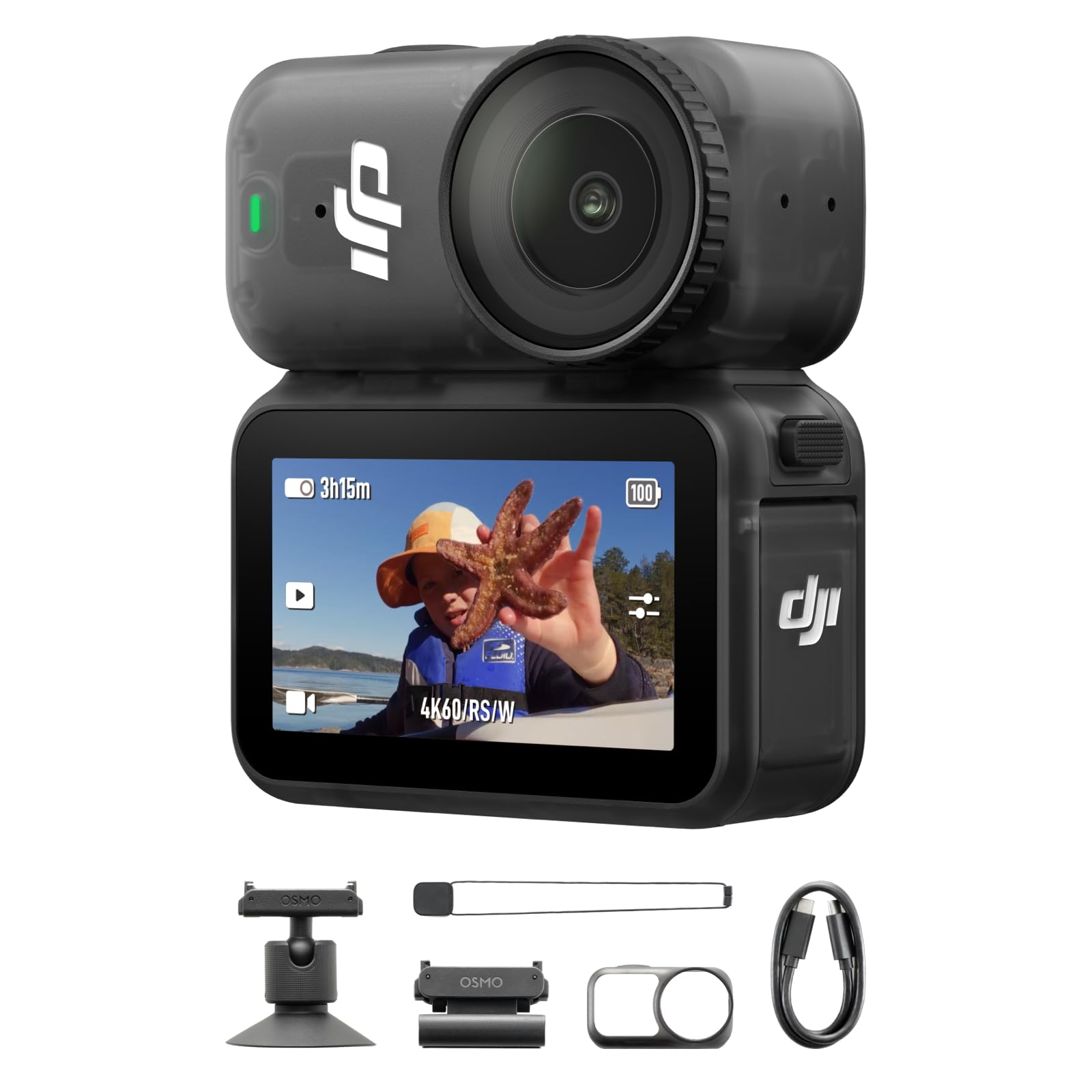
The DJI Osmo Nano is a magnetic wearable action camera that clips onto hats, straps, or metal surfaces for true hands-free POV vlogging. The 1/1.3-inch sensor shoots 4K/60fps with a 143-degree ultra-wide field of view, capturing both your face (if you hold it at arm’s length) and the world around you. The 10-bit D-Log M color profile provides more latitude for color grading than standard 8-bit footage, giving your social clips a polished look.
The Vision Dock doubles as a remote viewfinder, extra battery (bringing total runtime to about 200 minutes), and storage for the camera body. 128GB built-in storage means you can shoot immediately without buying a microSD card, though you can also expand via microSD. The magnetic lanyard holds the camera securely against your chest, and the magnetic hat clip offers an elevated first-person perspective that traditional gimbals can’t replicate.
The camera body is waterproof to 10m, but the Vision Dock is only splash-resistant (IPX4). Overheating can occur during high-resolution recording due to the compact size, and DJI’s endurance mode helps manage heat by lowering frame rates. For vloggers who want the smallest possible body for POV and travel clips, with industry-leading DJI color science, the Osmo Nano is a top-tier wearable.
Why it’s great
- Magnetic mounting for true hands-free POV
- 10-bit D-Log M for professional color grading
- 128GB built-in storage ready out of the box
- 200-min total battery with Vision Dock
Good to know
- Vision Dock drains battery when idle
- No built-in screen on camera body; requires dock
- Overheating protection can interrupt long clips
8. Insta360 GO Ultra Creator Bundle
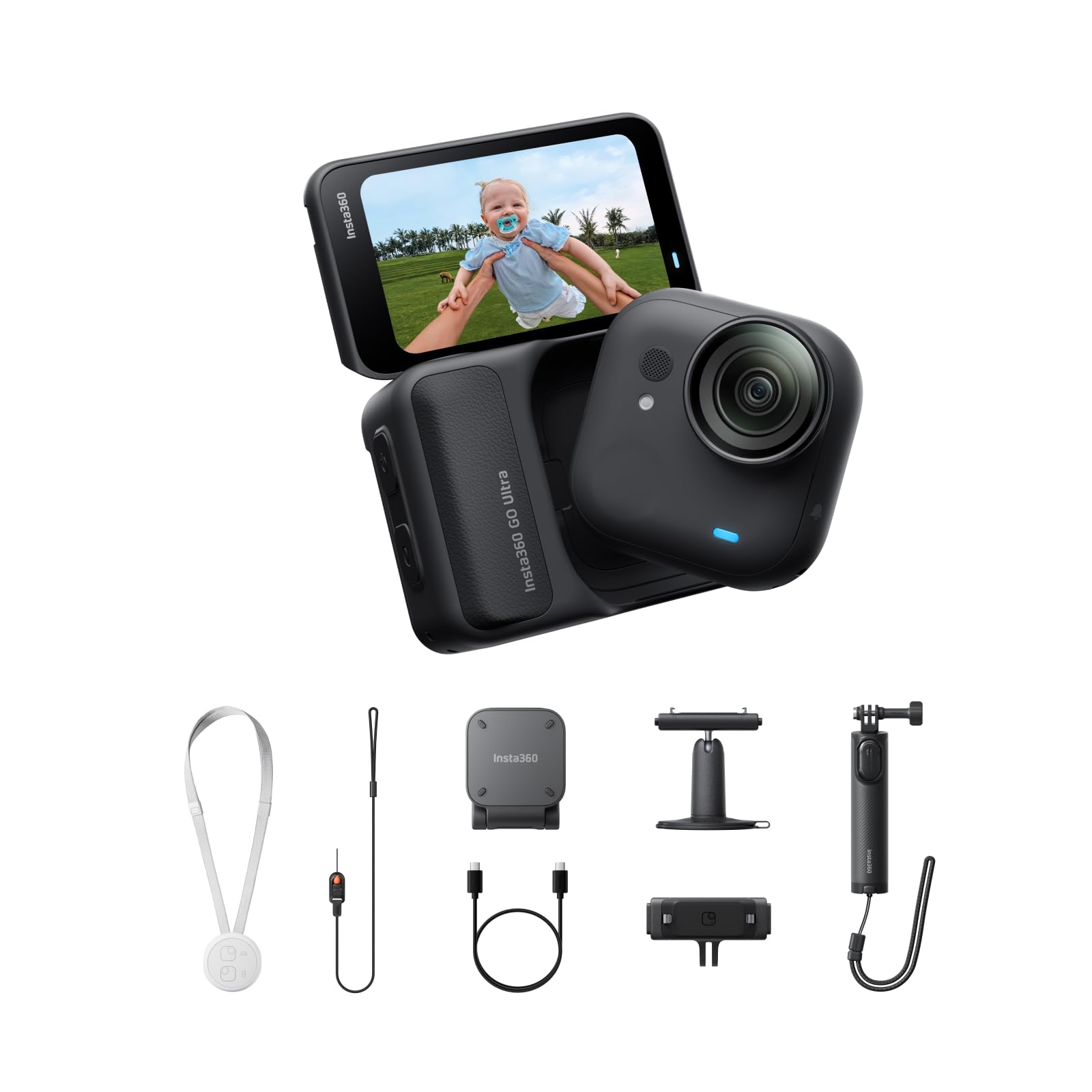
Weighing just 53 grams, the Insta360 GO Ultra is the lightest 4K vlogging camera on this list, and its magnetic mounting system lets you attach it to caps, pendant necks, or any metal surface for truly discreet POV shooting. The 1/1.28-inch sensor paired with a 5nm AI chip enables 4K/60fps video and a dedicated PureVideo mode that improves low-light performance significantly for such a tiny sensor. The 156° field of view captures an expansive view that works for immersive first-person content.
The Action Pod provides a touchscreen interface, extended battery life (up to 200 minutes total), and a built-in microSD slot for storage upgrades. The standalone camera itself is IPX8 waterproof to 33 feet, so you can shoot underwater vlogs without a housing. FlowState Stabilization offers three levels of smoothing plus 360 Horizon Lock, ensuring the horizon stays level even when you rotate the camera, which is rare at this size.
The camera body doesn’t have its own screen, so you need the Action Pod or the smartphone app to frame shots. There is no swappable battery on the standalone module—you must charge via the Pod or the wireless dock. The Auto Editing feature in the app finds highlights and creates polished video automatically, which reduces editing time. For ultralight travel vlogging, biking, or any situation where grams matter, the GO Ultra is the most carry-friendly option.
Why it’s great
- Weighs only 53g; clamps to any metal surface
- FlowState stabilization with Horizon Lock
- IPX8 waterproof to 33 feet
- 200-min total battery with Action Pod
Good to know
- No screen on the camera body itself
- Non-swappable battery in the standalone module
- Action Pod only splashproof (IPX4)
9. Xtra Muse Vlogging Camera

The Xtra Muse brings a true 1-inch CMOS sensor and a 3-axis internal gimbal stabilizer to a mid-range price point, offering a gimbal-vlogging experience similar to the DJI Osmo Pocket 3 at a lower entry cost. It records 4K video at up to 120fps, giving you the ability to slow down footage for dramatic transitions. The 2-inch touchscreen flips for horizontal or vertical orientation, and the Master Follow mode keeps you centered in the frame while you move around a tripod.
The 1-inch sensor and 10-bit X-Log color mode capture over one billion colors and provide significant editing flexibility in post-production, though the camera lacks the refined color science of Sony or DJI. Face and object tracking are reliable in good light, and the autofocus is fast enough for most vlogging scenarios. The included handle with a 1/4-inch tripod thread lets you attach standard accessories without a cage.
Battery life is decent for the class at around 161 minutes, and the USB-C PD cable included in the box supports fast charging. The carrying bag, wrist strap, and handle provide solid out-of-box value. Some users report that the gimbal calibration can drift after extended use, but for the price, the Muse offers the core feature set of a premium pocket gimbal without the premium price tag.
Why it’s great
- 1-inch sensor with 3-axis gimbal at a mid-range price
- 4K/120fps slow-motion recording
- 10-bit X-Log for color grading flexibility
- Master Follow keeps you centered on tripod
Good to know
- Gimbal calibration may drift over long sessions
- Color science less refined than Sony/DJI
- Autofocus reliable but not industry-fastest
10. Canon PowerShot V10

The Canon PowerShot V10 is one of the most uniquely designed compact vlogging cameras on the market, with a built-in stand that folds out from the body, allowing you to set it on a table for hands-free recording without an extra tripod. The 15.2MP 1-inch back-illuminated CMOS sensor captures 4K/30fps video with Canon’s reliable color science, and the fixed 19mm wide-angle lens (35mm equivalent) is wide enough for comfortable selfie framing. The retractable front-facing screen makes it easy to see yourself while recording.
Three image stabilization modes (IS Off, IS On, IS Enhanced) let you choose the level of steadying, with IS Enhanced using the widest crop for the smoothest result. The built-in stereo microphones include a third mic in the middle that Canon says helps cancel background noise, and there’s an auxiliary microphone input for an external lavalier. The 14 movie color filters let you apply a look in-camera without editing.
The V10 does not have optical zoom, so you are locked into the 19mm field of view, and battery life is adequate for short to medium vlogs but not marathon sessions. The SD card slot and battery share the same door, which can be inconvenient when swapping cards on the go. For content creators who want a pocket-friendly, stand-integrated camera that can go from table to hand in seconds, the V10 is a creative and convenient tool.
Why it’s great
- Built-in stand for hands-free tabletop recording
- 1-inch sensor with pleasing Canon color science
- Retractable front-facing screen for self-framing
- External mic input and 14 color filters
Good to know
- No optical zoom; fixed 19mm lens only
- Battery and SD card share the same door
- Battery life moderate; not for all-day shoots
11. Xtra Atto Wearable 4K Action Camera (128GB)
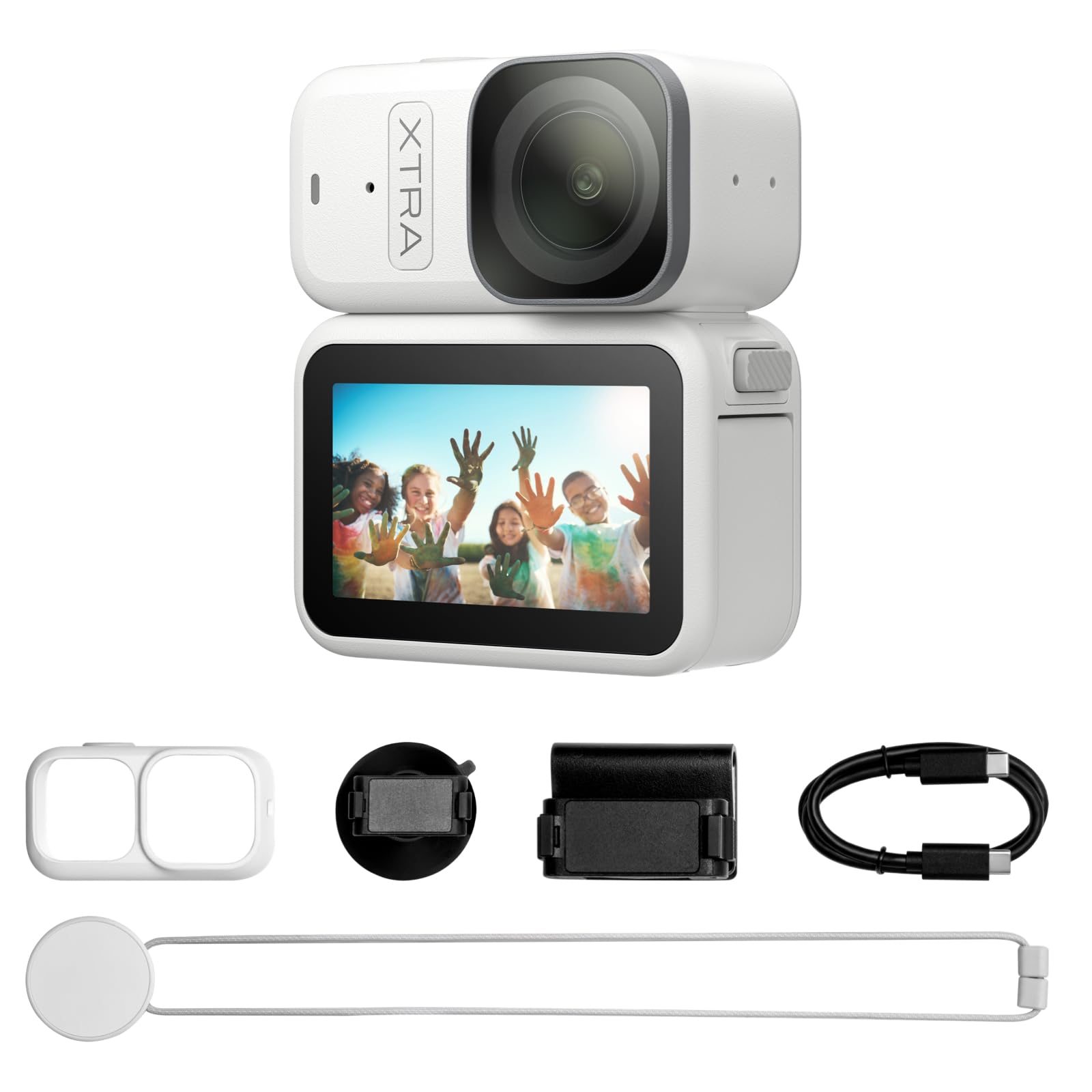
The Xtra Atto is a lightweight (54g) wearable camera designed for hands-free POV recording, mounting to caps or headbands via the included magnetic hat clip and lanyard. The 1/1.3-inch sensor captures 4K/60fps video with 10-bit color depth, producing vibrant, smooth footage that rivals action cams costing significantly more. The 5-minute pre-recording buffer saves footage from before you pressed the record button, ensuring you never miss a spontaneous moment—a useful feature for sports vlogging or pet POV.
Built-in 128GB storage and 600MB/s transfer speeds via the Vision Dock allow you to offload large 4K files to your computer in seconds, which speeds up the editing workflow. The 220-minute maximum runtime with the Vision Dock covers full-day excursions, and the magnetic mounting system attaches to metal surfaces (helmet, pet collar, gym equipment) for unique perspectives. The camera also supports DJI wireless mics via a firmware update, expanding audio options without proprietary adapters.
The lack of a built-in screen means you rely on the Vision Dock or the smartphone app for framing, and the microphone picks up wind noise outdoors without an external windscreen. The image stabilization is effective for its size but doesn’t match the gimbal-level smoothness of larger cameras. For budget-conscious creators who want a wearable 4K vlogger with built-in storage and long battery life, the Atto is a clever, feature-dense choice.
Why it’s great
- 54g ultra-light; mounts to hat or lanyard for POV
- 128GB built-in storage with extremely fast transfer
- 220-min runtime with Vision Dock for all-day use
- 5-min pre-recording buffer captures missed moments
Good to know
- No built-in screen; requires dock or app for framing
- Microphone susceptible to wind noise
- Stabilization good but not gimbal-level
FAQ
What is the minimum sensor size for good low-light vlogging?
How important is a flip-out screen for vlogging?
Can I use an external microphone with a compact vlogging camera?
How long does the battery last on a typical 4K vlogging camera?
Final Thoughts: The Verdict
For most users, the best compact camera for vlogging winner is the DJI Osmo Pocket 3 Creator Combo because its 1-inch sensor, 3-axis gimbal, and included DJI Mic 2 cover both image and audio quality without any compromise on portability. If you want optical zoom and premium selfie framing, grab the Sony ZV-1 II. And for ultra-light hands-free POV content that fits in a pocket and clips to your hat, nothing beats the Insta360 GO Ultra.

Mo Maruf
I created WellFizz to bridge the gap between vague wellness advice and actionable solutions. My mission is simple: to decode the research and give you practical tools you can actually use.
Beyond the data, I am a passionate traveler. I believe that stepping away from the screen to explore new environments is essential for mental clarity and physical vitality.