Our readers keep the lights on and my smoothie glass nicely filled. As an Amazon Associate, I earn from qualifying purchases.
The difference between a movie theater and a living room comes down to one thing: light. A cinema projector’s job is to control light with absolute precision — keeping black levels deep enough to make shadows disappear while pushing highlights bright enough to feel real. Finding the right balance of contrast, color accuracy, and brightness is the single biggest challenge in building a serious home theater. The cheap options wash out. The expensive ones demand perfect light control. Somewhere in the middle lies the right tool for your space.
I’m Mohammad Maruf — the founder and writer behind WellFizz. I focus entirely on analyzing the hardware specifications, optical engines, and real-world performance trade-offs that define the best projection systems in the consumer market.
This guide breaks down the top-performing models across different budgets and room types, helping you identify the best cinema projector that matches your specific setup and viewing habits.
How To Choose The Best Cinema Projector
Choosing a cinema projector means prioritizing your room’s light control, screen size, and seating distance over raw specs. A model with exceptional contrast will look mediocre in a bright room, while a super-bright unit may struggle to produce deep blacks in a fully darkened theater. Start with your environment.
Contrast Ratio and Black Levels
The single most cinematic quality a projector can have is how deep its blacks go. A high native contrast ratio — measured in the thousands-to-one range — allows dark scenes to retain detail without appearing gray. Designs like Epson’s 3LCD and Sony’s SXRD panels deliver some of the best native contrast in the industry, while many DLP projectors rely on dynamic iris systems or laser dimming to simulate deeper blacks. Always compare native contrast figures when reading specs.
Light Source Technology
Lamp-based projectors offer high brightness for a low upfront cost, but bulbs degrade over time and require replacement every few thousand hours. LED light sources last longer and maintain consistent color over years of use, but peak brightness is usually lower. Triple laser systems — combining red, green, and blue laser diodes — produce the widest color gamut and maintain brightness for over 20,000 hours, making them the premium choice for a theater that gets heavy daily use.
Resolution and Pixel Shifting
Native 4K panels deliver true 3840×2160 resolution with no artifacts, but most consumer projectors in the mid-range use pixel-shifting technology — a process that oscillates a 1080p or 2K chip to simulate 4K. The visual difference is small from normal seating distances, but native 4K models, like Sony’s SXRD line, offer noticeably sharper detail on screens larger than 120 inches. Pixel-shifting 4K is excellent for most homes, but purists gravitate toward true native panels.
Lens Features and Setup Flexibility
Optical zoom and lens shift allow you to position the projector off-center without keystone correction, which degrades image quality. A projector with 1.3x or 1.5x zoom and vertical/horizontal lens shift gives you massive placement freedom. Ultra-short-throw projectors bypass this entirely by sitting inches from the wall, but require a flat, dedicated surface. Standard throw projectors are more forgiving if you have a ceiling mount or a rear shelf.
HDR and Color Gamut Support
A credible cinema projector must cover at least 90% of the DCI-P3 color space for accurate HDR playback. Dolby Vision and HDR10+ support improve dynamic tone mapping, adjusting brightness and contrast scene by scene. Without proper HDR handling, bright highlights clip and dark scenes lose detail. Look for models with dedicated HDR tone mapping processors — this matters more than raw peak brightness for a convincing HDR image.
Quick Comparison
On smaller screens, swipe sideways to see the full table.
| Model | Category | Best For | Key Spec | Amazon |
|---|---|---|---|---|
| Epson 5050UB | Premium 3LCD | Deep blacks, motorized lens memory | 1,000,000:1 dynamic contrast | Amazon |
| XGIMI Horizon 20 Max | Triple Laser | Daylight viewing, motorized lens shift | 5,700 ISO lumens peak | Amazon |
| NEBULA X1 Bundle | Triple Laser + Sound | All-in-one theater with surround speakers | 56,000:1 enhanced contrast | Amazon |
| Valerion VisionMaster Pro2 | Triple Laser | Cinema color accuracy, gaming latency | 15,000:1 native contrast with EBL | Amazon |
| Hisense PX3-PRO | Ultra Short Throw | Compact rooms, large screen near-wall | 0.22:1 ultra-short throw ratio | Amazon |
| BenQ W4100i | LED Smart | Factory-calibrated DCI-P3 out of box | 100% DCI-P3, 10+ year light source | Amazon |
| Sony VPL-XW5000ES | Native 4K SXRD | Native 4K purity, Sony image processing | Native 3840×2160 SXRD panel | Amazon |
| Hisense XR10 | High-End Triple Laser | Very bright rooms, flexible placement | 6,000 ANSI lumens, 7-level iris | Amazon |
| NexiGo Aurora Pro MKII | Ultra Short Throw Laser | Low-latency gaming, 150-inch image | >30,000:1 contrast with SAE | Amazon |
| ViewSonic PX701-4K | Budget 4K Gaming | Competitive gaming, 240Hz at 1080p | 4.2ms input lag at 240Hz | Amazon |
| ViewSonic PA503HD | Entry-Level | Budget-friendly bright room presentations | 4,000 ANSI lumens | Amazon |
In‑Depth Reviews
1. Epson Home Cinema 5050UB 4K PRO-UHD

The Epson 5050UB is widely regarded as the reference standard for home theater under three thousand dollars. Its 3LCD design delivers 100% of the RGB color signal per frame — meaning no rainbow artifacts — and the motorized lens with memory recall allows seamless switching between 16:9 and 2.35:1 aspect ratios. Owners consistently praise its black levels, which rival far more expensive units, thanks to a dynamic iris that reaches a claimed 1,000,000:1 dynamic contrast ratio.
Brightness sits at 2,600 lumens, which is sufficient for a dedicated dark theater but not ideal for rooms with uncontrolled ambient light. The pixel-shifting 4K engine produces a sharp, detailed image on screens up to 150 inches, though it is not native 4K. The unit is large and heavy at 25 pounds, requiring a sturdy ceiling mount or a dedicated AV cart.
Gamers will appreciate the low input lag, and the HDR processor handles 10-bit tone mapping competently. Some users report a brief HDMI handshake delay when switching between 4K and 1080p sources. Overall, this projector remains the go-to choice for enthusiasts who prioritize deep contrast and color accuracy above all else.
Why it’s great
- Exceptional out-of-box color and black levels for its class
- Motorized lens with memory for different aspect ratios
- Low input lag for 4K gaming
Good to know
- Large and heavy — requires sturdy mounting
- Pixel-shifting 4K, not native 4K panel
- Brief HDMI handshake delay on format changes
2. XGIMI Horizon 20 Max 4K Triple Laser
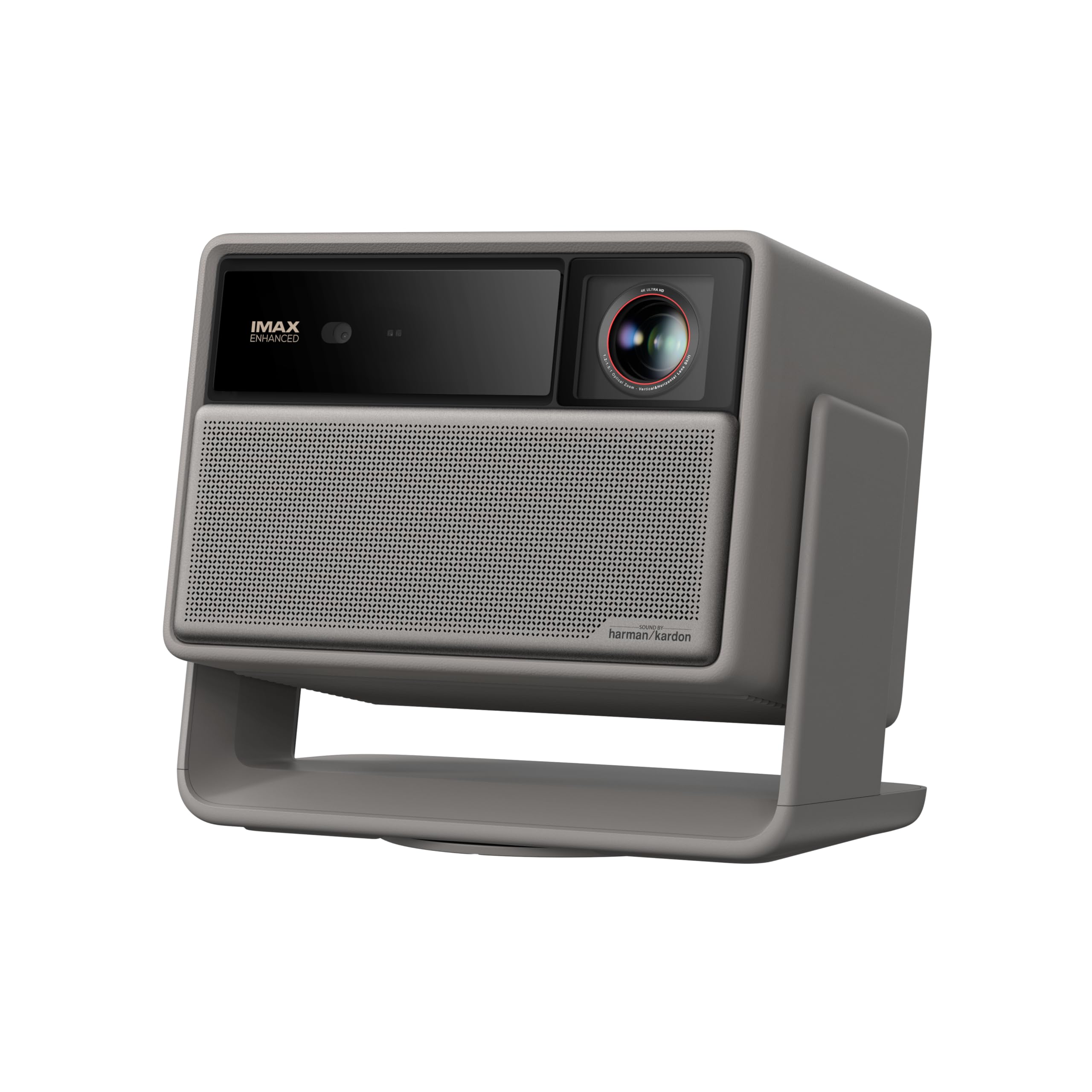
The XGIMI Horizon 20 Max is a triple laser projector that pushes brightness to 5,700 ISO lumens, making it one of the few models that can deliver a watchable image with room lights on. The motorized lens shift and optical zoom are a rare combination in the smart projector space — they remove the need for digital keystone correction entirely. The X-Master RGB triple laser engine covers 110% of the BT.2020 color gamut, producing exceptionally vibrant colors that hold up across long viewing sessions.
Owners report that actual usable brightness in standard 4K mode sits closer to 3,600-3,900 lumens, but that still outperforms most projectors in this price band. The built-in Harman Kardon speakers are the best integrated audio of any projector in this review — clear, neutral, and loud enough for a medium-sized room. The Google TV interface is snappy, with native access to Netflix, Disney+, and other streaming apps.
The key trade-off is laser speckle — a subtle grain visible on bright surfaces like skies or animated characters. Some users also notice rainbow effect artifacts in high-contrast scenes, though this varies by individual. For anyone needing a bright, flexible projector that works in a living room during the day, this is the strongest contender.
Why it’s great
- Exceptional brightness — usable with ambient light
- Motorized lens shift and optical zoom for flexible placement
- Best built-in speakers of any projector tested
Good to know
- Laser speckle visible on certain screen materials
- Rainbow effect may be noticeable to sensitive viewers
- Real-world brightness slightly lower than advertised peak
3. NEBULA X1 Bundle Triple Laser 4K Projector

The NEBULA X1 Bundle is a triple laser projector that arrives with two wireless Wi-Fi speakers, creating a complete 4.1.2 surround sound system with 200W total output. The projector itself uses a 14-element all-glass lens and a 6-blade iris to achieve a native contrast ratio of 5,000:1, which the NebulaMaster engine enhances to a rated 56,000:1. The 3,500 ANSI lumen brightness is competitive with the best in its class, and the liquid cooling system keeps noise under 26 dB.
The built-in micro gimbal offers a 25° motorized tilt range, making it easy to project onto walls up to 10 feet high. AI spatial adaptation automatically adjusts focus, keystone, and screen fit, and the Spatial Recall feature saves settings for different rooms or surfaces. Google TV is built in, with native support for Netflix and other major streaming apps.
Some early units have exhibited quality control issues, including washed-out colors that required manual calibration via the Conference Mode. The remote lacks an input select button and the power-on behavior can be inconsistent. The bundled speakers deliver lossless surround with low-latency wireless transmission, making this a rare turnkey solution for buyers who do not want to piece together a separate audio system.
Why it’s great
- Complete all-in-one system with wireless surround speakers
- Very quiet operation — under 26 dB
- Motorized gimbal allows flexible ceiling-avoiding placement
Good to know
- Quality control can be inconsistent between units
- Remote lacks dedicated input select button
- Requires manual calibration for optimal colors
4. Valerion VisionMaster Pro2 Triple Laser

The Valerion VisionMaster Pro2 is a rare triple laser projector that combines a native 15,000:1 contrast ratio with Enhanced Black Level (EBL) technology for true deep blacks without the gray wash typical of many DLP projectors. Its 110% Rec.2020 color gamut coverage produces rich, lifelike colors free from rainbow effects, and the ISF-certified calibration ensures accuracy straight out of the box. The OpticFlex Lens System offers a 0.9-1.5 throw ratio, meaning it can fill a 300-inch screen from the right distance.
Performance is bolstered by the AI-SoC MT9618 chipset, which provides 4GB of RAM and 128GB of storage — enough for seamless 4K streaming and fast app switching. The built-in Google TV interface supports Netflix, YouTube, and other apps natively, and integration with Alexa, Google Home, and Apple HomeKit allows voice control. Gaming latency is rated at 4ms with a 240Hz refresh rate, making this one of the few cinema-grade projectors that doubles as a competitive gaming display.
Owners consistently report that the VisionMaster Pro2 delivers an image quality that rivals projectors costing significantly more. The main caveat is that the short throw ratio requires some digital zoom in smaller rooms, which can slightly reduce sharpness and brightness. The fan noise is noticeable during fast-paced scenes but remains quieter than most lamp-based alternatives.
Why it’s great
- Excellent native contrast with EBL for deep black levels
- ISF-certified factory calibration for accurate colors
- Very low input lag — suitable for competitive gaming
Good to know
- Short throw ratio may require digital zoom in some rooms
- Fan noise audible during quiet or fast-paced scenes
- Premium build price reflects high-end component quality
5. Hisense PX3-PRO Ultra Short Throw Triple Laser

The Hisense PX3-PRO is an ultra-short-throw triple laser projector that sits directly beneath your wall and throws a 100-inch image from just inches away. This eliminates ceiling mounts, long cable runs, and the risk of people walking through the beam. It uses Hisense’s LPU Triple Laser technology to deliver 100% of the BT.2020 color gamut, along with a color accuracy rating of ΔE≈0.9 — meaning colors match the source material almost perfectly.
Brightness is rated at 3,000 lumens, and the built-in AI upscaling converts lower-resolution content to 4K effectively. Dolby Vision and IMAX Enhanced support provide scene-by-scene dynamic tone mapping. The PX3-PRO is designed for compact rooms where a standard long-throw projector would be impractical, and its Harman Kardon speakers deliver solid audio without an external soundbar.
Setup requires careful physical alignment — the auto-keystone feature relies on a photo-upload process accessed through a device web browser, which several users find cumbersome. The projector works best with a dedicated ALR screen to maintain contrast in rooms with some ambient light. Overall, the PX3-PRO is a good choice for apartment dwellers or anyone wanting a cinema-sized screen without remodeling their living room.
Why it’s great
- Zero-clearance placement — sits inches from wall
- Excellent color accuracy with ΔE≈0.9 rating
- Dolby Vision and IMAX Enhanced support
Good to know
- Auto-keystone process is cumbersome via web browser
- Requires ALR screen for best contrast in lit rooms
- Some users report slight rainbow effect
6. BenQ W4100i 4K HDR Smart Home Theater Projector
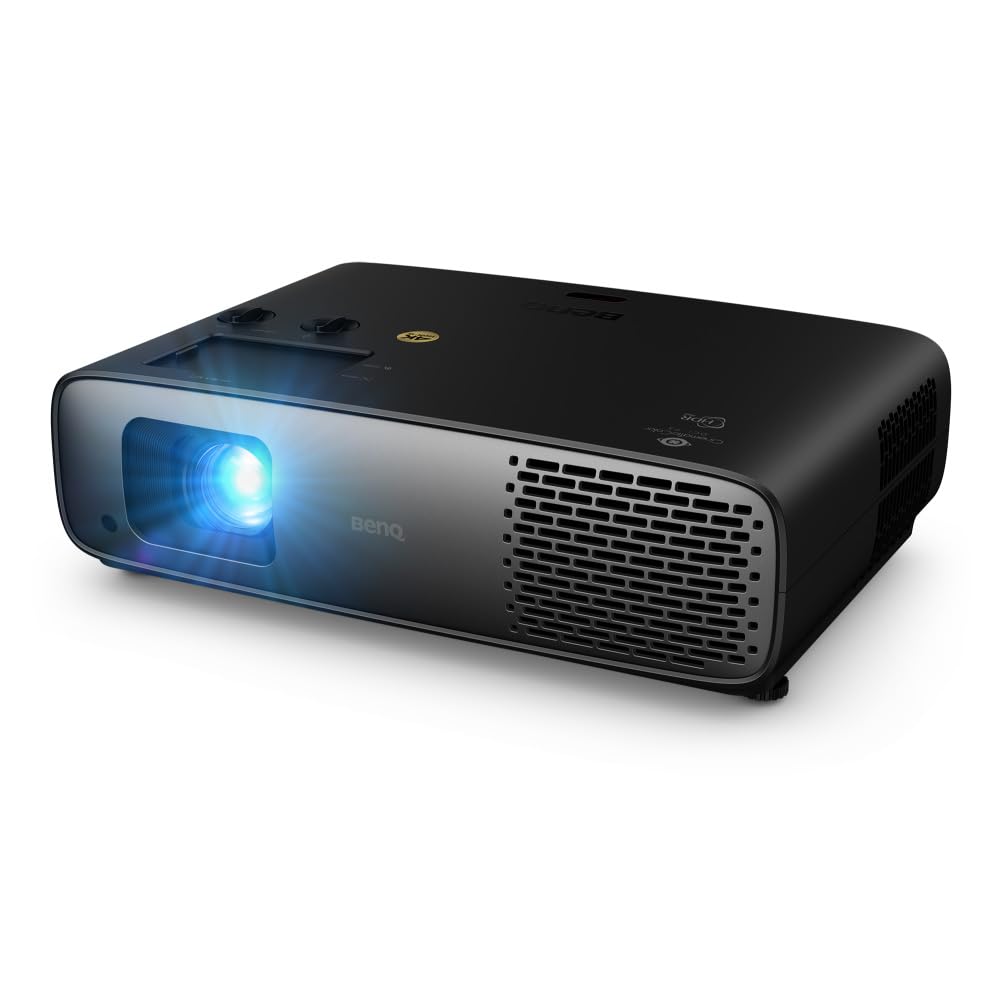
The BenQ W4100i is a 4K LED projector that arrives factory-calibrated to 100% DCI-P3 color coverage, meaning it delivers the same color standard used in commercial cinemas without requiring manual tweaks. The LED light source is rated for a 10+ year lifespan, eliminating bulb replacement costs entirely. With 3,200 lumens of brightness, it performs well in dedicated dark theaters and rooms with controlled ambient light.
The 2D lens shift and 1.3x optical zoom offer good placement flexibility for ceiling mounts or rear shelves. The built-in Android TV interface includes Netflix pre-loaded, and HDR10+ support ensures dynamic tone mapping across compatible content. Owners consistently note that the out-of-box experience is simple — the image is sharp, bright, and color-accurate without needing hours of calibration.
The unit is compact compared to lamp-based rivals, measuring about one-third the size of older Epson models. The LED light source also runs cooler and quieter than most lamp-based projectors. The main limitation is the lack of an automatic lens door, and some users note that black levels are solid but not as deep as the best 3LCD or LCoS competitors. For buyers prioritizing easy setup and long-term maintenance, the W4100i is a strong mid-range option.
Why it’s great
- Factory-calibrated DCI-P3 — accurate colors without setup
- LED light source rated for 10+ years, no bulb changes
- Compact footprint and quiet operation
Good to know
- Black levels are good but not class-leading
- No automatic lens door
- Requires controlled ambient light for best results
7. Sony VPL-XW5000ES Native 4K SXRD

The Sony VPL-XW5000ES is one of the most affordable true native 4K projectors on the market, using three SXRD panels to deliver 3840×2160 resolution without pixel shifting. The X1 Ultimate for projector processor — the same chip found in Sony’s flagship TVs — handles HDR tone mapping and motion handling with exceptional sophistication. The laser light source is rated for 20,000 hours of operation, and the Wide Dynamic Range optics achieve a 95% DCI-P3 color gamut at 2,000 lumens.
Owners migrating from Epson or other pixel-shifting projectors consistently report that the XW5000ES delivers noticeably sharper detail, especially on screens above 120 inches. The black levels are excellent for a DLP rival, with the SXRD panels providing deep, inky blacks and smooth shadow transitions. The fan noise is barely audible during quiet scenes, at nearly silent levels.
The setup is manual — there is no auto-keystone or motorized lens shift, so physical placement must be precise. The unit is also heavy at 28 pounds, requiring a robust ceiling mount. The remote is basic and the web/API controls are limited for automation users. For purists who value native 4K resolution and Sony’s renowned image processing over features like smart TV interfaces, this is a benchmark product.
Why it’s great
- True native 4K resolution — no pixel shifting
- Sony X1 Ultimate processor for superb HDR handling
- Very quiet fan — nearly silent operation
Good to know
- Manual lens setup — no auto-keystone or motorized lens shift
- Heavy at 28 pounds — needs sturdy mount
- No built-in smart TV platform
8. Hisense XR10 Triple Laser 4K Projector
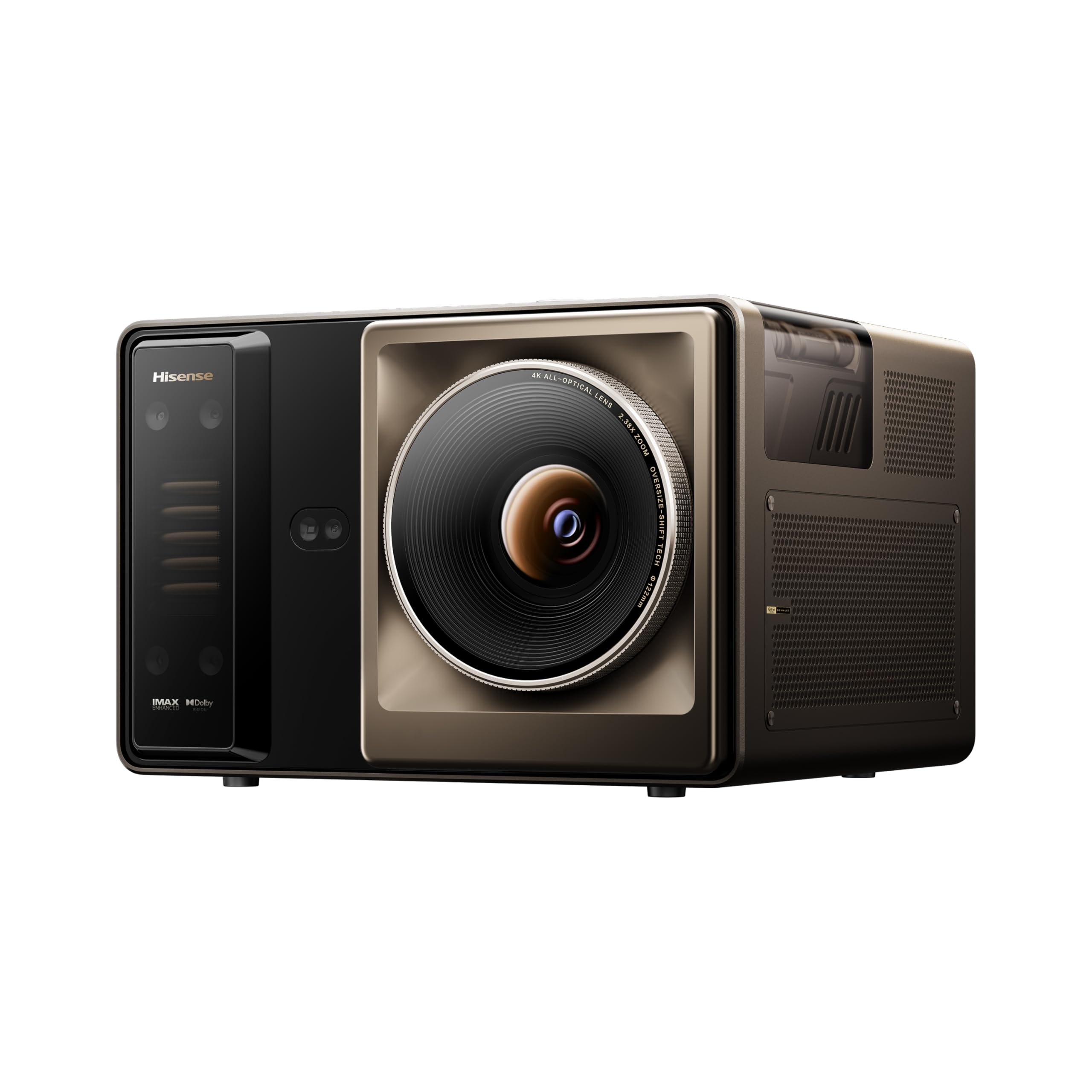
The Hisense XR10 is a flagship triple laser projector designed to handle the most challenging lighting conditions. Its 6,000 ANSI lumens of peak brightness — combined with a 7-level iris that adjusts contrast up to 6,000:1 — means it can produce a watchable image in rooms with significant ambient light. The 17-element all-glass lens is an industry-first design that minimizes chromatic aberration and maintains sharpness across the entire image field.
The liquid cooling system uses a single-tube, dual-channel design that keeps the internal laser modules at optimal temperatures while keeping fan noise low. The optical zoom range spans 0.84-2.0:1, giving enormous placement flexibility, and the lens shift allows precise positioning without moving the projector body. IMAX Enhanced and Dolby Vision support provide cinematic HDR handling, and the VIDAA smart OS offers over 1,200 apps and channels.
The XR10 projects from 65 inches to 300 inches, making it suitable for everything from a small apartment theater to a dedicated home cinema with a massive screen. Owners report that the image clarity and color saturation are outstanding even in moderately lit rooms. The main drawbacks are the price point and the fact that achieving full 6,000 lumen output requires the highest brightness mode, which may reduce color accuracy slightly. For buyers who need a projector that works in a bright living room without sacrificing cinematic quality, the XR10 is a capable high-end choice.
Why it’s great
- Extremely high brightness — works with ambient light
- 17-element all-glass lens for edge-to-edge sharpness
- Wide optical zoom and lens shift for any room configuration
Good to know
- Premium price point
- Peak brightness mode may slightly affect color accuracy
- Larger form factor than compact laser projectors
9. NexiGo Aurora Pro MKII 4K Tri-Color Laser UST

The NexiGo Aurora Pro MKII is an ultra-short-throw tri-color laser projector that uses the ALPD 5.0 laser engine — the latest generation of laser phosphor display technology. Its Scene Adapt Engine (SAE) combines a dynamic iris with laser dimming to achieve a contrast ratio greater than 30,000:1, producing deep blacks and bright highlights in real-time based on the content being played. The 0.21:1 throw ratio creates a 150-inch image from just a few inches off the wall.
With 2,400 lumens of brightness, the Aurora Pro MKII is best suited for rooms with moderate to controlled ambient light. The color gamut covers 107% of BT.2020, and the ΔE≈1 color accuracy ensures fidelity to the source. Dolby Vision and HDR10+ are both supported, and the 60W built-in speakers with Dolby Atmos provide immersive sound without an external system.
Gamers will appreciate the 4.2ms to 8ms input lag in Gaming Mode, along with 120Hz support for smooth motion. Some users report that the projector requires focus adjustment at each startup and that the remote is overly sensitive and directional. A few units have exhibited overheating and shutdown issues, though these appear to be isolated incidents. Overall, the Aurora Pro MKII is a solid mid-range UST choice for buyers who prioritize contrast and color volume.
Why it’s great
- Excellent contrast ratio with dynamic iris and laser dimming
- Very low input lag — 4.2ms in gaming mode
- Wide BT.2020 color gamut coverage
Good to know
- May require focus adjustment at each startup
- Some units reported overheating and shutdown issues
- Remote is sensitive and directional
10. ViewSonic PX701-4K 4K Projector

The ViewSonic PX701-4K is a budget-friendly DLP projector that punches well above its price class for gamers. It supports a 240Hz refresh rate at 1080p with an input lag of just 4.2ms, making it one of the fastest projectors on the market for competitive gaming. At 4K/60Hz, the input lag is still respectable, and the pixel-shifting 4K engine produces a sharp, detailed image for movies and casual gaming.
The 3,200 ANSI lumens of brightness are sufficient for rooms with some ambient light, and the SuperColor technology delivers vibrant, accurate colors. The auto V-keystone and H/V keystone with 4-corner adjustment make setup straightforward, even on uneven walls. The 1.1x optical zoom provides some placement flexibility, though the lack of a wide throw range means you need to carefully measure your room before purchasing.
The lamp life is rated at up to 20,000 hours in SuperEco mode, but some owners report premature bulb failure closer to 1.5-2 years of use. The fan noise is audible, especially in high-brightness mode, and the power cord is short. The remote is basic and the menu system feels dated. For buyers on a strict budget who need fast gaming performance above all else, the PX701-4K is a solid entry-level option.
Why it’s great
- Ultra-low input lag — 4.2ms at 240Hz/1080p
- Good brightness for mixed lighting rooms
- Affordable entry into 4K projection
Good to know
- Lamp life can be shorter than advertised in real use
- Limited optical zoom range — measure your room first
- Fan noise is noticeable in high-brightness mode
11. ViewSonic PA503HD 1080p Projector
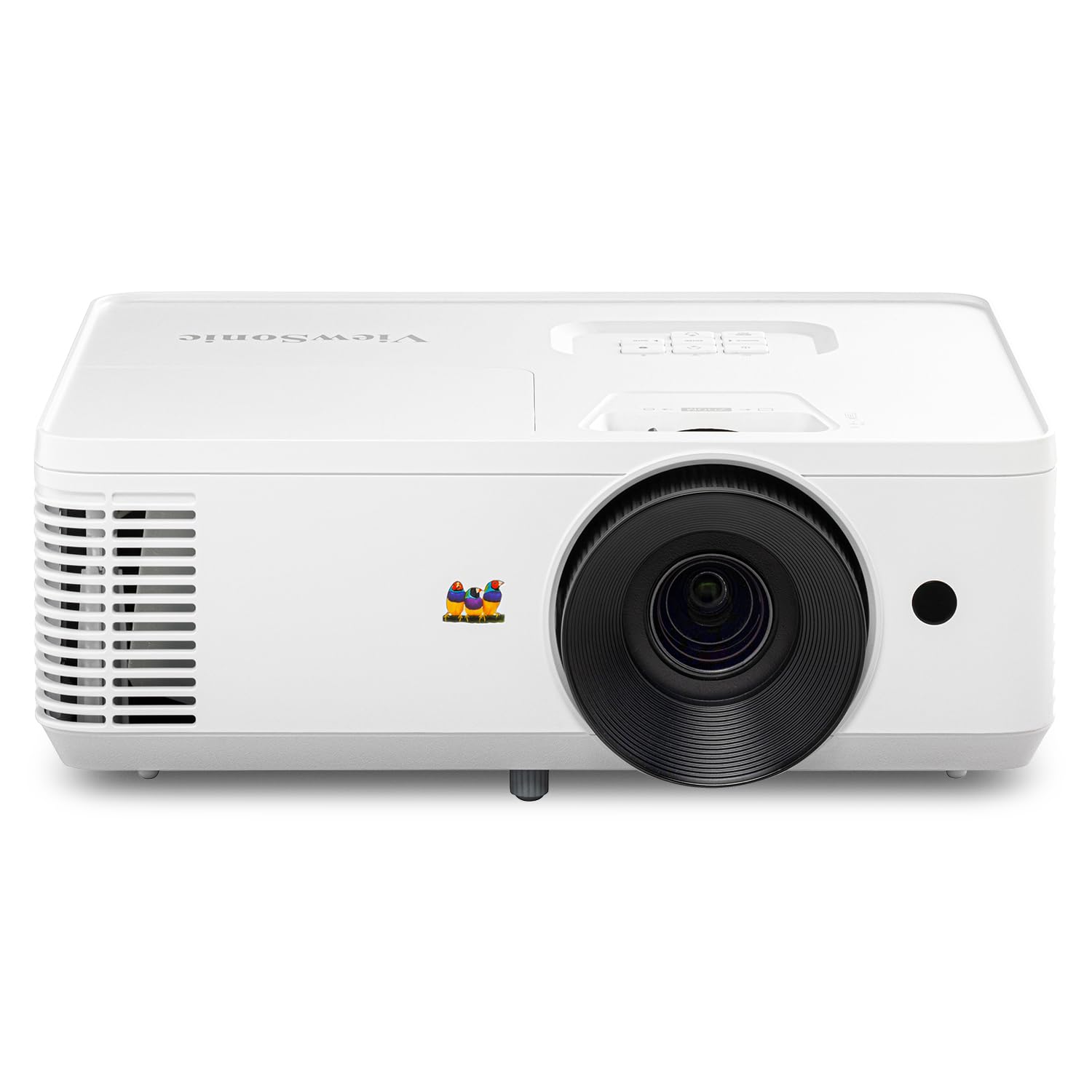
The ViewSonic PA503HD is an entry-level DLP lamp projector that focuses on high brightness — 4,000 ANSI lumens — to deliver a clear, watchable image even in well-lit rooms. It is native 1080p, not 4K, but the 22,000:1 dynamic contrast ratio and SuperColor technology provide decent color saturation and black levels for the price. The 1.1x optical zoom and auto keystone simplify basic setup, and the low 16ms input lag is acceptable for casual gaming.
The PA503HD is designed for versatility — it works for presentations, movies, and live sports. The lamp is relatively affordable to replace (around for third-party bulbs), and the unit is lightweight and well-packed for a projector in this price tier. Owners consistently praise its brightness and image clarity for the cost, and several report using it in sunlit rooms with excellent results.
The biggest downsides are the native 1080p resolution — which looks soft on screens larger than 120 inches — and the cheap, screw-type leveling feet that are fussy to adjust. The fan noise increases over time as the lamp ages, and some units have developed button glitches after extended use. For anyone needing a bright, no-frills projector for a multipurpose room on a strict budget, the PA503HD gets the job done.
Why it’s great
- Very bright — works in rooms with high ambient light
- Affordable bulb replacement cost
- Lightweight and easy to transport
Good to know
- Native 1080p only — not 4K
- Leveling feet are flimsy and difficult to adjust
- Some units develop button glitches after extended use
FAQ
What is the difference between native 4K and pixel-shifting 4K on a projector?
Why do some projectors produce a rainbow effect and how can I avoid it?
How much brightness do I need for a home theater projector?
Should I choose a lamp, LED, or laser projector for home cinema?
What screen material works best with a triple laser projector?
Final Thoughts: The Verdict
For most users, the best cinema projector winner is the Epson 5050UB because it delivers the deepest black levels and most accurate color at a price that undercuts native 4K competitors while offering motorized lens memory for flexible screen ratios. If you want a flexible setup that works with daylight in the room, grab the XGIMI Horizon 20 Max. And for purists who demand true native 4K resolution and Sony’s unrivaled image processing, nothing beats the Sony VPL-XW5000ES.

Mo Maruf
I created WellFizz to bridge the gap between vague wellness advice and actionable solutions. My mission is simple: to decode the research and give you practical tools you can actually use.
Beyond the data, I am a passionate traveler. I believe that stepping away from the screen to explore new environments is essential for mental clarity and physical vitality.