Our readers keep the lights on and my smoothie glass nicely filled. As an Amazon Associate, I earn from qualifying purchases.
A smart gaming build on a tight budget hinges on one decision: getting the most raw performance per dollar without paying for features you cannot actually use at 1080p. The video card market below the line is a minefield of stripped-down chips, mismatched VRAM counts, and confusing generation gaps. Understanding which specifications actually move frames in the games you play is the only way to avoid wasting money on a card that feels slow in six months.
I’m Mohammad Maruf — the founder and writer behind WellFizz. I have spent countless hours cross-referencing benchmark data, real user performance reports, and hardware specifications to isolate which sub- graphics cards deliver reliable frame rates and which ones rely on marketing tricks to seem competitive.
This guide cuts through the noise to help you identify the strongest best cheap video card for gaming that fits your case size, power supply limits, and resolution target without forcing you to overpay for ray tracing cores that sit idle at lower settings.
How To Choose The Best Cheap Video Card For Gaming
Selecting a budget gaming GPU requires balancing VRAM capacity, physical size, and the generation of the underlying architecture. A card that looks fast on paper can underperform if your case lacks space or your power supply lacks the right connector.
VRAM Capacity Is The First Filter
Six gigabytes is the minimum for comfortable 1080p gaming in 2025. Eight is better for titles that stream high-resolution textures. If a card ships with only 4GB or 6GB on a very narrow memory bus, it will struggle with texture pop-in and stuttering in newer releases regardless of core clock speed.
Physical Size And Power Requirements
Many budget builds use prebuilt office desktops from Dell, HP, or Lenovo. These systems often have small form factor chassis and proprietary power supplies with no PCIe power cables. If your case cannot fit a full-height dual-slot card, you need a low-profile model that draws all its power from the PCIe slot. Double-check the card length and slot width against your interior clearance.
Upscaling Technology And Driver Maturity
Modern budget cards rely on upscaling to maintain high frame rates. NVIDIA cards use DLSS, which offers clearer image quality at lower resolutions. AMD cards use FSR, which works across more games but is slightly less sharp. Intel Arc cards have improved enormously through driver updates but still require Resizable BAR support for full performance. Factor in which upscaling ecosystem matches the games you actually play.
Quick Comparison
On smaller screens, swipe sideways to see the full table.
| Model | Category | Best For | Key Spec | Amazon |
|---|---|---|---|---|
| ASUS RTX 5060 Dual OC | Premium | 1080p high-refresh & DLSS 4 | 8GB GDDR7, 2565 MHz boost | Amazon |
| GIGABYTE RTX 5060 Windforce OC | Premium | Smooth medium-high 1080p | 8GB GDDR7, 2512 MHz boost | Amazon |
| XFX Speedster SWFT210 RX 7600 | Mid-Range | 1080p/1440p & VR gaming | 8GB GDDR6, 2655 MHz boost | Amazon |
| ASRock Intel Arc A580 Challenger | Mid-Range | 1440p creative & XeSS upscaling | 8GB GDDR6, 2000 MHz boost | Amazon |
| Yeston RTX 3050 6GB | Mid-Range | Small form factor plug-and-play | 6GB GDDR6, no external power | Amazon |
| Maxsun RTX 3050 6GB | Mid-Range | Ultra-compact SFF builds | 6GB GDDR6, 1042 MHz base | Amazon |
| GIGABYTE RTX 3050 Windforce OC V2 | Budget | Basic 1080p with ray tracing | 6GB GDDR6, 96-bit bus | Amazon |
| MSI RTX 3050 LP 6G OC | Budget | Low-profile office PC upgrades | 6GB GDDR6, 1492 MHz boost | Amazon |
| ZER-LON GTX 1660 Super 6GB | Budget | Budget 1080p with no ray tracing | 6GB GDDR6, 1530 MHz base | Amazon |
In‑Depth Reviews
1. ASUS Dual NVIDIA GeForce RTX 5060 8GB GDDR7 OC Edition

The ASUS Dual RTX 5060 is the most forward-looking card in this roundup thanks to its GDDR7 memory and PCIe 5.0 interface. The 2565 MHz boost clock in OC mode and 623 AI TOPS for DLSS 4 mean this card handles 1080p high-refresh gaming today and will stay relevant longer than any DDR6-based alternative. The axial-tech fan design with 0dB technology keeps the card silent during lighter loads, and the 2.5-slot footprint meets the SFF-Ready Enthusiast standard for compact cases.
Real-world users report rasterization performance that nearly matches the RTX 2080 Ti, all while running at around 100W under typical gaming loads. The 8GB VRAM on a 128-bit bus raised concerns, but the massive bandwidth leap from GDDR7 and the smart memory management of Blackwell architecture prevent the bottlenecks seen on older 8GB cards. Installation on eight-year-old motherboards worked without compatibility issues according to verified buyers.
This card is the best option if you want a modern architecture with the latest upscaling and can stretch your budget to the top of the cheap category. It does not include RGB lighting, which actually helps keep the price within reach. The only genuine limitation is the 8GB VRAM ceiling — at 1440p with max texture detail, some upcoming titles may force a settings reduction.
Why it’s great
- GDDR7 memory delivers massive bandwidth per watt
- DLSS 4 provides the best upscaling image quality at this price
- SFF-compliant dual-fan design fits most mid-tower cases
Good to know
- 8GB VRAM may require texture setting adjustments in future titles
- Requires running DDU before install on systems with older GPU drivers
2. GIGABYTE GeForce RTX 5060 WINDFORCE OC 8G

The GIGABYTE RTX 5060 WINDFORCE OC shares the same Blackwell GPU and GDDR7 memory as the ASUS Dual but features a different cooling philosophy. The WINDFORCE system uses alternate-spinning fans to reduce turbulence and a larger heatsink area, which translates to lower noise levels under sustained gaming loads. The card runs at a 2512 MHz boost clock, slightly below the ASUS OC mode, but real-world frame rates are nearly identical in GPU-bound scenarios.
Verified buyers consistently report excellent thermal performance, with the card handling Cyberpunk and demanding creative tasks while staying quiet. The dual-fan design does not interfere with RAM slots on most ATX boards, and the 7.83-inch length fits comfortably in mid-tower cases. Users upgrading from the GTX 1660 generation saw roughly double the raw performance at medium to high settings, making this a strong generational leap for budget builders.
The primary edge this card holds over the ASUS Dual is its proven cooler acoustics — GIGABYTE’s Windforce design has a long track record of silent operation. One caveat: the card does not include an RGB lighting zone, which is a non-issue for value-focused builders. Make sure to run DDU before installation, as several users reported boot issues resolved only by fully clearing old GPU drivers in Safe Mode.
Why it’s great
- Excellent thermal performance with low noise under load
- GDDR7 and Blackwell architecture provide strong 1080p frame rates
- Compact 7.83-inch length fits most mid-tower builds
Good to know
- Requires DDU in Safe Mode for clean driver swap
- 8GB VRAM needs texture level management in new releases
3. XFX Speedster SWFT210 Radeon RX 7600 8GB

The XFX Speedster SWFT210 RX 7600 is the strongest AMD option in this budget roundup, built on the RDNA 3 architecture with a boost clock of 2655 MHz. The 8GB GDDR6 frame buffer gives it a VRAM advantage over 6GB cards, and the dual-fan SWFT cooling solution keeps temperatures in check without aggressive fan curves. Users upgrading from a GTX 1650 Super saw dramatic improvements in VR titles like Half-Life Alyx and Assetto Corsa at highest settings.
This card is a particularly strong choice for Linux gamers. Verified users report that replacing an Nvidia card on Arch Linux was seamless — all three display outputs worked immediately after swapping the hardware and installing Mesa/Vulkan. The card draws moderate power and runs quietly, though initial driver updates are required to prevent system crashes and high idle temperatures. Once updated, the card stabilizes in the upper 70°C range at 60% fan speed.
The RX 7600 does not support DLSS, relying instead on FSR upscaling. FSR works well across a wide range of titles but does not match DLSS in fine detail preservation at lower render resolutions. For pure rasterization performance per dollar at 1080p and entry-level 1440p, this card is very competitive. The only asterisk is that faster RDNA 3.5 cards exist at a slightly higher price point, which some users mentioned as a reason to deduct a star.
Why it’s great
- Excellent 1080p and entry 1440p rasterization performance
- Seamless Linux compatibility with open-source drivers
- 8GB VRAM handles high texture detail in modern titles
Good to know
- FSR upscaling is not as sharp as DLSS at lower resolutions
- Requires driver update out of the box to avoid crashes
4. ASRock Intel Arc A580 Challenger 8GB OC
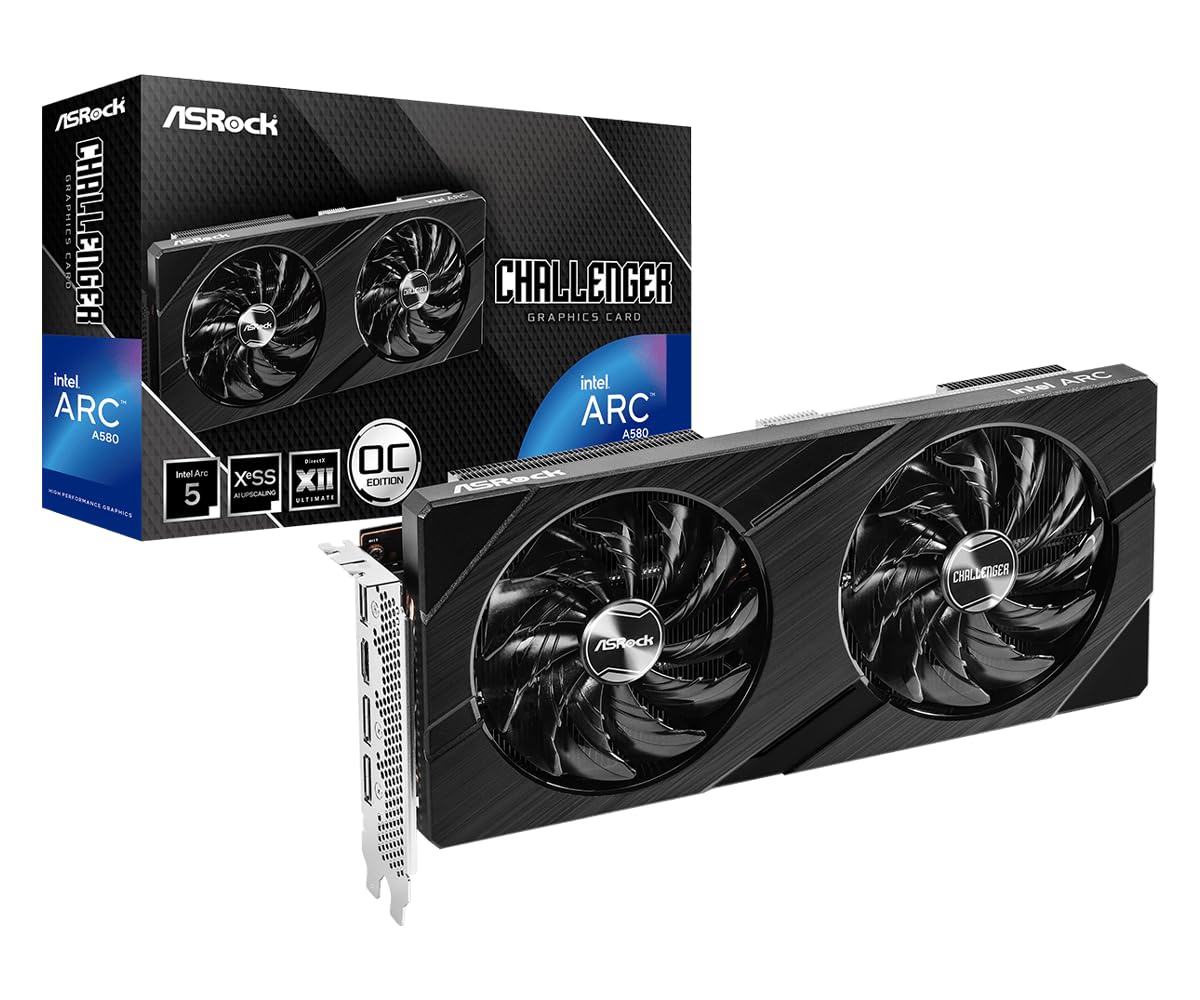
The ASRock Intel Arc A580 Challenger 8GB is the dark horse of this list. Powered by Intel’s Xe HPG microarchitecture with 384 XMX engines, it ships with 8GB of GDDR6 on a 256-bit interface — the widest memory bus in this price tier. The 2000 MHz factory overclock and PCIe 4.0 support give it strong bandwidth for 1440p gaming, and the dual-fan cooling with 0dB Silent Cooling stops the fans completely during low-load desktop use.
Driver maturity has improved enormously since Intel Arc launched. Verified users report excellent 1080p performance at max settings with no stuttering, and the card handles 1440p widescreen gaming well in titles that support XeSS upscaling. The card requires Resizable BAR support to reach full potential, which most modern motherboards provide. Some users noted a scrambled video output issue after sleep on DisplayPort, with HDMI remaining a stable alternative.
This card is the best value choice for builders who have a motherboard with ReBAR support and want 8GB of VRAM for a very competitive price. The 256-bit bus gives it a memory bandwidth edge over 128-bit cards, which helps in texture-heavy scenes. The 2.4-slot design requires two 8-pin PCIe power connectors and a recommended 650W PSU, so it is not suitable for prebuilt office systems with weak power supplies.
Why it’s great
- 256-bit memory bus provides excellent bandwidth for the price
- 8GB VRAM at a very low price point
- 0dB Silent Cooling for completely silent desktop operation
Good to know
- Requires Resizable BAR support for full performance
- Two 8-pin power connectors and 650W PSU recommended
5. Yeston RTX 3050 6GB GDDR6

The Yeston RTX 3050 6GB is purpose-built for small form factor systems and prebuilt office desktops that lack PCIe power connectors. It draws all its power from the PCIe slot, making it a direct drop-in replacement for older low-profile cards in Dell Optiplex and HP ProDesk machines. The GA107-325 core runs at a 1042 MHz base clock with a 1470 MHz boost, paired with 6GB of GDDR6 on a 96-bit bus.
Verified buyers report excellent results in Optiplex 3070 and 3050 systems, where the card fits snugly and provides adequate cooling despite the tight enclosure. Gaming performance is solid for 1080p medium-high settings, hitting 60fps in most modern titles. The card runs warm under load, peaking around 77°C, and the fan is audible at full speed, but users consider the noise acceptable for the form factor. The 6GB VRAM may limit texture detail in future releases, but it handles current games without issue.
The biggest caution comes from a user who experienced fan failure after two months and faced a difficult RMA process requiring international return shipping. This is a risk with smaller brands, so factor in the possibility of a difficult warranty claim. For the price, however, this remains one of the only RTX 3050 options that works in the tightest low-profile slots with zero power cable requirements.
Why it’s great
- Fits low-profile SFF cases with no external power needed
- Solid 1080p medium-high gaming performance in office PCs
- PCIe bus-powered design for proprietary PSU systems
Good to know
- Fan durability concerns with difficult RMA process reported
- 6GB VRAM may limit texture detail in upcoming titles
6. Maxsun GeForce RTX 3050 6GB GDDR6

The Maxsun RTX 3050 6GB is the most compact card in this review, measuring just 6.65 by 2.71 inches with a half-height bracket. It is designed specifically for small form factor systems like the Dell Optiplex 3060 SFF and Precision 3440, where full-height cards will not fit. The Ampere architecture core runs at a 1042 MHz base clock with a 1470 MHz boost, and the card draws all power from the PCIe slot — no six-pin or eight-pin connector required.
User reports confirm the card works well in Optiplex systems with i7 processors, achieving 80+ FPS in Warzone and Fortnite at 1080p. The Furmark score exceeds 3000, and peak power draw stays under 77W. Thermal performance is tight — the single-slot cooler runs hot, and the fan becomes loud under sustained gaming load. Several users added case fans or used MSI Afterburner to create custom fan curves to keep temperatures acceptable. Borderlands 4 at high resolution ran out of VRAM, forcing a reduction to medium settings.
This card is the right answer for anyone trying to turn a slim office PC into a capable 1080p gaming machine without replacing the power supply or case. The included low-profile adapter bracket is a welcome addition. If you can tolerate the fan noise under load and have a small case fan for airflow, the Maxsun delivers playable frame rates where no other card fits.
Why it’s great
- Smallest footprint of any card here — fits tightest SFF cases
- No external power connector required
- Low-profile bracket included for office desktop conversions
Good to know
- Fan is loud under sustained gaming load
- Runs hot; additional case fan recommended
7. GIGABYTE GeForce RTX 3050 WINDFORCE OC V2 6G

The GIGABYTE RTX 3050 WINDFORCE OC V2 brings NVIDIA’s Ampere architecture with ray tracing cores to the budget segment, but with a critical caveat: the 6GB VRAM is paired with a 96-bit memory bus. This narrower bus limits memory bandwidth compared to the 128-bit or 192-bit interfaces found on older cards, which can affect performance in texture-heavy games. The card runs at a 1477 MHz boost clock and features the dual-fan Windforce cooling system.
Buyer feedback is mixed but leans positive among users who understand the card’s limitations. Users upgrading from 2GB GPUs appreciate the substantial VRAM increase and overall performance boost. One reviewer noted the RTX 3050 V2 requires no external PCIe power connection, making it a simple upgrade for prebuilt systems. Minecraft with ray tracing ran well, and the card fits comfortably in media center PCs.
The 96-bit bus is the main reason this card sits lower in the rankings. Some games that stream large textures may experience hitching where a 128-bit 6GB card would not. If your gaming diet consists of esports titles and older AAA releases, this card is perfectly adequate. For newer open-world games, the memory bandwidth bottleneck becomes noticeable, and a wider-bus alternative would serve you better.
Why it’s great
- Ray tracing cores available at a budget price point
- No external power cable required for installation
- Dual-fan cooling keeps noise low during gaming
Good to know
- 96-bit memory bus limits texture-heavy game performance
- 6GB VRAM with narrow bus underperforms in open-world titles
8. MSI Gaming RTX 3050 LP 6G OC

The MSI RTX 3050 LP 6G OC is the best low-profile card from a major brand for office PC gaming conversions. The Twin Frozr cooling system includes two small fans that maintain nearly silent operation at idle thanks to zero RPM mode, and the low-profile bracket fits small form factor cases from Dell, HP, and Lenovo without modification. The 1492 MHz boost clock and 6GB of GDDR6 provide steady 60+ fps at 1080p medium-high settings.
Verified users report this card fits into a Dell Inspiron 3471 SFF without any case modification. The dual-fan design runs cool, with one long-term user noting only a brief fan noise issue at boot on rare occasions after 15 months of use. The card requires no additional power cables, drawing everything from the PCIe slot, which is essential for prebuilt systems with 300W or 500W proprietary power supplies. DLSS Quality mode in supported titles helps maintain smooth frame rates in demanding games.
The 6GB VRAM capacity and 96-bit bus are the same constraints seen on other RTX 3050 variants. This card is not suitable for 1440p gaming or titles that push beyond 6GB of texture memory. For its intended use case — upgrading a compact office PC into a capable 1080p gaming rig — the MSI LP is arguably the most reliable option from a trusted brand with good warranty support. The low profile includes both full-height and low-profile brackets in the box.
Why it’s great
- Fits Dell, HP, and Lenovo SFF cases without modification
- Twin Frozr cooling with zero RPM idle mode runs quietly
- No external power cable needed for installation
Good to know
- 6GB VRAM and 96-bit bus limit 1440p performance
- Occasional fan bearing noise reported on some units
9. ZER-LON GeForce GTX 1660 Super 6GB

The ZER-LON GTX 1660 Super is a throwback to the Turing generation that skips ray tracing and DLSS entirely but compensates with a wider 192-bit memory bus paired to 6GB of GDDR6. This bus width gives the 1660 Super a real bandwidth advantage over the 96-bit budget cards, which translates to smoother frame pacing in games that do not rely on upscaling. The card runs at a 1530 MHz base clock with dual freeze fans and a copper heat pipe composite cooler.
User experiences highlight two very different realities. Several buyers report excellent 1080p gaming performance, with high frame rates and quiet fan operation that turns off under light load. One user upgraded from a GTX 1060 and found the 1660 Super to be a worthwhile improvement in an older HP Omen desktop. The card supports up to 8K display output and includes HDMI, DisplayPort, and DVI ports for multi-monitor setups.
However, one verified buyer reported severe stuttering and lag when using OBS for streaming while gaming, even in CS:GO at modest settings. The card lacks the hardware encoder efficiency of the RTX series, so it struggles when multitasking recording and gaming simultaneously. If you want a pure gaming card for 1080p with no streaming ambitions, the 1660 Super offers solid raw performance. If you plan to stream or record, the RTX 3050 alternatives handle that workload far better.
Why it’s great
- 192-bit memory bus provides better bandwidth than cheaper 96-bit cards
- Quiet dual fans with zero RPM mode at low load
- Strong 1080p raw gaming performance without upscaling
Good to know
- Cannot handle gaming and OBS streaming simultaneously
- No DLSS or ray tracing support for modern titles
- Third-party RMA process may be difficult
FAQ
Can a cheap video card handle 4K gaming?
Does a low-profile card need a special power supply?
Why does memory bus width matter more than core clock speed?
Final Thoughts: The Verdict
For most users, the best cheap video card for gaming winner is the XFX Speedster SWFT210 RX 7600 because it offers 8GB of VRAM on a mature architecture with excellent 1080p rasterization and reliable Linux support. If you want the latest upscaling technology and can stretch your budget, grab the ASUS Dual RTX 5060 OC. And for converting a prebuilt office PC into a capable gaming rig without changing the power supply, nothing beats the MSI RTX 3050 LP 6G OC.

Mo Maruf
I created WellFizz to bridge the gap between vague wellness advice and actionable solutions. My mission is simple: to decode the research and give you practical tools you can actually use.
Beyond the data, I am a passionate traveler. I believe that stepping away from the screen to explore new environments is essential for mental clarity and physical vitality.