Our readers keep the lights on and my smoothie glass nicely filled. As an Amazon Associate, I earn from qualifying purchases.
You need inside the game, not stuck in the menu adjusting a heavy plastic brick on your face. Quest 3S wears like a feather; the 5K clarity of the Vive Pro 2 pulls you so deep into a racing cockpit that you’ll brace for corners. Finding a headset that serves both immersion and your bank account starts with one hard choice—fresnel lens sweet spot or pancake optics edge-to-edge clarity, wired latency or wireless convenience. Each pick here makes that tradeoff worthwhile for a different kind of player.
I’m Mohammad Maruf — the founder and writer behind WellFizz. I’ve analyzed dozens of PC VR headset specifications, from pixel-per-degree counts and display refresh rates to tracking camera fields of view and battery architecture, to build a guide that actually helps you decide where your money goes.
This guide breaks down nine affordable options that deliver genuine virtual reality immersion without breaking your setup budget, helping you find the cheap pc vr headset that matches your gaming priorities.
How To Choose The Best Cheap PC VR Headset
Every cheap VR headset makes a compromise—usually between resolution, tracking quality, and standalone capability versus raw PC connectivity. The key is knowing which compromise hurts your experience least.
Tracking System: Inside-Out vs. Base Stations
Inside-out tracking uses cameras on the headset to map your room. It’s convenient and requires no extra hardware, but the tracking volume is limited to where the cameras can see. Base station tracking, like the system used by the HTC Vive Pro 2 and Valve Index, offers precise 360-degree coverage for full-room VR, but adds setup complexity and cost. For a budget build, inside-out tracking usually wins on simplicity and setup time.
Display Resolution and Refresh Rate
Resolution determines how much screen-door effect you see—the visible grid between pixels. A combined resolution above 2880 x 1440 is the bare minimum for an immersive experience. Refresh rate, measured in Hertz (Hz), affects motion clarity: 80Hz is passable, 90Hz is standard, and 120Hz is fluid. The PSVR2 and Valve Index both push 120Hz, but your GPU must be powerful enough to drive that framerate.
Lens Type: Fresnel vs. Pancake
Fresnel lenses, used in the Rift S and Vive Pro 2, create a sharp sweet spot in the center but cause “god rays” around bright objects. Pancake optics, found in the Meta Quest 3S, offer edge-to-edge clarity with a thinner form factor. For reading small text in a flight sim or cockpit game, pancake optics are a massive advantage. For action games, fresnel lenses are still perfectly acceptable and cheaper to produce.
Quick Comparison
On smaller screens, swipe sideways to see the full table.
| Model | Category | Best For | Key Spec | Amazon |
|---|---|---|---|---|
| Meta Quest 3S | Standalone/Wireless PC VR | Best entry-level all-rounder | 1832×1920 per eye LCD, XR2 Gen 2 | Amazon |
| HTC Vive XR Elite | Hybrid PC VR | Premium mixed reality on a budget | 3840×1920 combined LCD, 90Hz | Amazon |
| Meta Quest 2 (Renewed) | Standalone/Wireless PC VR | High-capacity budget pick | 1832×1920 per eye LCD, 256GB storage | Amazon |
| PSVR2 Horizon Bundle | Console PC VR | OLED PC VR simulation gaming | 3840×2160 per eye OLED, 120Hz | Amazon |
| PSVR + Camera Bundle (Renewed) | Console PC VR | Lowest cost VR entry point | 1920×1080 OLED, 110° FOV | Amazon |
| PSVR Move Twin Pack (Renewed) | Console PC VR | Family VR exercise setup | 1920×1080 headset, includes Move controllers | Amazon |
| Oculus Rift S | Wired PC VR | Lightweight PC-simulator VR | 1440×1600 per eye LCD, inside-out tracking | Amazon |
| HTC Vive Pro 2 | High-res Wired PC VR | Sim racing and flight sims | 2448×2448 per eye LCD, 120Hz | Amazon |
| Valve Index Full Kit | Premium Wired PC VR | Full-body tracking & high FOV | 1440×1600 per eye LCD, 144Hz | Amazon |
In‑Depth Reviews
1. Meta Quest 3S 128GB

The Quest 3S is the rare budget pick that feels like a premium product. It uses pancake optics for edge-to-edge clarity that defeats the god rays common in cheaper fresnel lenses, and its 1832×1920 per-eye resolution keeps text in flight sims and cockpit games readable. The Snapdragon XR2 Gen 2 processor means PC VR streaming over Wi-Fi is smoother than Quest 2, with faster decoding and less perceptible latency.
Inside-out tracking with dual RGB cameras handles room-scale movement well, and the lack of base stations makes setup a five-minute job. The 128GB storage is fine for standalone content, but for PC VR you won’t even use it. The included Gorilla Tag bundle and three-month Meta Horizon+ trial add immediate value for new users. It’s the most capable wireless PC VR headset at this price point, hands down.
The head strap is front-heavy during long sessions, which makes a third-party Elite Strap a near-essential upgrade. Also, the battery lasts about two hours, which is standard for this tier. The glasses spacer can scuff prescription lenses, so consider lens inserts for daily use.
Why it’s great
- Pancake optics eliminate the narrow sweet spot
- Wireless PC VR with solid latency
- Dual RGB passthrough for mixed reality
Good to know
- Strap is front-heavy; budget for an aftermarket upgrade
- 128GB fills quickly with large games
2. HTC Vive XR Elite with Deluxe Pack

The Vive XR Elite delivers a combined 3840×1920 LCD display that makes text crisp and environments detailed. Its key advantage for budget-minded PC VR users is the base-station-free inside-out tracking—there’s no lighthouse setup required. The included Deluxe Pack adds a comfortable face gasket and a padded strap that balances the 2-hour swappable battery.
Stepless IPD and diopter adjustments let zero-compromise vision matching without glasses. The 90Hz refresh rate is standard, but the 19 pixels-per-degree density makes VR desktop apps like Immersed or Gravity Sketch genuinely usable for productivity. It works both standalone and tethered to a PC, giving flexibility if you upgrade your GPU later.
The battery life is a modest two hours, and some users report the full face-tracking module drains it to 30 minutes. The standalone performance doesn’t match the Quest 3S in raw speed, and the higher entry price means it’s only a budget pick relative to the + premium headsets. If you prioritize clarity over raw GPU grunt, this is a strong mid-range option.
Why it’s great
- Excellent pixel density for productivity apps
- Hot-swappable battery extends sessions
- Diopter adjustment for glasses-free use
Good to know
- Standalone performance lags behind Quest 3S
- Battery life drops sharply with full face tracking
3. Meta Quest 2 256GB (Renewed)

The Quest 2 remains a benchmark for cheap PC VR headsets because its 1832×1920 per-eye LCD and 90Hz refresh rate still look great for the price. The 256GB storage is the real draw—you can load a dozen standalone titles without sweating the space. For PC VR via Link cable or Air Link, the Snapdragon XR2 Gen 1 chip handles most games well, though decoding latency is slightly higher than the Quest 3S.
The included anti-slip controller grips and adjustable knuckle straps improve comfort during active games like Beat Saber or Echo VR. The IPD adjustment is limited to three notches, so users outside 58mm-68mm range may struggle with clarity. Inside-out tracking works reliably in good lighting, but the monochrome passthrough is a downgrade from the Quest 3S color cameras.
Renewed units vary—some arrive in factory-fresh condition, others show minor cosmetic wear. The strap is the same basic fabric design as the original Quest 2, which can cause weight distribution issues. A third-party strap is recommended if you plan extended sessions in VR fitness apps.
Why it’s great
- Generous 256GB for standalone content
- Excellent software library with six years of polish
- Low latency via wired Link or wireless Air Link
Good to know
- Limited three-notch IPD adjustment
- Monochrome passthrough only
4. PlayStation VR2 Horizon Bundle

The PSVR2 is a standout cheap option thanks to its OLED panels with HDR support. Each eye gets 3840×2160 with deep black levels and vivid colors—a huge step up from LCD-based headsets. The 110-degree field of view and 120Hz refresh rate make racing and horror games incredibly immersive. Eye tracking adds foveated rendering, which reduces GPU load and can extend the life of an older graphics card.
The adaptive triggers and haptic feedback in the Sense controllers add physical immersion that PC VR controllers lack. The Horizon Call of the Mountain bundle gives you a full game to start with. Community projects have developed PC drivers to use PSVR2 on Steam, though official support remains limited to PS5. Setup with a PS5 is plug-and-play, while PC usage requires some tinkering.
PC compatibility is unofficial and may require extra software and a dedicated USB card. The wire tether to the PS5 is shorter than some PC headsets, so you’ll stay near your console. The initial unit must be connected to a PS5 for setup, which adds friction if you only own a PC.
Why it’s great
- OLED HDR panels for incredible contrast
- Eye tracking with foveated rendering
- Haptic feedback in the controllers
Good to know
- Unofficial PC support requires tinkering
- Initial setup requires a PS5
5. Oculus Rift S PC-Powered VR Headset

The Rift S is the lightest wired option here at roughly 1.2 lbs, and its halo-style strap distributes weight evenly across the top of your head—no face fatigue after an hour of Elite Dangerous. The 1440×1600 per-eye LCD is lower resolution than modern headsets, but the 80Hz refresh rate is stable and the inside-out tracking doesn’t require base stations or external sensors.
Setup is a single USB 3.0 and DisplayPort connection. The integrated audio solution is adequate for casual use, but the mesh fabric padding traps sweat. The controllers are the same reliable Touch design, though the tracking ring can be blocked if you bring your hands too close to the headset. The Rift S has been discontinued, so finding a new unit is becoming harder, but renewed copies are available.
The 80Hz panel is noticeably less smooth than 90Hz or 120Hz panels for fast-paced shooters. Some users report needing a dedicated USB 3.0 PCIe card to avoid disconnects. The Rift S also uses a fixed IPD design—adjustable via software only—which may cause blur for users outside the average IPD range of 61-67mm.
Why it’s great
- Extremely light and comfortable for long sessions
- Simple plug-and-play USB/DisplayPort setup
- Inside-out tracking without base stations
Good to know
- 80Hz refresh rate limits motion clarity
- Software-based IPD adjustment only
6. HTC Vive Pro 2 Headset Only

The Vive Pro 2 packs a combined 4896×2448 resolution that makes dials and gauges in DCS World or Microsoft Flight Simulator readable without leaning in. The 120Hz refresh rate keeps motion smooth provided your GPU can push the pixels. The 120-degree field of view is wider than the Quest headsets, which helps situational awareness in racing sims.
The headset-only model requires existing SteamVR base stations and controllers, which adds cost if you’re starting from scratch. The balanced construction and IPD adjustment dial are comfortable for extended sessions, and the included AC adapter can power the headset without a separate link box. The fresnel lenses produce a bright sweet spot but suffer from glare and a narrow clarity zone outside center.
The Pro 2 demands serious GPU horsepower—an RTX 3080 or better is recommended for the full 5K resolution at 120Hz. Gamma calibration is reported at 1.8, which can look washed out compared to the industry standard 2.2. The included power box has a convenient on/off switch, but the cable is bulky and stiff, which adds drag during use.
Why it’s great
- Highest resolution for text readability
- Wide 120° FOV for situational awareness
- Comfortable for long simulator sessions
Good to know
- Requires base stations and controllers separately
- Fresnel lens sweet spot is narrow
7. Valve Index Full Kit
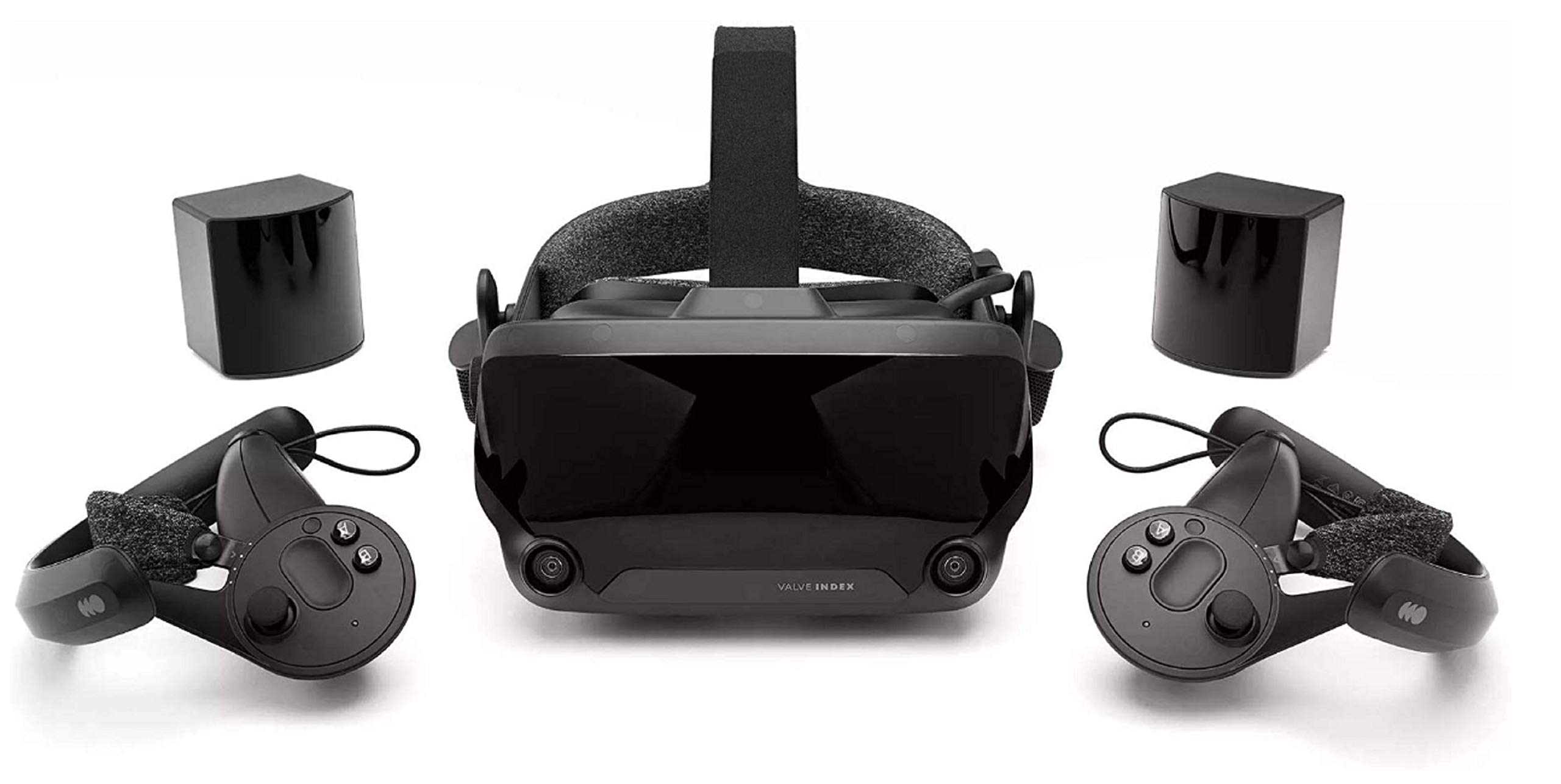
The Valve Index is the premium reference standard for PC VR, and its price has dropped enough to be a viable cheap option for those willing to buy once and cry once. The dual 1440×1600 LCDs run at 144Hz, making motion silky smooth. The 130-degree field of view is the widest on this list, eliminating the tunnel vision that plagues many headsets.
The off-ear speakers deliver immersive audio without touching your ears—stays cool and hygienic. The knuckle controllers track each finger independently, allowing you to grab objects naturally and open your hand without dropping them. The base station tracking with 360-degree coverage works in any room lighting and never loses tracking if you turn around completely.
The Index is a wired headset, and the cable can be a trip hazard during room-scale games. The resolution per eye, while adequate, is lower than the Vive Pro 2, so text in simulators isn’t as crisp. The full kit includes everything you need, but at the highest price point in this guide. The controllers also require AA batteries, which drain relatively quickly.
Why it’s great
- 130° FOV is the widest available
- 144Hz refresh for butter-smooth motion
- Knuckle controllers for natural hand presence
Good to know
- Lower per-eye resolution than some competitors
- Wired tether limits room-scale movement
8. PlayStation VR Headset + Camera Bundle (Renewed)

The original PSVR is the cheapest way to get into VR, using an OLED panel with 1920×1080 resolution and 110-degree field of view. The lightweight design actually holds up against modern headsets—it won’t weigh you down during sessions. The built-in cable is manageable, and the plug-and-play setup with a PS4 or PS5 (with adapter) is as simple as VR gets.
PC compatibility is limited to third-party drivers and can be finicky. The Move controllers, when paired, offer adequate tracking for Beat Saber, but the single-camera tracking volume is much smaller than inside-out systems—turning around fully can break tracking. The 1080p resolution looks dated, with noticeable screen-door effect.
This bundle is a great VR introduction for families or casual users who don’t want to invest heavily. The OLED black levels make horror games like Resident Evil 7 genuinely eerie. Just know that the tracking fidelity and resolution are a generation behind, and PC usage will require patience with community drivers.
Why it’s great
- Rock-bottom entry price to VR
- Lightweight and comfortable
- OLED display with good black levels
Good to know
- Low resolution with prominent screen-door effect
- Camera tracking limits 360-degree play
9. PlayStation VR Move Twin Pack (Renewed)

This bundle gives you the PSVR headset, PlayStation Camera, and two Move motion controllers—everything needed for active VR games. The OLED display with 1920×1080 resolution is identical to the standalone bundle, but the Move controllers unlock the full Beat Saber, Superhot VR, and Fruit Ninja experience. The camera mounts on top of your TV and provides passable tracking for forward-facing play.
This is a great value for families because the low cost and easy setup let you introduce multiple people to VR without breaking the bank. The Move controllers are robust, and the headset’s lightweight design means kids can wear it without discomfort. The PSVR library is large and well-cataloged, with many titles under .
The tracking volume is limited compared to modern systems. The camera uses visible light, so dark rooms can cause jittery tracking. Renewed units sometimes arrive with scratches on the headset or controllers, and the included cables may show wear. The lack of USB-C or modern connectivity means you’re locked to a PS4, PS5, or a finicky PC setup.
Why it’s great
- Complete family-ready VR kit with controllers
- Excellent for fitness games like Beat Saber
- Very low entry price for group play
Good to know
- Camera tracking range is limited
- Renewed condition can vary significantly
FAQ
Can a cheap PC VR headset run on a laptop with integrated graphics?
What is the screen-door effect and which headsets minimize it?
How much room do I need for inside-out tracking?
Do I need base stations for a cheap PC VR headset?
Final Thoughts: The Verdict
For most users, the cheap pc vr headset winner is the Meta Quest 3S because it combines pancake optics, wireless PC VR, and solid standalone performance at an accessible price. If you prioritize the highest resolution for simulator titles like DCS World or Microsoft Flight Simulator, grab the HTC Vive Pro 2. And for room-scale active VR with full-body tracking potential on a budget, nothing beats the Valve Index Full Kit despite its wires.

Mo Maruf
I created WellFizz to bridge the gap between vague wellness advice and actionable solutions. My mission is simple: to decode the research and give you practical tools you can actually use.
Beyond the data, I am a passionate traveler. I believe that stepping away from the screen to explore new environments is essential for mental clarity and physical vitality.