Our readers keep the lights on and my smoothie glass nicely filled. As an Amazon Associate, I earn from qualifying purchases.
Hanging a heavy mirror, mounting a TV, or securing a shelf all share one common risk: missing the stud. Drilling into drywall without knowing what is behind it leads to patched holes, damaged wiring, or worse. A reliable stud finder solves this, but the market is flooded with models that flash false positives or fail to detect anything at all. Finding one that actually works without breaking the bank requires knowing which sensor technology and depth range matters for your specific wall type.
I’m Mohammad Maruf — the founder and writer behind WellFizz. I’ve spent hundreds of hours analyzing sensor specs, customer feedback, and real-world performance data across dozens of wall scanners to identify which budget-friendly models deliver consistent, accurate readings.
Whether you’re a weekend DIYer or a professional installer, this guide breaks down the top contenders to help you find the best cheap stud finder that saves you time, frustration, and unnecessary drywall repairs.
How To Choose The Best Cheap Stud Finder
Not all stud finders are created equal. A model that costs less than twenty dollars can still deliver professional-grade accuracy if the right sensor technology is inside. Focus on these three factors to avoid buying a tool that leaves you guessing.
Sensor Technology and Count
Single-sensor stud finders use one detection point and require sliding the unit slowly across the wall to locate the stud edge. Multi-sensor models, like those with three patented sensors, detect density changes across a wider area simultaneously. This drastically reduces false positives and helps pinpoint the exact center of the stud, making them the preferred choice for hanging heavy loads.
Depth Range and Material Compatibility
Standard stud finders scan up to 3/4 inch deep, which works for typical drywall over wood framing. If you have older homes with thick plaster, metal lath, or tile backing, you need a unit that reaches deeper — ideally over 1 inch. Some budget-friendly options offer multiple scan modes for different depths, allowing you to toggle between 0.5 inch, 1 inch, and 1.5 inch settings depending on your wall construction. Always check the maximum depth before buying if your walls are non-standard.
AC Wire Detection
Drilling into a live wire is dangerous and costly. A built-in WireWarning or AC scan mode that alerts you to unshielded live electrical cables up to 2 inches deep is a safety feature that should not be skipped, even on an entry-level model. Some units keep this alert active in all scan modes, while others require switching to a dedicated AC mode. Confirming this feature exists saves you from potential shock hazards and costly repairs down the line.
Quick Comparison
On smaller screens, swipe sideways to see the full table.
| Model | Category | Best For | Key Spec | Amazon |
|---|---|---|---|---|
| Franklin Sensors M10 | Mid-Range | Accurate center finding | 3 patented sensors | Amazon |
| SUNTUTUFY TH530 | Mid-Range | Versatile multi-mode scanning | 5 scan modes | Amazon |
| USTUDCHY TH410 | Mid-Range | LCD display clarity | Depth up to 1.5 inches | Amazon |
| Zircon A100 | Premium | Trusted brand reliability | WireWarning detection | Amazon |
| CRAFTSMAN CMHT77620 | Budget | Simple edge detection | 3/4-inch depth | Amazon |
In‑Depth Reviews
1. Franklin Sensors ProSensor M10
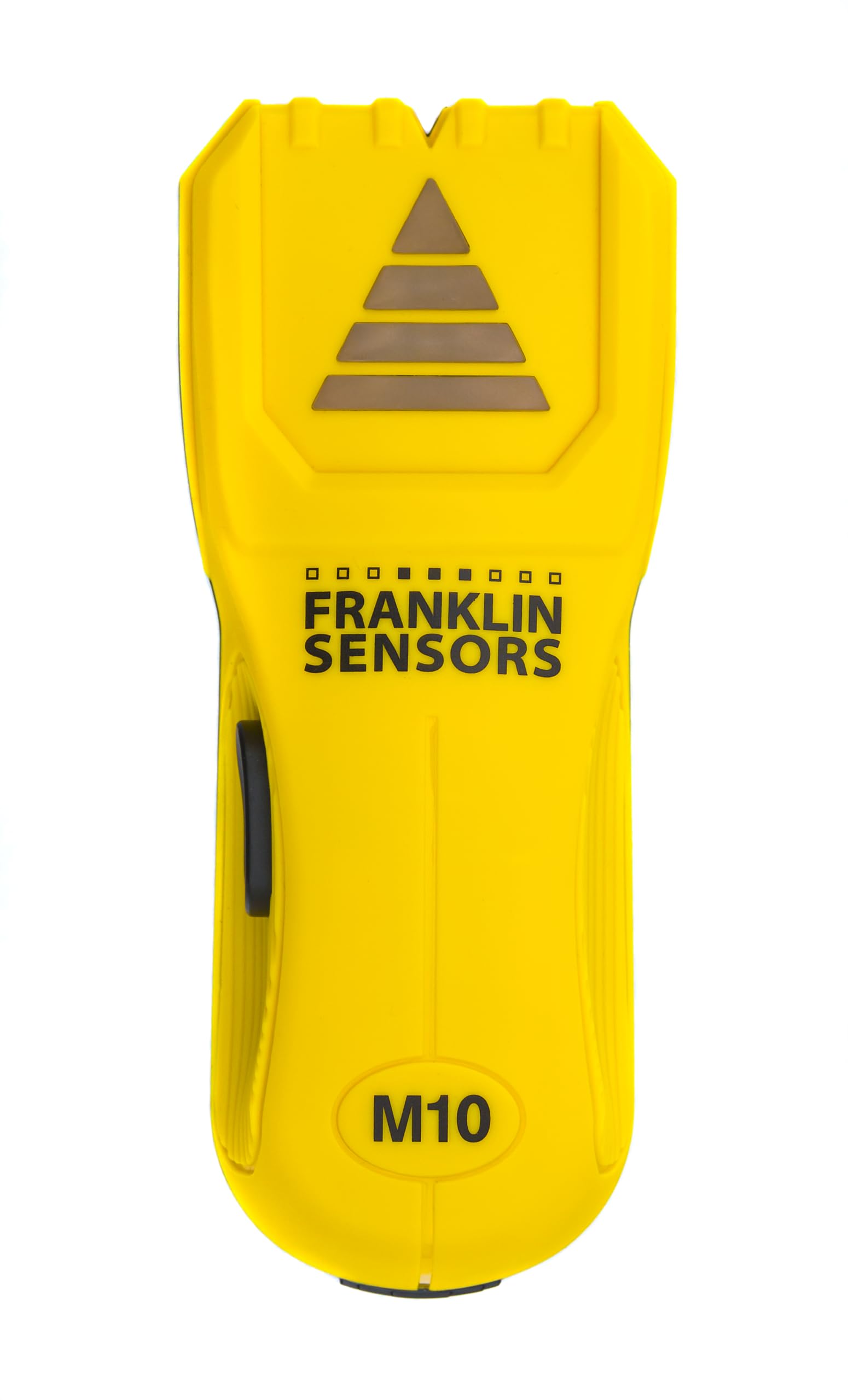
The Franklin Sensors M10 stands out because of its three patented sensors that detect changes in wall density across a wider area than single-sensor competitors. This design allows the unit to show the exact center of the stud with a green LED indicator, removing the guesswork of marking edges and measuring inward. It automatically adjusts for depth up to 1 inch, which covers standard drywall and some thicker plaster applications without manual mode switching.
Users consistently report that this mid-range model outperforms more expensive units they have tried in the past. Customer reviews frequently mention the M10’s ability to locate studs accurately on the first pass, eliminating the need for multiple confirmations or extra holes in the wall. It detects both wood and metal studs, making it suitable for a wide range of home construction types.
The unit requires two AA batteries and needs calibration before each use, which takes only a few seconds. Its compact plastic housing is lightweight at under 5 ounces, making it easy to handle for extended periods. This is the tool you reach for when precision matters and you want to avoid drilling into anything you will regret later.
Why it’s great
- Three sensors provide superior accuracy for center finding
- Auto-adjusts depth up to 1 inch without manual mode switching
- Detects both wood and metal studs reliably
Good to know
- Requires fresh AA batteries for consistent performance
- Calibration needed before every use
2. SUNTUTUFY TH530

The SUNTUTUFY TH530 packs five scan modes into one compact housing, offering separate settings for stud scanning at three depths — 0.5 inch, 1 inch, and 1.5 inches — plus dedicated metal and AC wire detection modes. This flexibility is rare at its price point and means you can confidently scan everything from thin drywall to thicker beams without switching tools. The upgraded sensor chip provides consistent accuracy, with customers noting it performs as well as name-brand alternatives costing significantly more.
An upgraded backlit LCD display provides clear visual feedback for edge, center, and signal strength, making it easy to read in dim crawlspaces or bright rooms. The audio alarm adds an extra layer of confirmation, beeping as you approach the target location. The automatic calibration process runs each time you start a scan, which users praise for its simplicity and reliability.
At 9.6 ounces, the TH530 is slightly heavier than the M10 but still comfortable for one-handed use. It includes batteries in the box, saving you a trip to the store. This model appeals to DIYers who want a versatile scanner that handles multiple wall scenarios without requiring a separate tool for electrical detection or deep metal scanning.
Why it’s great
- Five scan modes cover stud, metal, and AC detection
- Backlit LCD provides clear readings in low light
- Includes batteries and automatic calibration
Good to know
- Slightly heavier than single-sensor models
- May produce occasional false readings on heavily textured walls
3. USTUDCHY TH410

The USTUDCHY TH410 uses a latest-generation sensor chip designed to locate wood studs, metal pipes, rebar, and live AC wires behind walls, floors, and ceilings. Its five scan modes include stud scans at 0.5, 1, and 1.5-inch depths, a metal scan mode that works up to 60mm deep, and an AC scan mode for detecting unshielded 80-240V wiring. Customers consistently highlight its impressive accuracy across different wall materials, with one reviewer noting it stopped them from drilling into metal studs while mounting a bike rack.
The large LCD display shows a signal bar that indicates distance and direction as you scan, complemented by a beep alarm for audio confirmation. An ergonomic anti-slip handle provides a secure grip during extended use, reducing hand fatigue. The AC warning indicator remains active in all scan modes, giving you constant awareness of live wires even when you are focused on finding studs.
This model is ideal for anyone who needs a comprehensive wall scanner for complex projects involving multiple materials. Its deep scanning capability at 1.5 inches makes it effective for thicker walls found in older homes or commercial spaces. The peacock blue color makes it easy to spot on a cluttered workbench.
Why it’s great
- Deep 1.5-inch stud scanning for thick walls
- Ergonomic grip reduces hand fatigue
- AC warning active in all scan modes for safety
Good to know
- Minor false positives on heavily textured surfaces possible
- Requires fresh batteries for consistent deep scanning
4. Zircon StudSensor A100

Zircon is a well-established name in the stud finder space, and the A100 continues that reputation with reliable edge detection for wood and metal studs up to 3/4 inch deep. It uses WireWarning technology to alert you to live, unshielded AC wires up to 2 inches deep, adding a critical safety layer to every scan. The easy-to-read display uses arrows and audio indicators to signal when you have reached the stud edge, reducing the margin for error.
Users who have owned Zircon products for years report consistent performance across multiple projects, with one reviewer replacing a decade-old unit with this same model. The ergonomic contoured grip fits naturally in your hand, providing steady control even during long scanning sessions. Customers note that using a fresh 9V battery is essential — a weak battery can cause false error beeps or inconsistent readings.
The A100 is an edge-locating finder, meaning it shows where the stud starts and stops rather than its center. This is perfectly fine for most installations, though you will need to mark both edges and find the midpoint yourself. It is a straightforward, no-frills tool built for users who prioritize brand reliability and proven performance over extra features.
Why it’s great
- Trusted Zircon brand with consistent accuracy
- WireWarning alerts to live AC wires up to 2 inches deep
- Contoured grip for comfortable extended use
Good to know
- Edge-locating only, requires manual center calculation
- Requires new 9V battery for optimal performance
5. CRAFTSMAN CMHT77620

The CRAFTSMAN CMHT77620 offers center stud detection and AC wire detection in a thin, pocket-friendly profile. Its 3/4-inch depth range covers standard drywall applications, and the auto-calibration feature provides consistent readings without manual adjustment. LED arrows and audible tones guide you to the stud center, making it user-friendly even for first-time DIYers.
Customer feedback highlights its ease of use and accuracy on normal wall thicknesses. Several users report success scanning through older walls with thick skim coats, though the AC detection function struggles in environments with metal lath or wire mesh that interferes with the signal. It is best suited for modern drywall construction where the electrical wiring is the primary concern.
The unit is lightweight at 4.6 ounces and uses no batteries, drawing power directly when you press it against the wall — a unique energy-saving feature that means you never have to worry about dead batteries mid-project. The slim profile slides easily into a tool belt pocket. For someone who needs a simple, functional stud finder for occasional home projects and wants to keep costs minimal, this is a solid entry-level choice.
Why it’s great
- Center stud detection with LED and audible guidance
- Battery-free operation for worry-free use
- Thin profile fits easily in a pocket
Good to know
- AC detection accuracy is reduced on walls with wire mesh
- Depth limited to 3/4 inch, not suitable for thicker plaster
FAQ
How do I calibrate a cheap stud finder correctly?
Can a cheap stud finder detect live electrical wires?
Why does my cheap stud finder keep beeping or giving false readings?
Final Thoughts: The Verdict
For most users, the best cheap stud finder winner is the Franklin Sensors M10 because its three patented sensors provide center-finding accuracy that rivals premium models at a fraction of the cost. If you want versatile multi-mode scanning with a clear backlit display, grab the SUNTUTUFY TH530. And for a trusted brand name with proven reliability and AC safety alerts, nothing beats the Zircon StudSensor A100.

Mo Maruf
I created WellFizz to bridge the gap between vague wellness advice and actionable solutions. My mission is simple: to decode the research and give you practical tools you can actually use.
Beyond the data, I am a passionate traveler. I believe that stepping away from the screen to explore new environments is essential for mental clarity and physical vitality.