Our readers keep the lights on and my smoothie glass nicely filled. As an Amazon Associate, I earn from qualifying purchases.
Whether you’re running a butcher counter, processing a season’s worth of wild game, or preparing raw food for a kennel of dogs, a commercial grinder is the difference between a productive day and a frustrating one. The problem with most home-grade models is that they overheat, bind up on sinew, or simply lack the torque to handle whole muscle and bone-in cuts without stalling. A serious kitchen needs a machine that can run continuously, stay cool, and produce consistent texture batch after batch.
I’m Mohammad Maruf — the founder and writer behind WellFizz. My research process for this guide involved cross-referencing motor torque curves, auger gear geometry, and stainless steel gauge thicknesses across dozens of models to isolate the machines that hold up under sustained commercial demand.
After sifting through the specs and real-world feedback from butchers, hunters, and heavy-volume home cooks, these nine picks represent the best commercial grinder options that actually deliver on throughput, durability, and clean-up ease.
How To Choose The Best Commercial Grinder
A commercial grinder is a capital investment. Choosing the wrong one means replacing a motor mid-season or fighting with a machine that clogs on the first batch of venison. The three factors below will narrow your decision faster than any brand name.
Motor Wattage & Horsepower
Look at real sustained wattage, not peak marketing numbers. A grinder with 500W to 750W is fine for small batches of boneless meat. Once you need to process bone-in poultry or multiple deer in a session, look for at least 1.0 HP (roughly 750W sustained) with a permanently lubricated motor. Air-cooled motors allow longer run times without tripping thermal overload.
Auger Size & Gearbox
The auger diameter determines how fast meat moves from the hopper to the plate. A #12 auger is the minimum for serious home use — it can handle about 4–5 lbs per minute. A #22 or #32 auger nearly doubles that throughput. Metal gears (steel or alloy) outlast nylon gears significantly. Reverse function is a practical feature when grinding tough connective tissue, letting you clear a jam without disassembly.
Build Material & Cleanability
Full stainless steel — body, grinding head, auger, and tray — resists rust and food-acid corrosion better than painted steel or aluminum. Removable parts that separate fully for dishwasher-safe cleaning are a time-saver after high-volume sessions. Avoid units with blind crevices where meat can hide. Welded one-piece heads are easier to sanitize than bolted assemblies.
Quick Comparison
On smaller screens, swipe sideways to see the full table.
| Model | Category | Best For | Key Spec | Amazon |
|---|---|---|---|---|
| LEM BigBite #32 | Premium | Ultra-high volume & bone-in | 1.5 HP / 17 lbs per minute | Amazon |
| Weston Pro Series #22 | Premium | Continuous commercial grinding | 1.5 HP / 14 lbs per minute | Amazon |
| Valley Sportsman #22 | Mid-Range | High-volume restaurant kitchens | 1.0 HP / 550 lbs per hour | Amazon |
| Valley Sportsman #12 | Mid-Range | Serious home butcher / small farm | 0.75 HP / 450 lbs per hour | Amazon |
| ARINOO #12C | Mid-Range | Hunters processing game | 1.0 HP / 1100W peak | Amazon |
| ALDKitchen Swing Mill | Mid-Range | Spices & dry ingredient powdering | 4000W / 50-300 mesh | Amazon |
| NAIZEA Electric Grain Mill | Mid-Range | Grains & dry animal feed | 3000W / 75 kg per hour (wheat) | Amazon |
| MANNKITCHEN Pepper Cannon | Mid-Range | High-output manual peppering | 75 grind settings / 10x faster | Amazon |
| Weston #12 Electric | Budget | Entry-level meat & sausage | 750W / 4 lbs per minute | Amazon |
In‑Depth Reviews
1. LEM BigBite #32

The LEM BigBite #32 sits at the top of the commercial pecking order because it combines a true 1.5 HP motor with a #32 auger — the largest common plate size — giving you a sustained throughput of 17 pounds per minute. That speed matters when you’re processing a whole steer or a dozen deer in a single session. The noise-dampening housing is noticeably quieter than other heavy-duty units, which reduces fatigue during long grinding days.
All contact surfaces are full stainless steel, and the permanently lubricated motor eliminates the need for oiling. The included three plates (coarse, medium, fine) and four stuffing tubes make this machine completely self-contained for sausage making right out of the box. The stomper has a patented auger-grabbing design that pulls meat into the head instead of just pushing it, reducing the need for manual force.
At nearly 65 pounds, this grinder is not portable — it belongs on a sturdy cart or counter. Build quality is exceptional, with a five-year factory warranty and lifetime support. Real-world users report grinding bone-in chicken and partly frozen brisket without bogging down.
Why it’s great
- True 1.5 HP with noise-dampening design
- #32 auger for extreme throughput
- Full stainless steel, dishwasher-safe parts
- 5-year warranty with strong support
Good to know
- Very heavy (64.8 lbs)
- High upfront investment
- #8 throat may require pre-cutting large roasts
2. Weston Pro Series #22

The Weston Pro Series #22 is engineered for continuous operation, thanks to its air-cooled, permanently lubricated 1.5 HP motor that maintains torque even after hours of grinding. The rifled-head design and tapered throat funnel meat into the #22 auger without forcing, delivering a steady 14 pounds per minute. That makes it a strong second choice for anyone who needs industrial reliability but at a slightly lower price than the LEM #32.
This unit includes a built-in knife sharpener, which is rare in this class — you can refresh the blade between batches without disassembly. The forward-reverse function handles jams gracefully when you hit a pocket of tough connective tissue or bone. Included accessories cover coarse and fine stainless plates, four stuffing funnels, and a storage tray with cover that keeps everything organized.
At 58 pounds, the Weston Pro is a heavy, solid machine. The five-year limited warranty reinforces the build confidence. Owners report grinding bone-in chicken quarters and whole turkeys for raw pet food with minimal motor strain. One consideration is that the reverse mechanism can be slow to engage, but overall, this grinder rewards volume-focused users with reliable, consistent texture every time.
Why it’s great
- Air-cooled motor for continuous duty
- Built-in knife sharpener
- Rifled head reduces pushing effort
- Forward-reverse for jam clearing
Good to know
- Heavy (58 lbs) and takes up counter space
- Premium price point
- Reverse engagement can lag
3. Valley Sportsman #22

The Valley Sportsman #22 brings a 1.0 HP motor and a #22 auger together at a mid-range price that undercuts comparably specced machines from legacy brands. It grinds up to 550 pounds per hour, which is plenty for a busy restaurant kitchen or a multi-family hunting group. The overload protection system shuts the motor down before it burns out, a feature that adds peace of mind during long sessions with tough meat.
Every metal surface that contacts food is stainless steel — head, auger, tray, and throat. The enhanced auger geometry reduces clogging and the need to manually cram meat into the housing. It comes with three stuffing tubes (15mm, 25mm, 35mm) and two plates (4.5mm fine and 10mm coarse), covering most common applications from burger grind to coarse sausage.
Owners praise the clean disassembly: the head comes off without tools, and all stainless parts are dishwasher safe. The main shortcoming is the absence of a medium plate (6mm or 8mm) in the box — you may need to buy one separately if you want a standard hamburger texture. The one-year seller warranty is shorter than some competitors, but the robust build suggests longevity beyond that period.
Why it’s great
- Strong 550 lb/hr throughput for the price
- Overload protection for motor safety
- Fully stainless steel construction
- Tool-free disassembly for cleaning
Good to know
- No medium-grade grinding plate included
- Only 1-year seller warranty
- Heavy (59 lbs)
4. Valley Sportsman #12
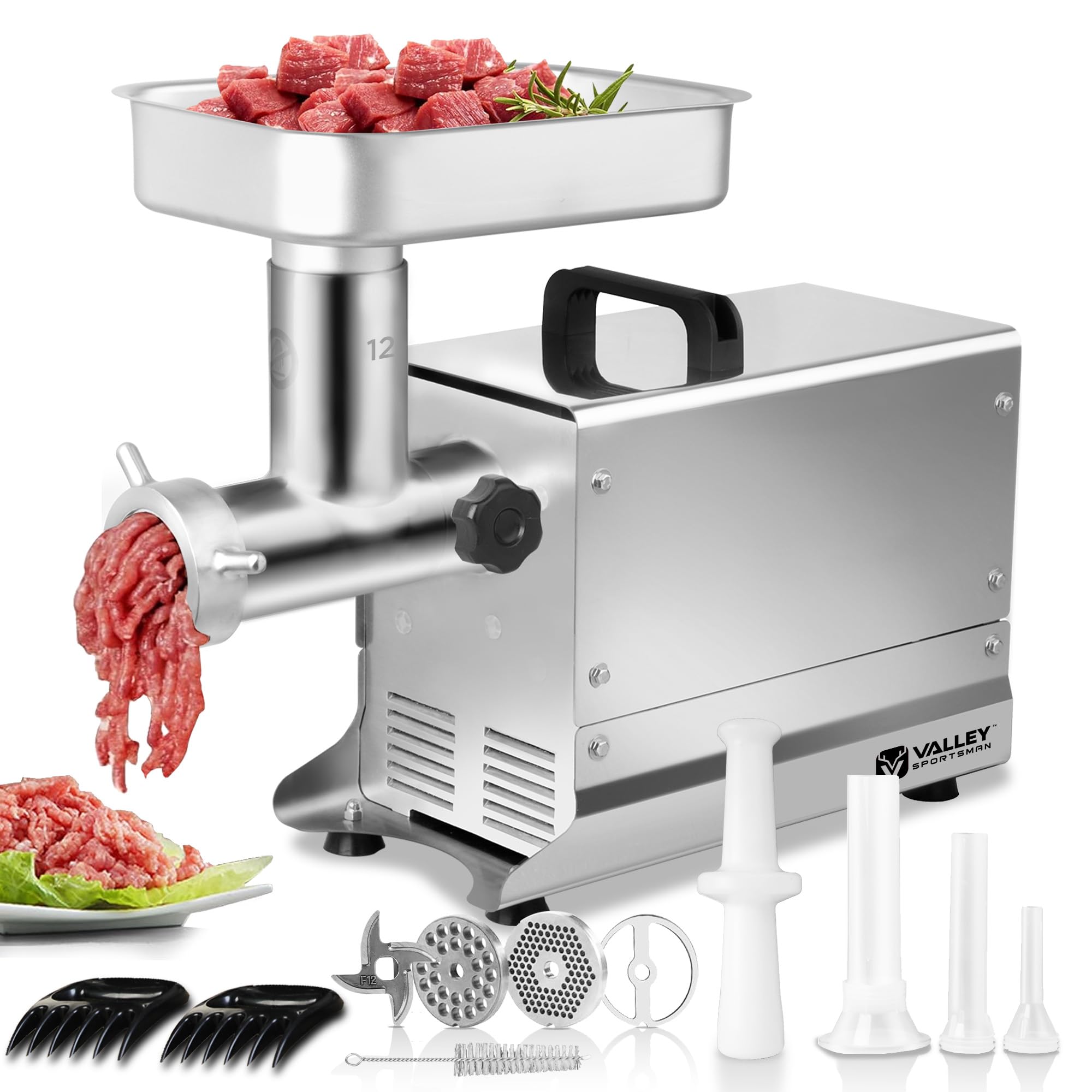
If your volume is serious but not industrial — think three deer a season or weekly meal-prep grinding for a large family — the Valley Sportsman #12 offers a compelling balance of power and price. Its 0.75 HP motor processes up to 450 pounds per hour, and the built-in overload protection keeps the windings safe if you push it hard. The #12 auger is the standard size for medium-volume work, and the precision-engineered auger reduces the amount of manual pushing.
The entire grinding assembly is stainless steel, including the case body, which resists rust better than painted metal. It includes two plates (4.5mm fine and 10mm coarse), a stainless blade, and three plastic stuffing tubes. The mirror-polished finish makes wipe-down cleaning easier, and all food-contact parts detach without tools for thorough washing.
Users consistently report that this grinder runs through meat “like butter” and stays quieter than many home-grade units. The six-year warranty is the longest in this comparison, signaling strong confidence in the build. The only gap is the lack of a medium grinding plate — like its #22 sibling, you may need to purchase a 6mm or 8mm plate separately for standard burger texture.
Why it’s great
- Excellent 6-year warranty
- 450 lb/hr capacity handles most home & farm needs
- Overload protection for longevity
- Mirror-polished stainless body
Good to know
- No medium plate included
- Plastic stuffing tubes (not stainless)
- #12 auger is slower than larger sizes
5. ARINOO #12C
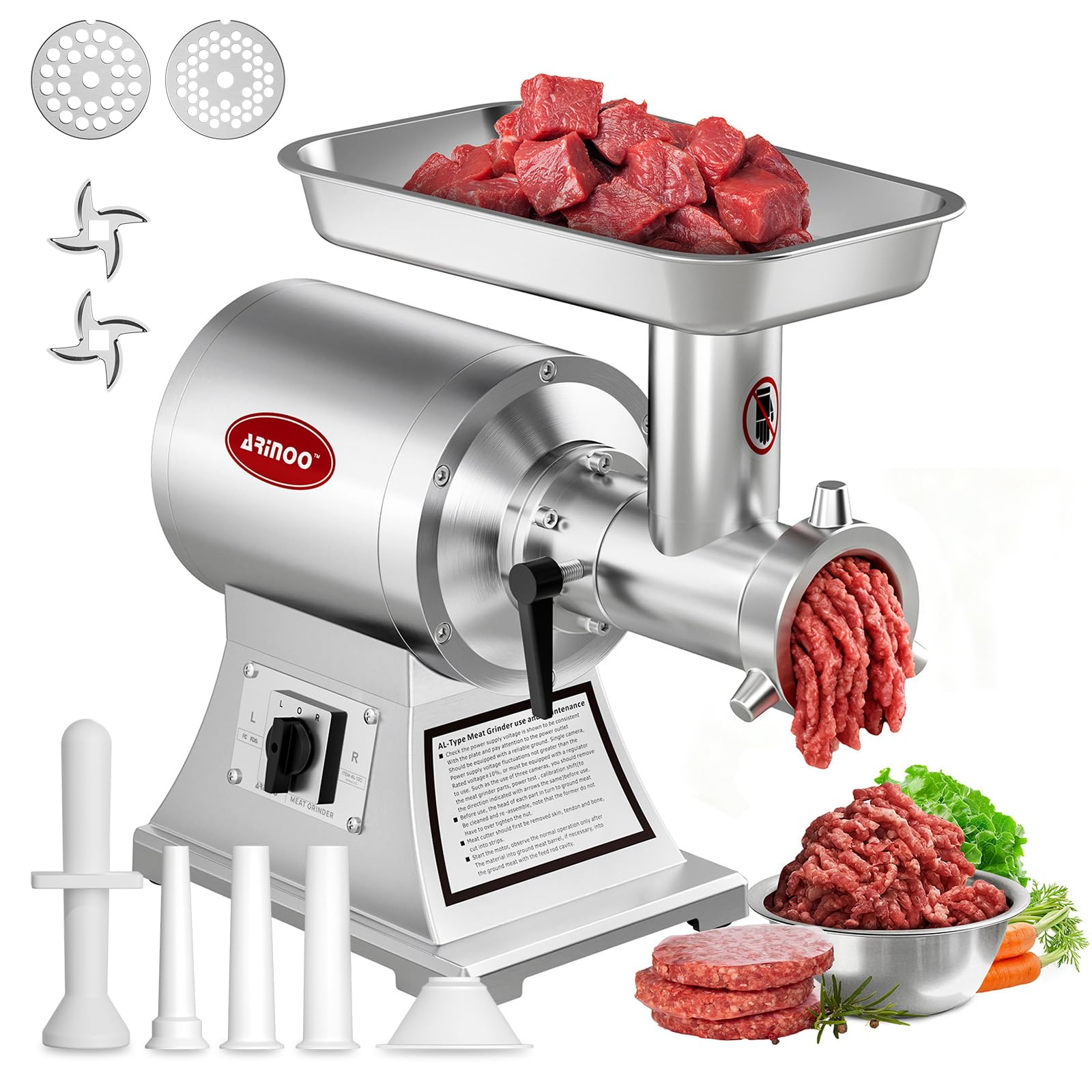
The ARINOO #12C is built around a high-torque 1.0 HP motor with pure copper windings — a detail that matters for heat dissipation. The motor peaks at 1100W and is rated for sustained output, making it a surprisingly aggressive grinder for its #12 size. It handled whole elk and deer without stalling in user reports, a testament to the torque curve rather than just peak wattage.
The housing is stainless steel, and the grinding head, auger, and tray are all food-safe metal. It ships with two plates (6mm and 8mm), giving you a medium-grind option out of the box that many competitors leave as an add-on. Three plastic stuffing tubes are included for sausage making, along with two stainless knives. The cam action headlock allows quick attachment and removal of the grinding head.
One caution from owners: the casting on some units had sharp burrs around the grinding housing that required light deburring before safe operation. The five-year factory warranty is strong, but the brand’s replacement parts availability is still being proven. For hunters who want a compact, powerful machine that fits on a countertop, this is a smart option.
Why it’s great
- True 1.0 HP pure copper motor
- Includes both 6mm and 8mm plates
- Compact footprint for the power
- 5-year manufacturer warranty
Good to know
- Some units require deburring
- Plastic stuffing tubes
- Replacement parts availability uncertain
6. ALDKitchen Swing Mill

The ALDKitchen Swing Mill is a different category of commercial grinder — it uses a high-speed swing blade that spins at 25,000 RPM to pulverize dry ingredients into ultrafine powder. This is the machine you reach for when you need 50 to 300 mesh fineness from spices, herbs, roots, or grains. The 4000W motor is overkill for a pepper mill but exactly right for breaking down fibrous turmeric root or hard cloves.
The chamber is stainless steel with a 3000-gram capacity, and the lid seals securely to prevent dust leaks during operation. Grinding takes seconds — users report achieving a talcum-like powder from rice or dried herbs in about 15 seconds. The included brush makes cleaning the chamber straightforward, though the blade assembly should be handled with care.
This grinder is loud, as expected from a 25K RPM motor, and the chamber heats up during extended runs, so it’s best for small-to-medium batches rather than continuous processing. Some owners found that grinding wet ingredients (like soaked soybeans) caused the unit to jam and produce a bad smell. For dry applications like spice blending or flour making, it performs consistently and saves significant time over manual methods.
Why it’s great
- 4000W motor for rapid fine grinding
- 3000g capacity for commercial batches
- 50-300 mesh adjustability
- Compact swing design saves counter space
Good to know
- Not for continuous or wet grinding
- Very loud during operation
- Chamber heating limits batch size
7. NAIZEA Electric Grain Mill
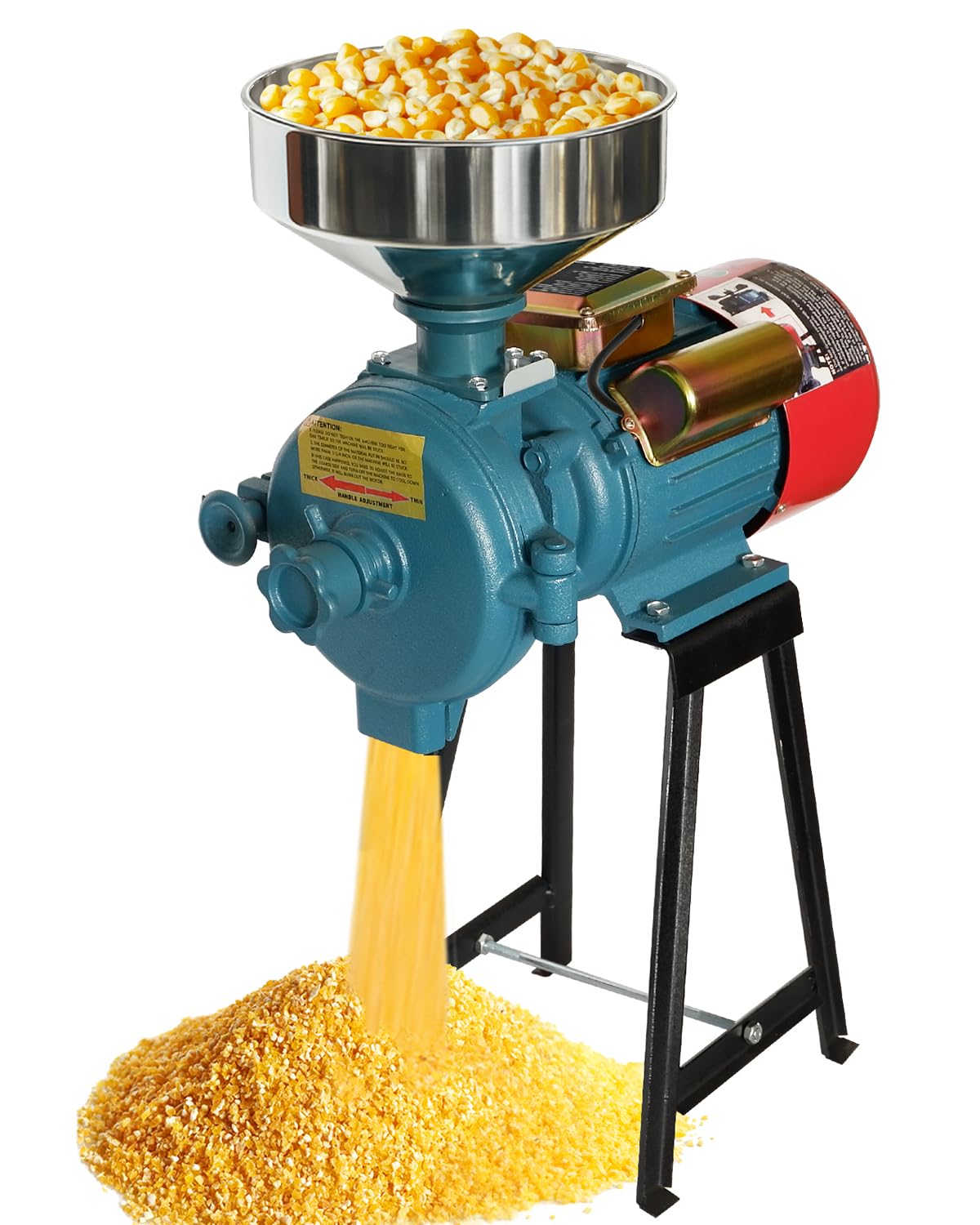
The NAIZEA Electric Grain Mill is built for dry grains — corn, wheat, rice, and soybeans — with a 3000W motor spinning at up to 2800 RPM. It processes up to 75 kg of wheat per hour, making it a legitimate choice for small-scale commercial milling or farm feed preparation. The galvanized cast iron shell resists corrosion and stands up to the vibration of heavy grinding.
The adjustable grinding mechanism lets you dial in texture from coarse cracked corn to fine flour. The funnel feeds grain steadily, and the counterclockwise rotation pushes material through the 150mm diameter drills. Owners report grinding 100 pounds of corn in roughly 30 minutes with the motor staying cool to the touch. The machine disassembles for cleaning, though the cast iron parts are heavy.
A critical limitation: this mill is designed for dry materials only. Attempting wet soybeans or soaked rice can cause the grinding plates to rust and bind, and several users experienced failure when using it for wet applications as advertised. The machine is also loud and dusty — having a well-ventilated space is necessary. For dry grain milling at a moderate price point, it delivers impressive throughput.
Why it’s great
- 3000W motor handles large dry grain volumes
- Adjustable grind from coarse to fine
- Rust-resistant galvanized cast iron shell
- Easy to disassemble and clean when dry
Good to know
- Not suitable for wet grains
- Very loud and dusty
- Heavy (110 lbs); requires permanent placement
- Plates can crack if overtightened
8. MANNKITCHEN Pepper Cannon

The MANNKITCHEN Pepper Cannon is a manual grinder, but calling it “manual” undersells the engineering. A bearing-supported drive shaft and high-carbon stainless steel burrs deliver pepper at up to 10 times the rate of typical pepper mills. You can fully pepper a steak in seven cranks instead of seventy — a genuine time-saver in a busy kitchen. The solid milled aluminum body weighs about a pound and feels dense and balanced in hand.
The grind range spans 75 coarseness settings, from cracked pepper to a fine powder, and the never-slip adjuster holds its position even during rapid cranking. The quick-release top allows refills without unscrewing, and the base cup doubles as a storage container and makes one-handed peppering possible. The ball bearing mechanism eliminates the wobble you feel in cheaper mills.
Capacity is limited to about 120ml (roughly half a cup of peppercorns), which is fine for a restaurant station but not for bulk prep. The manufacturer explicitly advises against using it for salt, as salt corrodes the carbon steel burrs. At the mid-range price point, this is a lifetime tool for any cook who values speed and consistency in pepper grinding.
Why it’s great
- 10x faster output than standard mills
- 75 precise grind settings
- Ball bearing mechanism for smooth operation
- Milled aluminum body; lifetime build
Good to know
- Small capacity (120ml)
- Not for salt
- Requires manual effort (no motor)
9. Weston Electric #12

The Weston Electric #12 is the most budget-conscious entry in this guide, but it punches above its weight for a #12-class grinder. The 750W motor is rated at 1 HP peak and processes 4–5 pounds of meat per minute — enough for regular home grinding and moderate batch sizes. The die-cast aluminum body and metal gears give it a solid feel that undercuts the plastic-heavy competition at this price point.
It comes with two stainless grinding plates (medium and coarse), a cutting blade, a sausage stuffing funnel, and a stomper. The two-speed operation lets you switch to a slower speed for stuffing sausage without overworking the meat. The cam action headlock secures the grinding head quickly and releases without tools, making disassembly for cleaning painless.
Where this unit shows its price is in sustained heavy use. Multiple owners noted that the locking lever can vibrate loose during large batches, and the internal plastic gear mechanism (despite the metal gearbox housing) is a wear point when processing bone-in meat. The one-year warranty is shorter than average. For boneless meat grinding and occasional sausage making, it’s a capable starter that won’t break the bank. For bone-in or daily commercial volume, step up to the higher-tier models on this list.
Why it’s great
- Metal gear housing in an entry-level price range
- Two-speed operation with reverse
- Quick cam lock head removal
- Compact footprint for counter storage
Good to know
- Plastic internal gear wears under bone grinding
- Locking lever can vibrate loose
- Only 1-year warranty
- Replacement knife blade availability is poor
FAQ
Can a #12 grinder handle bone-in chicken?
Should I look for a metal or plastic gearbox in a commercial grinder?
How important is the reverse function?
Can I use a meat grinder for making sausage stuffing?
Final Thoughts: The Verdict
For most users, the best commercial grinder winner is the LEM BigBite #32 because its 1.5 HP motor and #32 auger deliver the highest throughput with noise-dampened operation and full stainless steel construction. If you want a built-in knife sharpener and a rifled head that practically feeds itself, grab the Weston Pro Series #22. And for commercial kitchens that need reliable mid-volume output without the top-tier price, nothing beats the Valley Sportsman #12 with its 6-year warranty and overload protection.

Mo Maruf
I created WellFizz to bridge the gap between vague wellness advice and actionable solutions. My mission is simple: to decode the research and give you practical tools you can actually use.
Beyond the data, I am a passionate traveler. I believe that stepping away from the screen to explore new environments is essential for mental clarity and physical vitality.