Our readers keep the lights on and my smoothie glass nicely filled. As an Amazon Associate, I earn from qualifying purchases.
Finding a keyboard that keeps up with your coding flow without the ping, wobble, or extra travel time is harder than debugging a memory leak on a Friday night. The wrong switch feel or a cramped layout kills your rhythm faster than a crashing compile.
I’m Mohammad Maruf — the founder and writer behind WellFizz. I dug through the build materials, switch types, and programmability of dozens of wired and wireless boards to find the ones that actually reward every keystroke with precision and comfort.
Whether you need hot-swap versatility, a silent tactile bump, or an ergonomic contour that saves your wrists from years of strain, this best coding keyboard guide gives you a clear path to the right buy for your daily driver.
How To Choose The Best Coding Keyboard
Choosing the right board for engineers and writers comes down to three interlocked decisions: switch type, layout, and onboard programmability. A full-size number pad helps data entry but spreads your mouse hand wider, while a tenkeyless (TKL) or 75% layout keeps your shoulders neutral and your desk cleaner. The right switch feel — tactile bump or smooth linear — matches how hard you bottom out and how much audible feedback your brain needs to stay in flow.
Switch Feel and Acoustics
Coders who share an open office or work next to a sleeping partner need switches quieter than a clicky Cherry MX Blue. Tactile options like Cherry MX Brown or the HyperX Aqua give a physical bump without the loud snap, while linear switches (Cherry MX Red, Gateron Yellow) offer a smooth, quieter downstroke. The new Hall Effect magnetic switches remove the metal contact altogether, allowing adjustable actuation points from 0.4 mm to 3.6 mm so you can tune how deep you must press before a character registers.
Layout and Desk Space
Full-size boards (104 keys) give you dedicated navigation and a number pad, which helps if you regularly type IP addresses or numeric parameters. Tenkeyless and 75% layouts move the mouse closer to your home row, reducing shoulder reach. Ergonomic split designs like the Kinesis Advantage2 use deep contoured keywells and thumb clusters to reduce finger travel and wrist extension. Consider your desk depth and whether you need to carry the board between home and office.
Firmware and Programmability
Open-source firmware like QMK and its graphical companion VIA let you remap every key, build multi-layer shortcuts, and create macros without vendor lock-in. If you use custom key layouts for your IDE (e.g., moving Enter to a thumb key or remapping Caps Lock to Escape/Ctrl), a QMK/VIA board gives you full offline control. Hall Effect boards like the Corsair K70 PRO TKL and Logitech G PRO X TKL Rapid also allow per-key actuation and Rapid Trigger for instantaneous key repeats without a full release.
Quick Comparison
On smaller screens, swipe sideways to see the full table.
| Model | Category | Best For | Key Spec | Amazon |
|---|---|---|---|---|
| Kinesis Advantage2 | Ergonomic Premium | Deep ergonomic comfort | Contoured keywells + Cherry MX Brown | Amazon |
| Corsair K70 PRO TKL | Hall Effect TKL | Adjustable actuation | 0.4–3.6mm per-key actuation | Amazon |
| Logitech G PRO X TKL Rapid | Hall Effect TKL | Competitive typing speed | Magnetic analog + Rapid Trigger | Amazon |
| Logitech MX Mechanical | Low-Profile Wireless | Multi-device wireless | Low-profile clicky / 3-device BT | Amazon |
| HyperX Alloy Origins Core | TKL Gaming/Work | Bright RGB + all-metal frame | Aircraft-grade aluminum body | Amazon |
| Keychron V6 | Full-Size Hot-Swap | Endless customization | QMK/VIA + hot-swap sockets | Amazon |
| Cherry KC 200 MX | Wired Office | Budget tactile upgrade | MX2A Brown switches | Amazon |
In‑Depth Reviews
1. Kinesis Advantage2 Ergonomic Keyboard

The contoured keywells and thumb clusters of the Advantage2 change how you reach modifier keys — Backspace, Delete, Enter, and Space rest under your thumbs instead of forcing pinky extensions. The concave wells naturally guide your fingers to the home row, reducing wrist extension and finger travel during marathon coding sessions. Cherry MX Brown switches deliver a quiet tactile bump at 45g actuation, giving you physical confirmation without the sharp click.
Full onboard programmability via the Smart Set engine lets you remap any key or record macros without installing drivers — the settings live on the board’s 4 MB flash memory, so they travel with the keyboard across Windows, Mac, and Linux. The 20-degree tenting angle and cushioned palm supports keep your wrists in a neutral position, and the three-year warranty backs a design that Kinesis has refined since the early 1990s.
The taller body and fixed split-halves mean it needs permanent desk space — it won’t fit in a laptop bag for a coffee shop session. Expect a one-month adaptation period as your hands learn the new keywell geography; switching back to a flat board may feel strange for a few hours.
Why it’s great
- Contoured keywells reduce reaching, wrist extension, and finger travel dramatically
- Thumb clusters put Backspace, Delete, Enter, and modifiers under your strongest digits
- Driverless onboard programming works across macOS, Windows, and Linux
Good to know
- Tall, non-portable design demands dedicated desk real estate
- Non-hot-swappable switches require soldering to replace
- Requires about one month of daily use to build new muscle memory
2. Corsair K70 PRO TKL RGB

The K70 PRO TKL is the first mainstream Hall Effect board that lets you dial the actuation point per key from an ultra-shallow 0.4 mm up to 3.6 mm in 0.1 mm increments. Pre-lubricated MGX Hyperdrive magnetic switches eliminate metal contact wear, rated for 150 million keystrokes, and the dual-rail stem design reduces key wobble noticeably compared to traditional MX-style switches. The Rapid Trigger mode re-registers a key the instant you lift it slightly, so repeated characters in a debug console or find-and-replace come through faster than a mechanical switch can reset.
The tenkeyless layout with detachable USB-C cable keeps the board portable, and the aircraft-grade aluminum top plate gives it a 2.1-pound solid feel with zero flex. The volume roller and media keys sit on the top edge, and the included wrist rest attaches magnetically. The RGB lighting is exceptionally bright thanks to the exposed LEDs on the magnetic switches.
The iCue software offers deep per-key customization but has a steep learning curve and can occasionally drop profiles after a firmware update. The volume roller sits very close to the PgUp and Home keys, which may cause accidental scroll adjustments during rapid navigation.
Why it’s great
- Per-key adjustable actuation from 0.4 mm to 3.6 mm suits any typing style
- Hall Effect switches last 150 million presses with zero contact wear
- Rapid Trigger allows instant key re-registration without full release
Good to know
- iCue software is powerful but buggy and resource-heavy
- Volume roller placement near navigation keys can be accidentally triggered
- ABS keycaps wear faster than PBT under heavy daily use
3. Logitech G PRO X TKL Rapid

Logitech built the PRO X TKL Rapid with esports athletes, but the same magnetic analog switches and Rapid Trigger logic serve coders who need instantaneous repeated keystrokes for line navigation or cursor skipping. The Hall Effect switches actuate at 35g — lighter than most mechanical tactile switches — and you can adjust actuation points on the fly via the FN layer without launching G HUB. Rapid Trigger allows the key to reset at the exact point you begin lifting, so scrolling through a terminal or holding a movement key feels zero-lag.
The tenkeyless layout with detachable USB-C cable weighs only 150 grams (board only), making it one of the lightest premium TKL boards to carry between a home and office desktop. LIGHTSYNC RGB offers per-key color control synchronized with music or on-screen events, and the volume roller and dedicated media buttons are placed on the top edge for easy blind access.
The plastic enclosure feels less premium than the aluminum-bodied Corsair or HyperX boards. A small number of users report a wired disconnect issue that requires a full PC reboot rather than a simple USB unplug, and the USB-C port is not reinforced on the PCB — repeated cable stress could lead to expensive repairs.
Why it’s great
- Extremely light 35g actuation reduces finger fatigue over long sessions
- On-the-fly actuation adjustment via FN layer needs no software
- Rapid Trigger enables instant key repeats without full release travel
Good to know
- Plastic case lacks the heft and premium feel of aluminum alternatives
- USB-C port not reinforced; occasional disconnect requires full reboot for some users
- G HUB software required for advanced customization; not open-source like QMK
4. Logitech MX Mechanical

The MX Mechanical pairs low-profile clicky switches with Logitech’s multi-device wireless, letting you toggle between a desktop PC, a MacBook, and an iPad with a single button press. The low-profile keycaps reduce the travel distance compared to full-height mechanical switches, so your fingers don’t have to rise as far between keystrokes — a subtle efficiency that adds up over an eight-hour coding session. The backlighting automatically turns on when your hands approach and adjusts to ambient light, saving battery while keeping keys visible in dim environments.
Bluetooth Low Energy keeps the board connected to up to three devices, and the Logi Bolt USB receiver offers a lower-latency backup for desktop use. A full charge lasts up to 15 days with backlighting on or up to 10 months with the lights off, making it one of the lowest-maintenance wireless mechanical options. Logi Options+ lets you customize the function row and enable Flow for cross-computer mouse/keyboard control.
The clicky switches are louder than the tactile browns found on the Keychron V6 or HyperX board, so they may not be ideal for shared workspaces. The keycaps are non-replaceable in the sense that the switches are soldered, not hot-swappable, and the glossy keycaps attract fingerprints.
Why it’s great
- Seamless 3-device Bluetooth switching saves desk clutter
- Low-profile switches reduce finger travel compared to full-height boards
- Excellent battery life: 15 days with lights, 10 months without
Good to know
- Clicky switch noise may disturb coworkers in open-plan offices
- Non-hot-swappable switches — no easy way to change feel later
- Glossy keycaps show fingerprints and smudges quickly
5. HyperX Alloy Origins Core TKL

The full aircraft-grade aluminum frame on the Alloy Origins Core makes it the sturdiest TKL board in the mid-range segment — zero chassis flex even when you hold it at the corners. HyperX’s custom Aqua switches offer a tactile bump that sits between Cherry MX Brown and MX Clear, giving a more pronounced feel without the click. The exposed LEDs produce some of the brightest RGB in the category, and the pudding-compatible keycap design means the light bleeds around every keycap for a striking desktop look.
The tenkeyless layout with detachable USB-C cable keeps your mouse closer to the home row, and the three adjustable tilt angles (3°, 7°, 11°) let you find a wrist angle that reduces strain. Onboard memory stores three full RGB profiles and macros, so you can unplug and carry your lighting to a LAN event without reinstalling software. The 80 million keystroke durability rating on the switches is solid for a board at this tier.
The NGENUITY software is the weakest link — it crashes during profile saves and sometimes requires a reinstall to recognize the keyboard. The stock stabilizers on the spacebar and shift keys have noticeable lateral rattle that a tape mod can quiet down.
Why it’s great
- Full aircraft-grade aluminum body with zero flex at any point
- HyperX Aqua switches give a pronounced tactile bump without click noise
- RGB brightness outstrips most competitors in the same price tier
Good to know
- NGENUITY software crashes frequently and has a poor user interface
- No hot-swap support — you cannot change switches without soldering
- Stabilizers on large keys rattle out of the box
6. Keychron V6 Full-Size Hot-Swap

The V6 delivers the most customization per dollar in the full-size category: QMK/VIA firmware for limitless key remapping, hot-swap PCB sockets that accept nearly any 3-pin or 5-pin MX switch, and pre-lubed screw-in stabilizers that eliminate the rattle common on budget boards. The double-shot PBT keycaps resist shine even after months of oily fingertips, and the OSA profile gives a scooped feel that cradles your fingertips without the aggressive dish of OEM or SA profiles. The south-facing RGB prevents interference with Cherry-profile keycaps when you swap to your favorite set.
The full 108-key layout includes a function row, navigation cluster, and number pad for developers who frequently type numeric addresses or engage in data-heavy work. The volume knob on the top-right edge gives quick audible feedback for system volume. The acoustic silicone pad inside the case dampens the hollowness that plagues many metal-framed boards under this price point, resulting in a deeper, less pingy sound profile out of the box.
At nearly 5 pounds this board is heavy, so it stays put on a desk but doesn’t travel well. The Mac/Windows toggle works out of the box, but the supplied keycap set may map Option and Command differently than macOS-native expectations until you remap via VIA.
Why it’s great
- QMK/VIA offers unlimited key remapping and macro layers without vendor lock-in
- Hot-swap sockets let you swap switches anytime with no soldering
- Screw-in stabilizers and silicone pad deliver a quiet, rattle-free keystroke
Good to know
- Very heavy (5 lbs) — not suitable for regular transport
- Pre-loaded keycap legends need a VIA tweak for correct macOS modifier layout
- Backlighting illuminates the edges of the keycaps more than the legends
7. Cherry KC 200 MX
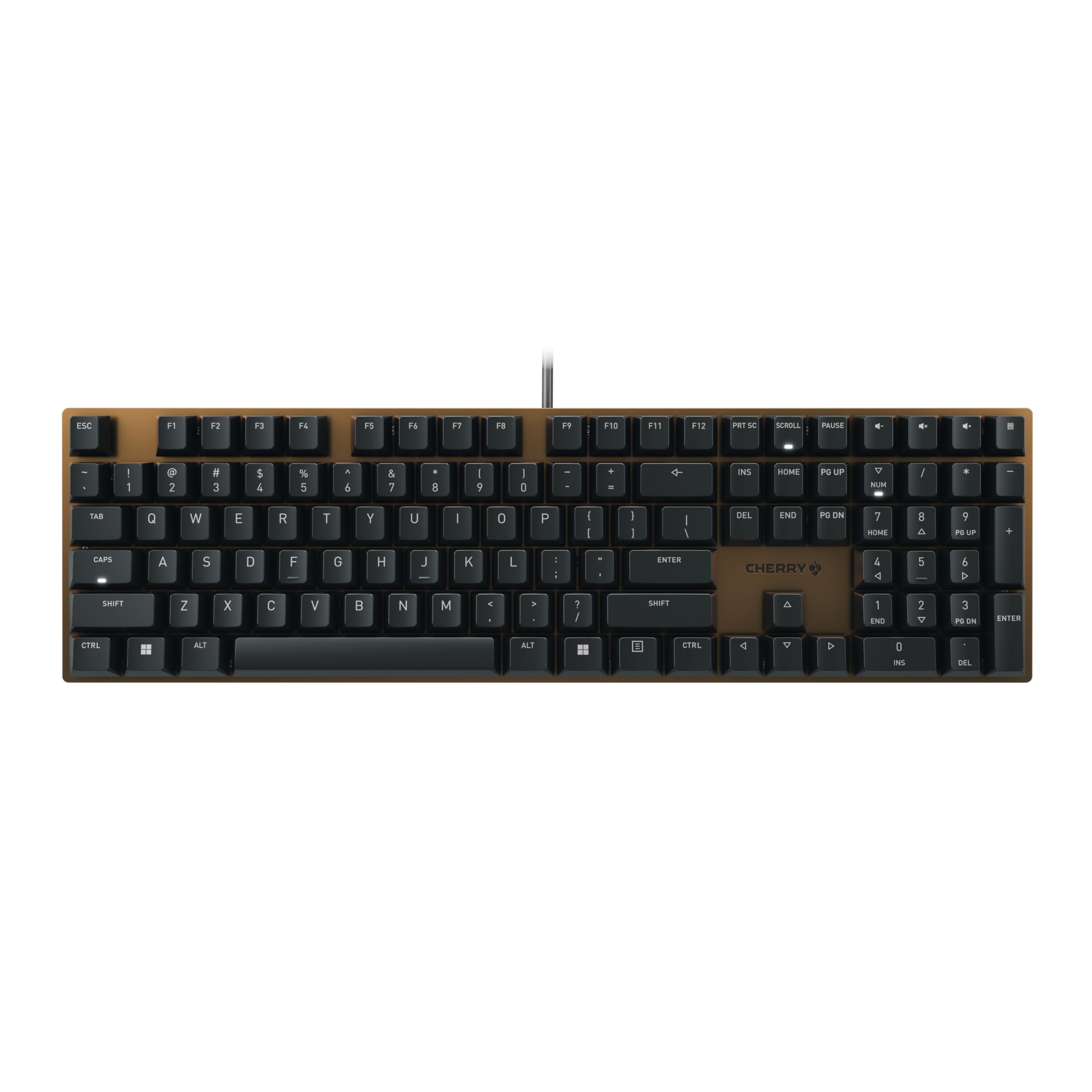
The KC 200 MX brings genuine Cherry MX2A Brown switches underneath a clean, understated anodized aluminum plate that gives the board a professional look suited for an office desk. The improved MX2A stem reduces the scratchiness and ping that older Cherry switches were known for, delivering a smoother tactile bump at the same 55g peak force. The full 104 keys include a number pad, and the laser-etched, abrasion-resistant keycaps keep legends readable for years without fading or wearing off.
Full N-key rollover and anti-ghosting ensure every simultaneous keypress registers correctly, which matters when you hold modifiers while typing complex shortcuts in an IDE. Dedicated calculator and volume control keys on the top row give you quick access without needing to learn a function-layer combo. The two-stage fold-out feet provide three typing angles.
The non-detachable USB-A cable limits cable management flexibility, and the three small rubber feet on the bottom lack enough grip to stop the board from sliding on a glossy desk surface — some users add aftermarket grip pads. The switches are soldered, so any switch change requires desoldering work.
Why it’s great
- Genuine MX2A Brown switches feel smoother and less scratchy than older Cherry variants
- Anodized aluminum top plate gives professional build quality without a gaming aesthetic
- Laser-etched keycaps stay readable through years of heavy use
Good to know
- Non-detachable USB-A cable limits cable routing options
- Small rubber feet don’t prevent sliding on smooth desks
- Soldered switches are not hot-swappable — future switch changes require soldering
FAQ
Can I use a wireless mechanical keyboard for low-latency programming?
What is the advantage of a tenkeyless layout for code writing?
Final Thoughts: The Verdict
For most users, the best coding keyboard winner is the Keychron V6 because it combines QMK/VIA programmability, hot-swap flexibility, and a full-size layout at a price that undercuts nearly every competitor with comparable features. If you want a Hall Effect board with per-key actuation adjustment, grab the Corsair K70 PRO TKL. And for chronic wrist strain relief, nothing beats the Kinesis Advantage2 — the contoured keywells will change how you think about ergonomics for life.

Mo Maruf
I created WellFizz to bridge the gap between vague wellness advice and actionable solutions. My mission is simple: to decode the research and give you practical tools you can actually use.
Beyond the data, I am a passionate traveler. I believe that stepping away from the screen to explore new environments is essential for mental clarity and physical vitality.