Our readers keep the lights on and my smoothie glass nicely filled. As an Amazon Associate, I earn from qualifying purchases.
Walking into a venue where the sound is thin, distorted, or just plain weak kills the mood instantly. Whether you’re managing a nightclub, a house of worship, a corporate event space, or a school auditorium, the audio system you choose becomes the backbone of every single experience that happens within those walls. A well-matched commercial audio system delivers clear vocal intelligibility, solid low-end punch, and enough headroom to fill the room without strain or feedback.
I’m Mohammad Maruf — the founder and writer behind WellFizz. I’ve spent countless hours analyzing amplifier topologies, DSP architecture, driver sensitivity ratings, and real-world SPL data to separate the truly capable commercial audio systems from the marketing hype.
This guide breaks down the top contenders across every tier so you can match the right hardware to your specific venue needs without wasting a dollar. Read on for the definitive best commercial audio system recommendations built from spec sheets, customer feedback, and real deployment scenarios.
How To Choose The Best Commercial Audio System
Selecting a commercial-grade sound system requires looking beyond basic wattage numbers. Factors like coverage angle, DSP flexibility, input count, and physical form factor dictate whether a system will thrive in a specific setting or frustrate you at every gig. Here are the three most critical decision points.
Active vs. Passive: Power and Simplicity
Active (powered) speakers contain built-in amplifiers and DSP, which simplifies cabling and ensures the amp is perfectly matched to the driver. Passive speakers require external amplifiers and crossover management, offering more flexibility for large installations but adding complexity and weight. For most mobile or fixed-install venues, active systems reduce setup time and warranty headaches.
Coverage Pattern and Dispersion
A system’s coverage angle determines how evenly sound spreads across the audience. Column arrays like the Bose L1 Pro or Electro-Voice Evolve series provide wide 120° to 180° horizontal dispersion with tight vertical control, reducing reflections and echoes. Traditional point-source speakers like the QSC K.2 series offer 90° axisymetric coverage, better for smaller rooms where you need precise aiming.
Input Flexibility and DSP Smarts
Commercial environments often juggle microphones, instruments, and backing tracks simultaneously. An integrated mixer with multiple XLR combo jacks, Bluetooth streaming, and onboard effects saves the cost of an external mixing board. Advanced DSP — parametric EQ, limiters, feedback suppression, and crossover control — lets you shape the sound to the room without additional outboard gear.
Quick Comparison
On smaller screens, swipe sideways to see the full table.
| Model | Category | Best For | Key Spec | Amazon |
|---|---|---|---|---|
| JBL PRX ONE | Powered Column Array | Full-range gigs | 20,000W peak / 130dB SPL | Amazon |
| Sony BRAVIA Theater Quad | Wireless 4-Speaker Array | Immersive surround | 16 drivers / 360 Spatial Sound | Amazon |
| Yamaha STAGEPAS 1K MKII | Column PA System | Clean uniform coverage | 125dB SPL / 1000W | Amazon |
| Bose L1 Pro16 | Portable Line Array | Mid-sized clubs | 16x 2″ neodymium drivers | Amazon |
| Electro-Voice Evolve 30M | Column Array System | Wedding and corporate | QuickSmart DSP / BTLE | Amazon |
| PreSonus StudioLive 32SC | Digital Console | Recording and live mix | 32-ch / 286 processors | Amazon |
| QSC K12.2 | Powered 12″ Speaker | Mains and monitors | 2000W Class-D / 12″ | Amazon |
| QSC K10.2 | Powered 10″ Speaker | Compact main PA | 2000W Class-D / 10″ | Amazon |
| Bose L1 Pro8 | Portable Line Array | Coffee shop and cafe | 8x 2″ drivers / RaceTrack woofer | Amazon |
| JBL EON208P | All-in-One PA | Portable karaoke | 300W / 8-ch mixer | Amazon |
| Fender Passport Venue | All-in-One PA | Large events/schools | 600W / 13 inputs | Amazon |
| Mackie 2404VLZ4 | Analog Mixer | Broadcast and stage | 24-ch / 20 Onyx pres | Amazon |
| Crown XLS1502 | Class-D Power Amp | Passive speaker power | 525W @ 4 Ohm / DSP | Amazon |
In‑Depth Reviews
1. JBL Professional PRX ONE

The PRX ONE shatters expectations for a single-box column array. Its 20,000-watt peak Class-D amplifier drives a 12-inch subwoofer and twelve 2.5-inch high-frequency drivers to deliver a staggering 130dB SPL — enough to fill medium-to-large venues without external sub support. The integrated seven-channel digital mixer includes Lexicon and dbx effects plus AFS Pro automatic feedback suppression, giving you studio-grade processing without rack gear.
JBL engineered the array with A.I.M. geometrical shading technology, which optimizes each tweeter’s output for even coverage across the listening area. The 100-hour stress test certification means this system is built to survive the road. The accompanying mobile app provides remote control over faders and DSP, though some Android users have reported connectivity issues after firmware updates.
At 55.65 pounds for the sub and array combined, the PRX ONE is heavier than column competitors, but the included nylon carry bag and ComfortGrip handle make one-person transport feasible. The lack of a dedicated cable pocket is a minor annoyance, and the optional adapter for wall-mounting the array adds cost, but the sonic performance is the clear benchmark in this category.
Why it’s great
- Unrivaled 130dB peak output from a single enclosure
- Professional Lexicon/dbx effects and feedback suppression built in
- Retains all mixer settings after power loss
Good to know
- Mobile app can be unreliable on Android after updates
- No master level display on the mixer panel
- Array is fragile when moved with speaker stands installed
2. Sony BRAVIA Theater Quad HT-A9M2

The Sony BRAVIA Theater Quad redefines home and commercial surround by placing four wireless speakers anywhere in the room. Each speaker houses four drivers, totaling 16 speaker units, and the system uses 360 Spatial Sound Mapping to create phantom speakers that trick your ears into hearing a full 5.2.4 array. The result is a convincing Dolby Atmos bubble without ceiling speakers or messy wires.
Sound Field Optimization auto-calibrates to the room’s acoustics, and support for Dolby Atmos, DTS:X, and IMAX Enhanced ensures compatibility with the latest cinema formats. The system also includes Acoustic Center Sync for compatible BRAVIA TVs, merging the TV’s audio into the center channel for pinpoint dialogue. For bass, owners consistently recommend adding the SW5 subwoofer because the speakers deliver clean highs and midrange but lack low-end extension below 30Hz.
The BRAVIA Connect app handles control, but the system’s software can be finicky — some users report Wi-Fi congestion preventing setup, requiring a wired LAN connection. Once running, the soundstage is magical, but the price sits at the premium end of the spectrum, and HDMI CEC can cause the TV to randomly switch to internal speakers until disabled.
Why it’s great
- No overhead speakers required for convincing Dolby Atmos
- Wireless placement flexibility across any room shape
- Phantom center channel delivers excellent dialogue clarity
Good to know
- Requires a dedicated Sony subwoofer for satisfying bass
- Software setup can fail on crowded Wi-Fi networks
- HDMI CEC may interrupt audio until disabled
3. Yamaha STAGEPAS 1K MKII

Yamaha’s STAGEPAS 1K MKII delivers the highest output in its class at 125dB SPL thanks to a 1000-watt Class-D amplifier driving the column array. The system covers a wide area with uniform sound and blends into the venue visually — an advantage for house-of-worship and corporate spaces where equipment should be seen but not dominate the decor. The integrated digital mixer offers a 4-band EQ, a priority ducker for announcements, and full app control via the STAGEPAS App.
Setup is genuinely simple: unfold the column, plug in the sub, and let the DSP handle room tuning. The dedicated cover protects the system during transport, and the 50.7-pound total weight is manageable for one person. That said, the woofer section is heavier than some competitors, and the system lacks 48V phantom power for condenser microphones — a limitation for spoken-word applications.
Users consistently praise the feedback-free operation and the ability to push the system outdoors at surprising volumes. The included mixer section is intuitive enough for volunteers or non-engineers, making this a top choice for schools and community centers.
Why it’s great
125dB SPL peak output with minimal setup complexity
Good to know
No phantom power for condenser microphones without external mixer
4. Bose L1 Pro16

The L1 Pro16 is Bose’s most powerful portable line array, packing sixteen articulated 2-inch neodymium drivers in a J-shaped array for 180-degree horizontal coverage. The integrated 10-by-18-inch high-excursion RaceTrack woofer matches the bass output of a conventional 15-inch driver while maintaining a smaller footprint. This system is optimized for singer-songwriters, mobile DJs, and small ensembles who need premium clarity and depth from one trip from the vehicle.
The built-in three-channel mixer supports phantom power, Bluetooth streaming, and app control for wireless adjustments. Real-world SPL sits around 123dB, and users report clean, punchy sound that feels authoritative even at low volume levels. The array section packs into a carry bag, while the base with the woofer rolls, making transport smoother than most column systems in this class.
Some users wish the column lock was more robust at the connection point, and the lack of a travel cover for the base is a noted omission. Despite these small concerns, the L1 Pro16 holds its value on the used market and is widely considered the benchmark for mid-sized club sound reinforcement.
Why it’s great
- Exceptionally wide 180-degree coverage
- Bass performance rivals a 15-inch sub in a lighter package
- Easy one-trip transport with included carry bag
Good to know
- Column-to-base connection can feel unsteady
- No travel cover included for the subwoofer base
5. Electro-Voice Evolve 30M

The Evolve 30M combines Electro-Voice’s pro-audio pedigree with a portable column design that matches the top shelf of portability. Its QuickSmart DSP can be fully controlled from the onboard panel or via the QuickSmart Mobile app using Bluetooth Low Energy, letting you walk the room and adjust EQ, delay, and crossover settings from your phone. The 10-inch wooden subwoofer produces surprising low-end authority for a system weighing just 16.6 pounds per component.
The four-input mixer (XLR, 1/4-inch TRS, RCA, 3.5mm) covers standard event gear, and the system includes a backpack carry case for the column array and pole sections. Setup is genuinely fast — pull the column sections from the bag, connect the two-piece pole, and attach the array to the sub. The tower extends over six feet, which may be too tall for low-ceiling rooms, and the short pole option is a separate purchase.
Users rave about the clear, accurate sound reproduction and how easily the system fills small-to-medium venues (up to 200 people) without distortion. The onboard controls require menu scrolling, which can be less immediate than dedicated knobs, but the app compensates with a clean interface.
Why it’s great
- QuickSmart DSP with full mobile app control
- 10-inch wooden sub delivers impressive bass depth
- Lightweight column sections pack into a carry backpack
Good to know
- Tower height exceeds six feet without option to shorten
- Onboard control requires scrolling through menus
- Short pole adapter costs extra
6. PreSonus StudioLive Series III 32SC

The StudioLive 32SC is a rack-mountable digital console designed for installed sound, mobile rigs, and recording. Its dual-core FLEX DSP engine runs 286 simultaneous processors, giving you full recall of every fader, EQ, and effect setting — a lifesaver for touring engineers and multi-venue installs. The 32-channel layout includes 16 FlexMixes that can serve as aux mixes, subgroups, or matrix feeds, plus four dedicated effects buses with legendary reverb and delay emulations.
Built-in AVB networking lets you connect PreSonus NSB stage boxes and EarMix 16M personal monitor mixers over a single Ethernet cable, creating a complete ecosystem without analog snake cables. The 64×64 USB interface is the highest channel count of any mixer in this form factor, and the onboard SD card recorder enables true Virtual Soundcheck — record the show, then play it back for mixing after load-out.
Some users note that the included Studio One Artist DAW lacks video import and notation features, which may require an upgrade to the Pro version for content creators. The rack-mount chassis is solid, and the learning curve is moderate for those familiar with digital consoles, but the comprehensive feature set justifies the investment for permanent installations.
Why it’s great
- Fully recallable 32-channel digital console
- AVB networking eliminates long analog cable runs
- Onboard SD recording for Virtual Soundcheck workflow
Good to know
- Studio One Artist lacks video and notation features
- Registration issues reported with pre-owned units
- Steep learning curve for first-time digital console users
7. QSC K12.2

The QSC K12.2 is the workhorse that sets the benchmark for powered 12-inch speakers in the commercial audio world. Its 2000-watt Class-D amplifier module drives Intrinsic Correction voicing, which tunes the speaker’s response to be flat and natural across the frequency range. The multi-function digital display gives access to factory presets and savable/recallable scenes, so you can switch between main PA and floor monitor configuration in seconds.
The low-noise variable-speed fan ensures the speaker stays cool during long events without adding fan noise to the room. The K12.2 handles rigors of corporate events, club gigs, and mobile DJ work, with users reporting clean output at well under 50% volume for outdoor gatherings. The blue locking power cord clip is a thoughtful touch for live use.
No speaker in this class is perfect for every role — the K12.2 lacks the 15-inch low-end extension of larger boxes, and some users wish the carry handles were better positioned for two-person lifting. Nonetheless, its consistent performance and six-year warranty with registration make it the safest bet for venues that need one box that does it all.
Why it’s great
- Intrinsic Correction for accurate, flat response
- Recallable scenes for mains or monitor duty
- Low-noise variable-speed fan
Good to know
- 12-inch woofer may need sub support for deep bass
- Handle placement is better suited for two-person carry
8. QSC K10.2

The K10.2 brings the same 2000-watt Class-D amplifier and Intrinsic Correction technology as its 12-inch sibling but in a lighter, more compact chassis. The 90-degree axisymetric coverage pattern delivers consistent sound across the listening area, and the speaker doubles as a wedge monitor on stage. Users upgrading from the original K10 report a cleaner mic-quality sound and a slicker cabinet design.
Frequency response spans 56Hz to 20kHz, and the K10.2 handles full-range audio for small venues or serves as a top box paired with a subwoofer for larger rooms. The LCD screen on the back provides clear access to presets, scenes, and DSP settings, though some users prefer the simplicity of analog knobs from older models. The lightweight design (under 30 pounds) makes quick grab-and-go setups practical.
One notable finding from long-term users is that the 2000W peak power rating doesn’t translate to higher perceived loudness compared to the original K10 at moderate volume — the real advantage is cleaner headroom at the edge of the speaker’s limits. The overall build quality and global six-year warranty are strong selling points.
Why it’s great
- Same DSP and amplification as the K12.2 in a lighter package
- Works as both main PA and stage monitor
- 90-degree axisymetric coverage
Good to know
- Perceived loudness similar to original K10 at moderate volumes
- LCD screen can be hard to read in bright light
9. Bose L1 Pro8

The L1 Pro8 is the entry point into Bose’s L1 Pro line, designed for the smallest venues — coffee shops, cafes, and intimate listening rooms. Its eight articulated 2-inch neodymium drivers form a C-shaped array that delivers 180-degree horizontal coverage, while the 7-by-13-inch high-excursion RaceTrack woofer produces bass that competes with a conventional 12-inch sub in a much smaller footprint. The system is lightweight enough to carry in one trip.
The built-in three-channel mixer includes phantom power for condenser microphones and Bluetooth streaming for backing tracks. The companion app gives you wireless access to EQ and tone controls, which is especially useful when you’re performing and can’t reach the back of the speaker. The column array secures with a simple locking mechanism, though some users found it less sturdy than the original L1 model.
The system handles small crowds of up to 75 people with ease, and the sound is consistently described as warm, clear, and balanced. The integrated subwoofer does not require a separate sub for vocals and acoustic instruments. Missing a travel cover for the base is a common complaint, and the column lock could be more confidence-inspiring.
Why it’s great
- Extremely portable — one person, one trip
- 180-degree coverage eliminates dead spots
- Compact sub rivals a 12-inch for low-end presence
Good to know
- Column locking mechanism feels less secure than previous generation
- No travel cover included for the base
10. JBL Professional EON208P

The EON208P is a true all-in-one PA system that packages a pair of 8-inch two-way speakers, a detachable eight-channel mixer, Bluetooth streaming, and an AKG vocal microphone in a suitcase-style carrier. The 300-watt amplifier powers the system to 121dB SPL, more than sufficient for small-to-medium events like corporate meetings, school assemblies, and karaoke nights. The detachable mixer lets you position yourself at the side of the stage while the speakers remain on stands.
The mixer offers four XLR/1/4-inch combo jacks, two stereo 1/4-inch channels, and RCA and 3.5mm inputs, providing flexibility for multiple microphones and line-level sources. Bluetooth support means you can cue songs from your phone without running extra cables. The system includes speaker cables, an XLR mic cable, and the AKG microphone right in the box — truly ready to go out of the box.
For critical listening or larger crowds, the EON208P benefits significantly from adding a powered subwoofer to reinforce the low end, since the 8-inch woofers naturally roll off below about 60Hz. The locking mechanism for the speaker stands can be unreliable over time, but a simple strap solves the issue. Despite these minor trade-offs, the convenience and sound quality are hard to beat for portable events.
Why it’s great
- Everything needed for a gig in one suitcase
- Detachable 8-channel mixer with Bluetooth
- AKG vocal microphone included
Good to know
- 8-inch woofers need a sub for full-range events
- Speaker stand locking mechanism may loosen over time
11. Fender Passport Venue Series 2

Fender’s Passport Venue Series 2 delivers 600 watts of all-in-one power through a pair of 10-inch full-range speakers and a powered mixer that packs into a single molded plastic enclosure. The 13 inputs — including four XLR/1/4-inch combos, two instrument/line jacks, two stereo 1/4-inch pairs, two 1/8-inch stereo inputs, and Bluetooth — give you massive connectivity for band gigs, school events, and worship services. Phantom power is available for condenser microphones.
The system includes a high-impedance instrument circuit for direct guitar input, a sub output with automatic high-pass filter, and a two-year warranty. Sound quality is described as warm and natural, with clean reverb and useful EQ shaping. The briefcase format includes cable compartments and casters for rolling, though at 50-plus pounds the unit is heavy for one person to lift into a vehicle.
At high volumes, the passive speakers can exhibit feedback in challenging rooms, and the plastic chassis scratches easily during transport. Users who need more low-end heft should plan to add a powered subwoofer, but for spoken word, acoustic music, and moderate-volume rock, this system projects clearly and reliably.
Why it’s great
- 13 inputs for maximum device connectivity
- All-in-one design with cable storage compartments
- Warm, natural sound with usable reverb
Good to know
- Heavy chassis can be awkward to lift alone
- Plastic finish scratches easily
- May need a sub for deep bass reproduction
12. Mackie VLZ4 Series 2404VLZ4
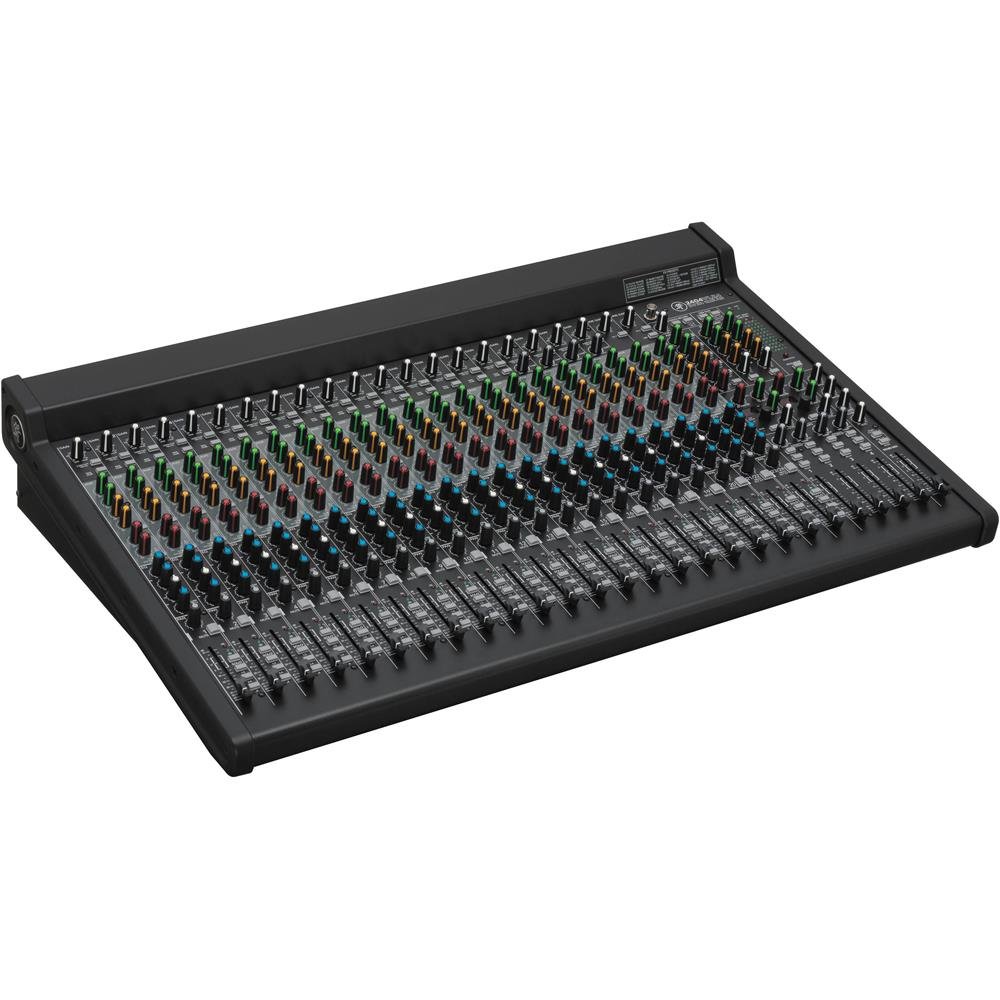
The Mackie 2404VLZ4 is a 24-channel 4-bus analog mixer built around twenty of Mackie’s boutique-quality Onyx mic preamps with an ultra-wide 60dB gain range. The high-headroom design and improved RF rejection make it particularly suitable for broadcast and installed sound applications. Dedicated inline compression on channels 17 through 20 gives you dynamic control over critical inputs without outboard compressors.
The all-metal chassis is roadworthy, and the layout puts every control within reach — three-band EQ with sweepable mid, four aux sends, and four subgroups. The mixer includes balanced XLR outputs and a USB connection for recording. The compact form factor with an external power supply keeps the main unit lightweight for a 24-channel console. The 31-pound weight is manageable for a single person to carry to the gig.
Users praise the clean signal path and the accurate LED metering. Some wish the auxiliary sends had a pre/post switch and that the EQ knobs had more grip for gloved hands. The headphone output is tied to the main mix rather than being independently assignable, a consideration for recording engineers. For analog purists who want a simple, high-quality front end for their passive system, this mixer is a reliable partner.
Why it’s great
- 20 boutique Onyx preamps with 60dB gain range
- Dedicated compression on four channels
- All-metal construction for touring durability
Good to know
- No independent headphone mix
- EQ knobs lack grip and center detent on some channels
- Quick Start Guide instead of full manual
13. Crown XLS1502

The Crown XLS1502 is a two-channel Class-D amplifier that leverages Crown’s ultra-efficient DriveCore technology to deliver 525 watts per channel at 4 ohms in a chassis that weighs under 11 pounds. The integrated DSP provides band-pass filters, Peakx limiters, and a PureBand crossover system, giving you precise control over your passive speaker system without external processing. Bridged mono operation at 4 ohms delivers 1550 watts — enough to drive a large subwoofer.
Selectable input sensitivity (1.4Vrms or 0.775Vrms) allows the amplifier to reach full output regardless of your source’s signal strength. The forced-air fan cooling keeps the amp stable during extended operation, and the auto-sleep mode saves energy when the system is idle. The front-panel secure menu lock prevents tampering in install environments.
Users report that the XLS1502 powers 11.2 surround systems with ease and remains nearly silent on speakers with moderate sensitivity. Some high-sensitivity horn speakers (like Klipsch LaScalas) reveal a slight noise floor hiss, but balanced inputs reduce this significantly. The low-pass filter is effective for subwoofer duty, though users seeking deep infrasonic performance below 30Hz should audition carefully.
Why it’s great
- Extremely lightweight for the power output
- Built-in DSP with crossover, EQ, and limiter
- Bridged mode delivers 1550W for subs
Good to know
- Noise floor may be audible on high-sensitivity speakers
- Low-pass filter struggles below 30Hz
- Menu-based control can be less immediate than knobs
FAQ
What is the difference between active and passive commercial audio systems?
How many watts do I need for a medium-sized venue?
What does the coverage angle mean for my room?
Do I need a subwoofer with a commercial line array?
Can I mix and match speakers from different brands?
Final Thoughts: The Verdict
For most users, the best commercial audio system winner is the JBL Professional PRX ONE because it combines 130dB peak SPL, an integrated 7-channel mixer with professional effects, and column-array portability — the closest thing to a do-everything system for mobile and installed setups. If you want the convenience of a wireless immersive surround experience, the Sony BRAVIA Theater Quad is the clear choice. And for small venues needing compact line-array performance, the Bose L1 Pro8 delivers stunning fidelity in a single-trip package.

Mo Maruf
I created WellFizz to bridge the gap between vague wellness advice and actionable solutions. My mission is simple: to decode the research and give you practical tools you can actually use.
Beyond the data, I am a passionate traveler. I believe that stepping away from the screen to explore new environments is essential for mental clarity and physical vitality.