Our readers keep the lights on and my smoothie glass nicely filled. As an Amazon Associate, I earn from qualifying purchases.
Cutting metal roofing panels with a standard wood blade invites kickback, burrs, and a dangerously overheated tool. The wrong tooth geometry burns through steel, dulls within a few feet of material, and leaves ragged edges that compromise the roof’s seal. A blade purpose-built for metal roofing uses a specialized tooth grind and negative hook angle to shear through steel without grabbing, generating minimal heat and virtually no burrs.
I’m Mohammad Maruf — the founder and writer behind WellFizz. I’ve spent hundreds of hours analyzing tooth configurations, carbide grades, kerf widths, and arbor compatibility across the most popular metal-cutting blades to identify the ones that deliver clean, consistent cuts on standing seam, corrugated, and R-panel roofing.
Whether you’re sheeting a new barn or replacing rusty panels on a shed, the best circular saw blade for metal roofing must balance tooth count, carbide quality, and heat management to rip through thin-gauge steel without chipping or warping the material.
How To Choose The Best Circular Saw Blade For Metal Roofing
Selecting a blade for metal roofing is different from choosing one for wood or non-ferrous metals. Roofing steel is thin — typically 26 to 29 gauge — but it’s also tough and prone to vibration. The right blade glides through with a clean shearing action; the wrong one snags, heats up rapidly, and leaves a dangerous burr that can cut through roofing felt and the installer’s gloves.
Tooth Count And Grind Geometry
For thin steel roofing panels, a blade with 48 to 56 teeth using a Triple-Chip Grind (TCG) is the sweet spot. The TCG tooth alternates between a flat-top raker and a chamfered shear tooth, effectively slicing steel rather than scraping it. This grind produces a clean edge that doesn’t need filing after the cut. Fewer than 40 teeth leaves a rougher finish, while more than 60 teeth increases friction and heat buildup on thin material.
Hook Angle And Safety
A standard wood-cutting blade has a positive hook angle (15 to 22 degrees), which naturally pulls the saw forward aggressively. On metal roofing, that grab can cause kickback if the blade catches a rib or seam. Blades designed for metal use a negative or neutral hook angle (typically -5 to 0 degrees). This design reduces the self-feeding action, giving the operator more control and significantly lowering kickback risk when cutting thin, vibratory sheets.
Carbide Quality And Heat Management
Premium carbide blends, such as TiCo (titanium-cobalt) or micrograin C-1, resist wear from the abrasive zinc coating on galvanized roofing panels. Laser-cut stabilizer vents in the blade body help dissipate heat and reduce vibration, preventing the blade from warping during long runs. A Perma-SHIELD or similar non-stick coating further reduces friction and protects against corrosion from moisture trapped between stacked panels.
Quick Comparison
On smaller screens, swipe sideways to see the full table.
| Model | Category | Best For | Key Spec | Amazon |
|---|---|---|---|---|
| Diablo D0748CF Steel Demon | Premium | Heavy-duty steel and rebar | 48 TCG with Cermet II carbide | Amazon |
| Diablo D0756NA Non-Ferrous | Premium | Aluminum and copper roofing trim | 56 TCG, TiCo carbide, Perma-SHIELD | Amazon |
| Evolution 185BLADEST | Mid-Range | Mild steel flat stock and purlins | 40 teeth, Japanese carbide | Amazon |
| IRWIN 4935555 | Mid-Range | Corrugated roofing and thin steel | 48 teeth, anti-vibration vents | Amazon |
| Oshlun SBNF-072560 | Mid-Range | Aluminum and light non-ferrous panels | 60 TCG, negative hook angle | Amazon |
| TOMAX 60 Tooth TCG | Budget | Thin non-ferrous metals and plastics | 60 TCG, electrophoretic coating | Amazon |
| Evolution RAGEBLADE | Budget | Multi-material including steel and wood | 20 teeth, anti-kickback system | Amazon |
In‑Depth Reviews
1. Diablo Steel Demon Cermet II D0748CF

The Diablo Steel Demon uses Cermet II — a ceramic-infused carbide that holds its edge far longer than standard C-1 or C-2 grades. This blade chewed through 1/4-inch Corten steel plate in customer tests without bogging down the saw, and the metal remained cool enough to touch seconds after the cut. The 48-tooth TCG configuration delivers a smooth, burr-free edge on steel roofing panels and purlins alike.
Laser-cut stabilizer vents trap vibration and keep the blade body from flexing during deep cuts. This is critical when slicing through 3/16-inch angle iron or schedule 40 pipe, where blade wobble leads to rough edges and unnecessary carbide stress. The Perma-SHIELD coating further reduces gumming and corrosion, especially important when cutting through coated or painted roofing material.
Users report cutting dozens of sections of galvanized pipe and heavy steel plate before any noticeable dulling begins. The only trade-off is that this blade is engineered specifically for ferrous metals — using it on aluminum or wood will wear the ceramic matrix prematurely. For metal roofing, this is the blade that sets the standard for longevity.
Why it’s great
- Exceptional edge life thanks to Cermet II composite carbide.
- Laser-cut vents nearly eliminate vibration and heat buildup.
Good to know
- Not designed for non-ferrous metals or wood; restricts use to steel and iron.
- Slightly heavier feel due to thicker carbide tips.
2. Diablo D0756NA Non-Ferrous Blade
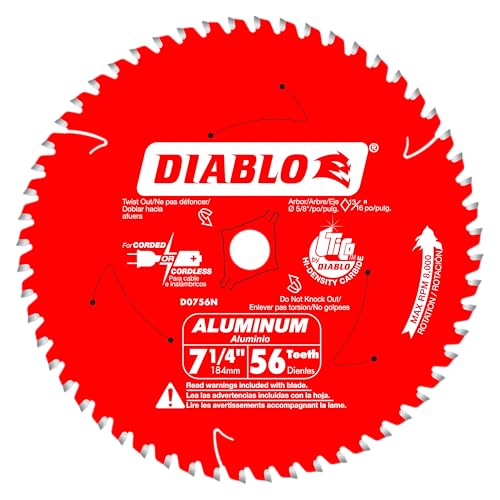
The D0756NA is non-ferrous specialist, making it the best choice for roofing jobs that involve aluminum flashing, copper gutters, or brass trim. Its 56 TCG teeth cut through 1/4-inch aluminum plate with a polished finish that requires no secondary deburring. The TiCo carbide formulation resists the adhesive buildup common when cutting softer metals, so the blade stays clean cut after cut.
Diablo’s Tri-Metal Shock Resistant Brazing bonds the carbide tips to the steel body with a copper layer that absorbs impact. This matters on a roof where you might accidentally hit a hidden screw or nail embedded in the sheathing — the blade absorbs the shock rather than losing teeth. The Perma-SHIELD non-stick coating also prevents the zinc from galvanized flashing from fusing to the carbide faces.
Users mention that this blade outperforms plasma cutters for clean edge quality on thick aluminum extrusions. The laser-cut stabilizer vents keep noise levels lower than most metal blades, which is a welcome relief during a full day of cutting. Stick to non-ferrous materials only — this blade will dull fast if fed steel roofing.
Why it’s great
- Extremely smooth, burr-free cuts on aluminum and copper.
- Tri-Metal brazing prevents tooth loss on impact.
Good to know
- Cannot be used for ferrous steel; limited to non-ferrous applications.
- Premium tier pricing reflects specialized carbide formulation.
3. Evolution 185BLADEST
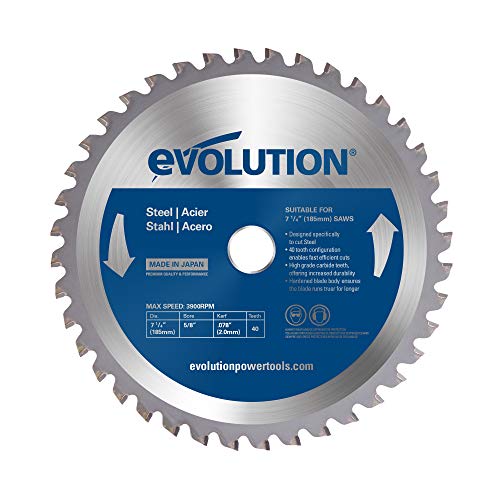
The Evolution 185BLADEST is purpose-built for mild steel cutting, and it shows in the performance. Its 40-tooth configuration with Japanese carbide tips produces almost no sparks and generates remarkably low heat — you can safely touch the cut edge within moments of the pass. This Drycut technology is especially useful on metal roofing, where hot sparks can ignite underlying felt or debris on the ground.
Evolution designed this blade specifically for use in their metal-cutting circular saws, but it works well in any standard 7-1/4-inch circular saw. The thin kerf design (2.4 mm) reduces material waste and places less strain on the saw motor, allowing a mid-range saw to cut through 3/16-inch flat bar or purlin stock without bogging down. Customers report cutting 16 feet of plate steel with a single budget saw before the blade showed significant wear.
The main limitation is that Evolution specifically warns against using this blade on galvanized, hardened, or high-carbon steel — exactly the type of steel used in premium standing seam panels and structural clips. Stick to mild steel purlins, flat stock, and uncoated steel sheet for best results. For pure mild steel roofing support framing, this blade is hard to beat.
Why it’s great
- Drycut design produces almost no sparks or heat on mild steel.
- Thin kerf reduces motor strain and extends saw battery life.
Good to know
- Not intended for galvanized or high-carbon steel panels.
- Best performance achieved in a dedicated metal-cutting saw.
4. IRWIN 4935555 Metal-Cutting Blade
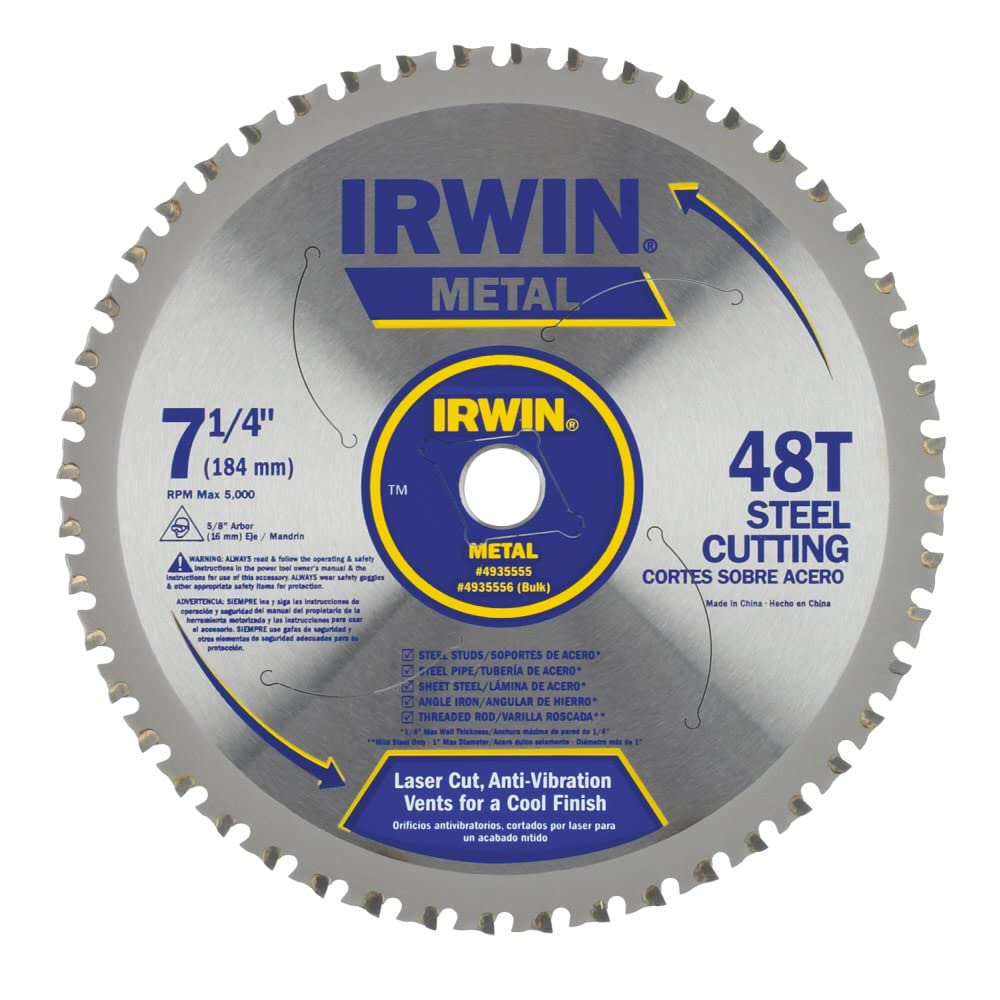
The IRWIN 4935555 is a crowd-pleaser among roofers for its ability to cut corrugated metal panels cleanly — often slicing through multiple stacked sheets at once without straining the saw. Its 48 carbide-tipped teeth use an anti-kickback shoulder design that limits the blade’s grab on thin material, significantly improving safety when working on a sloped roof surface.
Laser-cut anti-vibration vents keep the blade running cool even during extended cutting sessions. Customers report making over 75 straight cuts on max rib panel steel plus 20 angled cuts before the blade began to dull — remarkable for a mid-range tier blade. The IRWIN handles ferrous steel sheets up to about 3/16-inch thickness, making it suitable for both roofing panels and the purlins that support them.
The blade is noticeably loud during operation, and it produces sharp, hot chips that require full personal protective gear. Some users noted that on jobs exceeding 100 cuts, the blade required more saw pressure toward the end. For weekend projects and light commercial work, the IRWIN offers a fantastic balance of cost and cutting ability.
Why it’s great
- Cuts multiple corrugated sheets simultaneously with clean edges.
- Anti-kickback shoulder provides significant safety margin on thin steel.
Good to know
- Loud operation with heavy chip generation; PPE is mandatory.
- Dulls faster on heavy-gauge rebar or thick plate steel.
5. Oshlun SBNF-072560

The Oshlun SBNF-072560 is a non-ferrous specialist with a strong following among aluminum roofing and solid-surface installers. Its 60-tooth TCG grind produces exceptionally clean cuts on aluminum extrusions, brass, and copper without any burr formation. The negative hook angle reduces the blade’s tendency to grab, making it a safe choice for handheld circular saw use on thin-gauge panels.
Professional-grade C-1 carbide tips stay sharp for well over 100 cuts on extruded aluminum fencing and deck railing, according to customer reports. The heat vents in the blade body help it run cooler than many 60-tooth competitors, which is important because higher tooth counts naturally generate more friction. The 5/8-inch DMK arbor fits virtually all standard circular saws without need for adapters.
Some users have also used this blade on light steel roofing with decent results, though the manufacturer rates it specifically for non-ferrous metals. The 60-tooth count means slower feed rates compared to a 48-tooth blade, so you’ll want a saw with enough torque to maintain blade speed. For aluminum panel roofs and copper trim work, this Oshlun delivers professional-grade edge quality.
Why it’s great
- Negative hook angle enhances safety and reduces kickback risk.
- Excellent cut quality on non-ferrous metals without secondary filing.
Good to know
- Requires slower feed rate due to high tooth count.
- Classified as non-ferrous; steel use may accelerate wear.
6. TOMAX 60 Tooth TCG

The TOMAX 60-tooth TCG blade occupies a strong position for budget-conscious buyers who need a reliable non-ferrous cutter. It uses construction-grade carbide tips and an electrophoretic coating to resist rust and corrosion — a practical feature when blades are stored between roofing jobs in damp toolboxes. Users report cutting through 1/2-inch 6061 aluminum like oriented strand board, producing smooth edges that need no cleanup.
The 5/8-inch DMK arbor fits miter saws and circular saws equally well, and the TCG grind delivers the same burr-free performance as higher-priced competitors. The tooth geometry is designed for miter saw use, but it performs admirably in a portable circular saw for cutting aluminum roofing flashing and trim pieces. Some customers reported losing a tooth after heavy use on thick-walled tubing, but the blade delivered dozens of cuts before that failure.
TOMAX backs this blade with a limited lifetime warranty, which is unusual at this tier. For homeowners tackling an aluminum roof replacement or building a metal-framed pergola, this blade offers professional-style results without the professional price tag. Stick to non-ferrous materials to maximize its lifespan.
Why it’s great
- Electrophoretic coating prevents rust during storage.
- Limited lifetime warranty adds peace of mind at this tier.
Good to know
- Some users reported tooth loss after heavy use on thick-walled tubing.
- Classified as a miter saw blade; circular saw use requires care.
7. Evolution RAGEBLADE
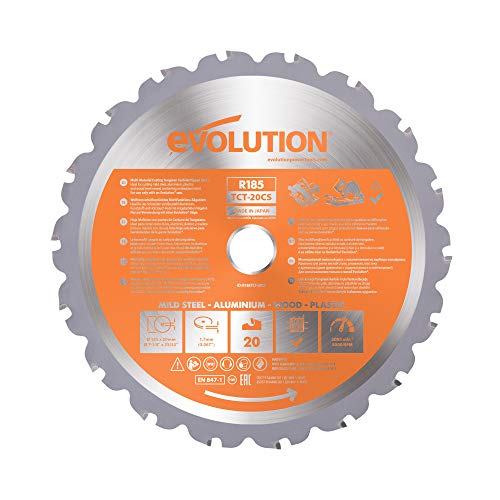
The Evolution RAGEBLADE is the most versatile option in this lineup — it cuts steel, aluminum, wood, and plastics without needing a blade change. With only 20 teeth, it uses a more aggressive feed rate than high-tooth-count blades, making it a fast choice for rough-cutting roof framing or slicing through lumber and metal on mixed demolition projects. The anti-kickback system adds a layer of safety when switching between materials.
Drycut technology keeps the blade running cool and minimizes burrs on steel, though the lower tooth count means the cut surface is noticeably rougher than a 48-tooth TCG blade. It’s ideal for cutting support purlins, steel studs, or aluminum angle where edge finish is less critical than speed. Customers report that the blade lasts through dozens of cuts on 1-inch square steel tube and 3/16-inch flat bar before needing resharpening.
Because the RAGEBLADE is a general-purpose cutting tool, it doesn’t deliver the polished edge quality that roofing finishers expect for visible panel edges. Use it for structural cutting, framing, and demo work, then switch to a higher-tooth-count blade for the final roof surface cuts. The RAGEBLADE shines brightest as a single blade for job-site versatility rather than a dedicated roofing finisher.
Why it’s great
- Cuts steel, aluminum, wood, and plastic without changing blades.
- Anti-kickback system provides safety across different materials.
Good to know
- 20-tooth design leaves a rougher edge than dedicated metal blades.
- Not ideal for final surface cuts on visible roofing panels.
FAQ
Can I use a standard wood-cutting blade on metal roofing?
What tooth count is best for cutting corrugated steel panels?
Why do some metal blades say “not for galvanized steel”?
Does a negative hook blade affect cutting speed?
Can I resharpen metal roofing blades?
Final Thoughts: The Verdict
For most users, the best circular saw blade for metal roofing winner is the Diablo Steel Demon D0748CF because its Cermet II carbide and 48-tooth TCG grind deliver unmatched edge life and cut quality on ferrous steel. If you need a non-ferrous specialist for aluminum or copper roofing trim, grab the Diablo D0756NA for its TiCo carbide and smooth, burr-free finish. And for heavy-duty mild steel purlin and structural cutting at a value price, nothing beats the Evolution 185BLADEST with its Drycut technology and minimal sparking.

Mo Maruf
I created WellFizz to bridge the gap between vague wellness advice and actionable solutions. My mission is simple: to decode the research and give you practical tools you can actually use.
Beyond the data, I am a passionate traveler. I believe that stepping away from the screen to explore new environments is essential for mental clarity and physical vitality.