Our readers keep the lights on and my smoothie glass nicely filled. As an Amazon Associate, I earn from qualifying purchases.
A photo that prints muddy, with colour shifts and banding, is worse than no print at all — it wastes expensive paper and good memories. The gap between what you see on screen and what comes out of the tray comes down to ink architecture, print head precision, and colour gamut, none of which are visible on the box. Matching the right printer to your workflow — whether you print one glossy 4×6 at a time or batch 13×19 gallery sheets — is the only way to close that gap.
I’m Mohammad Maruf — the founder and writer behind WellFizz. For this guide, I analysed ink chemistry, droplet size specs, page yields, and real-world colour accuracy data across nine printers to separate the machines that deliver true photo quality from those that just claim to.
This breakdown covers dye-sublimation units, six-ink consumer models, and eight-pigment pro machines so you can find the best colour printer for photos that matches your volume, size, and budget without guessing.
How To Choose The Best Colour Printer For Photos
Photo printing is a different discipline from document printing. You need wide colour gamut, fine droplet control, and paper-handling that supports borderless sheets. Here are the three decisions that will define your results.
Ink Architecture: Dye vs. Pigment vs. Sublimation
Entry-level colour printers use four dye-based cartridges (CMYK). A six-ink system adds light cyan and light magenta to smooth skin tones and skies — essential for photo realism. Dye-sublimation printers use heat to vaporise solid dyes into the paper, producing continuous-tone, water-resistant prints with zero risk of clogged nozzles. Pigment inks offer the best archival fade resistance but narrower gamuts. For glossy photo paper, dye inks typically produce more vivid colour.
Resolution and Droplet Size
Look for a minimum of 4800 x 2400 dpi for photo work. Droplet size matters more than raw DPI: a 2 picolitre (pl) droplet places less ink on the paper, reducing grain and improving highlight detail. Printers with variable droplet technology can switch between fine dots for smooth gradients and larger dots for solid fills, giving you both speed and quality.
Paper Handling and Print Sizes
If you print mostly 4×6 snapshots, a dedicated photo tray and a printer that supports borderless output at that size are non-negotiable. For fine-art or portfolio work, you need flat-bed feeding for media up to 13×19 inches (A3+). Some models include a rear straight-through path for thick paper or canvas up to 300 gsm — a feature that separates home photo printers from serious creative tools.
Quick Comparison
On smaller screens, swipe sideways to see the full table.
| Model | Category | Best For | Key Spec | Amazon |
|---|---|---|---|---|
| Canon PIXMA PRO-200S | Pro Inkjet | Gallery-quality 13×19 prints | 8 dye-based inks, 2 pl droplets | Amazon |
| Epson Expression Photo XP-980 | 6-Ink Inkjet | Fast 4×6 prints + wide format | 6-color Claria ink, 11 sec 4×6 | Amazon |
| HP Envy Photo 7975 | All-in-One Inkjet | Family photo + document printing | AI-enabled print, separate photo tray | Amazon |
| Liene M200 Battery Edition | Portable Sublimation | Travel and on-the-go 4×6 prints | Rechargeable battery, WiFi hotspot | Amazon |
| iDPRT CP4100 | Desktop Sublimation | Easy home 4×6 printing with app | Dye-sublimation, AR photo scan | Amazon |
| KODAK Dock Plus | Dock Sublimation | Smartphone docking + instant prints | 4PASS lamination, 55 sec per print | Amazon |
| Brother Work Smart 1410 | All-in-One Inkjet | Home office with occasional photos | Auto duplex, 16 ppm black | Amazon |
| Canon PIXMA TS7720 | All-in-One Inkjet | Budget home printing with photos | 15/10 ppm, 2.7″ touchscreen | Amazon |
| HP Color LaserJet Pro 3301fdw | Laser | Office colour documents, not photo | 26 ppm color, TerraJet toner | Amazon |
In‑Depth Reviews
1. Canon PIXMA PRO-200S

The PRO-200S is a dedicated photo printer — no scanner, no fax, no compromise. Its eight dye-based ink cartridges (including photo black, grey, and a dedicated red) deliver a colour gamut that extends beyond sRGB, making reds and skin tones look richer than any four- or six-ink machine can manage. The 2 picolitre droplet system produces virtually grain-free highlights on glossy paper, and borderless printing runs from 3.5×3.5 inches all the way up to 13×19 inches (A3+).
Print speed is respectable for a pro-level unit: a bordered 8×10 takes about 53 seconds, and an A3+ sheet finishes in 90 seconds. The 3.0-inch colour LCD gives you clear ink-level monitoring, but the initial WiFi setup can be finicky if you already have another Canon printer on the same network. Once connected, the wireless connection stays stable.
The trade-off is size and cost of consumables. The PRO-200S weighs 32 pounds and sits deep on a desk — this is not a space-saver. Cartridges hold less ink than some users expect; the black cartridge can run half-empty after roughly 30 full-bleed prints. For serious photographers printing portfolios or gallery pieces, the results justify the spend, but casual users will find the ongoing ink cost heavy.
Why it’s great
- Eight-ink system produces gallery-grade colour and smooth gradients.
- Borderless up to 13×19 opens up fine-art and portfolio printing.
- Very quiet operation and low vibration during long print runs.
Good to know
- Large footprint at 32 pounds — requires dedicated desk space.
- Ink cartridges are expensive and deplete faster than some rivals.
- No support for 11×14 paper size, limiting some framing options.
2. Epson Expression Photo XP-980
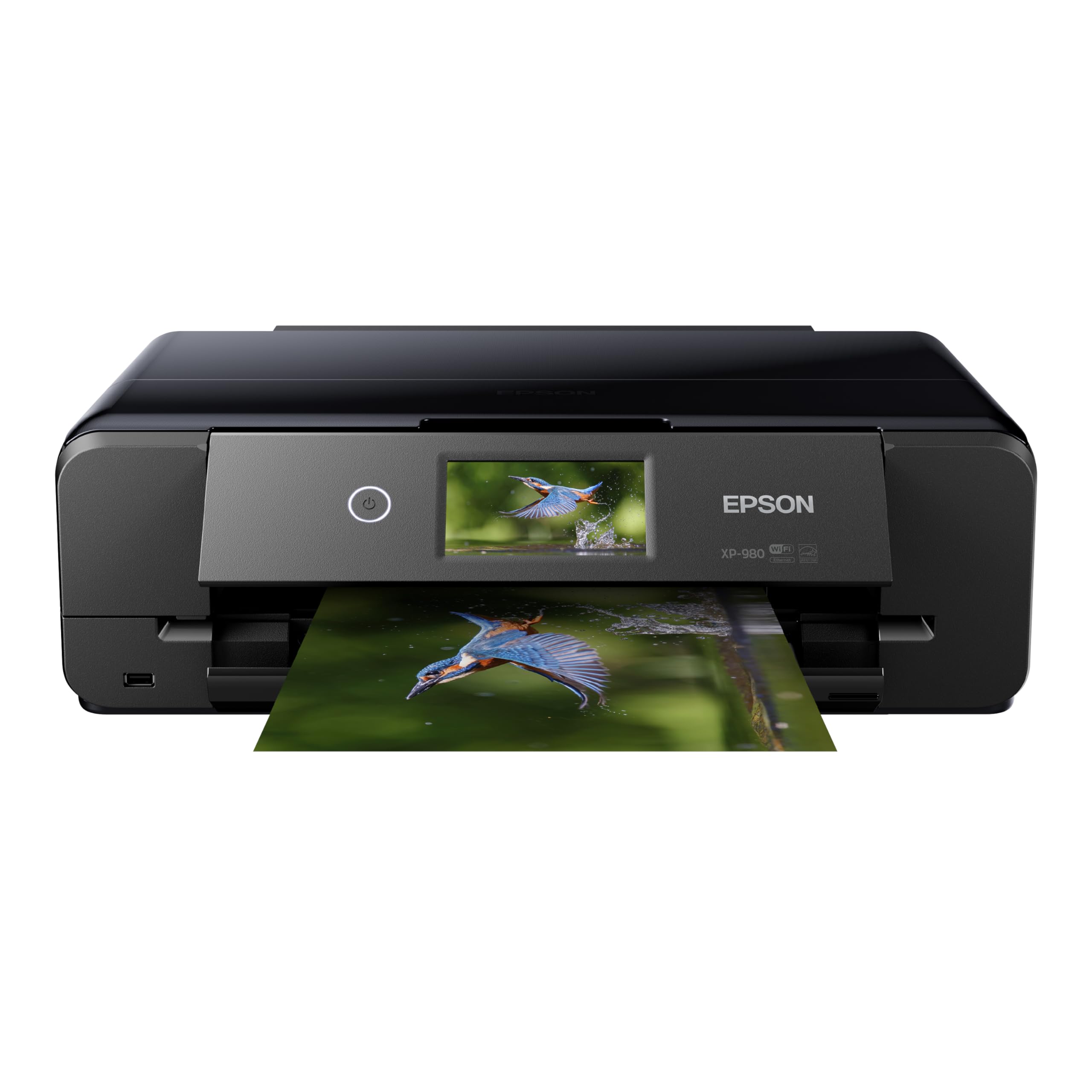
The XP-980 strikes an unusual balance: it packs a 6-color Claria Photo HD ink set (CMYK plus light cyan and light magenta) and a 5760 x 1440 dpi print head into an all-in-one chassis with scanner and copier. That six-ink architecture eliminates the banding and coarse-looking skies that four-ink printers produce, especially on 8×10 and 11×17 glossy prints. The printer delivers a 4×6 borderless photo in as fast as 11 seconds — genuinely fast enough to print party snapshots in real time.
Paper handling is the XP-980’s standout feature. Separate trays for plain paper and photo paper let you switch between document runs and glossy output without reloading. The rear feed accepts thick fine-art media up to 300 gsm, and the 4.3-inch colour touchscreen makes navigation intuitive. The Epson Smart Panel app handles setup and control from your phone, and Wi-Fi Direct allows router-free printing when you’re away from your network.
The main drawbacks centre on reliability quirks. Some users report that the 4×6 label feed creeps crooked, and the 11×17 paper path is rear-only, making it slow for multiple sheets. Ink can dry on the print head after a few days of non-use, forcing a cleaning cycle that consumes roughly a third of each cartridge. For regular printing, this is manageable; for occasional use, the waste adds up quickly.
Why it’s great
- Six-ink system delivers smooth skin tones and wide gamut.
- Fast 11-second 4×6 borderless speed for party printing.
- Separate paper trays for plain and photo media reduce fumbling.
Good to know
- Ink dries on the print head during idle periods, wasting ink on cleaning.
- 11×17 prints require slow single-sheet rear loading.
- Photo tray design is less intuitive than the main paper tray.
3. HP Envy Photo 7975
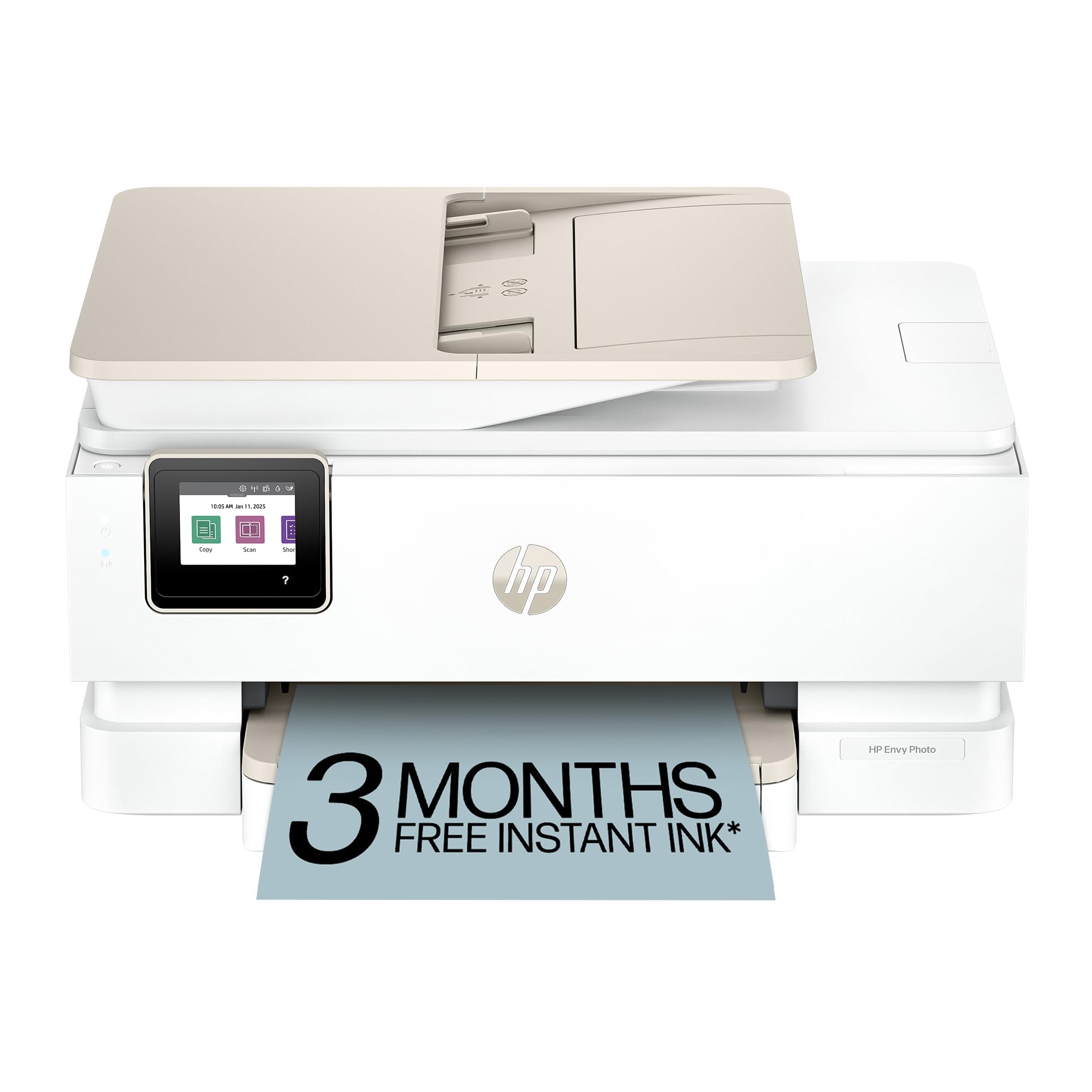
The Envy Photo 7975 is HP’s answer to the household that prints school projects, homework, and 4×6 photos from the same machine. Its AI web-print feature strips out ads and blank pages from web content before printing — a genuinely useful detail for recipe pages and trip itineraries. The separate photo tray keeps glossy paper loaded without swapping it in and out of the main paper feed, so you can print a borderless 4×6 without changing media.
Colour output is bright and saturated for a four-ink printer, though it lacks the subtlety of a six- or eight-ink system. Skin tones look slightly punchy rather than neutral, which many family users prefer for snapshots. Setup through the HP Smart app typically finishes in under ten minutes, and the Wi-Fi connection holds reliably once configured. The 3-month Instant Ink trial is included, which can lower running costs if you print regularly.
The reliability record is mixed. A number of units develop false “out of paper” errors or persistent jams after a few weeks of use, and the “quiet mode” cannot be disabled, which slows print speed. The print head also tends to show faint horizontal banding on large solid areas — a common complaint on four-ink designs. For families printing casual snapshots, the convenience and low entry cost outweigh the occasional quality hiccup.
Why it’s great
- Separate photo tray enables instant switching from documents to glossy prints.
- AI web-print removes ads and saves paper on online content.
- Quick setup and reliable wireless after initial connection.
Good to know
- Four-ink system can’t match six-ink colour subtleties.
- Quiet mode is permanently on, slowing every print job.
- Some units develop paper-feed errors within weeks.
4. Liene M200 Battery Edition

The Liene M200 is a dye-sublimation printer designed for mobility. With a built-in rechargeable battery that handles roughly 40 prints per charge, you can print 4×6 snapshots at a family gathering or on a road trip without hunting for a wall outlet. The internal WiFi hotspot creates a direct connection to your phone in about three seconds, bypassing home network issues entirely.
Print quality from the dye-sub process is consistent: colours are clear, prints are water- and smudge-proof due to the protective overcoat layer, and there is zero risk of ink drying or nozzle clogs. The supplied 20-sheet starter pack and one ink cartridge get you going immediately. The magnetic cassette holder on top is a small but thoughtful design touch that stops the paper tray from cluttering your workspace.
The privacy concern is serious. The Liene app uploads your photos to servers in Beijing, the US, Singapore, and Germany — there is no opt-out. Unlike HP, Canon, or Epson, which process images locally, this system stores your prints indefinitely. If you print sensitive images, this should give you pause. The app also requires you to disable mobile data during connection, and custom-frame editing is not supported — only pre-loaded borders are available.
Why it’s great
- Rechargeable battery allows true portable printing without a power cord.
- Dye-sublimation output is water-resistant and smudge-proof.
- WiFi hotspot connects in seconds without a home network.
Good to know
- App uploads photos to remote servers — a privacy risk.
- No custom frame or border options in the app.
- Must disconnect mobile data to establish WiFi connection.
5. iDPRT CP4100
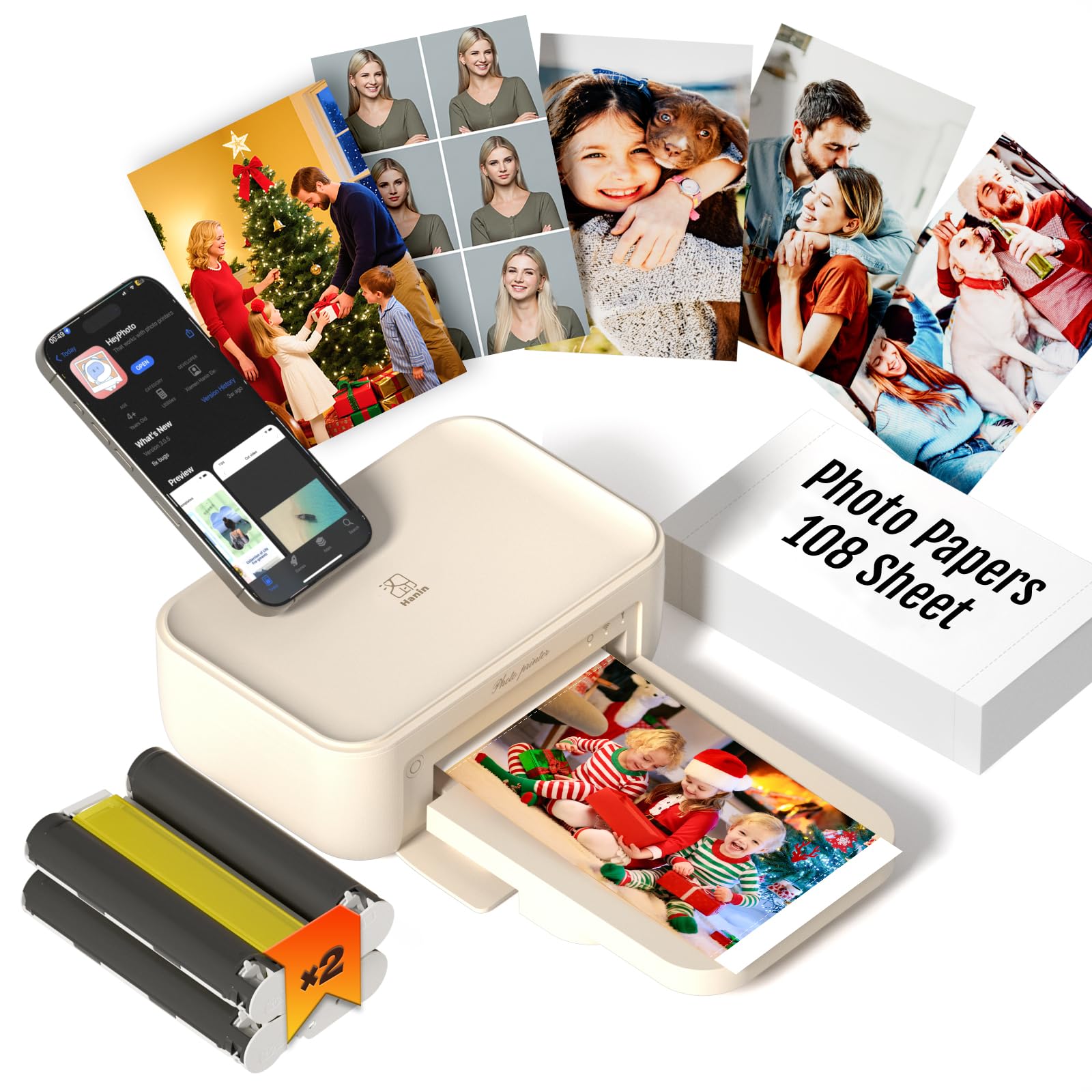
The iDPRT CP4100 brings dye-sublimation printing to a desktop-friendly size at a price point well below most mainstream photo printers. The kit includes 108 sheets of photo paper and two ribbon cartridges, so you can start printing immediately without buying consumables. Each 4×6 print takes about 60 seconds and is laminated with a protective layer that resists fingerprints and fading.
The “HeyPhoto” app offers a full editing suite: filters, text overlays, stickers, and the ability to create ID photos in various sizes. The standout feature is the AR photo scan — after printing, you can scan the physical photo with the app and it plays the original video clip. It works as a gimmick for gifts but adds genuine value for parents printing memories of young children.
The prints come out slightly less vibrant than KODAK’s 4PASS output, with colours that look a touch muted on some sample sets. The 300 DPI resolution is adequate for small framing and scrapbooking but does not match the sharpness of a 4800 dpi inkjet. The included app setup can be fiddly — you need to enable Bluetooth in phone settings first, then connect via the “Hereprint” app over WiFi, which confuses first-time users.
Why it’s great
- Generous starter pack with 108 sheets and two ribbon cartridges.
- AR photo scan feature adds interactive fun to prints.
- Dye-sub output is waterproof and smudge-proof with a durable laminate.
Good to know
- 300 DPI resolution lacks the sharpness of high-end inkjet photo prints.
- App setup process is multi-step and can confuse new users.
- Colour saturation falls short of KODAK and Canon dye-sub models.
6. KODAK Dock Plus
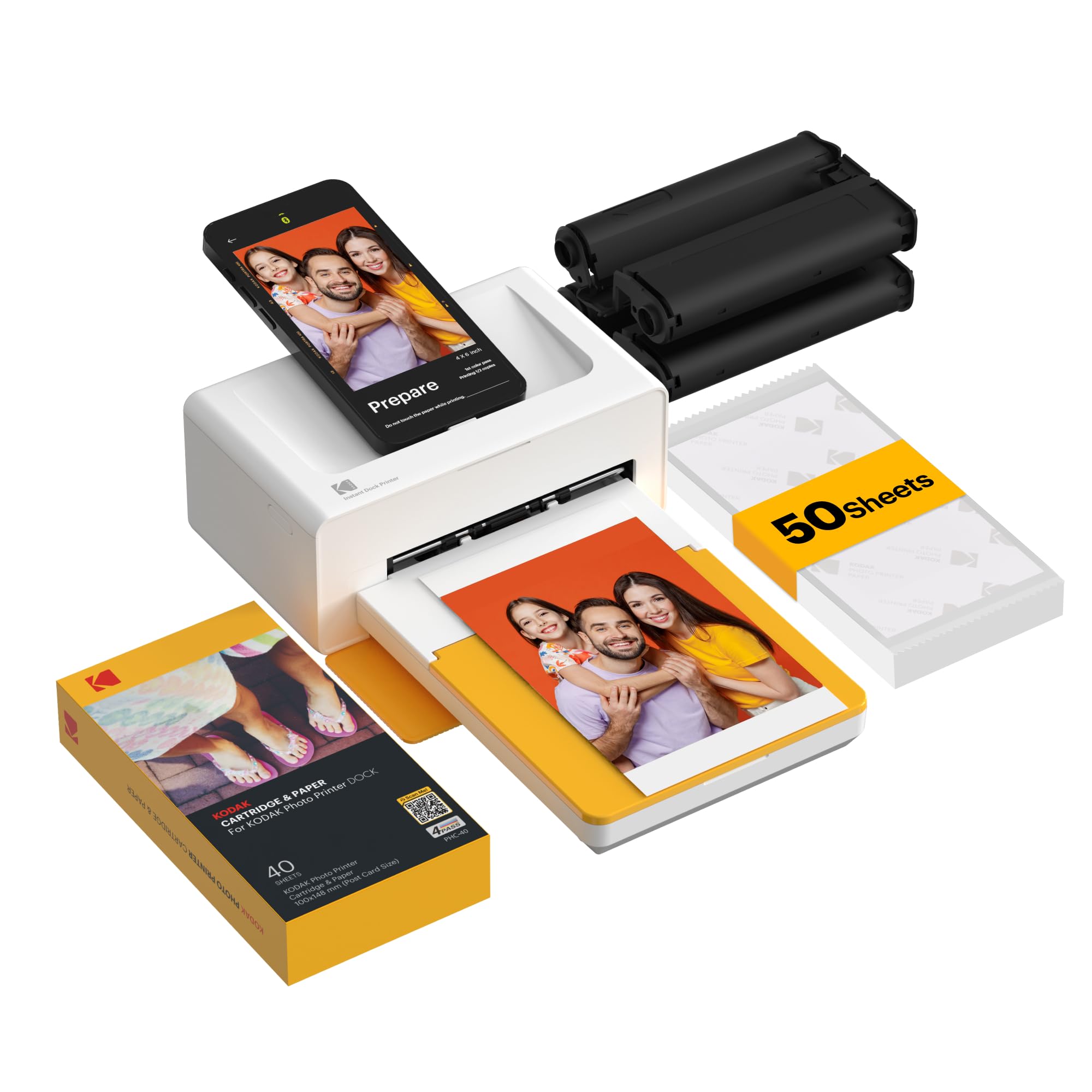
The KODAK Dock Plus is a dedicated 4×6 dye-sublimation printer with an integrated phone dock that charges your device while printing. The 4PASS process applies three colour layers (yellow, magenta, cyan) and a clear protective laminate over about 55 seconds per print. The final image is smooth, water-resistant, and resistant to fading — a clear upgrade over traditional inkjet glossy photos that can smear when wet.
Print quality is consistently vibrant, with saturation that rivals lab prints from Walgreens or Walmart. The KODAK Photo Printer app is straightforward: connect via Bluetooth, select your images, edit, and print. The app stays open during the whole print cycle, and you need to tap after each print to continue — a minor workflow interruption if you’re printing more than five photos at a time.
The instruction manual is small and poorly laid out, making the initial setup frustrating for some users. Paper jams are more common than they should be, and loading one sheet at a time for the 4-pass cycle adds friction. The colour balance can run slightly cool (blue-tinted) on some batches of paper, though most users find the results satisfactory for albums, fridge magnets, and casual sharing. This is not a printer for fine-art or framing work.
Why it’s great
- 4PASS laminates each print with a waterproof, smudge-proof coating.
- Integrated dock charges your phone while printing snapshots.
- Colour output is consistently vibrant and lab-quality for 4×6 prints.
Good to know
- Painful setup due to small, incomplete instruction manual.
- Paper jams occur more often than expected with single-sheet loading.
- Colour balance tends slightly cool (blue) on certain paper batches.
7. Brother Work Smart 1410 (MFC-J1410DW)
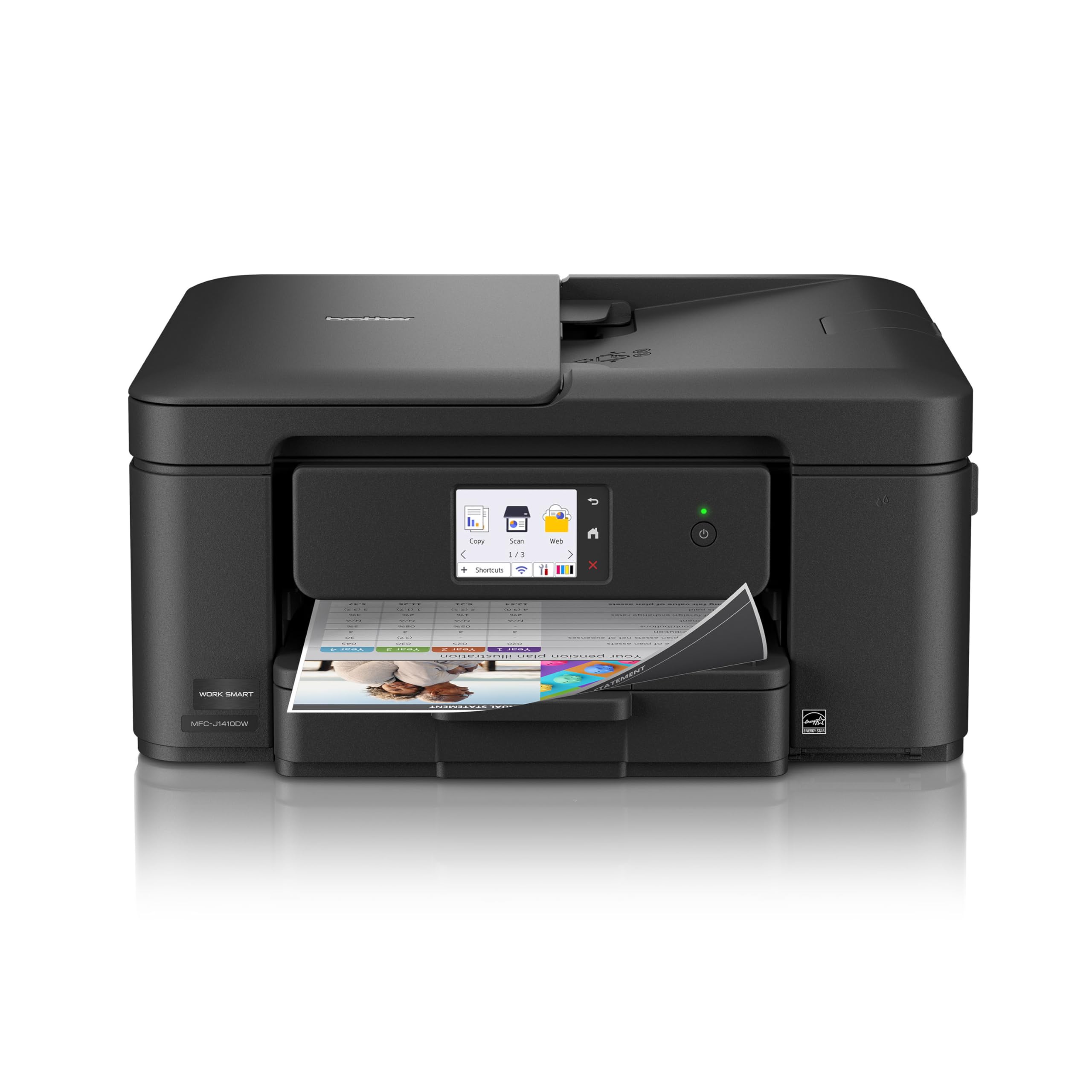
The Brother Work Smart 1410 is an all-in-one colour inkjet designed primarily for home offices that need printing, scanning, copying, and faxing. Its print speed of 16 pages per minute in black and 9 pages per minute in colour is exceptionally fast for an inkjet, and the automatic duplex (two-sided) printing saves paper without slowing down much. The 2.7-inch colour touchscreen gives you direct access to cloud apps like Google Drive and Dropbox.
Photo quality is functional rather than impressive. The four-ink system produces vivid colours on glossy paper, but skin tones lack the subtlety you get from a six-ink system, and gradients in skies and shadows show visible banding. For documents with embedded charts and graphics, the output is crisp. For dedicated photo work, it feels like a compromise.
Setup via USB can be problematic — some users report driver issues that take multiple attempts to resolve. The Brother Mobile Connect app works well once configured, providing on-screen ink monitoring and remote printing. The 150-sheet input tray is small for a busy office, and the LC501 ink cartridges, while cheaper than HP equivalents, still add up if you print high volumes of colour documents. Some early production units have been reported to jam after several weeks of use.
Why it’s great
- Fast print speeds at 16 ppm black and 9 ppm colour for an inkjet.
- Auto duplex and 20-sheet ADF improve productivity.
- Cloud app integration via the 2.7-inch touchscreen is seamless.
Good to know
- Four-ink system cannot deliver true photo-quality colour gradients.
- USB driver setup can be frustrating and time-consuming.
- Some units develop paper jams after a few weeks of use.
8. Canon PIXMA TS7720

The PIXMA TS7720 is Canon’s entry-level wireless all-in-one, targeting households that need occasional colour prints, copies, and scans without a big investment. The 2.7-inch LCD touchscreen makes navigation straightforward, and automatic duplex printing saves paper on school projects. Speeds of 15 pages per minute in black and 10 pages per minute in colour are competitive at this level.
Photo output is best described as adequate. The two-cartridge system (one black, one tri-colour) cannot produce the same depth as models with separate colour tanks. Colours look less vivid than those from Canon’s five-ink PIXMA models, and the trial cartridges included in the box run out quickly — sometimes after fewer than 20 full-page prints. Glossy 4×6 photos look decent from arm’s length but show visible grain on close inspection.
Connectivity can be a pain point. Setup often requires manual router configuration rather than simple push-button WPS, and the printer defaults to a 4-hour auto power-off that must be changed manually if you want it to stay on. Some users report that the printer often shows “printer not available” on the network, requiring a restart. Ink consumption is relatively high, and the tri-colour cartridge forces you to replace all colours if one runs out, wasting the remaining ink.
Why it’s great
- Compact footprint fits easily on a small desk or shelf.
- Intuitive 2.7-inch LCD touchscreen for navigation.
- Good print speeds for a budget inkjet at 15/10 ppm.
Good to know
- Two-cartridge system produces less vivid photos than models with separate colour tanks.
- Network setup can be finicky and often requires manual configuration.
- Auto power-off default disrupts workflow; must be changed manually.
9. HP Color LaserJet Pro MFP 3301fdw
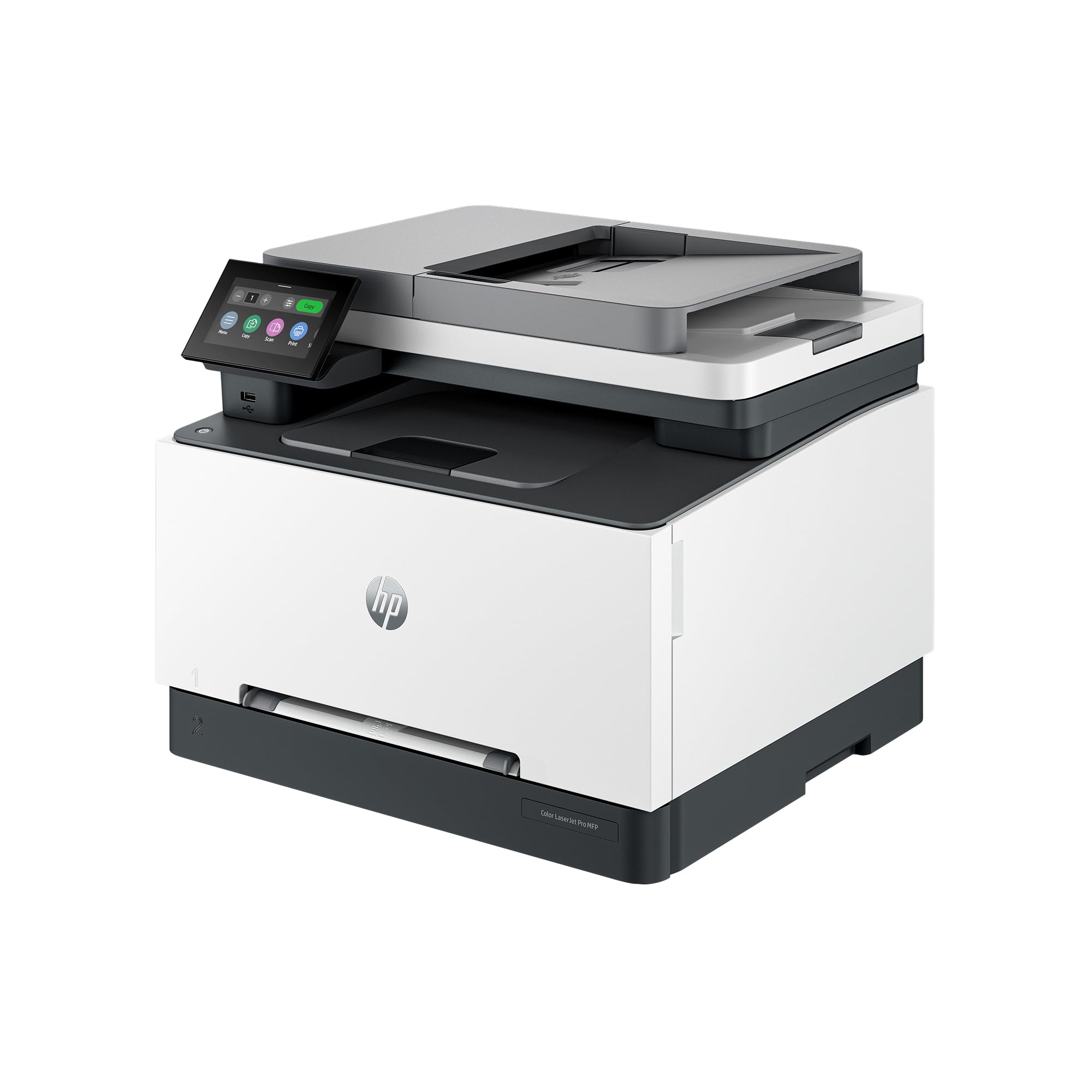
The HP Color LaserJet Pro 3301fdw is a high-speed laser all-in-one built for small offices that produce colour documents, not photo prints. Its TerraJet toner system delivers more vivid colour than previous HP laser generations, making charts, proposals, and marketing materials look punchy. Print speed is 26 pages per minute in both black and colour — roughly double what an inkjet offers — and the automatic duplex scanning ADF handles double-sided originals in one pass.
Photo output is the wrong reason to buy this printer. Laser toner sits on top of the paper rather than being absorbed like ink, which gives glossy photo paper a plastic-like sheen and flattens highlight details. Gradients in skies and skin tones show visible dot patterns (dithering). For occasional photo prints that need to look good in a frame, a sub- inkjet will outperform this laser.
Toner is expensive and the printer actively blocks third-party cartridges via firmware enforcement, locking you into HP’s supply chain. The introductory cartridges run out after roughly 50 pages — far sooner than the standard yield. Some units have suffered from severe colour banding and streaks, and HP support has had difficulty supplying replacement toner for this new model. The MFP 3301fdw is an excellent document printer but a poor choice for photo work.
Why it’s great
- Blazing 26 ppm speed for colour documents and spreadsheets.
- TerraJet toner creates vibrant colour in charts and presentations.
- Auto duplex ADF scans double-sided originals in one pass.
Good to know
- Laser toner produces a plastic-like sheen on glossy photo paper.
- Blocks third-party toner cartridges via firmware enforcement.
- High toner costs and low starter yields increase running expenses.
FAQ
Why do my glossy photo prints look dull compared to the screen?
Is dye-sublimation printing better than inkjet for photo quality?
How many photos can I print before replacing the ink?
Final Thoughts: The Verdict
For most users, the best colour printer for photos winner is the Canon PIXMA PRO-200S because its eight-ink dye system produces gallery-quality colour and smooth gradients on prints up to 13×19 inches — the clear choice for serious photographers and hobbyists. If you want wide-format capability with faster print speeds for party snapshots, grab the Epson Expression Photo XP-980. And for portable, water-resistant 4×6 prints that you can hand around without smudging, nothing beats the Liene M200 — provided you accept its privacy trade-off.

Mo Maruf
I created WellFizz to bridge the gap between vague wellness advice and actionable solutions. My mission is simple: to decode the research and give you practical tools you can actually use.
Beyond the data, I am a passionate traveler. I believe that stepping away from the screen to explore new environments is essential for mental clarity and physical vitality.