Our readers keep the lights on and my smoothie glass nicely filled. As an Amazon Associate, I earn from qualifying purchases.
Carbon monoxide is a silent, odorless, and invisible threat that makes a detector’s sensor accuracy your home’s only line of defense. Whether you’re replacing an aging unit or installing the first alarm in a new home, the difference between a basic chirp and a digital readout showing actual PPM levels can determine how quickly you respond to a real leak. The market now offers options that combine electrochemical sensors with ten-year sealed batteries, dual smoke and CO detection, and even smartphone integration for remote alerts.
I’m Mohammad Maruf — the founder and writer behind WellFizz. I’ve spent hundreds of hours researching home safety hardware, comparing sensor response curves, battery chemistries, and real-world reliability data so you can choose a CO detector that will actually protect your family.
Whether you need a plug-in unit with a backup battery or a hardwired system with smart home connectivity, this guide covers the best co detectors on the market today and breaks down exactly what each one does differently.
How To Choose The Best CO Detectors
Selecting a carbon monoxide detector isn’t as simple as grabbing the first white disc you see. Sensor type is the most critical factor — all modern CO detectors use electrochemical sensors, which measure CO concentrations in parts per million (PPM) and trigger alarms at specific thresholds. Avoid detectors with older technologies like metal oxide semiconductors, which can produce false alarms and degrade faster.
Sensor Accuracy and Certification
Look for UL 2034 certification, which ensures the detector meets the safety standard for response times and alarm patterns. A certified unit must alarm at 70 PPM within 60 to 240 minutes, at 150 PPM within 10 to 50 minutes, and at 400 PPM within 4 to 15 minutes. Any detector without this certification should not be trusted in your home.
Power Source and Battery Life
Hardwired units with a sealed 10-year lithium battery provide the most reliable protection because the battery lasts the entire lifespan of the detector, eliminating the need for annual battery swaps. Plug-in models with a 9V battery backup are a good alternative for homes where hardwiring isn’t practical, but you must remember to replace that backup battery every year.
Digital Display and Smart Features
A digital display that shows real-time PPM levels lets you identify dangerous CO buildup before it reaches alarm threshold. Peak Level Memory records the highest CO concentration since the last reset, giving paramedics or technicians valuable data. Smart detectors send push alerts to your phone, which is useful for monitoring vacation homes or detached garages.
Quick Comparison
On smaller screens, swipe sideways to see the full table.
| Model | Category | Best For | Key Spec | Amazon |
|---|---|---|---|---|
| Kidde KN-COEG-3 | Premium | Homes with gas appliances | Digital display + explosive gas detection | Amazon |
| Kidde KN-COPP-3 2-Pack | Premium | Whole-house plug-in coverage | Digital display, 85 dB alarm, 2-pack | Amazon |
| SimpliSafe CO Detector | Premium | Smart home security system users | Remote alerts + professional monitoring | Amazon |
| First Alert SMCO100 | Mid-Range | Dual smoke and CO protection | Precision Detection, battery-operated | Amazon |
| X-Sense XP0H-SN | Mid-Range | Combo unit with digital LCD | 10-year sealed battery, UL certified | Amazon |
| SITERWELL A4602A-7 | Value | Travel or portable use | 85 dB alarm, 10-year battery, 2-pack | Amazon |
| First Alert SMI105-AC | Value | Hardwired interconnect system | 10-year battery backup, interconnect | Amazon |
In‑Depth Reviews
1. Kidde KN-COEG-3

The Kidde KN-COEG-3 stands out because it detects both carbon monoxide and explosive gases like natural gas and propane. This dual-sensor approach is invaluable for homes with gas stoves, furnaces, or water heaters — you get one unit that covers two major safety threats instead of installing separate detectors for each gas type. The 85-decibel alarm is loud enough to wake deep sleepers, and the digital LED display cycles between showing the current CO level and indicating “GAS” when explosive gas is present.
Peak Level Memory records the highest CO concentration detected since the last power cycle, which can help technicians diagnose intermittent leaks. The plug-in design with a 9V battery backup keeps it operational during power outages, and the 3rd Edition has improved sensor stability that reduces false alarms from household chemicals. Users consistently report reliable performance with propane heaters and gas fireplaces over multiple heating seasons.
The only tradeoff is that it requires a standard wall outlet, which may limit placement options in rooms where outlets are behind furniture. Some users note the unit extends 2.5 inches from the wall, so it won’t fit behind a couch or dresser. For homes with gas appliances, this is the most comprehensive single detector you can install.
Why it’s great
- Detects both CO and explosive natural gas/propane in one unit
- Digital LED display shows real-time PPM and gas detection status
- Peak Level Memory records maximum CO exposure since reset
Good to know
- Requires a wall outlet, limiting placement flexibility
- No Wi-Fi or smart home connectivity for remote alerts
2. Kidde KN-COPP-3 2-Pack

Getting two detectors in one box makes the KN-COPP-3 2-Pack the most convenient way to cover multiple floors without placing separate orders. Each unit plugs into a standard 120V outlet and includes a 9-volt battery backup, so you maintain protection even during extended power outages. The digital LED display shows real-time CO concentration in PPM, and the 85-decibel alarm meets UL 2034 standards for response timing.
Peak Level Memory records the last time CO was detected or the unit was tested, providing useful data for leak investigations. The simple form factor — 6 inches tall and 3.75 inches wide — fits unobtrusively in most rooms. Customer reviews highlight severe incidents where these detectors alerted families to dangerous CO levels (one review reported 463 PPM upstairs), proving the sensor is accurate enough to save lives at critical moments.
The main drawback is that the alarm pattern chirps if the 9V backup battery is missing, even when the unit is plugged into AC power. Some users also report that Kidde’s customer support can be slow to respond to technical questions. For a straightforward, reliable CO detector that works right out of the box, the 2-pack is tough to beat in terms of value.
Why it’s great
- Two detectors in one package for whole-floor coverage
- Digital display with Peak Level Memory for CO history
- Battery backup ensures protection during power outages
Good to know
- Alarms persistently if 9V backup battery is not installed
- No explosive gas detection like the KN-COEG-3 model
3. SimpliSafe Smoke & Carbon Monoxide Detector

The SimpliSafe detector is designed exclusively for the Gen 3 SimpliSafe security system, making it the right choice if you already own or plan to install that ecosystem. It combines smoke and CO detection in a single battery-powered unit that communicates wirelessly with the base station. The key advantage is professional monitoring: when the alarm triggers, SimpliSafe’s monitoring center receives the alert and can dispatch emergency services even if you’re away from home.
The detector uses advanced algorithms to distinguish between dangerous smoke and steam from cooking, which reduces nuisance alarms. A built-in internal siren sounds locally, and the base station also triggers its own siren for maximum audibility. The battery-powered design means no hardwiring is required — just screw the mounting bracket to the ceiling and snap the unit into place. Remote notifications through the SimpliSafe app let you check on your home from anywhere.
The obvious limitation is that it only works within the SimpliSafe Gen 3 system, so it’s not a standalone detector. If you cancel your monitoring subscription, you lose the professional dispatch feature. Some users report occasional false alarms from cooking, though the system’s proactive follow-up calls help confirm false alarms quickly. For SimpliSafe homeowners, this is the most integrated safety solution available.
Why it’s great
- Professional monitoring triggers automatic emergency dispatch
- Remote alerts sent to phone even when you are not home
- Battery powered with no wiring needed for installation
Good to know
- Requires SimpliSafe Gen 3 security system to function
- Monitoring subscription needed for professional dispatch feature
4. First Alert SMCO100

The First Alert SMCO100 brings the brand’s Precision Detection technology to a battery-operated combination alarm, making it a strong contender for anyone who wants dual smoke and CO protection without running new wiring. Precision Detection uses advanced sensing algorithms to distinguish between real fire emergencies and cooking steam, which is the most common source of nuisance alarms. The battery operation means you can mount it anywhere — walls, ceilings, or hallways — without worrying about outlet proximity.
The unit is powered by included AA batteries, so no hardwiring is needed. The test/silence button lets you verify the alarm is working properly, and the end-of-life warning chirps remind you when the entire unit needs replacement after approximately ten years. Users consistently note how easy installation is — just screw the bracket to the wall or ceiling, snap in the batteries, and twist the detector into place.
The downside is that this alarm lacks a digital display, so you cannot see real-time PPM levels. It also does not support wireless interconnection, meaning if one alarm goes off, the others in the house stay silent unless they are directly triggered. For those who prioritize simplicity and dual detection over networked features, the SMCO100 offers reliable protection at an accessible price point.
Why it’s great
- Combines smoke and CO detection in a single battery-powered unit
- Precision Detection technology reduces nuisance alarms from cooking
- Easy battery-operated installation with no hardwiring required
Good to know
- No digital display showing real-time CO concentration
- Does not support wireless interconnect between multiple units
5. X-Sense XP0H-SN
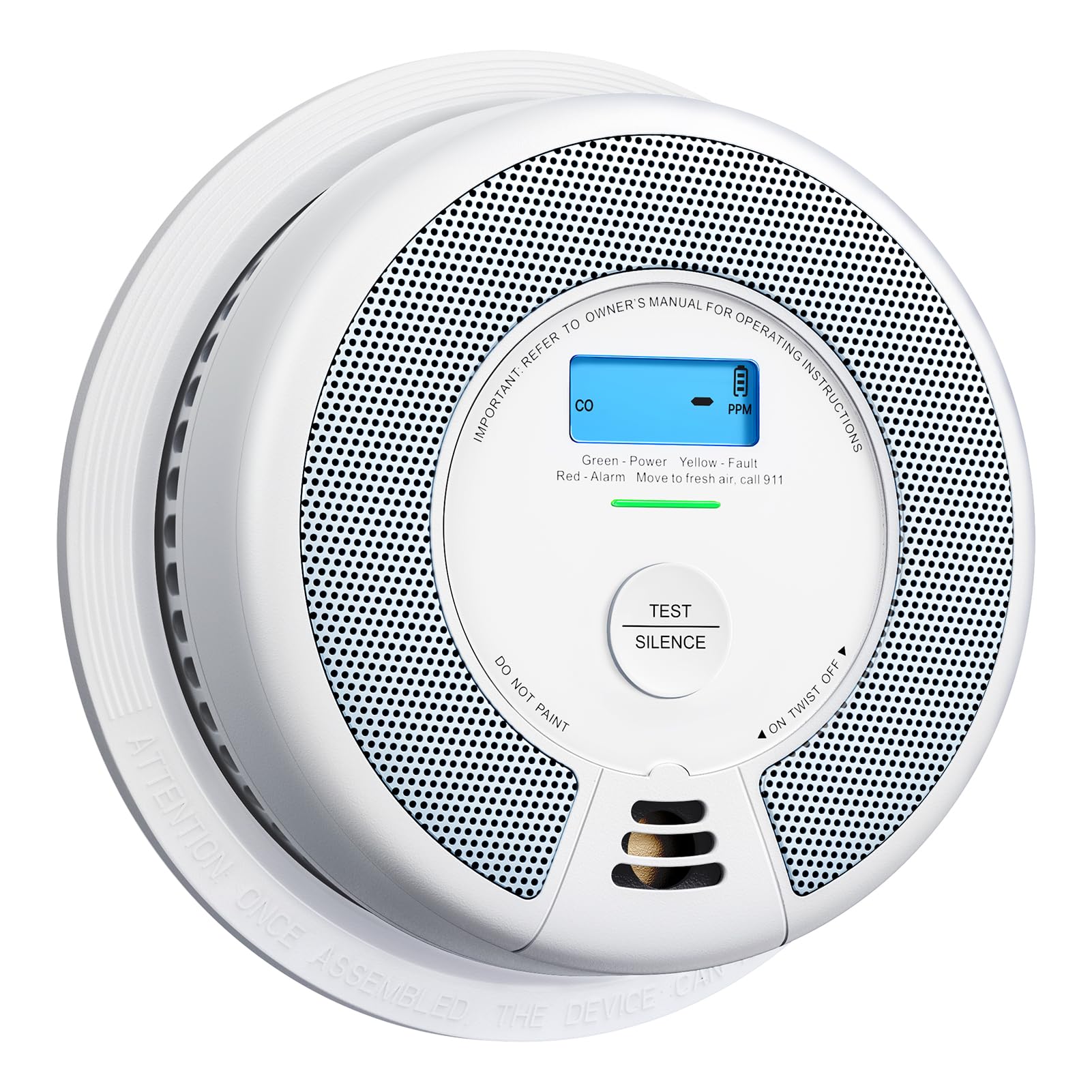
The X-Sense XP0H-SN combines photoelectric smoke and electrochemical CO sensors in a compact battery-powered enclosure with a clear LCD screen. The LCD shows real-time CO levels and remaining battery life, but stays off during standby to avoid light pollution in bedrooms. The large 5.7-inch mounting bracket hides old screw holes and ceiling stains from previous alarms, making replacement installations look clean without patching or painting.
The sealed lithium battery lasts the full ten-year lifespan of the device, so you never need to replace a battery mid-cycle. Built-in self-test runs every 60 seconds to check sensor electronics and battery integrity, and the unit meets both UL 217 (smoke) and UL 2034 (CO) certifications. Users consistently praise the clean appearance and simple installation, with many purchasing multiple units to replace older hardwired systems that had become unreliable.
This is a standalone unit — it does not support wireless interconnection or Wi-Fi connectivity, so it cannot alert other alarms or your phone. For those who want a straightforward, certified combo detector with a useful display and zero battery maintenance, the XP0H-SN delivers where it counts most: accurate sensing and long-term reliability.
Why it’s great
- LCD screen shows real-time CO levels and battery status
- 10-year sealed battery eliminates annual battery replacements
- Large mounting bracket covers old screw holes for clean installation
Good to know
- No wireless interconnect or Wi-Fi connectivity for remote alerts
- Basic standalone unit without smart home integration
6. SITERWELL A4602A-7 2-Pack

The SITERWELL A4602A-7 is a compact, battery-powered CO detector designed for both stationary home use and portability. Its small footprint — 4.72 x 2.76 x 1.65 inches — makes it easy to pack in a suitcase, backpack, or handbag for hotel stays or RVs where built-in detectors may be old or absent. The advanced electrochemical sensor accurately detects CO from gas appliances, fireplaces, clogged chimneys, and running vehicles, triggering an 85-decibel alarm when dangerous levels are present.
A breathing light indicator uses green for normal operation, yellow for fault, and red for alarm, providing at-a-glance status without needing to press a button. The one-touch silence function lets you mute nuisance alarms quickly, and the unit comes with a CR123A battery that lasts the full ten-year lifespan. Users appreciate the simplicity of having two detectors in one pack for coverage across multiple rooms or for one in the home and one in a travel bag.
The lack of a digital display means you get no numerical PPM readout, and the unit does not support any interconnection or smart features. Placement is also fully limited to wherever you can set or hang it, since there’s no wall outlet required. For a low-maintenance, dual-pack solution that prioritizes portability and straightforward operation, the SITERWELL covers the basics effectively.
Why it’s great
- Compact and portable design fits in luggage for travel safety
- Two detectors included for multi-room or travel coverage
- Ten-year sealed battery with breathing light status indicators
Good to know
- No digital display showing real-time CO concentration
- No wireless interconnect or smart home compatibility
7. First Alert SMI105-AC

The First Alert SMI105-AC is a hardwired smoke alarm that features a 10-year sealed battery backup, ensuring continuous protection even during prolonged power outages. While it does not detect carbon monoxide, it is a critical component of a layered home safety system when paired with a dedicated CO detector elsewhere. The Precision Detection advanced sensing technology meets new industry standards for reducing cooking nuisance alarms while providing early warning of actual fire emergencies.
Through early warning interconnect capability, when one SMI105-AC initiates an alarm, all compatible units in the home sound simultaneously, giving everyone more time to evacuate. The alarm indicator visually identifies which unit triggered the alarm, helping you locate the source of a fire without climbing to every ceiling. The end-of-life warning lets you know when it is time to replace the entire unit after roughly a decade of service.
Users report that installation is straightforward when replacing existing hardwired alarms, though some units do not include mounting screws. The interconnect feature requires compatible First Alert or BRK alarms with the same wiring standard. For homes that already have dedicated CO detectors and want a reliable interconnected smoke alarm network with long battery backup, this is a solid, no-fuss choice.
Why it’s great
- 10-year sealed battery backup for uninterrupted power outage protection
- Interconnect capability triggers all alarms simultaneously
- Precision Detection reduces nuisance alarms from cooking steam
Good to know
- Smoke-only detector — does not detect carbon monoxide
- Mounting screws not included in the package
FAQ
How often should I test my carbon monoxide detector?
At what PPM level does a certified CO detector alarm?
Can I use a plug-in CO detector if I have no outlet near my bedroom?
Why does my CO detector chirp even after replacing the battery?
Final Thoughts: The Verdict
For most users, the best co detectors winner is the Kidde KN-COEG-3 because it combines carbon monoxide detection with explosive gas sensing in one plug-in unit, giving you the broadest protection for homes with natural gas or propane appliances. If you want a dual-pack for whole-house coverage with digital display and battery backup, grab the Kidde KN-COPP-3 2-Pack. And for smart home users who want professional monitoring and remote alerts, nothing beats the SimpliSafe Smoke & Carbon Monoxide Detector for its seamless integration with the Gen 3 security system.

Mo Maruf
I created WellFizz to bridge the gap between vague wellness advice and actionable solutions. My mission is simple: to decode the research and give you practical tools you can actually use.
Beyond the data, I am a passionate traveler. I believe that stepping away from the screen to explore new environments is essential for mental clarity and physical vitality.