Our readers keep the lights on and my smoothie glass nicely filled. As an Amazon Associate, I earn from qualifying purchases.
You watch your indoor garden struggle or your photos come out muddy, and you can’t tell if the light’s the problem. Without a measurement, you’re just guessing. A dedicated meter cuts the mystery: it reads the actual foot-candles or lux hitting your surface, so you can place your lights exactly where they need to be. Skip the phone apps; they don’t capture the full spectrum or angle.
I’m Mohammad Maruf — the founder and writer behind WellFizz. My approach to this guide involved cross-referencing hundreds of customer ratings, comparing sensor ranges and rotation angles, and filtering out any meter with inconsistent readings across verified buyer tests.
Each option below offers a clear LCD readout and a rotatable sensor for under fifty dollars. Here is the shortlist of the best cheap light meter models you can buy right now without burning your budget.
How To Choose The Best Cheap Light Meter
Most entry-level meters look similar, but three factors separate a useful tool from a frustrating one. Focus on the measurement range, the sensor design, and the data-recording capability.
Measurement Range and Units
Look for a meter that covers at least 0 to 200,000 lux if you plan to measure both dim corners and powerful grow lights. Units matter: lux is standard for most indoor work, while foot-candles (FC) remain common in photography and some engineering specs. A meter that switches between both gives you flexibility.
Rotatable vs Fixed Sensor
A fixed sensor forces you to turn the entire device toward the light source, which often blocks the display. A rotatable sensor — typically 270° — lets you point the detector exactly where you need it while keeping the screen angled toward your eyes. This feature alone makes readings faster and less awkward.
Data Hold and Memory
Budget meters often include a data-hold button that freezes the current reading on screen, handy when you are measuring an overhead fixture. Some models store multiple reading sets, which helps if you are comparing light levels across several spots in a grow tent or office.
Quick Comparison
On smaller screens, swipe sideways to see the full table.
| Model | Category | Best For | Key Spec | Amazon |
|---|---|---|---|---|
| DANOPLUS DP-331 | Mid-Range | Home and office use | 360° rotating sensor | Amazon |
| AIOMEST AI-881E | Mid-Range | Plant growth monitoring | 0.1 to 300,000 lux range | Amazon |
| Dr.meter 1332B | Premium | Grow tents and studios | Tripod mountable base | Amazon |
| BTMETER BT-881D | Premium | Wide illumination work | 0.01 to 400,000 lux | Amazon |
| BTMETER BT-881E | Budget | Everyday quick checks | 33 reading memory logs | Amazon |
In‑Depth Reviews
1. DANOPLUS DP-331

The DANOPLUS DP-331 stands out with a rotating sensor that spins a full 360°, a feature uncommon at this spending level. The sensor is tethered by a short cord, so you can place it behind a fixture or inside a tight shelf while you watch the readout from a comfortable angle. Its four auto-range settings cover up to 200,000 lux, which is enough for most household and plant tasks.
Accuracy sits at +/-4% with a spectral range of 400 to 700 nm, matching the photosynthetically active range that plants use. The 4-digit LCD is clear and shows both lux and foot-candle values. Buyers consistently note it removes the guesswork from grow-light positioning, and several reviewers mention how useful the data-hold and MIN/MAX functions are for comparing different spots in a room.
This meter runs on two AAA batteries that come included, and the overall weight of 5.3 ounces makes it easy to carry from room to room. The build feels solid for the price, though the plastic housing is lightweight.
Why it’s great
- 360-degree detachable sensor reaches tight spots
- Auto-range simplifies one-hand operation
- Includes MIN/MAX, data hold, and low-battery indicator
Good to know
- No memory storage for multiple readings
- Upper range of 200,000 lux may be low for very strong HPS lights
2. AIOMEST AI-881E
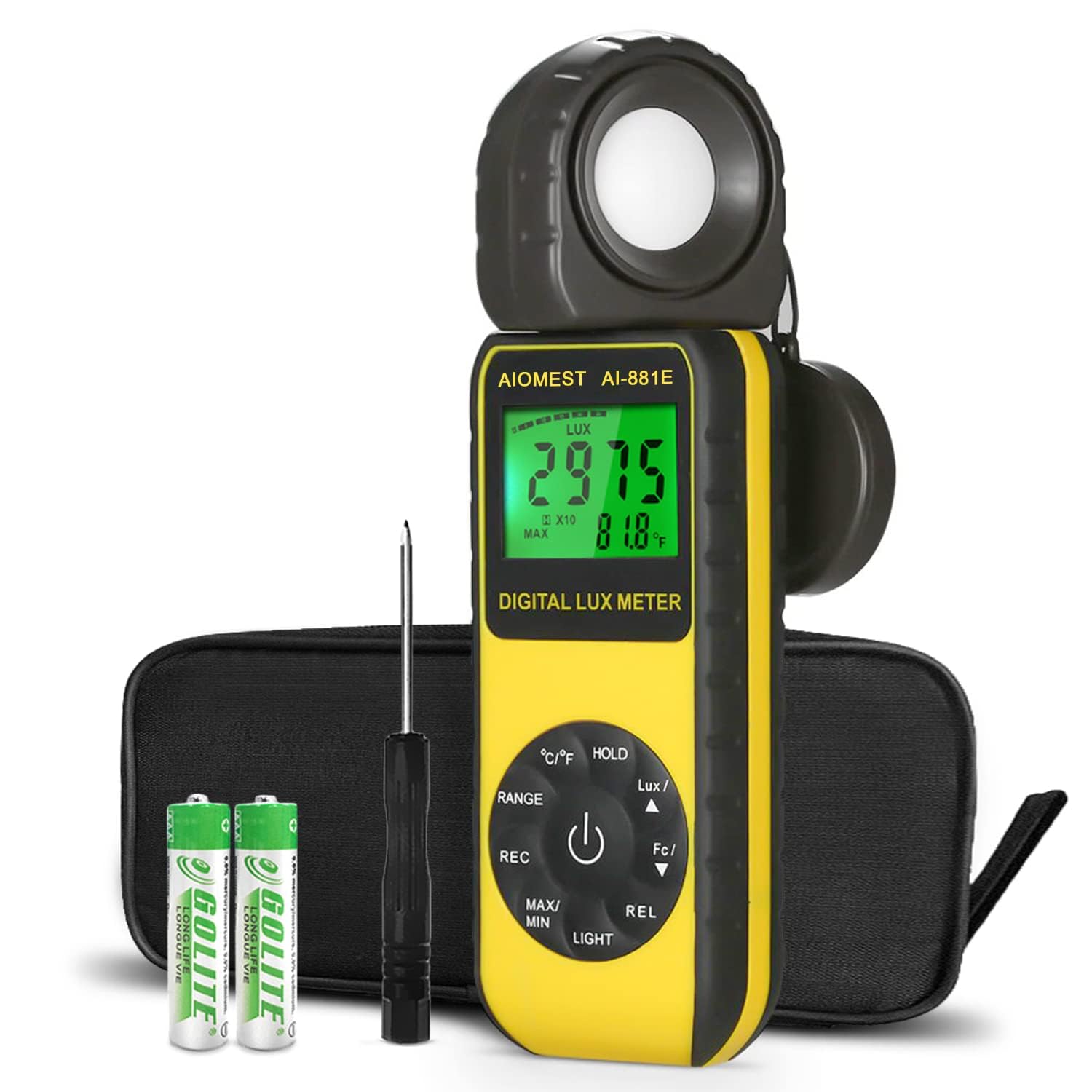
The AIOMEST AI-881E stretches its measurement ceiling to 300,000 lux, a noticeable step up from the 200,000 lux models. That extra headroom matters if you work with high-output LED arrays or metal-halide fixtures. The 270° rotatable sensor uses a silicon-diode filter for consistent readings across angles, and the backlit screen makes it usable in dim grow rooms.
A standout feature for plant growers is the simultaneous display of ambient temperature in Celsius or Fahrenheit alongside the light reading. This lets you track both environmental variables without juggling two devices. The meter samples two to three times per second and stores up to 33 data sets, ideal for mapping light distribution across a canopy.
The unit weighs 9.1 ounces and comes with a storage bag and screwdriver in the box. A few customers noted the spring on the sensor retractor popped out, but most found the tool accurate and reliable for comparing grow-light output.
Why it’s great
- 300,000 lux range handles intense horticultural lights
- Dual display of lux and ambient temperature
- 33-set memory stores readings for comparison
Good to know
- Sensor spring assembly can detach with rough handling
- Heavier than comparable meters at 9.1 ounces
3. Dr.meter 1332B

The Dr.meter 1332B differentiates itself with a threaded tripod mount on the bottom, a rare find in this price tier. If you need hands-free measurement — for example, holding a reflector while checking light spread — you can screw it onto a standard light stand and walk away. The 270° rotating detector works with four manually selectable ranges up to 200,000 lux, and the sensor reads twice per second.
Buyers who grow under LEDs, HPS, CMH, and T5 fluorescents report that the readings correlate reasonably well with PAR meters after applying a conversion factor. One reviewer compared it against a Phantom photobio PAR meter and found the Dr.meter stayed within roughly 50 PAR points. Note that the unit does not ship with batteries, so you will need a 9V battery to start.
The plastic shell feels adequate but not premium. Several owners mentioned an initial defective unit was replaced quickly by the manufacturer, suggesting that quality control can vary, but customer service is responsive.
Why it’s great
- Tripod-mountable for steady hands-free readings
- Works across LED, HPS, CMH, and fluorescent sources
- Four manually selectable ranges give control
Good to know
- Requires a 9V battery not included
- Occasional defective units reported but replaced
4. BTMETER BT-881D

The BTMETER BT-881D pushes the measurement envelope to 400,000 lux, the highest ceiling among the meters in this roundup. That makes it the best fit for anyone measuring direct-sunlight levels or extremely bright industrial fixtures. The 270° pivoting sensor and 0.4-second response time give you quick, reliable data without twisting the whole device.
Like the AIOMEST, this model stores up to 33 readings and includes a relative measuring mode that shows the difference between your current and stored value. That is helpful when you are adjusting a dimmer and want to see the delta instantly. The unit also displays temperature, and the backlit screen stays readable in low-light environments.
One five-year owner reported that his unit still performed well until it eventually locked on a constant value, which is an acceptable lifespan for a tool at this tier. The meter comes with a zippered case and tiny screwdriver for assembly. Customer reviews consistently call it reliable and easy to use.
Why it’s great
- 400,000 lux range covers the brightest sources
- Relative mode shows live difference from stored reading
- Proven five-year lifespan in some units
Good to know
- Top range can overshoot for typical indoor use
- Some units eventually fail after several years
5. BTMETER BT-881E

The BTMETER BT-881E closely matches the BT-881D but caps at 300,000 lux instead of 400,000. For most home growers, office workers, and hobbyists, that is still more than enough — an overcast day delivers about 1,000 lux, and a strong LED grow panel at 18 inches rarely exceeds 80,000 lux. The 270° rotatable sensor and 0.4-second response remain identical to its higher-range sibling.
This model also records 33 reading sets, includes a relative measurement mode, and displays temperature alongside lux or foot-candles. The kit comes with a zippered case, screwdriver, and batteries, so it is ready to use out of the box. Accuracy is rated at +/-4% for readings under 10,000 lux, which covers most indoor applications.
Buyers consistently mention how intuitive the controls are and note the included carrying case as a nice bonus. The plastic body feels light at 5.5 ounces, making it the most portable option here. A handful of users mentioned using it for home science experiments and classroom demonstrations without any reliability concerns.
Why it’s great
- Matches premium features at an entry-level cost
- Included case and batteries for immediate use
- Lightweight and easy to carry at 5.5 ounces
Good to know
- No tripod mount for hands-free use
- 300,000 lux limit for very high-output fixtures
FAQ
Can I use a cheap light meter for photography?
How does a rotatable sensor help when measuring overhead lights?
Final Thoughts: The Verdict
For most users, the cheap light meter winner is the DANOPLUS DP-331 because its 360° detachable sensor and auto-range settings deliver the most versatility for home and plant use. If you want ambient temperature display and a 300,000 lux ceiling, grab the AIOMEST AI-881E. And for hands-free tripod measurements in a grow tent, nothing beats the Dr.meter 1332B.

Mo Maruf
I created WellFizz to bridge the gap between vague wellness advice and actionable solutions. My mission is simple: to decode the research and give you practical tools you can actually use.
Beyond the data, I am a passionate traveler. I believe that stepping away from the screen to explore new environments is essential for mental clarity and physical vitality.