Our readers keep the lights on and my smoothie glass nicely filled. As an Amazon Associate, I earn from qualifying purchases.
A dull lawn mower blade tears the grass instead of cutting it, leaving a ragged, brown-tipped lawn that’s vulnerable to disease. For commercial landscapers and property care professionals, every pass counts — and a sharp blade is the difference between a pristine finish and a costly redo. A dedicated sharpener engineered for the daily volume of commercial use delivers consistent bevels without overheating the steel, which ruins the temper and edge retention.
I’m Mohammad Maruf — the founder and writer behind WellFizz. I’ve spent hundreds of hours analyzing motor specs, grinding wheel materials, blade guide precision, and build stability across dedicated lawn mower blade sharpeners to separate hobby-grade tools from the ones that earn their keep in a commercial trailer.
This guide breaks down the top contenders in the commercial lawn mower blade sharpener category — from 1HP workhorses with ceramic wheels to precision jigs for cordless grinders — so you can match the right machine to your blade inventory, shop budget, and sharpening volume.
How To Choose The Best Commercial Lawn Mower Blade Sharpener
Choosing the right sharpener for a commercial operation is different from picking one for a home garage. You need a machine that can process a full trailer of blades in a reasonable time, hold its angle repeatably, and survive years of use without excessive maintenance.
Motor Power and Speed
Commercial blades — especially gator and high-lift styles — are built from thicker, harder steel than residential blades. A motor in the 1 HP (750W) range running at 1700-1750 RPM provides the torque to remove material quickly without stalling. Smaller motors (1/3 HP to 2/3 HP) can handle occasional residential jobs but will bog down under sustained commercial use. RPM is less critical than torque here: ceramic wheels running at lower RPM produce less heat, preserving the blade’s heat treat.
Grinding Wheel Material and Size
Ceramic grinding wheels dominate the current market because they run cooler and last longer than traditional aluminum oxide stones. A 9-inch ceramic wheel removes material efficiently while minimizing the risk of overheating blade edges. Sixty-grit provides aggressive removal for nicked blades; 180-grit is for finishing. Some traditional machines still use bonded Carborundum stones, which work well but require periodic dressing to keep the surface true. Wheel availability longer-term is a consideration — proprietary sizes can become a supply chain headache.
Blade Guide System
The guide holds the blade at a fixed angle — usually 30° for standard blades, 40° for reverse-profile blades. A good guide system locks securely and adjusts without tools. Machines with preset stops reduce operator error and ensure every blade in a set gets the same bevel. Look for guides that accommodate standard, mulching, low-lift, high-lift, and flat blades without requiring adapters.
Build Stability and Safety Features
A sharpener that vibrates across the bench will produce uneven results. Look for a heavy steel base plate, rubber feet, and a low center of gravity. Bolted-down machines are ideal for permanent shop setups. Safety features like emergency kill switches, non-auto-restart after power loss, and grit collectors (to capture metal dust) are valuable in a commercial environment where the machine runs daily.
Quick Comparison
On smaller screens, swipe sideways to see the full table.
| Model | Category | Best For | Key Spec | Amazon |
|---|---|---|---|---|
| RBG 934 | Premium Pro | High-volume commercial fleets | 3/4 HP, 9-inch 24-grit ceramic wheel | Amazon |
| RBG 712 | Premium Pro | Mid-volume lawn care businesses | 7-inch Carborundum wheel | Amazon |
| VEVOR 1HP | Mid-Range | High torque with grit control | 1 HP, 9-inch 60-grit ceramic wheel | Amazon |
| JLD10-9 | Mid-Range | Large wheel diameter for wide blades | 1 HP/750W, 9-inch ceramic wheel | Amazon |
| SporGain DDLMBS | Mid-Range | Dual-grit finishing in one setup | 2/3 HP/550W, 7-inch ceramic wheel | Amazon |
| RFRYZE TD7550 | Mid-Range | Emergency stop safety feature | 3/4 HP/550W, 7-inch ceramic wheel | Amazon |
| SporGain B0GVF2TKC4 | Mid-Range | Adjustable speed for precise control | Brushless motor, 7-inch ceramic wheel | Amazon |
| All American 5005 Gen 2 | Mid-Range | Portable angle jig for cordless grinders | Adjustable 15-45°, fits cordless grinder | Amazon |
| Oregon 88-025 | Entry-Level | Simple setup for small shops | 1/3 HP, 1750 RPM, 8-inch stone | Amazon |
In‑Depth Reviews
1. RBG 934 Disc Wheel Blade Grinder

The RBG 934 is built for the weekly sharpening load of a professional lawn care operation. Its 3/4 HP motor drives a 9-inch 24-grit ceramic wheel at 1725 RPM, providing the torque needed to reshape the edge of a heavily nicked commercial blade in under a minute. The aggressive grit removes material quickly, and the ceramic formulation runs cool enough to preserve blade temper even under repeated passes. The preset 30-degree guide delivers repeatable bevels without requiring the operator to hold the angle manually.
The machine includes a rear chute to direct sparks away from the operator and switch, a significant safety upgrade compared to open bench grinders. Users who maintain fleets of 10 or more mowers report that the RBG 934 cuts their sharpening time roughly in half compared to angle-grinder jigs. The 24-grit wheel is too aggressive for final finishing on some blades, but the speed tradeoff is justified for daily commercial throughput. Capable of handling standard right-hand and reverse left-hand blades of any length.
This is not a machine for a homeowner sharpening two blades a season. The motor is powerful enough that overfeeding can cause it to lock up — the recommended technique is light, repeated passes. The included 1-year warranty covers defects, and replacement wheels are readily available from RBG. For a commercial shop that sharpens in volume, the 934 is a time-to-money machine that justifies its cost in the first season.
Why it’s great
- Aggressive 24-grit ceramic wheel removes nicks fast
- Rear spark chute improves shop safety
- Preset 30° guide ensures repeatable bevels
Good to know
- Motor can lock up if blade is forced too hard
- 24-grit leaves a rough finish requiring hand deburring
- Premium price point for solo operators
2. RBG 712 Professional Fast Grind

The RBG 712 is a rotary blade sharpener that uses a durable bonded Carborundum wheel rather than a ceramic disc. The wheel is rated for 100 to 150 sharpenings before replacement, making it a long-term investment for a mid-volume commercial shop. The preset blade guide eliminates guesswork, clamping the blade at the correct 30-degree angle so the operator simply slides the edge into the wheel. Standard and reverse blades both fit without adjustment.
The machine is compact enough to sit on a workbench without dominating the space, yet the build quality is heavy enough to resist vibration during operation. Users running a lawn care business report that the 712 restores factory edges consistently, with minimal learning curve. The dust from the Carborundum wheel is less aggressive than ceramic dust, but the company recommends using a grit collector accessory to keep the shop air clean. The grinder runs quieter than many open bench grinders, which improves the work environment over a long sharpening day.
Some operators find the 712 slower than open-grit ceramic wheel machines like the upper-tier RBG 934, but the tradeoff is a finer edge finish that requires less hand work. If you sharpen 20-30 blade sets per week and value consistency over speed, this is a top contender. The price is higher than many new machines, but the replacement wheel availability and established dealer network make it a safe bet for the long haul.
Why it’s great
- Carborundum wheel lasts 100-150 sharpenings
- Simple preset guide reduces operator error
- Quiet, low-vibration operation
Good to know
- Slower material removal than open-grit ceramic wheels
- Higher initial investment than entry-level units
- Wheel dressing required to maintain flat surface
3. VEVOR 1HP Lawn Mower Blade Sharpener
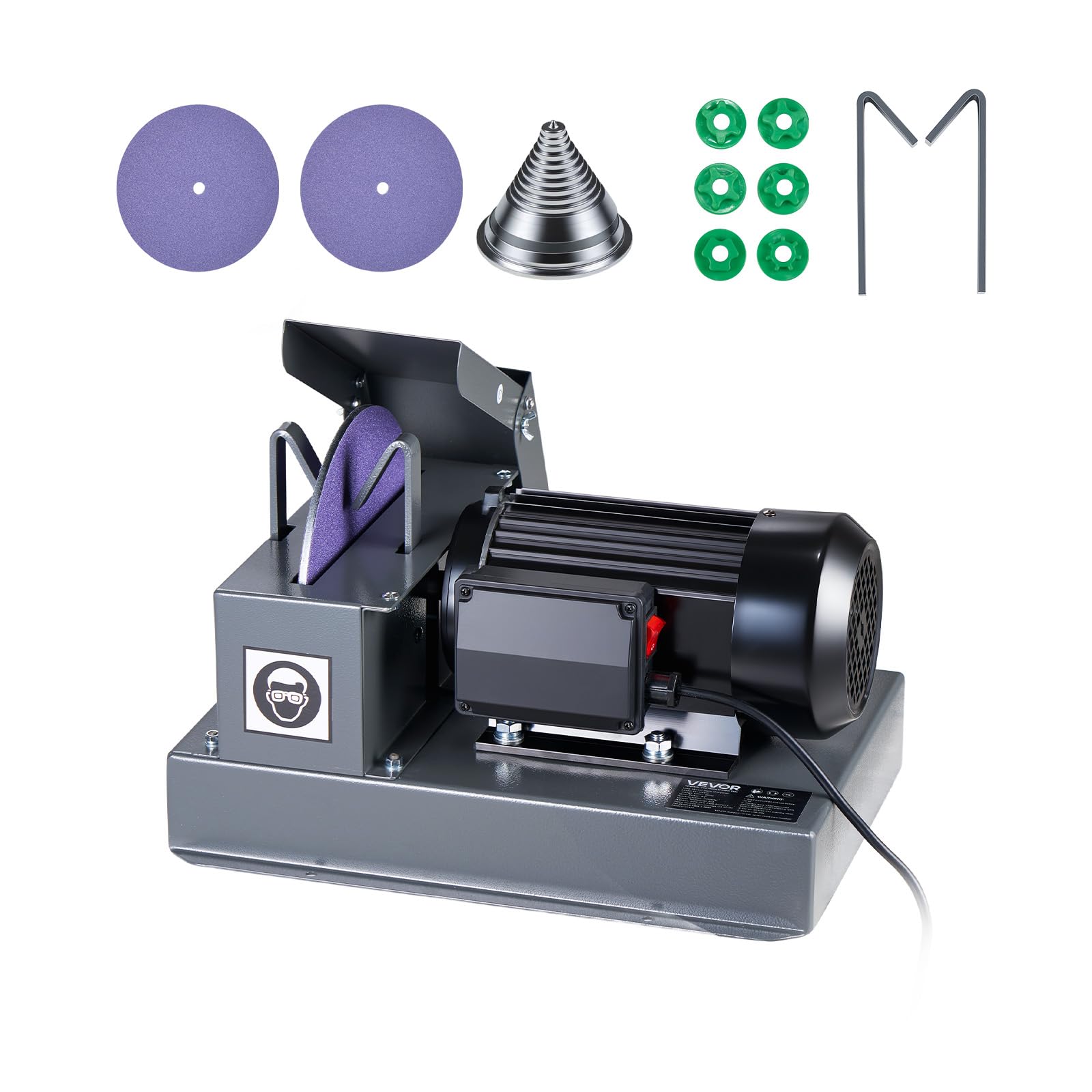
The VEVOR 1HP sharpener brings genuine torque to the mid-range market. The 1725 RPM motor spins a 9-inch 60-grit ceramic wheel that removes material efficiently without the aggressive overfeed risk of the 24-grit machines. The package includes a blade balancer, two replacement sanding discs, and a grit collector — practical accessories that add real value for a commercial shop. The 30° and 40° fixing brackets snap into place for quick changeover between standard and reverse blades.
The steel base is heavy enough to stay planted on a bench without bolting, though the manufacturer includes bolt holes for permanent installation. Users report that the ceramic discs hold up well through multiple sharpenings, though ordering extra discs upfront is recommended since the 9-inch size is less common at local hardware stores. The grit collector attaches via a port and captures most airborne metal dust, keeping the shop visibly cleaner than open machines. The motor handles thick commercial blades without bogging, though curved gator blades require multiple passes to get the full edge.
This machine occupies a sweet spot: enough power for daily commercial use without the sticker shock of the RBG line. The included balancer is a useful addition, because an unbalanced blade will cause vibration that damages mower spindles. For a growing landscape business upgrading from an angle grinder jig, the VEVOR delivers professional results at a cost that pays back quickly.
Why it’s great
- 1 HP motor handles thick commercial blades
- Includes blade balancer and grit collector
- 60-grit ceramic wheel runs cool
Good to know
- 9-inch replacement discs harder to find locally
- Curved gator blades require multiple passes
- Grit collector bag fills quickly on heavy use
4. JLD10-9 Lawn Mower Blade Sharpener

The JLD10-9 is built around a 9-inch ceramic grinding wheel driven by a 1 HP motor at 1700 RPM. The larger wheel diameter means more surface area contacts the blade per pass, which speeds up sharpening on wide commercial blades. The 60-grit ceramic wheel removes material at a good rate without excessive heat buildup — a critical factor for blade edge integrity. The package includes five replacement discs, a metal blade balancer, and two 40° knife holders, covering the basics for a commercial sharpening station.
The adjustable mounting system fits most standard lawn mower blades, including high-lift and low-lift profiles. The machine’s integrated steel structure and broad base provide stability, though the 40-pound weight is still light enough to move between benches if needed. Users consistently report that the sharpener produces edges that can shave hair after a single pass on each side, indicating the guide holds the blade at the correct angle consistently. The metal balancer is a welcome inclusion, since blade vibration after sharpening is a common source of spindle wear.
A notable concern is that the manufacturer has reportedly discontinued 9-inch replacement wheels, which could create a supply problem over time. Verify current disc availability before committing to this model for long-term use. If you plan to use it for a season or two and can stock up on discs now, the JLD10-9’s sharpening performance is strong for the investment. The 40-pound build and 1 HP motor make it competitive with machines costing significantly more.
Why it’s great
- 9-inch wheel sharpens wide blades faster
- Produce shaving-sharp edges in one pass
- Includes five spare discs and a balancer
Good to know
- 9-inch replacement discs potentially discontinued
- Some units shipped without the advertised balancer
- Weight requires a sturdy bench or bolting down
5. SporGain DDLMBS (2/3 HP)
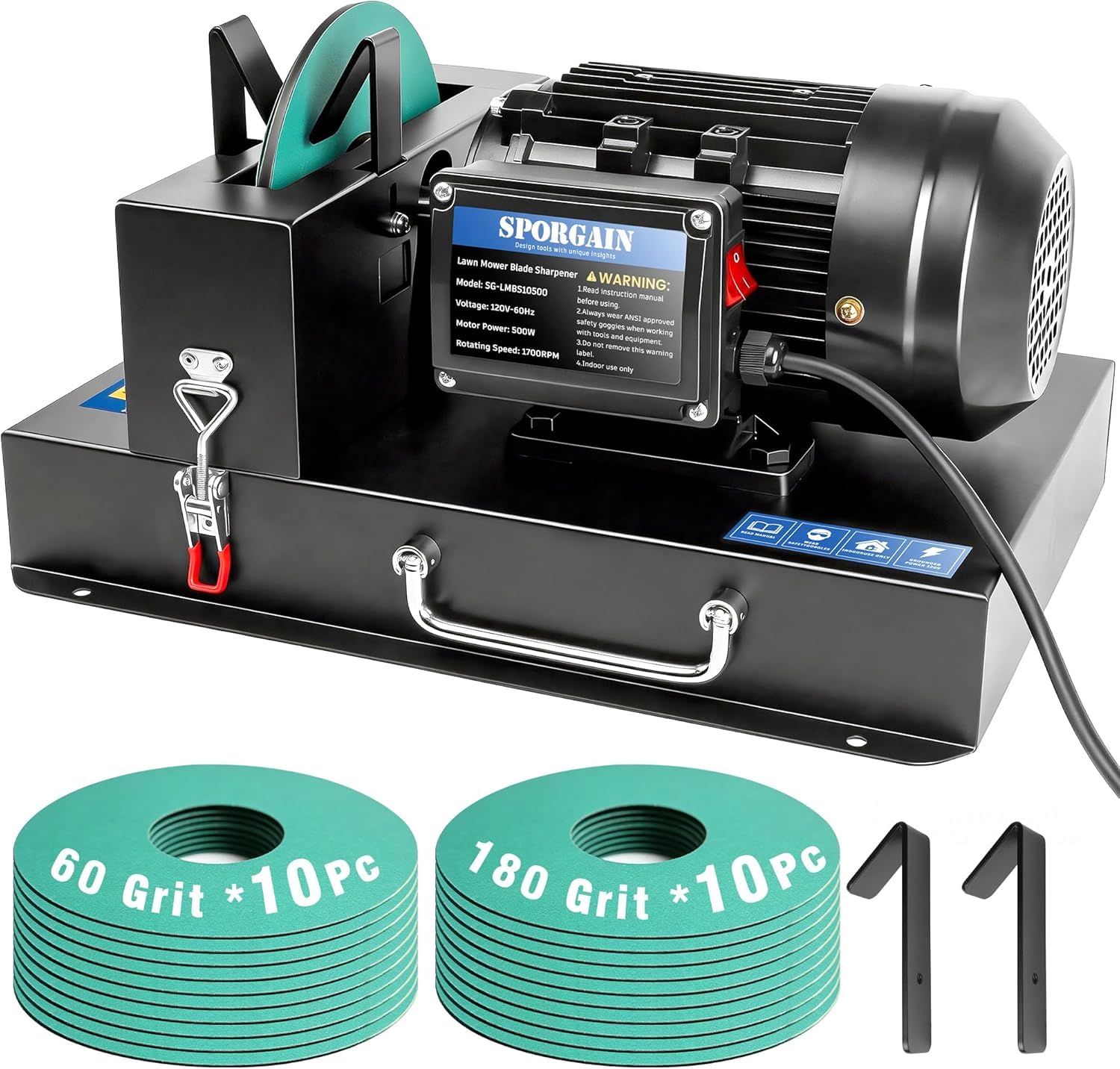
The SporGain DDLMBS uses a 2/3 HP motor driving a 7-inch ceramic wheel, designed for operators who prioritize edge finish over raw speed. The machine ships with 10 pairs of 60-grit and 180-grit sandpaper discs, allowing the user to switch between aggressive material removal and fine finishing without changing machines. The snap-lock wheel cover design makes disc swaps fast — a practical feature when you are working through a stack of blades and need to refine the edge after rough grinding.
The integrated steel base and secure blade brackets keep the machine stable during operation, though the 550W motor is noticeably less torquey than 1 HP units. Multiple users note that the motor tends to slow when encountering heavy nicks, which actually prevents overheating the blade but extends sharpening time. The 30° and 45° blade holders are adjustable and work well with high-lift, low-lift, gator, and flat blades. The machine weighs 37 pounds, heavy enough to stay planted on a bench without significant vibration.
This is a strong choice for a small commercial operation or a high-end residential landscaper who finishes blades to a near-mirror edge. The dual-grit system eliminates the need to chase a coarse cut with a separate file or grinder. However, the lower torque means you will spend more time on badly nicked blades, and some users report the guide can lift the blade into the sandpaper if not adjusted carefully. For operators who value a polished finish and have the patience for light passes, the DDLMBS delivers professional-grade results.
Why it’s great
- Dual-grit discs (60/180) for rough and finish passes
- Snap-lock disc change saves time
- Motor slows to prevent blade overheating
Good to know
- 550W motor lacks torque for badly nicked blades
- Guide can lift blade into sandpaper if misadjusted
- Sharpening curved gator blades is time-consuming
6. RFRYZE TD7550 (3/4 HP)
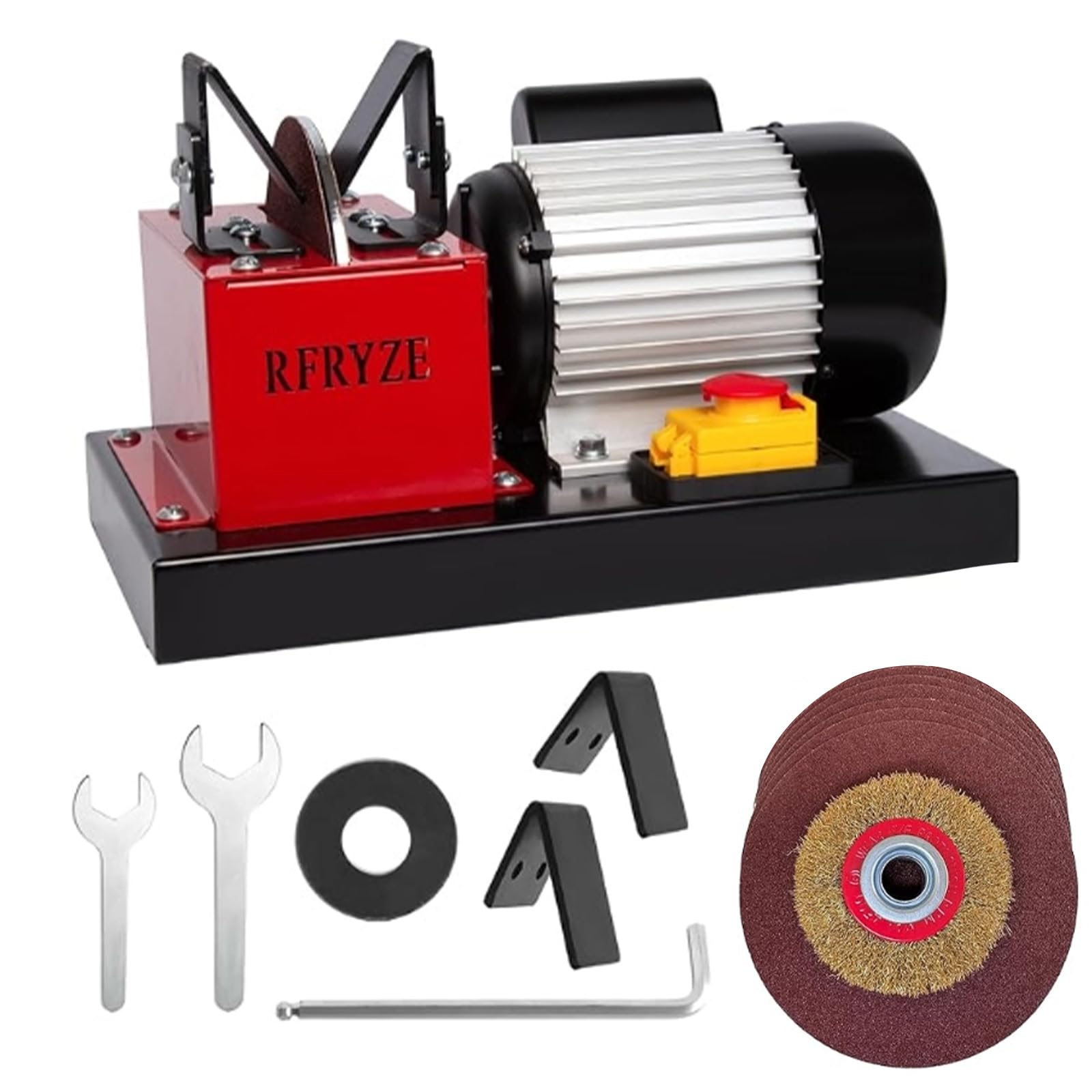
The RFRYZE TD7550 is a 3/4 HP sharpener with a practical emphasis on safety. It includes an emergency stop switch that prevents the motor from restarting automatically after a power outage — a genuine safety concern in commercial shops where the machine might be left unattended. The 1700 RPM motor delivers 550W of power to a 7-inch ceramic wheel, with adjustable 30° and 40° grinding angles for high-lift, low-lift, gator, and flat blades. The kit includes six 80-grit ceramic discs, a 4-inch wire brush for rust removal, and maintenance wrenches.
The machine weighs 30.8 pounds, making it one of the lighter commercial-capable units, but the aluminum construction still provides adequate stability for most benchtop setups. Users report that the sharpener produces clean edges after some practice dialing in the correct angle, and the 80-grit discs remove material at a moderate rate without overheating. The included wire brush is genuinely useful for cleaning rust off stored blades before sharpening — a step many operators skip due to convenience, but which extends disc life.
The 30-pound weight and compact footprint make the TD7550 a good candidate for mobile trailer setups where space and weight matter. The learning curve is slightly steeper than preset-guide machines, because you manually adjust the angle bracket. The 550W motor is adequate for residential and light commercial use, but heavy daily volumes will push its limits. If you need a portable unit with strong safety features for a small fleet, this is a solid, well-priced choice.
Why it’s great
- Emergency stop with auto-restart prevention
- Includes wire brush for pre-sharpening rust removal
- Lightweight and compact for mobile setups
Good to know
- 550W motor bogs under heavy commercial loads
- Angle adjustment requires manual setup each time
- Some early units experienced motor failure
7. SporGain B0GVF2TKC4 (Brushless)
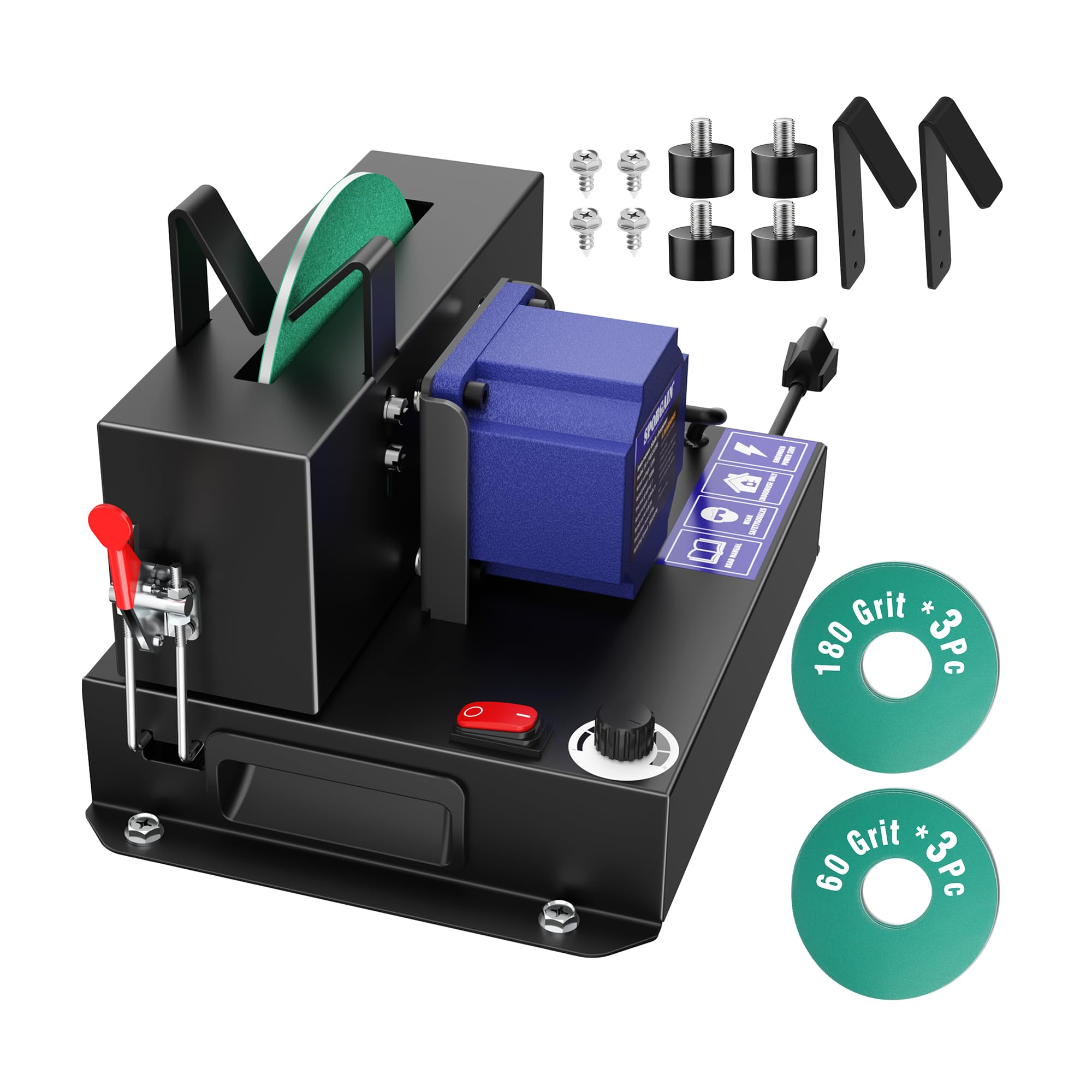
The SporGain brushless model is unusual in this category because it offers variable speed control up to 3000 RPM, giving the operator the ability to dial in the rotational speed based on blade condition and grit. The brushless motor runs quieter and cooler than brushed alternatives, and the included lifetime motor warranty suggests confidence in the powertrain’s longevity. The machine uses a 7-inch ceramic wheel and ships with 3 pieces of 60-grit sanding discs plus 60 pieces of 180-grit discs for fine sharpening.
The 30° and 45° blade guides allow compatibility with high-lift, low-lift, gator, and flat blades. Users report the machine is easy to assemble and that the brushless motor delivers smooth power across the RPM range. At lower speeds, the machine runs quietly enough for use in noise-sensitive environments — a factor for landscapers sharpening near residential areas. The 15-pound weight is light enough for occasional transport, though the machine is best suited for a permanent bench position.
The downside of the brushless motor is that torque is not as high as a comparably rated brushed motor at the same price tier. Several users note the machine feels underpowered when encountering heavy nicks or thick commercial blade material, and the variable speed is of limited use if the motor lacks the torque to cut at lower settings. The guide system also has a tendency to lift the blade into the sandpaper, which can gouge the disc. Best suited for light commercial or high-end residential use where noise and speed control are priorities.
Why it’s great
- Variable speed up to 3000 RPM for precise control
- Brushless motor runs quiet and cool
- Lifetime motor warranty included
Good to know
- Lower torque struggles with thick commercial blades
- Guide can lift blade and cut into sandpaper
- Fewer abrasive discs than some competitors
8. All American Sharpener Model 5005 Gen 2
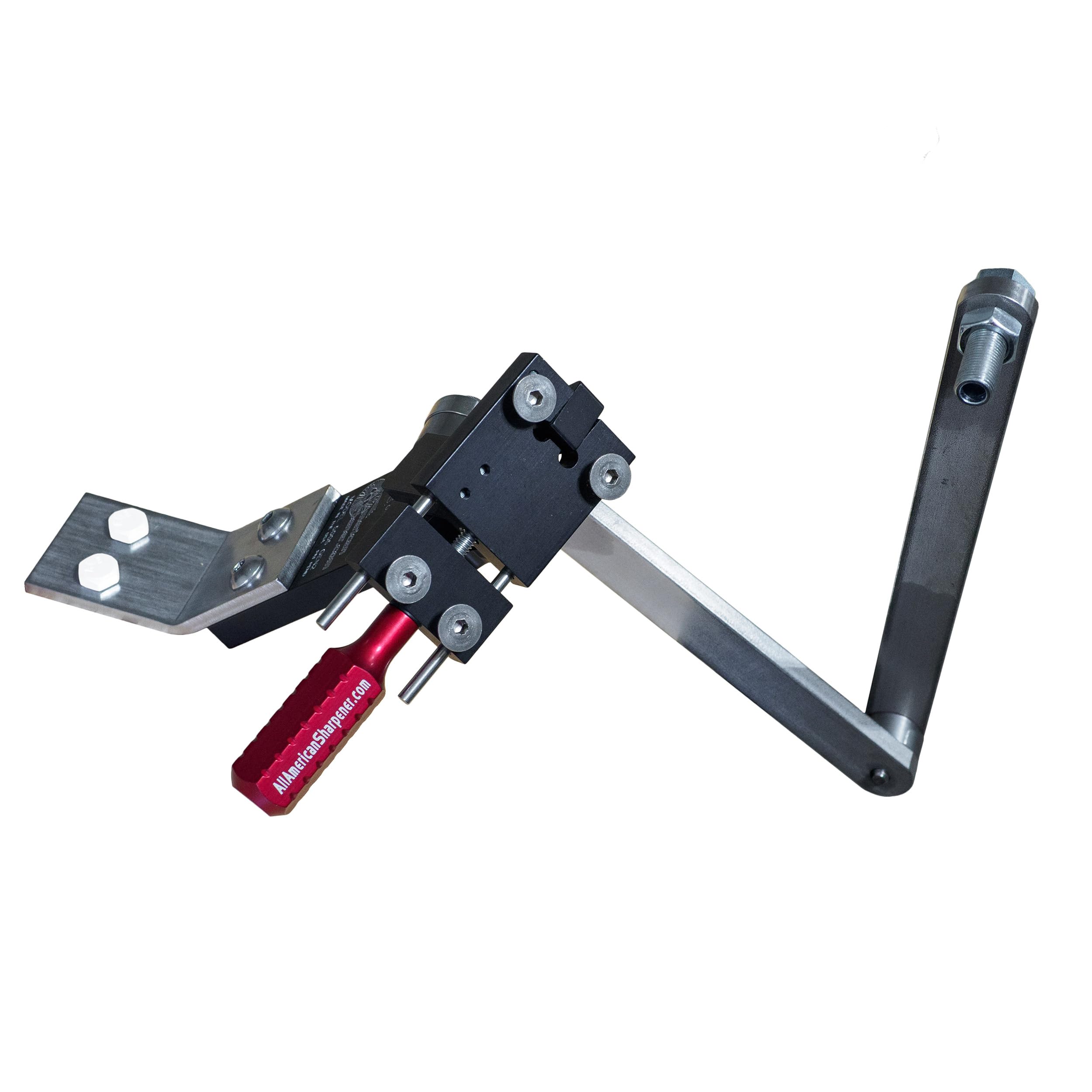
The All American Sharpener takes a fundamentally different approach: instead of a dedicated motor and wheel, it is a precision jig that accepts any cordless angle grinder. The tool body is machined aluminum and stainless steel, weighing just over 1 pound, and adjusts from 15° to 45° to accommodate standard, mulching, and high-lift blades. The jig clamps the blade securely while a C-shaped guide forces the grinder wheel to present the correct angle — eliminating the freehand wobble that produces uneven bevels.
The Gen 2 design features solid stainless steel guide arms rather than the hollow steel found on cheaper knockoffs. Users report that after sharpening multiple sets of blades, the angle measures consistently at 30 degrees as set, proving the repeatability of the guide. The tool is completely portable — you can toss it in a trailer or tool bag and sharpen blades at the job site. The lifetime warranty on the jig itself speaks to the build quality, and the US manufacturing means replacement parts are accessible.
The downside is that this is strictly a jig — you must supply your own angle grinder and grinding wheel. The total cost of grinder plus jig can approach or exceed the price of a dedicated machine like the SporGain, especially if you buy a high-quality grinder. The plastic thumb screw used for angle adjustment is a noted weak point, though the metal components are robust. For a mobile operator who already owns a grinder and wants repeatable angles without hauling a heavy bench machine, the All American is a unique space- and weight-saving solution.
Why it’s great
- Portable — fits in a tool bag with a cordless grinder
- Consistent angle repeatability across multiple blades
- Made in USA with military-spec aluminum and stainless steel
Good to know
- You must supply your own angle grinder and wheel
- Plastic thumb screw feels fragile compared to metal frame
- Higher total cost when adding a quality grinder
9. Oregon 88-025 Economy Blade Grinder
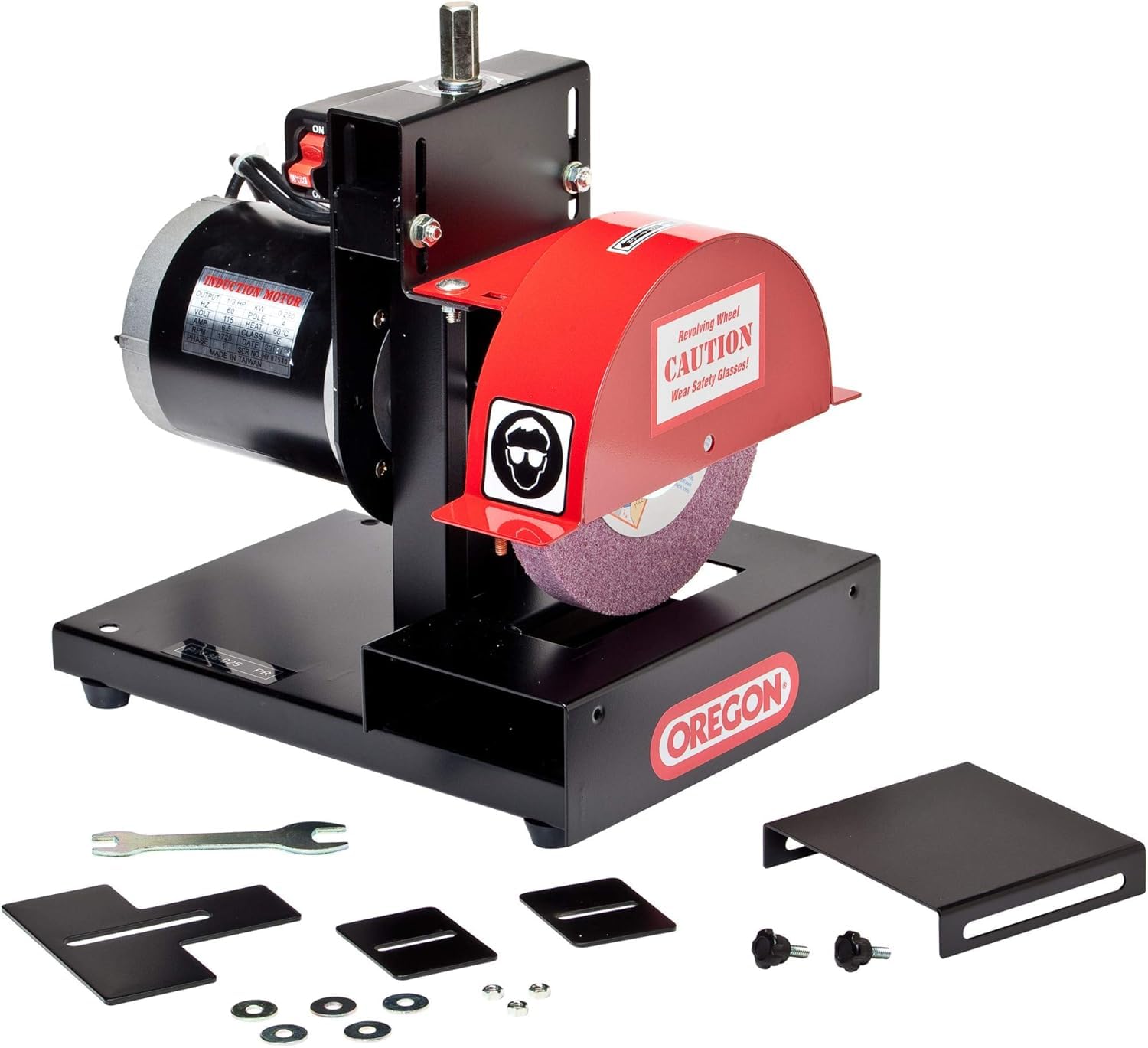
The Oregon 88-025 is the classic entry-level dedicated blade grinder that has been in production for years. It uses a 1/3 HP motor (the smallest of the machines reviewed here) running at 1750 RPM with an 8-inch sharpening stone that is a bonded aluminum oxide material, not ceramic. The stone requires periodic dressing to maintain a flat surface, but replacement stones are inexpensive and widely available. The machine includes a built-in safety kill switch and will sharpen blades from all manufacturers.
The 41-pound weight and 21-inch length make this the largest footprint machine in the budget tier, but the generous 9-inch blade depth clearance allows handling even the longest commercial blades. Users consistently report that the 1/3 HP motor gets hot under sustained use — the motor is rated for 60°C ambient — so it is best used in short bursts rather than continuous heavy grinding. The 46-grit stone removes material at a moderate rate; hammering out heavy nicks before grinding is recommended. The machine is quiet and produces minimal vibration compared to aggressive ceramic wheels.
For a part-time commercial operator or a high-end homeowner managing a small fleet, the Oregon 88-025 is a reliable, proven platform. It will not keep up with the throughput of a 1 HP machine on a full trailer of blades, but it will produce consistent, angle-correct edges when used with patience. Replace the thumb screws with nuts for a more secure setup, and add a blade balancer as a companion purchase. The 1-year warranty covers manufacturing defects, and Oregon’s dealer network is extensive.
Why it’s great
- Large 9-inch blade depth clearance
- Proven design with wide stone availability
- Quiet, low-vibration operation
Good to know
- 1/3 HP motor runs hot under sustained use
- Slower removal rate than ceramic wheels
- Bonded stone requires periodic dressing
FAQ
Can I use a bench grinder instead of a dedicated mower blade sharpener?
How often should I sharpen commercial mower blades using a dedicated sharpener?
What is the correct sharpening angle for commercial lawn mower blades?
Do I really need a blade balancer after sharpening?
Final Thoughts: The Verdict
For most users, the commercial lawn mower blade sharpener winner is the VEVOR 1HP because it delivers 1 HP torque, a 9-inch ceramic wheel, and a blade balancer and grit collector at a price that pays for itself fast in a growing landscape business. If you want the fastest throughput for a high-volume commercial fleet, grab the RBG 934. And for portable precision without hauling a bench machine, nothing beats the All American Sharpener Gen 2.

Mo Maruf
I created WellFizz to bridge the gap between vague wellness advice and actionable solutions. My mission is simple: to decode the research and give you practical tools you can actually use.
Beyond the data, I am a passionate traveler. I believe that stepping away from the screen to explore new environments is essential for mental clarity and physical vitality.