Our readers keep the lights on and my smoothie glass nicely filled. As an Amazon Associate, I earn from qualifying purchases.
Postural Orthostatic Tachycardia Syndrome turns a simple act like standing into a battle against gravity, where blood pools in the lower extremities and the heart races to compensate. The right compression garments deliver the external counter-pressure needed to squeeze that pooled blood back toward the central circulation, reducing heart rate spikes and symptoms like lightheadedness and fatigue.
I’m Mohammad Maruf — the founder and writer behind WellFizz. I’ve spent countless hours analyzing customer feedback, product specifications, and clinical recommendations for compression wear, particularly within the nuanced demands of dysautonomia care, to isolate the designs that deliver measurable relief rather than just marketing claims.
Whether you need thigh-highs that stay up, waist-high pantyhose for full abdominal support, or specialized leggings with higher mmHg ratings, finding the right best compression garments for pots comes down to understanding your specific symptom profile and daily activity needs.
How To Choose The Best Compression Garments For POTS
Choosing compression wear for POTS isn’t about picking the highest number on the packaging. The key is matching the garment’s physical design to your body’s specific pooling pattern and your lifestyle tolerance threshold.
Compression Level and Graduated Pressure
POTS buyers typically need at least 20–30 mmHg to meaningfully move blood from the legs back to the upper body. Lower levels (15–20 mmHg) offer comfort for mild symptoms but fail to prevent the heart rate surge during standing. The pressure must be graduated — tighter at the ankle and looser higher up — to avoid creating a tourniquet effect that worsens pooling below the compression edge.
Garment Length and Abdominal Engagement
Thigh-highs work when pooling is isolated to the lower legs, but many POTS patients also experience splanchnic pooling in the abdomen. Waist-high or legging-style designs address this by compressing the abdomen and lower torso, which stabilizes venous return more effectively. The trade-off is heat retention (warmer layers) and increased difficulty with bathroom breaks. Silicone top bands on thigh-highs must grip securely without rolling — a common failure point in daily POTS use.
Fabric, Breathability, and Donning Effort
Compression garments for POTS are often worn for 8–16 hours daily. Nylon-spandex blends offer durability and a polished look but trap heat. Bioactive fiber knits (like Bioflect’s ceramic-infused fabric) provide micromassage and feel cooler, though they show texture under thin leggings. Donning difficulty directly impacts compliance — if getting the garment on causes a pre-syncope episode from bending over, the design fails regardless of its mmHg rating.
Quick Comparison
On smaller screens, swipe sideways to see the full table.
| Model | Category | Best For | Key Spec | Amazon |
|---|---|---|---|---|
| CzSalus Flat Knit K2 | Premium Leggings | High-stage lymphedema & POTS with abdominal pooling | 25–30 mmHg flat knit | Amazon |
| JOBST Relief Waist High Open Toe | Premium Pantyhose | Long work days & full-leg/torso coverage | 20–30 mmHg closed/open toe | Amazon |
| JOBST Relief Waist High Pantyhose | Mid-Range Pantyhose | All-day standing & varicose vein relief | 20–30 mmHg closed toe | Amazon |
| Mediven Assure Thigh High | Mid-Range Thigh | Active days & easy bathroom access | 20–30 mmHg open toe | Amazon |
| Bioflect Capri Compression Leggings | Value Leggings | Comfort-driven wear & shorter torsos | Moderate compression knit | Amazon |
In‑Depth Reviews
1. CzSalus Flat Knit K2 Lipedema Lymphedema, POTS Support High Compression Leggins (25–30 mmHg)

The CzSalus K2 delivers the highest compression level in this lineup — a flat knit rated at 25–30 mmHg, which is the tier that actually makes a dent in significant blood pooling for advanced POTS and lymphedema patients. The Italian construction uses 80% polyamide and 20% elastane, creating a dense, structured fabric that resists stretching out over 12+ hour wear days. The high-waist design engages the abdomen, a crucial factor for those whose tachycardic episodes are driven by splanchnic venous pooling after meals.
Donning these is a genuine effort — several reviewers note the first application takes up to 10 minutes, and sizing must be done through the CzSalus website’s own chart rather than Amazon’s size guide. The fabric is thicker than most, making these better suited for cooler months under pants rather than summer wear. The open toe design allows natural toe movement and helps with temperature regulation at the foot.
Durability is a standout — users report these lasting through daily wear for months without losing compression, and the graduated pressure profile effectively reduces leg pain and swelling. The trade-off is a substantial time investment in putting them on and a two-to-four-week shipping window since the seller is based in Italy. For those who need the highest reliable compression in a legging format, this is the most effective option here.
Why it’s great
- True 25–30 mmHg flat knit provides measurable blood-pooling reduction.
- High-waist cut engages abdomen for splanchnic pooling management.
- Extremely durable Italian construction retains compression over months.
- Open toe improves breathability and allows toe movement.
Good to know
- Sizing requires use of the manufacturer’s website chart; Amazon chart is inaccurate.
- Thick fabric can feel warm; best for cooler seasons or air-conditioned environments.
- Donning is physically demanding — may trigger pre-syncope if bending over is difficult.
- Shipping from Italy can take 2–4 weeks to the US.
2. JOBST Relief Waist High Graduated Compression Stockings 20-30mmHg – Open Toe, X-Large, Beige
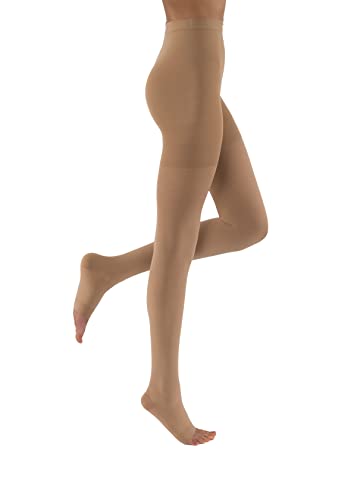
JOBST is the most physician-recommended compression brand in the US for a reason — the Relief Waist High line offers a proven 20–30 mmHg graduated profile with a full pantyhose cut that compresses from the ankle through the abdomen. The open-toe version (this specific variant) provides flexibility for those whose foot swelling varies or who simply need better airflow. The fabric blend of 75% nylon and 25% spandex delivers a semi-opaque, professional look that layers cleanly under work clothes.
Users consistently highlight the comfort of these for 12-hour nursing shifts and long travel days, with the waistband staying in place without rolling. The closed-toe version of this same line is also available, but the open-toe variant addresses a common complaint of excess heat at the foot. The gradient pressure does soften slightly over months of use, but the overall value in terms of cost-per-wear is high when compared to custom-fitted medical compression.
The primary complaint is the same across JOBST waist-high products: the stomach band can roll or feel restrictive when seated for long periods. Some users also note that the fabric bunches behind the knees after hours of sitting, though this is typical for any full-length compression hose. For a POTS patient who needs reliable abdominal compression and doesn’t want to wrestle with thigh-high slippage, this is a solid, no-surprises pick.
Why it’s great
- Physician-recommended 20–30 mmHg graduated compression proven for POTS symptoms.
- Open toe allows better airflow and accommodates variable foot swelling.
- Waist-high design addresses both lower-leg and abdominal pooling.
- Professional appearance suitable for office, scrubs, or casual wear.
Good to know
- Waistband can roll or feel constrictive during prolonged seated periods.
- Fabric may bunch behind the knees after hours of sitting.
- Donning is difficult due to the 20–30 mmHg tightness; a donning aid is recommended.
- Some users report the garment tearing after limited wears if laundered roughly.
3. JOBST Relief 20-30 mmHg Compression Stockings, Waist High Pantyhose, Closed Toe, X-Large, Beige
This is JOBST’s standard waist-high closed-toe pantyhose — same 20–30 mmHg gradient and physician-recommended pedigree as the open-toe version, but with a full foot enclosure for those who need compression all the way to the toes. The closed-toe design is better for patients whose edema extends into the feet or who feel the open-toe band creates an uncomfortable pressure edge. It shares the same nylon-spandex blend that is durable enough to survive machine washing on delicate cycles.
Customer reviews converge on one insight: these are noticeably effective at reducing leg fatigue and that “heavy leg” sensation after work or standing, with several users explicitly noting an energy boost after removing them at the end of the day. The 20–30 mmHg level is enough to help with POTS-related pooling but not so aggressive that it causes toe numbness or skin irritation for most body types. The unisex sizing works well for men who need POTS compression but find women’s cuts too narrow in the thigh.
The closed toe does trap more heat, and the waistband sits high enough that some users find it uncomfortable over the lower ribs when sitting. The difficulty of donning this compression level is a consistent theme — it requires bending over and pulling, which can be problematic if the bending motion itself triggers presyncope. Having a partner or using a donning aid significantly reduces this friction point.
Why it’s great
- Complete foot-to-abdomen compression with physician-recommended 20–30 mmHg gradient.
- Closed-toe design is essential for patients with foot edema or toe swelling.
- Unisex sizing accommodates a wider range of body shapes and men’s sizes.
- Durable enough for daily wear with proper machine washing on delicate.
Good to know
- Closed toe increases heat retention; not ideal for warm climates.
- Donning is very difficult — pre-syncope from bending over is a real risk.
- Waistband may roll or feel restrictive over the lower ribs when seated.
- Replacement needed every 3–6 months as compression naturally degrades.
4. Mediven Assure 20–30 mmHg Thigh High Compression Stockings – Open Toe, X-Large, Beige

The Mediven Assure thigh-high addresses the single biggest complaint about thigh-high compression: rolling down. The wide silicone top band is designed to grip the thigh skin without causing a tourniquet effect, and real-world reviews from nurses, gardeners, and long-distance commuters confirm these stay in place for the entire workday. At 20–30 mmHg, the graduated compression is consistent with what POTS patients need, and the open toe design keeps the feet from overheating.
These are easier to don than waist-high pantyhose because there is less fabric to manage, and the bathroom convenience is a major quality-of-life improvement — no full undressing required. The silicone band does mean these are not suitable for anyone with latex sensitivity or skin conditions that react to the adhesive grip. Some users also note that the band leaves a temporary red mark on the skin, which fades quickly after removal but may be concerning at first glance.
The main limitation is that thigh-highs only address lower-leg pooling. If your POTS symptoms are significantly driven by abdominal blood pooling after meals or upright sitting, these will not provide enough central compression. But for patients whose pooling is clearly in the calves and thighs, or who need an easy-to-manage option for summer under shorts or skorts, the Mediven Assure is the best thigh-high design in this price tier.
Why it’s great
- Wide silicone top band stays in place all day without rolling down — a rare feature for thigh-highs.
- 20–30 mmHg graduated compression effectively reduces lower-leg pooling for POTS.
- Open toe provides breathability and shoe compatibility.
- Easy bathroom access compared to waist-high pantyhose.
Good to know
- Does not compress the abdomen — splanchnic pooling is not addressed.
- Silicone band may cause skin reactions in latex-sensitive individuals.
- Red marks from the band are temporary but may be visible.
- Material can feel warm in hot weather despite the open toe.
5. Bioflect Capri Compression Leggings with Bioactive Fibers and Raised Massaging Knit

Bioflect’s capri leggings take a completely different approach — rather than relying solely on high mmHg numbers, they combine moderate compression with bioactive ceramic fibers and a raised 3D knit that creates micromassage against the skin. The theory is that this micromassage stimulates the superficial lymphatic network, encouraging fluid movement through mechanical action in addition to the squeeze. Published studies on bio ceramic garments support this mechanism, making this an interesting option for POTS patients who also manage lipedema or lymphedema.
The capri length (ending mid-calf) is the key trade-off — these do not cover the foot or ankle, which means they provide zero compression to the largest venous pooling area in the lower leg. For POTS patients whose primary pooling is in the feet and ankles, this is a dealbreaker. But for those whose pooling is more diffuse in the thighs and calves, or who cannot tolerate full foot compression, the capri format is more comfortable and easier to don than knee-highs or full pantyhose. The high waist design goes up near the bra line, providing abdominal engagement without feeling restrictive across the ribs.
Users report that these feel “different” than standard compression — the wavy texture is palpable against the skin, and the material is breathable enough for daily wear. The donning effort is lower than the 20–30 mmHg options, making these a good entry point for someone new to compression or who experiences presyncope during the bending motion required for tighter garments. The durability is solid after cold-water washes and hang drying, though the bumpy texture shows under thin leggings or form-fitting pants.
Why it’s great
- Bioactive fibers and raised knit provide micromassage that complements compression for fluid movement.
- Much easier to don than 20–30 mmHg garments — lower presyncope risk during application.
- High waist accommodates abdominal compression without rib restriction.
- Breathable fabric works well for all-day wear in warm environments.
Good to know
- Capri length leaves the foot and ankle uncompressed — not ideal for lower-leg pooling.
- Moderate compression level may be insufficient for severe POTS symptoms.
- Textured fabric is visible under thin clothing.
- Size selection requires careful attention to the brand’s specific chart.
FAQ
Is 15–20 mmHg enough for POTS or do I need 20–30 mmHg?
Should I choose thigh-highs or waist-high pantyhose for POTS?
How do I avoid presyncope when putting on compression garments?
Final Thoughts: The Verdict
For most users, the best compression garments for pots winner is the CzSalus Flat Knit K2 because its 25–30 mmHg flat knit construction provides the most reliable graduated compression in a legging format that engages the abdomen. If you want a more affordable waist-high option with a proven brand name, grab the JOBST Relief Waist High Open Toe. And for a comfortable, easy-to-don entry point that still offers abdominal support, the Bioflect Capri Compression Leggings is a worthwhile start, though its moderate compression and capri length mean it is best suited for milder symptom profiles.

Mo Maruf
I created WellFizz to bridge the gap between vague wellness advice and actionable solutions. My mission is simple: to decode the research and give you practical tools you can actually use.
Beyond the data, I am a passionate traveler. I believe that stepping away from the screen to explore new environments is essential for mental clarity and physical vitality.