Our readers keep the lights on and my smoothie glass nicely filled. As an Amazon Associate, I earn from qualifying purchases.
The wrong chopping board dulls a premium knife faster than a year of heavy use. Edge retention depends less on your steel and more on the surface you cut against — hard materials like glass or marble chip micro-serrations instantly, while soft, fibrous woods absorb the blade and protect the grind. The category split between end-grain and edge-grain construction determines whether your board extends blade life or shortens it, and that distinction matters more than size, color, or brand.
I’m Mohammad Maruf — the founder and writer behind WellFizz. I’ve spent hundreds of hours analyzing wood density, grain orientation, moisture resistance, and knife-edge impact across dozens of cutting board models to bring clarity to this overlooked but critical kitchen decision.
This guide isolates the specific construction traits, species performance, and maintenance requirements that separate a genuine chopping board for knives from a countertop decoration that silently destroys your cutlery investment.
How To Choose The Best Chopping Boards For Knives
Choosing a board for knife safety means prioritizing grain orientation over every other spec. End-grain boards use wood fibers oriented vertically so the blade slides between fibers rather than cutting across them — this prevents edge dulling. Edge-grain boards expose the long side of the wood fibers, which act like a series of tiny saw teeth against your knife. Bamboo, despite being wood-like, is harder than most hardwoods and contains silica that accelerates dulling. The material decision is the most consequential factor.
Grain Orientation: End-Grain vs Edge-Grain vs Bamboo
End-grain boards display a checkerboard pattern on the surface — this is the gold standard for knife preservation. The vertical fibers part when the blade contacts them, then spring back, self-healing minor cuts. Edge-grain boards show long parallel lines and cut across the grain, which blunts knives faster. Bamboo scores highest on hardness tests but lowest on knife safety — it feels durable but costs edge life. Any board claiming to be gentle on knives must be end-grain wood.
Wood Species Hardness and Moisture Resistance
Teak and walnut dominate the premium tier because they balance moderate hardness with natural oil content. Teak resists moisture and warping without needing heavy oiling — ideal for wet prep environments. Walnut is slightly softer, which makes it even more knife-friendly, but requires regular mineral oil application. Acacia falls between them — harder than walnut, softer than bamboo, with attractive grain variation. Maple is classic but requires more maintenance in humid climates. The Janka hardness scale provides a measurable guide: lower numbers mean easier cutting, higher numbers mean more surface durability.
Thickness, Weight, and Surface Area
A board under 1.5 inches thick risks warping and sliding during heavy use. Premium end-grain boards range from 1.5 to 1.9 inches — this mass anchors the board on the counter and prevents movement during rock-chopping motions. Surface area should match your prep volume: a 20-by-15-inch board handles whole turkeys and multiple ingredients simultaneously, while a 14-by-12-inch board suits smaller kitchens. Rubber feet prevent slippage on smooth countertops, and built-in cutouts for plates simplify ingredient transfer without compromising structural integrity.
Juice Grooves, Handles, and Maintenance Requirements
Juice grooves collect liquid from meat carving and prevent countertop messes — essential if you frequently cut proteins. Handles make heavy boards easier to move but can trap food debris if not properly sealed. Every wood board requires periodic oiling with food-grade mineral oil or board conditioner — un-oiled wood absorbs moisture, bacteria, and odors. Boards that arrive pre-seasoned save the initial step, but long-term care determines whether the board lasts five years or twenty.
Quick Comparison
On smaller screens, swipe sideways to see the full table.
| Model | Category | Best For | Key Spec | Amazon |
|---|---|---|---|---|
| American Black Walnut (BABILONIA) | End-Grain | Knife preservation & presentation | 1.7″ thick end-grain walnut | Amazon |
| Dalstrong Lionswood Teak | End-Grain | Professional knife care | 1.9″ thick end-grain teak | Amazon |
| Yes4All Large Teak | End-Grain | Heavy daily prep | 1.5″ thick end-grain teak | Amazon |
| Ironwood Gourmet Carolina Acacia | End-Grain | Juicy meat carving | 1.5″ thick end-grain acacia | Amazon |
| Tramontina Teak End-Grain | End-Grain | Entry-level end-grain | 1.5″ thick Brazilian teak | Amazon |
| GAOMON Extra Large Bamboo | Edge-Grain | Stove-cover extra space | 0.8″ thick organic bamboo | Amazon |
| XXL Black Walnut (BABILONIA) | End-Grain | Large-volume knife prep | 1.7″ thick end-grain walnut | Amazon |
In‑Depth Reviews
1. American Black Walnut Cutting Board (BABILONIA) 19.7″ x 12.2″
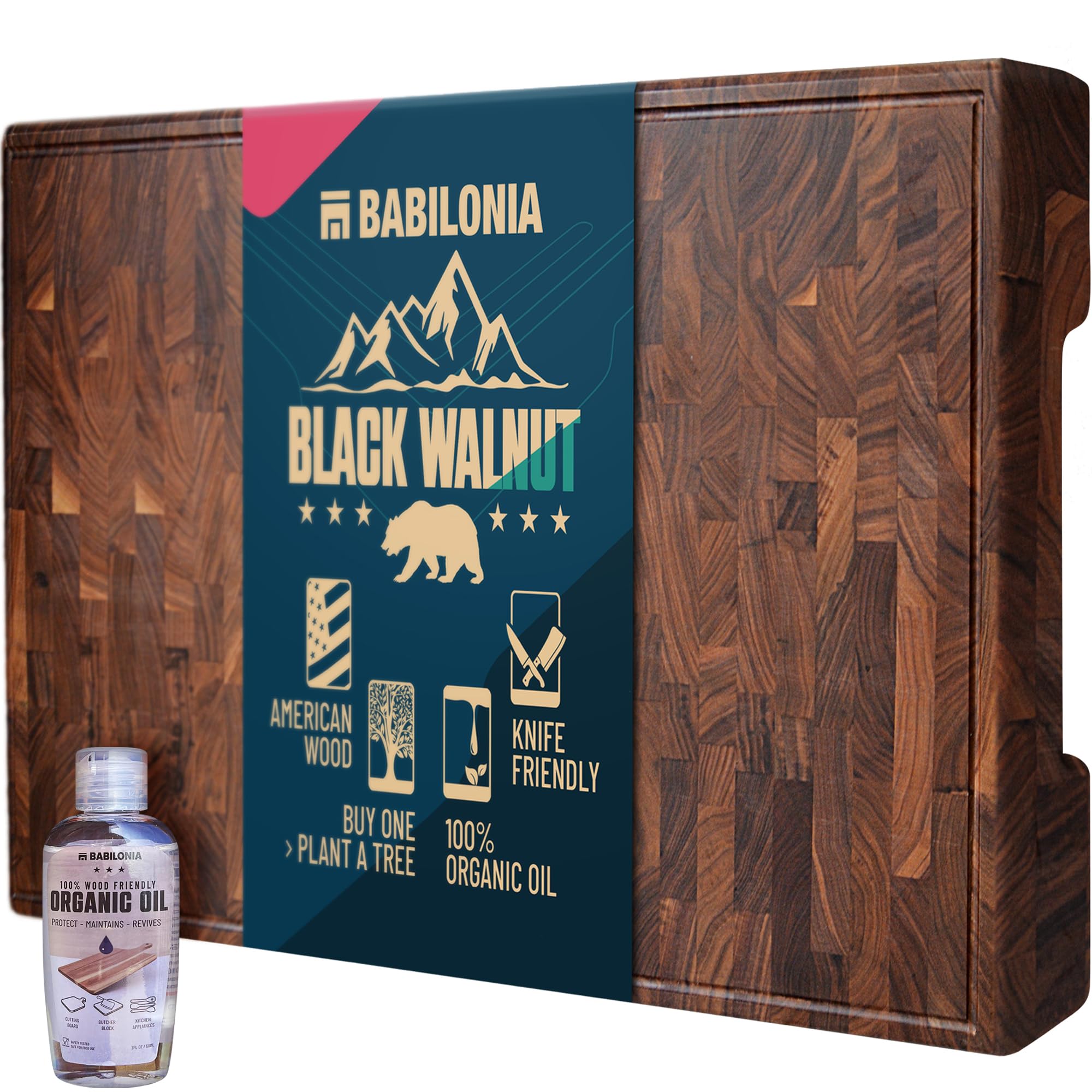
This board uses vertical end-grain fibers in American black walnut — a wood species that sits at a moderate Janka hardness (around 1010 lbf), which means it absorbs blade impact without dulling edges. The 1.7-inch thickness gives it substantial mass so it stays planted during rock-chopping motions. The reversible design includes a juice groove on one side and a flat serving surface on the other, so you can use the grooved side for proteins and the flat side for vegetables without cross-contamination.
A built-in notch holds the included stainless steel plate at an angle — slide chopped ingredients directly into a bowl or pot without lifting the board. The board arrives pre-seasoned with mineral oil, and the included oil bottle extends the treatment cycle for several months. Rubber feet prevent sliding on countertops and allow airflow underneath to prevent moisture buildup. Users consistently report the surface remains smooth even after heavy daily use, provided they apply board conditioner every two to three weeks.
The end-grain pattern self-heals minor knife marks over time, so the board resists the scarred look common on edge-grain models. At approximately 8.8 pounds, it is heavy enough to stay stationary but light enough to move between prep and serving spaces. The walnut grain has natural color variation from light brown to deep chocolate — each board is visually unique.
Why it’s great
- End-grain walnut protects knife edges significantly better than edge-grain or bamboo surfaces
- Included oil and plate add immediate utility without separate purchases
- Built-in notch with plate allows one-handed ingredient transfer to pots and bowls
- Rubber feet and 1.7-inch thickness prevent slipping and warping
Good to know
- Requires periodic mineral oil application to maintain moisture balance and prevent splitting
- Some units have reported grain lifting after first wash — immediate conditioning usually resolves this
- 19.7-inch length may not fit under low kitchen cabinets when stored vertically
2. Dalstrong Cutting Board Lionswood End-Grain Teak 16″ x 12″

The Dalstrong Lionswood board is cut from end-grain teak with a checkerboard pattern that alternates wood grain direction — this geometry prevents the blade from catching on a single grain line, preserving knife sharpness longer than any edge-grain competitor. At 1.9 inches thick, it is among the heaviest consumer boards available, providing absolute stability during aggressive cutting or meat breakdown. The teak species contains natural oils that resist moisture absorption, so it requires less frequent oiling than walnut or maple.
Stainless steel carrying handles are embedded into opposite sides of the board, making it easy to transport from prep to grill to serving table. A half-moon cutout on the underside accepts a standard plate for ingredient collection — the same concept as the BABILONIA board but executed with the plate recessed under the board rather than at the edge. The surface holds up to repeated knife contact without forming deep gouges because the vertical fibers spring back after each cut.
Multiple user reports confirm the board maintains its appearance after months of daily use when conditioned with mineral oil and board wax. Some units have arrived with small cracks or surface imperfections, but Dalstrong customer service has consistently replaced damaged boards without charge. The 16-by-12-inch surface area is ideal for medium-volume prep — enough for a whole chicken or batch of vegetables, though larger cooks may prefer the 20-inch class of boards.
Why it’s great
- Thickest board in the comparison at 1.9 inches — maximum stability and knife impact absorption
- Teak natural oils reduce maintenance frequency compared to other hardwoods
- Stainless steel handles make carrying and serving effortless
- Underside cutout allows plate-based ingredient transfer without extra prep space
Good to know
- Some reports of cracking within the first week — immediate conditioning helps but first-unit quality varies
- Plate cutout may not accommodate plates larger than 8 inches in diameter
- Surface area is smaller than the 20-inch class boards, limiting large-volume prep
3. Yes4All Large Teak Cutting Board 20″ x 15″ x 1.5″

The Yes4All board delivers end-grain teak construction at a generous 20-by-15-inch surface area — large enough to break down a whole turkey or multiple protein batches without shifting ingredients. The 1.5-inch thickness provides enough mass to prevent sliding on countertops while keeping the board manageable for transport. Teak wood sits at approximately 1070 lbf on the Janka scale, moderately hard yet soft enough to avoid damaging knife edges during repetitive chopping motions.
A deep juice groove runs around the perimeter to capture liquids from carving meats, and ergonomic cutout handles on both short sides make lifting and moving the board comfortable even with wet hands. The end-grain checkerboard pattern self-repairs minor knife marks over time, so the surface does not develop the gouged look common on edge-grain boards after months of use. Multiple users confirm the board arrived flat and warp-free, which is critical for even cutting pressure and blade contact.
Some users noted that the juice groove and handle cutouts could benefit from finer sanding — particles may cling to the board after the first wash, but a scouring pad and mineral oil treatment smooth these areas quickly. The teak grain ranges from golden brown to darker streaks, and the board requires periodic conditioning with board butter or mineral oil to maintain its moisture balance and prevent checking. At 11.24 pounds, it sits solidly on the counter yet can be moved by one person.
Why it’s great
- Generous 20×15-inch surface handles large-volume prep including whole poultry
- End-grain teak construction preserves knife edges better than edge-grain or bamboo alternatives
- Deep juice groove and cutout handles add practical functionality for meat preparation
- Flat, warp-free surface out of the box ensures even cutting pressure
Good to know
- Juice groove and handle areas may require manual smoothing for optimal feel
- Teak wood requires regular mineral oil application to maintain moisture resistance
- Heavier than most boards at over 11 pounds — not ideal for frequent repositioning
4. Ironwood Gourmet Carolina Acacia Chopping Board 14″ x 14″ x 1.5″

Ironwood Gourmet uses end-grain acacia wood — a species with a Janka rating around 1750 lbf, which is harder than teak or walnut but still significantly more knife-friendly than bamboo or glass. The 1.5-inch thickness and end-grain construction work together to absorb impact from heavy cleaver work or repetitive rock-chopping without transferring shock to the blade edge. The 14-inch square form factor fits standard countertop spaces while offering a full prep area.
The juice channel around the perimeter is deep enough to hold liquid from a large roast chicken or carved brisket without spillover. Users who remove the rubber feet report that the board lies completely flat against the counter, eliminating the gap that can trap minced ingredients. Acacia wood contains natural antifungal properties and resists water absorption better than most hardwoods, so the board can handle wet protein prep without warping between oiling sessions.
Customer reviews highlight excellent support — one user received a replacement board with return postage paid when the first unit developed raised grain after washing. The board arrives with a smooth, pre-oiled surface ready for immediate use. The square shape makes it equally effective for charcuterie presentation and kitchen prep. Some users note that the grooved surface adds slight friction when moving chopped ingredients across the board, but this also prevents sliding during precise cuts.
Why it’s great
- End-grain acacia balances hardness with knife safety — suitable for both chef knives and cleavers
- Deep juice channel handles large volumes of liquid from roasted meats without overflow
- Removable feet allow flat counter contact, eliminating ingredient trap gaps
- Acacia natural moisture resistance reduces warping risk between maintenance
Good to know
- Grooved cutting surface adds slight resistance when sliding ingredients off the board
- Square 14-inch size is compact for large-volume meal prep requiring multiple ingredients at once
- Some units have raised grain after first wash — immediate oiling and fine sanding resolves it
5. Tramontina Chopping Board Teak End-Grain 17.75″ x 13.5″

Tramontina offers a Brazilian teak end-grain board at a notably accessible tier — the 17.75-by-13.5-inch surface fits comfortably on smaller counters while still providing room for medium-scale prep. The 1.5-inch thickness gives the board enough mass to stay stationary during cutting, and the end-grain construction ensures the blade interacts with vertical fibers rather than slicing across long grain edges. This reduces edge dulling compared to edge-grain boards in the same price bracket.
The teak species naturally contains oils that repel water and resist bacterial absorption, which means this board can handle wet ingredients without swelling or cracking during normal use. Users confirm the board feels solid and well-constructed out of the box, though many emphasize the importance of initial conditioning with food-grade mineral oil and board wax to maximize longevity. The board does not include rubber feet, so it may shift slightly on smooth countertops unless placed on a damp towel.
Multiple reviews note that while the board is durable and attractive, some users prefer larger surfaces for multi-ingredient prep. The teak grain is consistent with attractive medium-brown tones, and the board resists deep knife marks better than edge-grain alternatives at a similar tier. The manufacturer recommends hand washing only, and periodic oiling every three to four weeks keeps the surface from drying out in low-humidity environments.
Why it’s great
- Genuine end-grain construction at a notably budget-friendly entry point
- Brazilian teak offers natural moisture resistance without heavy chemical treatment
- Compact dimensions fit smaller kitchen layouts while still providing adequate prep area
- Resists deep gouging better than comparably-priced edge-grain boards
Good to know
- No rubber feet means the board may slide on smooth countertops without a towel underneath
- Smaller surface area limits handling of large meats or simultaneous multi-ingredient prep
- Requires immediate mineral oil conditioning — not pre-seasoned out of box
6. GAOMON Extra Large Bamboo Cutting Board 30″ x 20″ x 0.8″

This GAOMON board is built from organic bamboo in an edge-grain orientation — not the end-grain construction preferred for knife preservation. Bamboo has a Janka hardness around 1400 lbf and contains silica particles that increase abrasive wear against steel edges. For knife-focused buyers, this board represents a trade-off: excellent size utility but accelerated blade dulling compared to end-grain wood alternatives. The board measures 30 by 20 inches, making it large enough to cover a standard stove or sink.
The 0.8-inch thickness is thinner than the 1.5-inch minimum recommended for heavy chopping, which means the board may flex under repeated knife impact and does not provide the same blade absorption as thicker models. The four-sided juice groove collects liquids from carving, and the reversible design allows separate surfaces for raw meat and fresh produce.
This board is best understood as a multi-functional kitchen tool rather than a dedicated knife-friendly chopping surface. It works well for rolling dough, creating extra counter space over a stove, or serving charcuterie. For users who prioritize blade longevity, this board should be paired with an end-grain option for heavy knife work and used for lighter tasks. The board’s 5.65-kilogram weight makes it manageable for one person to move between the stove and counter.
Why it’s great
- Massive 30×20-inch surface doubles as a stove cover or sink cover for extra prep space
- Reversible design with juice groove handles both meat carving and vegetable prep
- Bamboo construction resists moisture absorption and staining with proper care
- Users report no splintering or warping after extended use
Good to know
- Bamboo and edge-grain orientation dulls knife edges faster than end-grain wood boards
- 0.8-inch thickness provides less blade impact absorption and may flex under heavy pressure
- Not ideal as a primary cutting surface if knife sharpness preservation is the priority
7. XXL American Black Walnut Cutting Board (BABILONIA) 24″ x 15″ x 1.7″
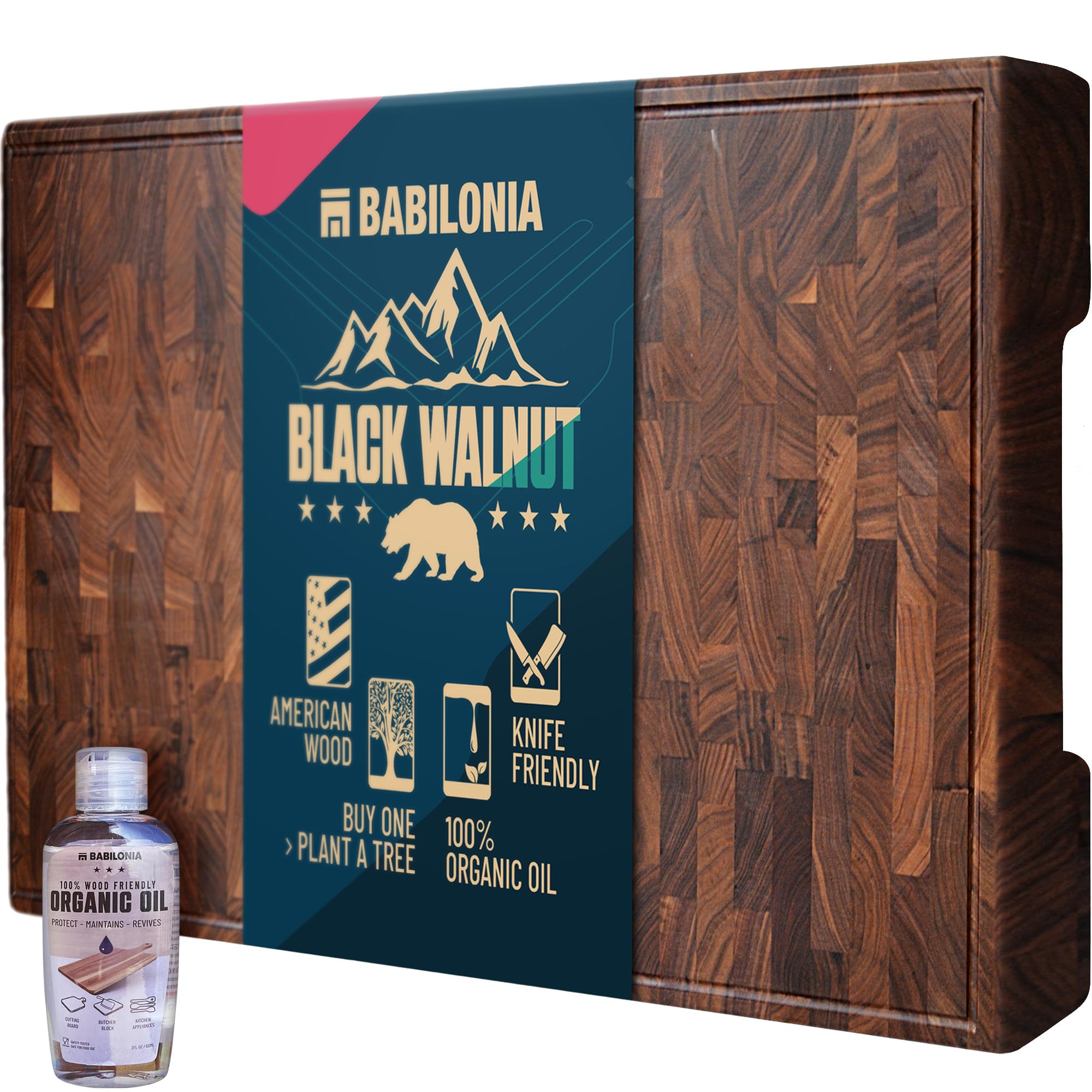
The XXL variant from BABILONIA expands the flagship design to 24 by 15 inches — an additional 4 inches of length compared to the standard model — while retaining the same 1.7-inch end-grain walnut construction. This extra surface area is practical for batch cooking, breaking down multiple proteins simultaneously, or rolling dough on the flat side. The end-grain configuration uses vertical walnut fibers that spread blade impact across thousands of microscopic cells, reducing edge wear compared to any non-end-grain surface.
The board includes the same plate notch mechanism as the smaller version — slide chopped vegetables directly into the included stainless steel plate without lifting the board. Rubber feet on the underside prevent sliding and allow airflow for even drying. The board arrives pre-oiled and seasoned, with an additional bottle of organic mineral oil included for long-term maintenance. Users consistently report that the board remains visually pristine after months of use when conditioned every two to three weeks with the included oil.
Some users have reported splitting within the first two months of use, though BABILONIA customer service replaced affected boards without charge. The split issue appears isolated to units that may have been stored in low-humidity environments or exposed to temperature extremes during shipping. The walnut grain is rich and varied, with light and dark streaks that give each board a distinct appearance. At approximately 8.8 pounds, the board is manageable for its size despite the expansive surface.
Why it’s great
- Expansive 24×15-inch surface handles very large prep volumes without ingredient crowding
- End-grain walnut construction maximizes knife edge preservation compared to any bamboo or edge-grain board
- Built-in plate notch and included oil set provide complete prep system out of the box
- Rubber feet and substantial 1.7-inch thickness prevent all counter movement during heavy use
Good to know
- Some units have reported wood splitting — immediate conditioning may help, and warranty support is responsive
- Large surface may not fit under low cabinets or in compact storage spaces
- Requires consistent mineral oil application every 2-3 weeks to maintain moisture balance
FAQ
Why does end-grain wood protect knife edges better than other materials?
How often should I oil my wood chopping board?
Can bamboo chopping boards damage my knives?
What thickness should a chopping board be for heavy daily use?
Is acacia wood better than teak for knife protection?
Final Thoughts: The Verdict
For most users, the chopping board for knives winner is the Yes4All Large Teak Cutting Board because its 20-by-15-inch end-grain teak surface balances generous prep area, genuine knife protection, and a practical price tier that requires no compromise on construction quality. If you want a dedicated knife-first board with the thickest build and natural oil-rich wood, grab the Dalstrong Lionswood Teak. And for a complete prep system with built-in plate transfer and included oil, nothing beats the American Black Walnut (BABILONIA) — especially if you value both aesthetic presentation and long-term blade health.

Mo Maruf
I created WellFizz to bridge the gap between vague wellness advice and actionable solutions. My mission is simple: to decode the research and give you practical tools you can actually use.
Beyond the data, I am a passionate traveler. I believe that stepping away from the screen to explore new environments is essential for mental clarity and physical vitality.