Our readers keep the lights on and my smoothie glass nicely filled. As an Amazon Associate, I earn from qualifying purchases.
Setting drywall screws to the perfect depth without cracking the paper surface is the hallmark of a professional finish. A corded screw gun delivers that consistency, but the freedom of a battery-powered model changes how you move across a job site—no extension cords to trip over, no outlets to hunt for, just you and the tool moving at the speed of work. The problem is that not every cordless screw gun delivers the same precision; some lack the torque to sink into metal studs, while others chew through batteries faster than you can swap them.
I’m Mohammad Maruf — the founder and writer behind WellFizz. I research cordless tool specifications and analyze user feedback across hundreds of work cycles to identify which models actually hold up under real drywall and deck-fastening conditions.
This guide breaks down seven competing models by their brushless motor efficiency, depth-adjustment range, and grip ergonomics to help you decide which best cordless screw gun matches your trade and your budget without wasting time on tools that fade after a few hundred screws.
How To Choose The Best Cordless Screw Gun
A cordless screw gun lives or dies by three things: how consistently it sets screw depth, how long it runs before a battery swap, and how comfortable it feels during repetitive overhead drives. The wide RPM range and adjustable noses separate production tools from general-purpose drills pressed into drywall duty, so understanding the trade-offs saves you from buying something that only works half the time.
Brushless Motor and RPM Bandwidth
Brushless motors use electronic commutation instead of carbon brushes, which reduces heat buildup and extends runtime by up to 50 percent compared to older brushed designs. For a cordless screw gun, you want at least 0-4,000 RPM on the top end to handle quick drywall runs, but also a usable low speed of around 1,500 RPM for metal or cabinet work where you need more control. Narrow-speed tools force you to feather the trigger constantly, which fatigues the hand and produces inconsistent results.
Depth Adjustment and Drive Technology
The nose cone depth collar adjusts how deep the screw sits in relation to the surface—too deep breaks the paper, too shallow leaves the head proud. Look for a collet that tightens with a simple twist or a tool-free friction ring that does not drift during heavy use. Push-drive technology, where the motor only engages when you press the bit into the screw head, saves battery and reduces noise, but a lock-on switch with variable-speed trigger gives you more control for specialty fasteners like deck screws or metal self-tappers.
Battery Platform and System Weight
Every screw gun is part of a larger battery ecosystem. Sticking with a platform you already own saves money on chargers and extra packs, but the battery size also dictates the balance point of the tool. An 18-volt pack adds weight that can wear you down during a full day of ceiling work, while a 12-volt system keeps things light at the expense of total runtime. Check whether the gun accepts both compact and high-capacity batteries so you can switch between light-duty and production runs without buying a second tool.
Quick Comparison
On smaller screens, swipe sideways to see the full table.
| Model | Category | Best For | Key Spec | Amazon |
|---|---|---|---|---|
| DEWALT DCF622B 20V Max XR Versa-Clutch | Premium | Metal roofing & deck screws | Versa-Clutch adjustable torque, 2,000 RPM | Amazon |
| Makita XSF03Z 18V LXT Brushless | Premium | Production drywall runs | Push-drive, 0-4,000 RPM | Amazon |
| Bosch GTB18V-45N 18V Brushless | Premium | Auto-feed & light commercial framing | Xtend Drive, 4,500 max RPM | Amazon |
| DEWALT DCF601B 12V Max Brushless | Mid-Range | Electrical & light fastening | 15 clutch settings, 1,100 RPM | Amazon |
| RYOBI P225 18V Brushless Drywall Gun | Mid-Range | Budget-friendly drywall | 4,700 RPM, silent mode | Amazon |
| Milwaukee 2402-20 M12 12V Screwdriver | Entry-Level | Assembly & tight-space handyman work | 1/4″ hex collet, 2 lb weight | Amazon |
| Milwaukee 2101-22 M4 1/4 Hex Kit | Entry-Level | Light assembly & field repairs | Compact stick design, 2 batteries included | Amazon |
In‑Depth Reviews
1. DEWALT 20V MAX XR Screw Gun, Versa-Clutch, Adjustable Torque, Tool Only (DCF622B)

The DCF622B stands apart from the rest of the field because of its Versa-Clutch system, which lets you set a maximum torque that disengages the drive train the moment the screw reaches the desired depth. This feature makes it the ideal choice for metal roofing, siding, and deck screws where an impact driver would keep spinning and cam-out damage the material. The brushless motor delivers a steady 2,000 RPM, which is lower than a drywall-specific gun but purposeful for applications where exact control matters more than raw speed.
Users consistently mention the low-vibration operation and smooth trigger response, with several noting that the screw depth control prevents over-driving into softwoods and thin-gauge steel. The belt clip positions the tool securely at the hip, and the built-in LED works well in soffit and eave areas where shadows are a problem. Bare-tool availability means you only pay for the gun if you already own 20V Max batteries, which keeps the upfront cost reasonable for existing DeWalt users.
This is not the fastest tool for hanging thousands of drywall sheets, but the torque control and reduced wrist fatigue make it a standout for metal and wood fastening where precision is the priority. Experienced tradespeople who value consistency over sheer throughput will find the DCF622B a worthy addition to their fastening lineup.
Why it’s great
- Versa-Clutch gives unmatched depth control for metal and deck screws
- Brushless motor runs cool and extends runtime per charge
- Smooth low-vibration operation reduces hand fatigue
Good to know
- 2,000 RPM is slower than dedicated drywall screw guns
- Bare tool requires existing 20V battery investment
2. Makita XSF03Z 18V LXT Lithium-Ion Brushless Cordless Drywall Screwdriver (Bare Tool Only)

The XSF03Z uses Makita’s Push-Drive technology to engage the brushless motor only when you press the bit into the screw head, which makes the tool quieter on the job site and extends runtime by up to 50 percent compared to older brushed models. The 0-4,000 RPM range covers both the fast drywall cadence needed for production work and a slower setting for metal studs where you need to feel the bite. The electronic controller matches torque to the load demand, so you do not waste battery power on idle spin.
Users who upgraded from corded Makita drywall guns report that this version handles exactly like the old tool but without the cord drag, and the smooth engagement makes consistent depth easy to achieve across hundreds of fasteners. The compact nose design allows the bit to sit close to the material surface, giving you better leverage and accuracy during overhead ceiling drives. The 3-year warranty on the tool provides reasonable coverage for daily commercial use.
Weight with a full 18V battery is around 3 pounds, which is heavier than 12V alternatives but justified by the runtime you gain. The bare-tool format assumes you already have LXT batteries and charger, making this a logical upgrade for existing Makita users who want to trade the cord for mobility.
Why it’s great
- Push-Drive saves battery and cuts job-site noise
- 0-4,000 RPM range suits both drywall and metal stud work
- Brushless motor delivers up to 50% more runtime
Good to know
- Heavier than 12V competitors at roughly 3 pounds with battery
- Bare tool requires existing LXT platform investment
3. Bosch GTB18V-45N 18V Brushless 1/4 In. Hex Screwgun (Bare Tool)

The Bosch GTB18V-45N delivers 4,500 RPM from a brushless motor, which is among the highest speeds in this class and directly translates to faster screw cycles when you are working through pallets of drywall. The Xtend Drive technology activates the motor only when the bit senses forward pressure, reducing noise and preventing unnecessary battery drain between fasteners. The grip geometry is designed so your thumb and index finger naturally control the tool, and the compact barrel keeps your hand close to the work surface for maximum leverage.
Users highlight the retractable depth gauge as a practical feature because you do not need to remove the entire nose cone to reverse a screw—just slide the collar back and the bit engages in reverse without disassembly. The auto-feed screwdriver compatibility makes this a go-to for cabinet assembly and light framing where consistent depth across dozens of collated fasteners saves time. The belt clip is included, and the lock-on switch allows extended operation without holding the trigger.
At a sub-0.01 pounds stated weight (actual around 2.5 pounds with battery), this is a light tool that handles well during long overhead work. The downside is that the auto-on engagement can make it awkward to back out mis-set screws without a separate driver, so keep a manual screwdriver nearby for corrections.
Why it’s great
- 4,500 RPM top speed for fast drywall production
- Retractable depth gauge eliminates nose-cone removal for reverses
- Lightweight barrel design reduces fatigue during overhead work
Good to know
- Auto-on mode can complicate screw removal adjustment
- Bare tool requires Bosch 18V battery system
4. DEWALT XTREME 12V MAX Cordless Screwdriver, 1/4-Inch, Tool Only (DCF601B)
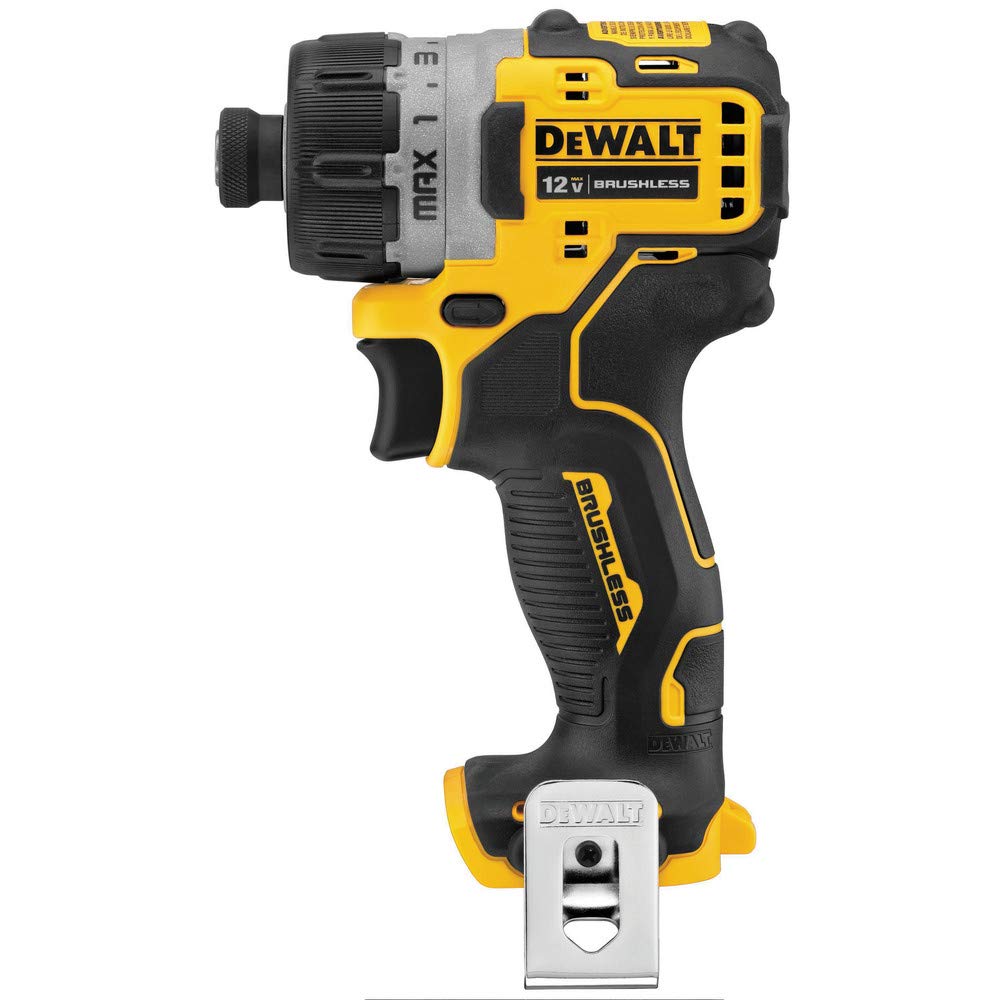
The DCF601B runs on the 12V MAX platform and uses a brushless motor to deliver 25 percent more power than previous DEWALT 12V screwdrivers while the body is 23 percent shorter, making it the most compact option in this review for tight cabinet and electrical panel work. The 15 clutch settings give you granular control over torque output, with each step roughly representing 2 in-lbs of force, so you can dial in exactly the amount needed for 3/16-inch screws without stripping the head. The 1,100 RPM top speed is low, but that is intentional—this is a precision fastener driver, not a drywall production gun.
Users consistently praise its light weight of 1.63 pounds, noting that the battery sits under the handle rather than hanging off the back, which makes overhead work feel balanced and effortless. The three-LED nose ring provides shadow-free illumination right at the fastener point, and the drop-and-load 1/4-inch hex collet accepts standard 1-inch bit tips without a chuck collar. Belt clip comes included, and the quick-release mechanism allows one-handed bit swaps in awkward positions.
This tool is not suited for driving long deck screws or hanging full sheets of drywall—it lacks the RPM range and depth collar for those jobs. For electrical, cabinet assembly, and general maintenance work where weight and control are the main priorities, the DCF601B is nearly perfect.
Why it’s great
- 15 clutch settings give precise torque control for delicate materials
- Ultra-light at 1.63 pounds with excellent overhead balance
- Brushless motor extends runtime despite small battery size
Good to know
- 1,100 RPM is too slow for production drywall work
- Lacks a depth-adjustment nose for drywall-specific driving
5. RYOBI ONEAND 18V Cordless BRUSHLESS Drywall Screw Gun Tool ONLY P225

The P225 is RYOBI’s entry into the dedicated drywall screw-gun space, offering a brushless motor that spins up to 4,700 RPM with a silent-mode option that kills the continuous motor whine between fasteners. The nose cone adjusts with a simple twist, and the included depth gauge sets the screw head flush with or slightly below the paper surface depending on your preference. For users already invested in RYOBI’s ONE+ 18V platform, this tool provides a cost-effective way to add drywall capability without buying into a new battery system.
Real-world reports show users installing upward of 6,000 screws during a single house build, which speaks to the motor’s thermal endurance despite the budget-friendly positioning. The silent mode is particularly appreciated on residential jobs where the constant high-pitch buzz of a standard screw gun irritates homeowners. The depth collar holds setting reasonably well, though some users note drift after extended use on uneven drywall brands, requiring mid-job recalibration.
The biggest complaint revolves around the weak magnet at the collet tip, which struggles to hold a screw steady during one-handed placement. Expect to use your free hand to guide the fastener until the threads engage. If your budget is tight and you already own RYOBI batteries, the P225 delivers respectable speed and runtime for light-to-moderate drywall schedules.
Why it’s great
- 4,700 RPM top speed rivals premium models for less investment
- Silent mode reduces noise on residential job sites
- Compatible with existing RYOBI ONE+ battery ecosystem
Good to know
- Weak collet magnet makes one-handed placement difficult
- Depth collar can drift during long runs and need recalibration
6. Milwaukee Cordless Screwdriver, 12V, 1/4 In., Red (2402-20)
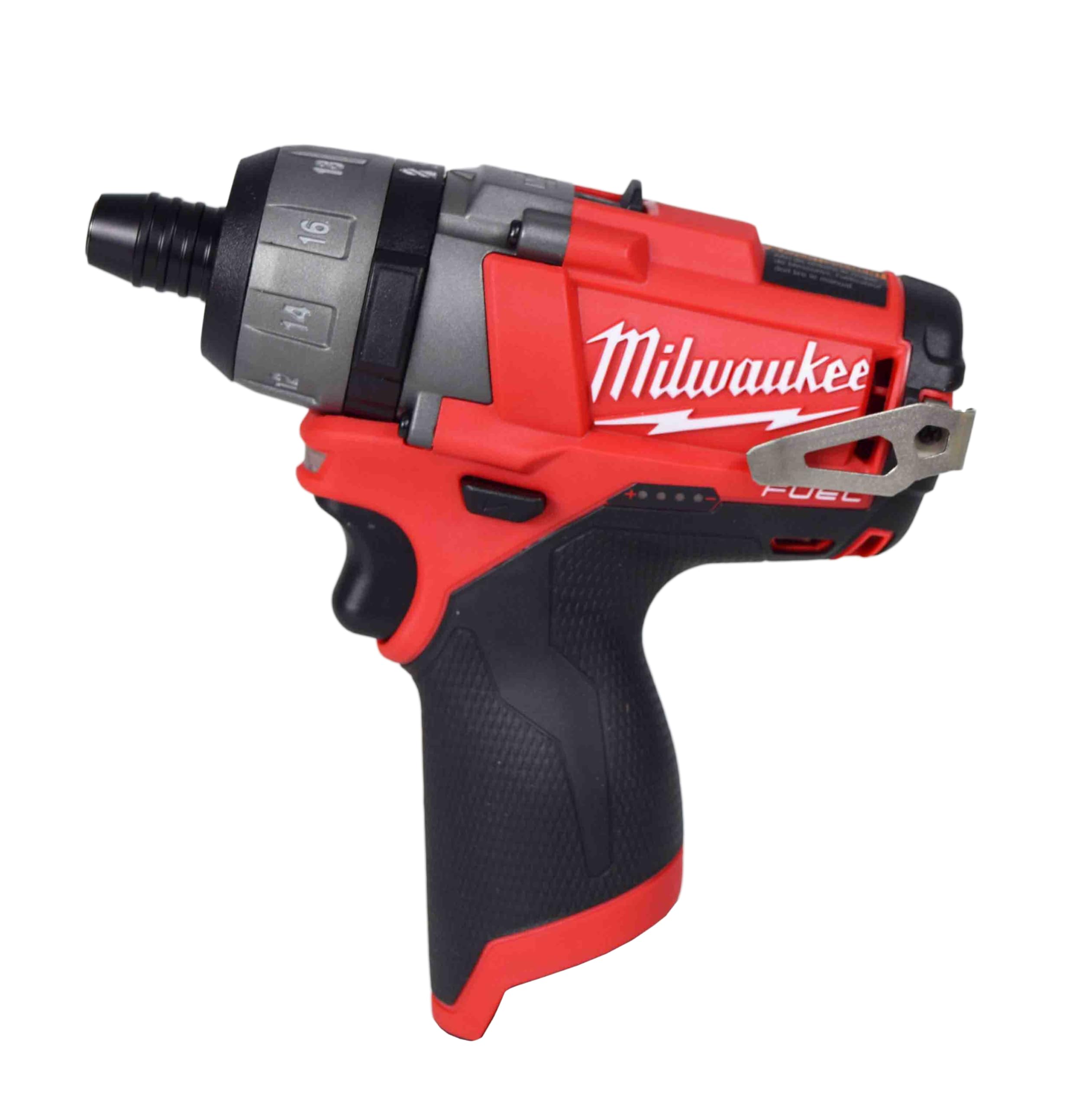
The 2402-20 is a 12V cordless screwdriver that weighs only 2 pounds with a compact stick design that fits into tight engine bays, underbelly panels, and cramped cabinet spaces where bulkier guns simply cannot reach. The 1/4-inch hex collet accepts standard driver bits, and the variable-speed trigger gives you enough control for removing metric bolts and driving 2-inch screws into soft wood during light handyman runs. It runs on Milwaukee’s M12 battery system, which is shared across dozens of tools in the same lineup, so an existing M12 user gains a dedicated screwdriver at a reasonable incremental cost.
Users regularly call this their go-to tool for bench work and assembly because it provides more torque than a manual screwdriver without the mass of an impact driver. The 2.0 Ah High Output battery adds a good balance of runtime and weight, while the 5.0 HO battery delivers more power but makes the gun feel nose-heavy and defeats the compact advantage. The multi-speed settings let you dial between delicate cabinet screws and harder fasteners with a simple switch on the top of the handle.
This is not a drywall gun—it lacks a depth-adjustment collar and the RPM range for production hanging—so treat it as what it is: a lightweight, portable screwdriver that saves your wrist during repetitive fastening tasks. The 5-year warranty adds confidence for long-term ownership.
Why it’s great
- Extremely compact for tight-space work like engine bays and panels
- Multi-speed trigger gives good control across varied fasteners
- Strong M12 ecosystem with excellent battery options
Good to know
- Not suitable for drywall production due to lack of depth collar
- Large battery defeats the compact form factor
7. Milwaukee 2101-22 M4 1/4 Hex Screwdriver Kit W/2 Bat

The 2101-22 kit includes two M4 batteries and the screwdriver body in a single package, which eliminates the bare-tool hurdle for newcomers who do not yet own Milwaukee batteries. The M4 system is a sub-compact platform separate from the M12 lineup, offering an even smaller form factor at just 1.08 pounds—light enough to carry in a tool belt pocket without noticing the weight. The 1/4-inch hex collet accepts standard bits, and the stick-style grip feels natural for light assembly, construction work, and field repairs where you need a powered driver but not the bulk of a traditional drill.
Users describe it as the ideal gadget for working smarter rather than harder, noting that it handles #10 machine screws and smaller fasteners up to 1/4 inch without stripping. The dual-battery setup means you can keep one on the charger while working with the other, which effectively gives you continuous runtime for a full day of light fastening. The compact design fits into toolboxes with minimal space, and the included bit set covers the most common screwdriving needs out of the box.
The torque is limited compared to full-size screw guns—this will struggle with large deck screws or drywall—but for the intended use of assembly, electronics, and trim work, the 2101-22 excels as a complete ready-to-run kit. The separate M4 battery system means you cannot share packs with M12 or M18 tools, which limits platform consolidation.
Why it’s great
- Complete kit with two batteries removes the bare-tool barrier
- Ultra-light 1.08 pounds for all-day carry and pocket storage
- Excellent for light assembly, cabinets, and fast field repairs
Good to know
- Low torque limits use to small fasteners and trim work
- M4 battery system cannot share packs with larger Milwaukee platforms
FAQ
Can I use a cordless screw gun for deck screws or is it only for drywall?
Do I need a separate battery platform for a cordless screw gun or can I share with my other tools?
Why does my screw gun keep over-driving screws or breaking the drywall paper?
Final Thoughts: The Verdict
For most users, the best cordless screw gun winner is the DEWALT DCF622B because its Versa-Clutch system gives you precise depth control across drywall, metal, and deck applications without the risk of over-driving. If you want a dedicated production drywall tool with excellent runtime and push-drive efficiency, grab the Makita XSF03Z. And for precision assembly and electrical work where weight and balance matter most, nothing beats the DEWALT DCF601B.

Mo Maruf
I created WellFizz to bridge the gap between vague wellness advice and actionable solutions. My mission is simple: to decode the research and give you practical tools you can actually use.
Beyond the data, I am a passionate traveler. I believe that stepping away from the screen to explore new environments is essential for mental clarity and physical vitality.