Our readers keep the lights on and my smoothie glass nicely filled. As an Amazon Associate, I earn from qualifying purchases.
The shelf of a typical big-box store is packed with colorful boxes promising volcanoes and growing crystals, but most of them are just fancy baking soda and vinegar kits. A real chemistry set for a curious kid needs to teach the method behind the reaction — not just deliver a quick fizz. The difference between a toy that gets tossed aside after one use and a set that builds genuine lab skills comes down to the instruction manual, the quality of the included tools, and whether the experiments actually explain the science as they go.
I’m Mohammad Maruf — the founder and writer behind WellFizz. I’ve spent countless hours researching chemistry sets, analyzing their experiment counts, chemical safety, and the depth of their instructional manuals to separate the true learning tools from the flash-in-the-pan toys.
After reviewing dozens of kits side by side, these seven represent the very best options for turning a child’s curiosity into real scientific thinking. This guide is focused on finding the absolute best chemistry set for your young scientist based on age, depth of content, and long-term engagement.
How To Choose The Best Chemistry Set
Chemistry sets vary wildly in ambition. Some are designed for preschoolers to mix colored water, while others expect a 10-year-old to follow multi-step procedures. The key is matching the set to the child’s reading level and patience, not just their age.
Experiment Count vs. Experiment Depth
A set advertising 300 experiments often achieves that number by repeating the same reaction with different food colors or splitting a single project into many tiny steps. Look for a manual that explains the chemical principles behind each experiment — that is where the real learning happens. A kit with 50 well-explained experiments will teach more than a kit with 200 repetitive ones.
Real Lab Tools vs. Plastic Trinkets
The best chemistry sets include glass beakers, real test tubes, and metal spatulas that teach proper handling and measurement. Plastic everything might be safer for very young children, but it also teaches carelessness. For kids 8 and up, a set with fragile, real equipment is a feature, not a bug — it forces careful technique.
Chemical Quality and Safety
Check whether the kit meets ASTM F963-17 (US safety standard) or EN 71-4 (European safety standard for chemistry sets). The included chemicals should be clearly labeled with GHS hazard information. A good kit will also include safety goggles that are ANSI Z87 rated, not just decorative plastic. Avoid any set that uses unlabeled powder packets.
The Manual Is the Curriculum
Read reviews that mention the instruction manual specifically. Is it a thin leaflet with a few pictures, or a full-color booklet that explains why the reaction happened? The best manuals also include sections on lab safety, waste disposal, and clean-up procedures — all real lab skills.
Quick Comparison
On smaller screens, swipe sideways to see the full table.
| Model | Category | Best For | Key Spec | Amazon |
|---|---|---|---|---|
| Thames & Kosmos Chem C1000 | Premium | Aspiring young chemists 10+ | 125 experiments + 7 real chemicals | Amazon |
| UNGLINGA 300+ Experiments | Mid-Range | Variety seekers 8+ | 300+ experiments across 4 science fields | Amazon |
| Butterfly EduFields 150+ | Mid-Range | STEM enthusiasts 8-14 | 150+ experiments with bonus booklet | Amazon |
| Thames & Kosmos Chem C500 | Entry-Level | Absolute beginners | 28 guided experiments + 48-page manual | Amazon |
| National Geographic Junior Chemistry | Entry-Level | Young scientists 4-6 | 50 experiments + 20+ lab tools | Amazon |
| Doctor Jupiter Girls’ Science Kit | Niche | Girls 8-14 starting STEM | 135+ experiments + bonus booklet | Amazon |
| Smartivity Magic Science | Budget | Early learners 4-8 | 50+ experiments with messy mat | Amazon |
In‑Depth Reviews
1. Thames & Kosmos Chem C1000 (V 2.0)

This is the real deal. The Chem C1000 comes with seven genuine chemicals — sodium carbonate, copper(II) sulfate, citric acid, and others — not just baking soda and vinegar. The 80-page full-color manual organizes 125 experiments into ten themed chapters covering everything from invisible inks and chromatography to electrolysis and carbon dioxide chemistry. Each experiment builds on the last, teaching real lab technique and the scientific method.
The included equipment reflects serious intent: glass test tubes, two graduated beakers with lids, a funnel, three dropper pipettes, copper wire, filter paper, and ANSI Z87-rated safety goggles. The set also includes a 9-volt battery clip for electrochemistry experiments that generate electricity from chemical reactions. The manual integrates proper safety rules, first-aid guidance, and GHS hazard labeling for every chemical.
This is not a set for casual play. The experiments often require patience — some need to sit for a day before showing results — and the manual expects a 10-year-old to read carefully. But for a child who is ready to graduate from kitchen-science toys, the Chem C1000 builds a foundation that leads directly into high school chemistry. It won a Parents’ Choice Gold Award for good reason.
Why it’s great
- Real glass lab equipment teaches careful handling
- Seven authentic chemicals with GHS labeling
- Manual explains the chemistry behind each reaction
- Builds toward more advanced Thames & Kosmos sets
Good to know
- Requires many common household items (sand, denatured alcohol, distilled water) not included
- Some experiments take a full day to complete
- Adult supervision is mandatory for all activities
2. UNGLINGA 300+ Experiments Science Kit
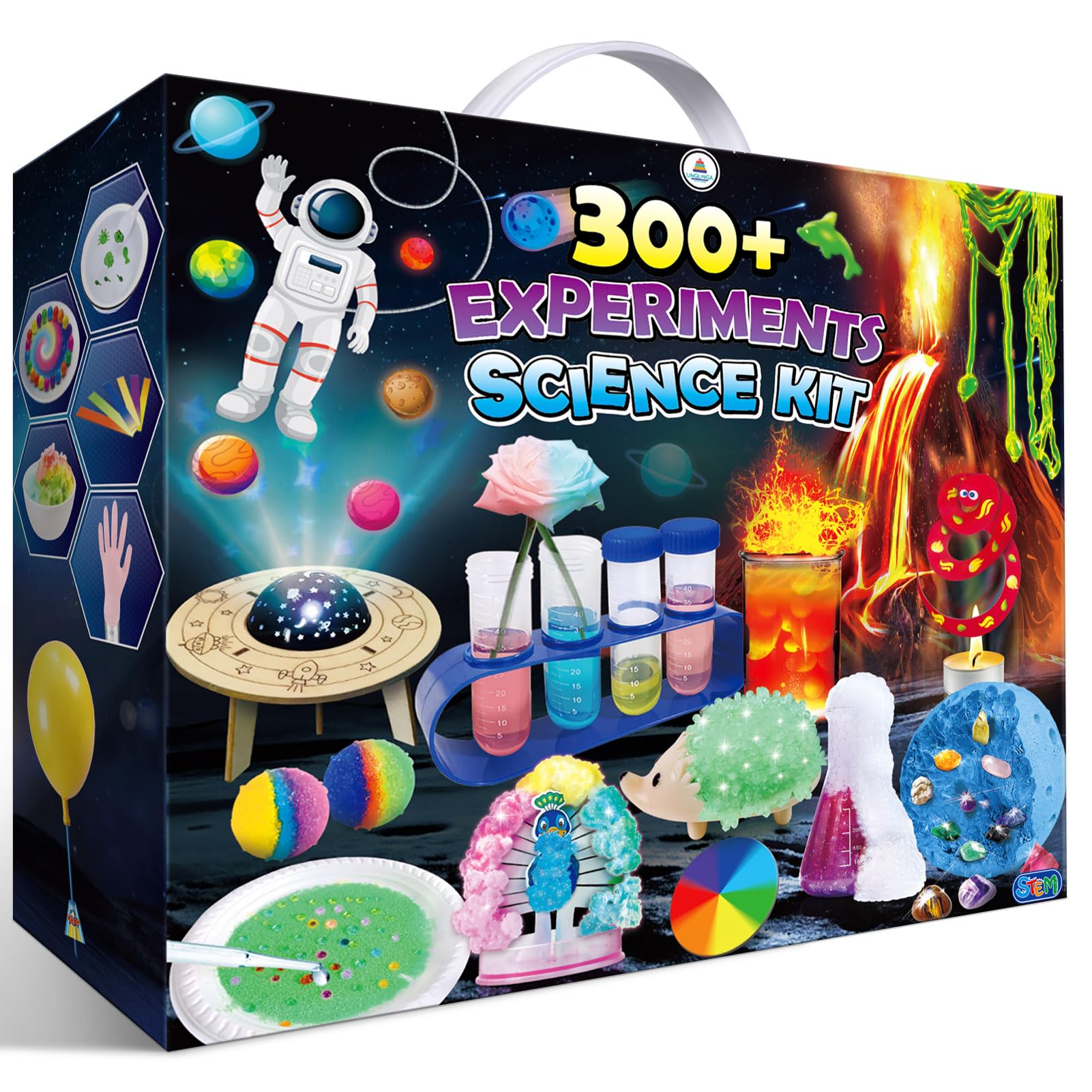
With an advertised count of over 300 experiments, this kit delivers an enormous amount of content. The experiments span chemistry, physics, geology, and even a few magic tricks — including volcanoes, crystal growing, soap making, bouncy balls, and fruit circuits. The step-by-step illustrated manual is clear and well-organized, though it leans lighter on explaining the scientific principles behind each activity.
The kit includes proper lab tools: test tubes, a dropper, a beaker, a conical flask, and safety goggles. The materials are durable plastic, which is appropriate for the 8+ age range. The set also comes with food coloring, baking soda, citric acid, and other consumables. Reviews note that the materials are not pre-sorted per experiment, requiring an adult to help organize before starting.
This is a strong choice for a child who likes variety and wants to try a bit of everything — chemistry, geology, and physics — in one box. The sheer number of activities means it will take weeks to work through completely, and many of the consumables are reusable or easily replaceable. It is a practical, high-value set for the mid-range price.
Why it’s great
- Massive variety keeps kids engaged for weeks
- Clear illustrated instructions with pictures
- Includes tools for physics and geology, not just chemistry
- Good value for the number of experiments
Good to know
- Materials not grouped per experiment — needs prep time
- Scientific explanations are light; more show than tell
- Some projects require patience (bouncy balls need 30-minute drying)
3. Butterfly EduFields 150+ Science Kits

This kit focuses heavily on hands-on, screen-free play with 150+ experiments in a single box. The included components are substantial: a 50ml test tube, measuring spoon, stirring stick, three measuring cups, a tray, safety gloves, a volcano mold, food colors, and additives like snow powder, glow-in-dark powder, bubble solution, and gum arabic. The dual manual — a main instruction book plus a bonus experiment booklet — covers a wide range of activities from slime-making to color reactions.
The curriculum emphasizes concept development, critical thinking, and observational skills. Experiments are designed to be done with basic household materials, so the consumables in the box last longer. The kit meets ASTM F963-17 safety standards, and the components are made from durable plastic rather than cheap, brittle materials. Parents appreciate that children aged 8 to 10 can complete many experiments with minimal help.
One common note from reviewers: the food coloring included in some batches can leak during shipping, so consider having backup colors on hand. Also, while the kit claims 150+ experiments, some activities are variations of the same core reaction, which keeps the fun going but does not always teach new concepts. For the price, this kit offers excellent depth for the 8-14 age bracket.
Why it’s great
- Strong STEM focus with concept development exercises
- Includes safety gloves and tray for clean play
- Bonus booklet extends the kit’s lifespan
Good to know
- Food coloring can leak in transit
- Some experiments are just creative variations, not new science
- Not all 150+ experiments are fully unique concepts
4. Thames & Kosmos Chem C500

The Chem C500 is the introductory member of the Thames & Kosmos chemistry line, and it serves as a perfect first step before moving to the Chem C1000. The 48-page manual covers 28 classic experiments that teach acids and bases, fizzy reactions, invisible ink, and the behavior of solids, liquids, and gases. Every experiment includes a clear “what happened and why” explanation that reinforces real chemical concepts.
The kit includes real lab equipment: beakers, test tubes, chemicals, stoppers, and pipettes. The chemicals are food-grade and safe for young hands, though the set ships with only four substances (including baking soda), meaning most experiments require household supplies like vinegar, paper, paint brushes, and distilled water. The experiment count is low, but each experiment is thoughtfully designed to teach a distinct concept.
This set is best for a child who is new to chemistry and needs a structured, guided introduction. The 28 experiments can be completed in a weekend if you push through, but taking them slowly — one per day — allows the concepts to sink in. Parents should expect to be active lab partners, especially for the first few experiments. The Chem C500 earned a Parents’ Choice Silver Award for its instructional quality.
Why it’s great
- Excellent manual teaches real lab protocol
- Real glass and test tubes — not cheap plastic
- Food-grade chemicals are safe for young scientists
- Perfect stepping stone to the C1000
Good to know
- Only 28 experiments — go through them quickly
- Requires many household items not included
- Chemicals are minimal; will need to buy more
5. National Geographic Junior Chemistry Set

Built specifically for the 4 to 6 age range, this kit from Blue Marble (the Toy of the Year Award-winning company behind National Geographic’s science line) focuses on safe, visual, cause-and-effect experiments. The 50 experiments are designed to use common household items like baking soda and vinegar, which means the included 20+ lab tools — test tubes, goggles, and other kid-friendly implements — last through many repeat experiments.
The illustrated instructions are fully visual, allowing pre-literate children to follow along by looking at the pictures. The included materials are durable rubber and plastic, which survive drops, spills, and enthusiastic handling. The kit also comes with red, yellow, and blue food coloring for color-mixing experiments that teach the basics of chemical indicators without requiring actual litmus paper.
Parents report that this set works well for children who are too young for the Thames & Kosmos line but are already showing interest in reactions. The experiments are short — five to ten minutes each — which matches the attention span of a four-year-old. The kit does not teach lab technique or chemical names, but it is a wonderful introduction to the idea that mixing things creates predictable results.
Why it’s great
- Durable rubber and plastic tools survive rough handling
- Visual instructions work for pre-readers
- Quick 5-10 minute experiments suit young attention spans
- Developed by an award-winning educational brand
Good to know
- Experiments rely heavily on baking soda and vinegar
- Does not teach chemical names or lab technique
- Best suited for casual exploration, not deep learning
6. Doctor Jupiter Girls’ Science Kit
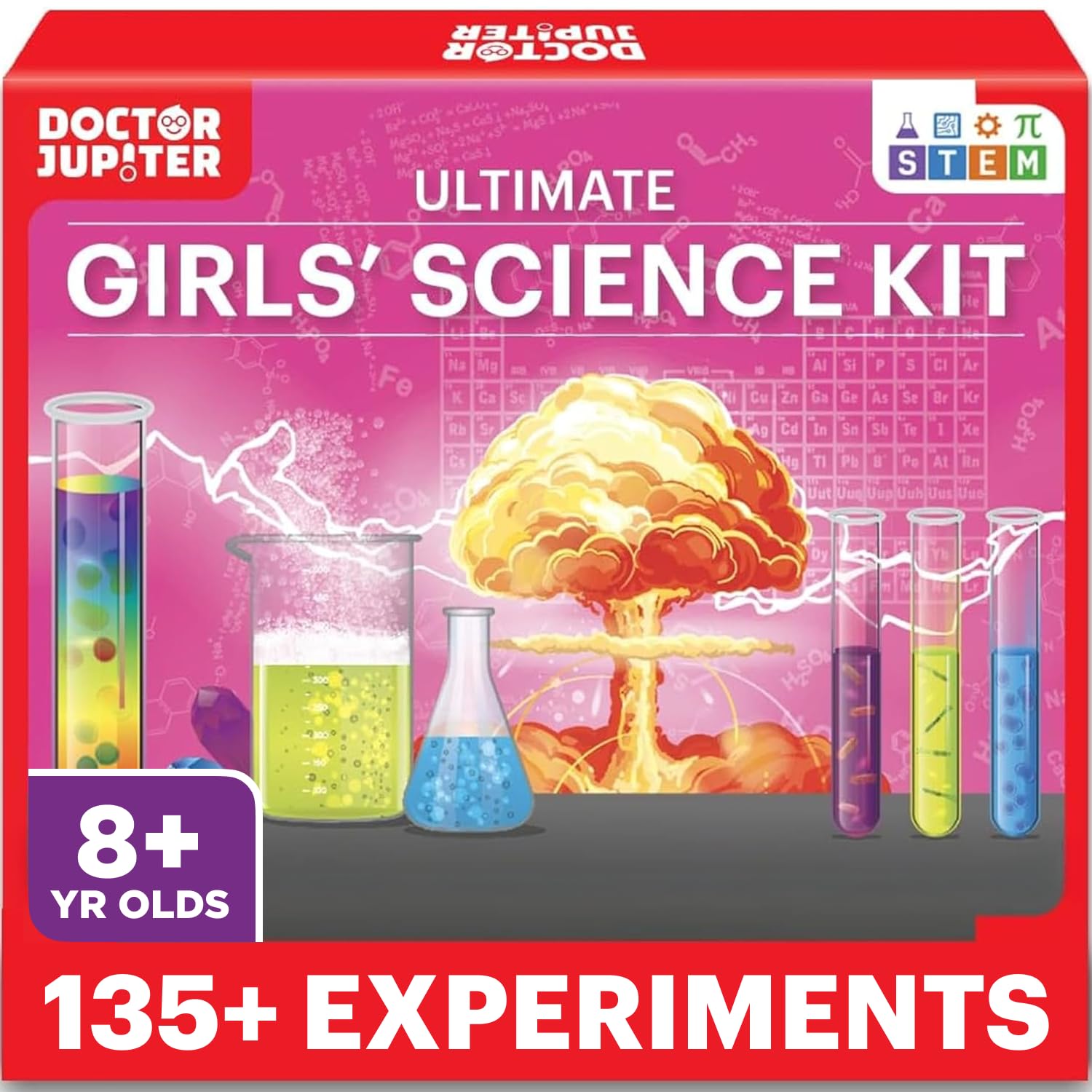
This kit was designed specifically to appeal to girls aged 8 to 14, with a focus on making STEM learning feel accessible and exciting. The 135+ experiments cover volcano science, water science, color science, crystal growing, and soap making. The included components are extensive: a measuring cylinder, conical flask, spatula, stirring sticks, test tube stand, funnel, tray, soap molds, food essences, and six ingredients including glow powder, crystal powder, and citric acid.
The instruction manual is written for independent use — reviewers consistently note that children as young as 9 can follow the steps without constant adult help. The experiments are designed to be short (5-10 minutes), which holds attention and builds confidence. The kit also includes a bonus experiment booklet that adds variety beyond the main 135 activities. Safety is addressed through ASTM F963-17 compliance, and the kit comes with fabric face masks and gloves for the soap-making projects.
Some parents mention that the kit requires additional vinegar and slime ingredients if you want to repeat experiments, and the many small pieces demand organized storage. But the overall feedback is overwhelmingly positive — children feel like “real scientists” because the kit provides genuine lab tools and a structured approach. It is a thoughtful, well-designed set for its target audience.
Why it’s great
- Designed for independent use by children 9+
- Includes soap molds, essences, and glow powder for variety
- Quick experiments build confidence and engagement
- Meets US safety standards ASTM F963-17
Good to know
- Requires extra vinegar and slime ingredients for repeats
- Many small pieces need organized storage
- Some experiments are variations of the same reaction
7. Smartivity Magic Science Kit

Smartivity has built a strong reputation across 24 countries for durable, well-designed educational toys, and this Magic Science kit is one of their most popular offerings. Aimed at ages 4 to 8, it combines chemistry and physics experiments — chemical reactions, density, polymers, air pressure, magnetism, electricity, and optics — into a single 50+ experiment collection. The kit includes 58 parts and a detailed instructional manual.
The standout feature is the inclusion of a messy mat, a practical addition that makes clean-up much easier for parents. The experiments are designed to use only basic household items like water, milk, and cooking oil, which means the kit’s consumables last longer. Children can make rockets, explore color mixing, and test whether oil and water can mix — all with step-by-step guidance that works for early readers.
Parents appreciate that the set is non-toxic and has been tested in global labs. The experiments are safe and the materials are sturdy. The main trade-off is that the set covers many types of science, so chemistry still gets only a portion of the 50 experiments. For a child who is just starting to explore science broadly, this kit is a strong entry point at a budget-friendly price.
Why it’s great
- Includes a messy mat for easy clean-up
- Covers chemistry, physics, and biology in one set
- Non-toxic materials tested in global labs
- Sturdy parts designed for rough handling
Good to know
- Chemistry is only a fraction of the 50+ experiments
- Manual is good but could explain science concepts more deeply
- Best for broad exploration rather than focused chemistry learning
FAQ
What is the difference between a chemistry set and a science kit?
How much adult supervision does a chemistry set really need?
Can I reuse a chemistry set after the consumable chemicals run out?
Which safety certifications should I look for in a chemistry set?
Final Thoughts: The Verdict
For most users, the best chemistry set winner is the Thames & Kosmos Chem C1000 because it combines real lab equipment, seven authentic chemicals, and an 80-page manual that teaches genuine laboratory technique across 125 experiments. If you want a massive variety of activities at a mid-range price, grab the UNGLINGA 300+ Experiments kit. And for a young learner just starting their science journey, nothing beats the National Geographic Junior Chemistry Set for safety and age-appropriate fun.

Mo Maruf
I created WellFizz to bridge the gap between vague wellness advice and actionable solutions. My mission is simple: to decode the research and give you practical tools you can actually use.
Beyond the data, I am a passionate traveler. I believe that stepping away from the screen to explore new environments is essential for mental clarity and physical vitality.