Our readers keep the lights on and my smoothie glass nicely filled. As an Amazon Associate, I earn from qualifying purchases.
A crack in the driveway, a dandelion in the turf, a patch of clover threatening to take over the flower bed — the battle against unwanted vegetation is constant, and the cost of commercial sprays adds up fast. The trick is knowing exactly where to spend and where to save, because the cheapest bottle on the shelf can either save your weekend or waste an entire season of effort.
I’m Mohammad Maruf — the founder and writer behind WellFizz. I’ve spent hundreds of hours digging into herbicide chemistry, mixing ratios, rain-fast windows, and the real-world kill rates reported by homeowners to separate the truly effective low-cost options from the diluted disappointments.
This guide cuts through the marketing noise to recommend only formulas that deliver measurable results without draining your wallet, so you can confidently pick the best cheap weed killer for your specific yard and budget.
How To Choose The Best Cheap Weed Killer
Choosing a budget-friendly herbicide isn’t about grabbing the lowest price sticker. The real savings come from picking a formula that matches your target weeds, your application equipment, and your tolerance for re-treatment. A poorly chosen bargain can end up costing more in repeat applications and wasted time.
Match the active ingredient to the weed type
Glyphosate is the gold standard for non-selective total vegetation control — it kills anything green by disrupting the plant’s enzyme pathway. Diquat dibromide works faster but may require multiple passes on established perennial roots. For lawns, look for selective formulas containing 2,4-D or dicamba that spare grass while eliminating broadleaf invaders like dandelion and clover.
Concentrate vs. ready-to-use — which saves more
Concentrates always deliver a lower cost per ounce of active ingredient, but they require a sprayer and careful mixing. A 32-ounce bottle of concentrate can yield several gallons of finished spray, covering thousands of square feet for roughly the same price as a single trigger-spray bottle. If you have more than a few spot weeds, concentrate is the smarter long-term value.
Rain-fast windows and visible results
Some formulas become rainproof in as little as 15 minutes; others need up to 6 hours of dry weather. If you live in an area with unpredictable afternoon showers, a fast rain-fast window (under 2 hours) is a practical feature that prevents wash-off waste. Visible results can range from 3 hours to 14 days depending on the active ingredient — faster isn’t always better if it sacrifices root kill depth.
Quick Comparison
On smaller screens, swipe sideways to see the full table.
| Model | Category | Best For | Key Spec | Amazon |
|---|---|---|---|---|
| Hi-Yield Killzall 365 | Total Vegetation Control | Bare ground & heavy brush | Treats up to 4,300 sq ft per bottle | Amazon |
| Spectracide Weed & Grass Killer Concentrate | Fast-Acting Concentrate | Driveways, patios, fences | Visible results in as fast as 3 hours | Amazon |
| Control Solutions Eraser Concentrate | High % Glyphosate | Large-area spot treatment | 41% Glyphosate active ingredient | Amazon |
| Ortho WeedClear Lawn Weed Killer | Lawn-Safe Selective | Killing weeds in turf without harming grass | Kills over 250 listed weeds | Amazon |
| Roundup Weed & Grass Killer III | Ready-to-Use Foam | Quick spot touch-ups | Visible results in 6 hours | Amazon |
In‑Depth Reviews
1. Hi-Yield Killzall 365

This 32-ounce concentrated formula punches far above its price point. With a 7.4-ounce-per-gallon mixing ratio for bare-ground control, one bottle treats up to 4,300 square feet — making it the most cost-efficient option in this lineup for large areas. Users consistently report that it remains effective even when rain falls the next day, a practical advantage for anyone who can’t wait for a perfect 72-hour dry window.
Designed for non-crop areas, this product is not lawn-safe. It delivers total vegetation kill including broadleaf weeds, grasses, brush, and woody vines. The active ingredient system takes several days to show full yellowing, but the root penetration is thorough. Some reviewers noted that stubborn moss did not respond, which aligns with its label focus on vascular plants rather than bryophytes.
For homeowners managing fence lines, gravel driveways, or large patches of poison ivy, the value per gallon of mixed spray is hard to beat. The concentrate format gives you precise control over strength — use the lower ratio for maintenance spot sprays and the higher ratio for dense brush. Just keep it off any plant you want to keep.
Why it’s great
- Best coverage-to-cost ratio in the group at 4,300 sq ft per bottle
- Rain-resistant even if precipitation falls the next day
- Flexible mixing ratio for light weeds or heavy brush
Good to know
- Not safe for use on lawns or desirable vegetation
- Does not control moss; repeat applications may be needed on woody vines
2. Spectracide Weed and Grass Killer Concentrate
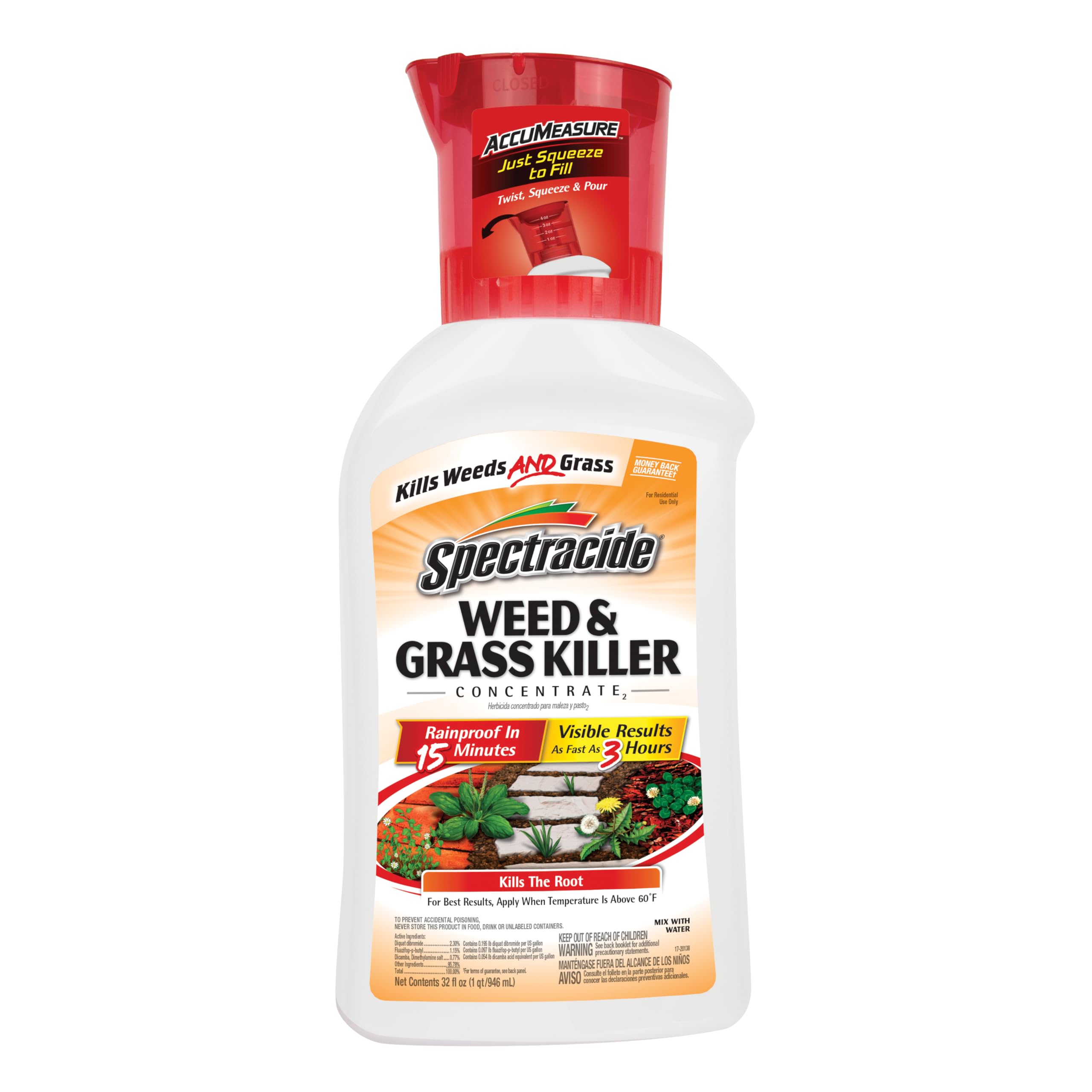
If you need immediate gratification, this diquat dibromide concentrate provides visible browning in as little as three hours. That speed comes from a contact-kill mechanism rather than a systemic root destroyer, but for surface weeds on driveways, walkways, and around fences, the fast visual feedback is satisfying and practical. The integrated Accumeasure cap simplifies mixing — twist, squeeze, and pour eliminates the need for a separate measuring cup.
Despite the rapid top kill, many users found the formula rainfast after just 15 minutes, a critical detail for those who spray in the morning before unpredictable afternoon storms. The 32-ounce bottle covers roughly 1,350 square feet at the recommended dilution, placing it in the mid-range for coverage per dollar among concentrates. A few reviewers noted the measuring cap can be fussy and replaced it with a standard lid.
Because diquat works on contact, established perennial weeds with deep taproots may require a second application. For annual weeds and grasses along hardscapes, however, this is one of the fastest ways to clean up a border without waiting a week for results. Always wear gloves and safety glasses — the same speed that kills weeds can irritate skin.
Why it’s great
- Visible results within three hours, fastest in this lineup
- Rainfast in only 15 minutes after application
- Built-in measuring cap reduces prep time
Good to know
- Contact killer only — deeper-rooted perennials may need re-treatment
- Coverage is lower than glyphosate concentrates at 1,350 sq ft
3. Control Solutions Eraser Grass & Weed Killer Concentrate
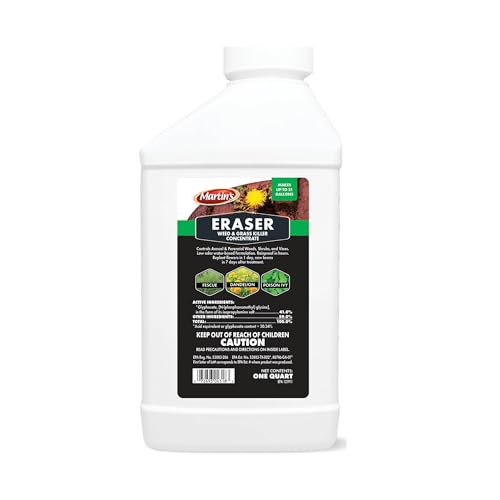
At 41% glyphosate, this concentrate delivers the highest active-ingredient concentration in the lineup without any of the markups found on retail-shelf brands. Users who mix at 8 ounces per gallon report complete kill on everything from annual weeds to established poison ivy within one to two weeks. The low-odor formula makes it more tolerable for backyard applications compared to older solvent-based herbicides.
Patience is the trade-off. Unlike the fast-browning diquat products, this glyphosate formula shows no visible effect for the first two to four days. Yellowing typically appears between days four and seven, with full desiccation around day ten to fourteen. Adding a non-ionic surfactant improves droplet adhesion on waxy leaves and speeds uptake, especially in hot, sunny conditions.
For anyone accustomed to buying name-brand glyphosate at big-box stores, the per-ounce cost savings here are significant. The 32-ounce bottle yields multiple gallons of ready-to-spray solution, making it a strong candidate for large properties, fence rows, or anyone fighting woody invaders. Just be aware that glyphosate is non-selective — any overspray will kill grass and ornamentals, so shield desirable plants.
Why it’s great
- Highest glyphosate percentage (41%) in the budget tier
- Low-odor, water-based carrier is pleasant to handle
- No residual soil activity allows replanting after die-off
Good to know
- Slow visible action — wait up to two weeks for full results
- Non-selective; will kill any plant it touches
4. Ortho WeedClear Weed Killer for Lawns Refill
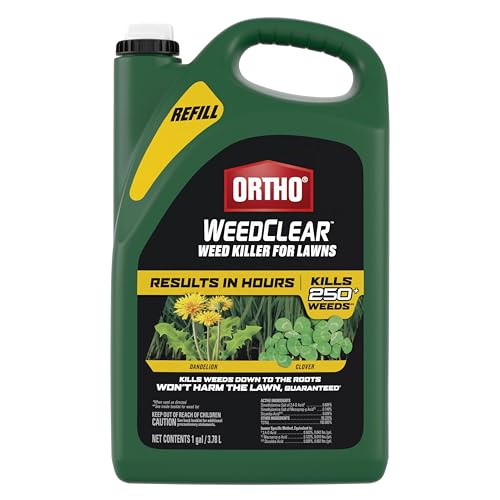
This is the only product in the roundup that preserves your turf while eliminating broadleaf weeds. Covering up to 5,000 square feet per gallon of ready-to-use refill, it targets dandelion, clover, chickweed, and over 250 other listed species without harming St. Augustine, Bermuda, Zoysia, or Fescue grasses when applied at the correct temperature (below 90°F). Long-time buyers report it as their go-to solution for clover in particular.
The selective chemistry works systemically, moving through the weed down to the root. Visible results take a bit longer than non-selective contact killers, but the benefit is that you don’t have to reseed bare patches afterward. Users noted the absence of the harsh gasoline-like odor common to older weed killers, making it more pleasant for residential lawns where kids and pets play.
One limitation: it is explicitly not labeled for Floratam St. Augustinegrass, and it should be kept away from flower beds and ornamental shrubs. The 1-gallon refill is designed for Ortho’s Comfort Wand applicator, but it can be poured into any garden sprayer. If lawn aesthetics matter and you want to avoid dead brown patches, this is the smart choice for broadleaf control.
Why it’s great
- Selective formula kills broadleaf weeds without harming most lawn grasses
- Covers a large 5,000 sq ft area per gallon
- Mild odor compared to solvent-based herbicides
Good to know
- Not safe for Floratam St. Augustine or ornamental plants
- Slower visible results than non-selective contact killers
5. Roundup Weed and Grass Killer III Ready-to-Use Trigger Spray

When you need to zap a single dandelion sprouting through a crack in the patio or handle a small patch of weeds along a foundation wall, this ready-to-use foam spray is the most convenient entry-level tool. The foaming technology provides visual feedback so you can see exactly where the product has landed, reducing the risk of drift onto desirable plants. Users report visible damage within six hours and root kill that prevents regrowth from the same spot.
The 30-ounce bottle covers approximately 3,000 square feet of spot treatment, but in practice it empties quickly if you’re tackling a large infestation. Several reviewers mentioned that the bottle runs out faster than expected, and some experienced broken spray triggers during shipping. The active ingredient profile includes triclopyr and diquat rather than glyphosate, which means it can be used around certain lawn grasses without killing them — but always read the label for your specific grass type.
For homeowners who only have a handful of weeds to manage per season, the premium per-ounce cost is offset by zero mixing and zero cleanup. Just point, spray, and toss the bottle when empty. If your weed problem extends beyond a few square feet, however, you’ll save money by moving up to a concentrate and a sprayer.
Why it’s great
- Foam technology shows exactly where you’ve sprayed
- Visible results in as little as six hours
- Rainproof within 10 minutes for flexible application timing
Good to know
- Small bottle empties fast on larger areas
- Higher cost per ounce compared to concentrates
FAQ
Can I use a cheap weed killer on my vegetable garden?
Why does my cheap weed killer not kill dandelions?
How much concentrate should I mix for the best results?
Final Thoughts: The Verdict
For most users, the best cheap weed killer winner is the Hi-Yield Killzall 365 because it delivers the lowest cost per treated square foot with rain-resistant performance and flexible mixing ratios. If you want a fast visible kill on hardscapes, grab the Spectracide Weed and Grass Killer Concentrate. And for a lawn-safe solution that spares your turf while erasing broadleaf weeds, nothing beats the Ortho WeedClear Lawn Weed Killer.

Mo Maruf
I created WellFizz to bridge the gap between vague wellness advice and actionable solutions. My mission is simple: to decode the research and give you practical tools you can actually use.
Beyond the data, I am a passionate traveler. I believe that stepping away from the screen to explore new environments is essential for mental clarity and physical vitality.