Our readers keep the lights on and my smoothie glass nicely filled. As an Amazon Associate, I earn from qualifying purchases.
A clear coat on metal is the difference between a project that looks finished for a decade and one that rusts into an eyesore within a season. Whether you are preserving a freshly painted engine block, sealing a custom motorcycle gas tank, or protecting a restored piece of furniture, the wrong clear can yellow, peel, or fail under heat and UV exposure within months. The market is flooded with single-stage aerosols that dry soft and offer little chemical resistance, which makes choosing the right formulation the single most important decision you will make for your metal project.
I’m Mohammad Maruf — the founder and writer behind WellFizz. For this guide, I have spent hours dissecting the technical specifications, real user feedback, and chemical formulations of the most popular clear coats on the market to separate the few that genuinely protect and beautify metal from the many that simply don’t hold up.
After extensive analysis of formulations covering heat resistance, cure time, chemical durability, and final finish quality, I have identified the five candidates that deserve your attention when searching for the best clear coat for metal.
How To Choose The Best Clear Coat For Metal
Selecting the right clear coat for a metal substrate is not about picking the shiniest can. The formulation must match the specific demands of your project — heat exposure, chemical contact, UV stress, and the desired final aesthetic. The wrong choice leads to premature failure, yellowing, or a soft finish that scratches at the lightest touch.
Component System: 1K vs. 2K
The single most important distinction in clear coats is whether the can contains a single-component (1K) or a two-component (2K) formula. A 1K clear coat dries primarily through solvent evaporation. It is easier to use because there is no mixing, but the resulting film is softer and less resistant to chemicals and solvents like gasoline or brake cleaner. A 2K clear coat contains a separate hardener that you activate by pressing a button on the bottom of the can. Once mixed, a chemical cross-linking reaction occurs, creating a much harder, more durable film that resists chipping, scratching, and chemical attack far better than any 1K product. For any metal piece that will face abrasion or automotive fluids, a 2K system is the only serious choice.
Heat Resistance
Not all metal projects sit at room temperature. An engine block, exhaust manifold, or brake caliper can reach temperatures well above what a standard clear coat can handle. A standard acrylic lacquer will burn, discolor, or delaminate when exposed to sustained heat above 200°F. Specialty high-heat formulas, like those using ceramic and urethane resin blends, are rated to withstand 500°F or more. If the clear coat is intended for anything under the hood or near an exhaust system, the temperature rating is non-negotiable.
Finish Type and Gloss Level
The visual outcome of your project is defined by the gloss level of the clear coat. High-gloss clears deliver that deep, wet-look shine that makes metallic flake pop and creates a mirror-like surface that is easy to clean. Matte clear coats, which typically measure between 10 and 15 gloss units, provide a modern, non-reflective, almost velvety surface that hides minor surface imperfections but is often more challenging to keep clean because dirt shows on the flat surface. Satin finishes sit in between. There is no “best” gloss level — it comes down entirely to the style you want and the environment the metal will live in.
Coverage and Dry Time
The amount of metal you need to cover and the time you have to wait between coats are practical constraints that directly affect your workflow. Aerosol cans typically cover anywhere from 5 to 30 square feet per can depending on the formulation and application technique. Products with a wide fan nozzle pattern can cover larger areas in fewer passes. Dry times vary significantly — some clears dry to the touch in 20 minutes, while 2K products may require a full 12- to 48-hour cure before the part can be handled or polished. If you are coating a large panel like a car door, you need a product with adequate coverage per can. If you are doing a small bracket, a lower-coverage can may still be perfectly sufficient.
Quick Comparison
On smaller screens, swipe sideways to see the full table.
| Model | Category | Best For | Key Spec | Amazon |
|---|---|---|---|---|
| SprayMax 2K Matte Clear | Premium 2K | Automotive panels & full coverage | 12 ± 3 Gloss Units | Amazon |
| Eastwood 2K Aerosol Gloss Clear | Premium 2K | High-gloss show finishes | 1.2-mil per spray pass | Amazon |
| VHT SP145 Engine Enamel Clear | Heat-Resistant 1K | Engines & high-heat parts | 550°F Rating | Amazon |
| Rust-Oleum Chalked Matte Clear | Decorative 1K | Furniture & indoor decor | Dries in 20 minutes | Amazon |
| Hycote Clear Lacquer | Budget 1K | General touch-ups & crafts | 400ml per can | Amazon |
In‑Depth Reviews
1. SprayMax 2K Matte Clear Coat
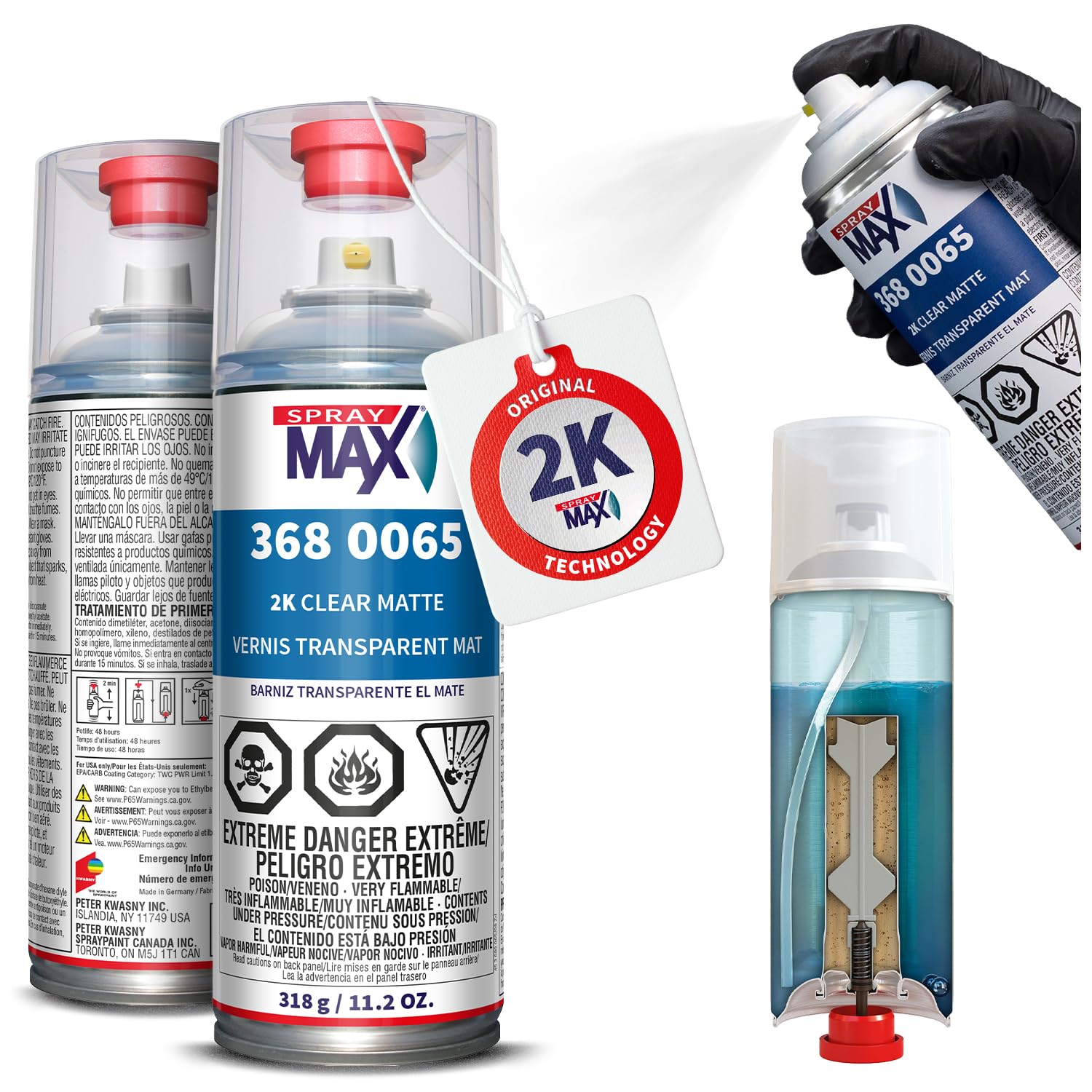
The SprayMax 2K is the clear professional-grade winner in this category because it delivers true two-component chemistry in a convenient aerosol format. After activating the hardener by pressing the button on the can bottom, the urethane resin cross-links to form a film that is exceptionally hard, UV-resistant, and chemically tough against gasoline and solvents. Users consistently report that its self-leveling properties are outstanding, meaning that even a first-timer can achieve a smooth finish without fish eyes or craters, provided the surface is properly degreased.
The matte finish measures between 9 and 15 gloss units, giving it that modern, flat-satin look that is popular on contemporary automotive projects and custom metal parts. It dries dust-free in 12 minutes and can be recoated after 80 minutes, which makes it surprisingly fast for a 2K product. The fully cured film reaches maximum chemical and scratch resistance after 48 hours, at which point it feels rock-hard to the touch and resists chipping far better than any 1K clear available.
The main trade-off is that the aerosol can is a one-shot deal — once the hardener is activated, you have approximately 48 hours of usable pot life, after which the remaining paint hardens in the can and cannot be used. This is not a project you can dip into over several weekends. The price is also higher than standard aerosol clears, but the performance justifies the cost for anyone who values a finish that lasts for years without yellowing or peeling.
Why it’s great
- True 2K chemical hardness for maximum durability
- Excellent self-leveling and consistent matte gloss
- Fast dust-free dry time for a two-component paint
Good to know
- Pot life is limited to 48 hours after activation
- Requires a respirator for safe application
2. Eastwood 2K Aerosol Gloss Clear Coat

Eastwood’s 2K aerosol is the reference standard for anyone who wants a deep, high-gloss finish that rivals a professional spray-gun application. Like the SprayMax, it is a genuine two-component system that requires activating a hardener before use. The recommended application method involves 1-2 spray passes with a 50% overlap, laying down approximately 1.2-mil of film per pass. Users who have followed these instructions report that after wet-sanding with 2000-grit and machine buffing, the orange peel is eliminated and the finish takes on a near-perfect, mirror-like gloss that looks exactly like a factory OEM clear coat.
One of the most frequently praised characteristics of this Eastwood clear is its resistance to yellowing over time. Several reviewers compared it directly to 1K clears that had yellowed on parts exposed to sun and heat. After extended use on vehicles in harsh climates, the Eastwood 2K remained water-clear. The flash time between coats is short — just 3-7 minutes depending on ambient temperature — and full cure can be achieved in 12 hours at 68°F, or in as little as 35-40 minutes if you use infrared drying at 140°F.
On the downside, the coverage is relatively low compared to many 1K aerosols, at roughly 5.4 to 8.1 square feet per can. If you are coating a full car panel, you will need multiple cans. The product also requires a proper respirator and good ventilation, as is standard for any 2K paint system. Some users also noted that the nozzle can clog if not cleaned immediately after use, so keep a can of cleaner handy.
Why it’s great
- OEM-grade high-gloss finish after cutting and buffing
- Exceptional resistance to yellowing from UV and heat
- Fast flash times for efficient multi-coat application
Good to know
- Low coverage per can for large surfaces
- Requires additional wet-sanding for optimal gloss
3. VHT SP145 Gloss Clear Engine Enamel

If you are coating an engine block, valve cover, transmission, or any metal part that will see sustained heat, the VHT SP145 is the clear specialist in this lineup. The formulation blends urethane and ceramic resins specifically to withstand temperatures up to 550°F without burning, cracking, or discoloring. This is a 1K aerosol — no hardener activation required — meaning you can spray it directly out of the can and it cures through solvent evaporation and heat cycling. The instructions recommend a specific heat-curing process where the engine is run at idle for a period to fully set the coating, and users who follow this process report spectacular results that resist corrosion, salt spray, and degreasers.
The gloss clear finish is designed to provide a hard, shiny shell that keeps engine grime from sticking to the surface. Reviewers have used it on everything from full LS swap engine blocks to brake caliper covers, and the consensus is that it adheres tenaciously to properly cleaned metal. The coverage is generous at 24-30 square feet per can, making it economical for engine bays and large components. It dries to the touch in one hour and can be handled overnight, although full heat-curing is needed for maximum chemical resistance.
The main limitation is that this is still a 1K formula, so the film hardness and solvent resistance do not match a 2K product like the SprayMax or Eastwood. If you are painting a part that will be constantly exposed to fuel or brake cleaner, the 2K options are superior. The VHT gloss clear can also dull slightly after heat cycling before returning to a shine once fully cured, so patience during the process is key.
Why it’s great
- Engineered for sustained 550°F heat exposure
- Excellent corrosion and chemical resistance for engine parts
- High coverage per can for large components
Good to know
- Requires heat cycling for full cure and hardness
- 1K formulation is softer than 2K clear coats
4. Rust-Oleum Chalked Ultra Matte Clear

Rust-Oleum Chalked is not an automotive-grade clear coat, but it occupies a valuable niche for metal projects that will live indoors and do not face extreme conditions. The formula is designed for easy, beginner-friendly application on furniture and decor, and it delivers a soft, velvety ultra-matte finish that feels smooth to the touch. It adheres directly to metal without needing primer or sanding, which is a huge time-saver for quick refreshes on metal nightstands, lamp bases, or decorative metal signs. The 12 square feet of coverage per can is reasonable for small to medium projects.
The big advantage here is speed. This clear dries to the touch in just 20 minutes, and the one-coat coverage claim holds true for most applications — even over previously painted surfaces. Users have praised it for its forgiving nature; it does not run or sag easily, and it hides brush marks and minor irregularities from the underlying paint layer. The matte finish is consistent and does not flash or patch, which is a common complaint with some matte clears that go on unevenly.
The trade-offs are significant if you need any kind of durability. This clear is not waterproof, it offers no heat resistance, and it is a 1K formula that remains relatively soft. It will scratch far more easily than a 2K product, and it cannot handle outdoor weather or cleaning chemicals. It is perfect for an indoor decorative metal piece that sits on a shelf and sees gentle use, but it is the wrong choice for a tool, a gate, or anything that needs to survive the elements.
Why it’s great
- Dries in just 20 minutes for fast project turnaround
- No primer or sanding needed on most metal surfaces
- Luxurious ultra-matte finish with excellent coverage
Good to know
- Not waterproof and not suitable for outdoor use
- Soft film scratches easily under regular use
5. Hycote Clear Lacquer Spray Paint

The Hycote Clear Lacquer is the most straightforward entry-level option in this comparison. It is a conventional 1K acrylic lacquer clear coat packaged in a 400ml aerosol can with an integrated adjustable fan spray nozzle. The fan nozzle is a genuine advantage at this price point — it atomizes the paint well and allows for wider, more uniform passes than a standard cone spray nozzle. Users have noted that it goes on smoothly, dries fast, and produces a clean, high-gloss finish when applied in multiple light coats from the recommended distance.
The product is marketed as suitable for metal, plastic, wood, and ceramic surfaces, which makes it versatile for a hobbyist who works across multiple materials. It is fully waterproof once cured, and the finish provides a decent level of protection against minor scuffs and moisture. The dry time is listed at 24 hours for a full cure, but it becomes touch-dry much faster, allowing for recoating within a reasonable window. Several users have successfully used it to seal over painted metal parts on vehicles, with the caveat that it is not as hard or chemical-resistant as a dedicated 2K system.
The critical weakness of the Hycote is its limited durability under stress. The 1K lacquer remains comparatively soft and does not have the cross-linked density of a 2K urethane. It is vulnerable to solvents like gasoline and brake cleaner, and it can chip if the underlying metal is struck hard. For light-duty decorative projects, craft items, or touch-ups where cost is the primary concern, the Hycote performs respectably. For any automotive, outdoor, or heavy-use application, the 2K options or the VHT heat-resistant formula are far better investments.
Why it’s great
- Adjustable fan nozzle for wider, more even coverage
- Works on multiple materials beyond metal
- Very budget-friendly for general-purpose use
Good to know
- 1K formula is soft and not chemical-resistant
- Requires multiple coats for a durable finish
FAQ
Can I use a standard clear coat on an engine block or exhaust?
Why does my clear coat turn yellow after a few months?
What is the difference between a clear coat and a lacquer?
Can I apply a 2K clear coat over a 1K base paint?
How long does a 2K clear coat take to fully harden?
Final Thoughts: The Verdict
For most users, the clear coat for metal winner is the SprayMax 2K Matte Clear Coat because it delivers professional-grade 2K hardness and chemical resistance in an accessible aerosol format, with a consistent matte finish that suits modern automotive and custom metal projects. If you want a deep, high-gloss finish that can be cut and buffed to an OEM mirror shine, grab the Eastwood 2K Gloss Clear Coat. And for high-heat engine components where heat cycling is the primary stress, nothing beats the VHT SP145 Engine Enamel Clear.

Mo Maruf
I created WellFizz to bridge the gap between vague wellness advice and actionable solutions. My mission is simple: to decode the research and give you practical tools you can actually use.
Beyond the data, I am a passionate traveler. I believe that stepping away from the screen to explore new environments is essential for mental clarity and physical vitality.