Our readers keep the lights on and my smoothie glass nicely filled. As an Amazon Associate, I earn from qualifying purchases.
Assembling a PC from individual components demands more than just a list of specs — it requires a strategy that balances thermal management, electrical stability, and physical fit within a single chassis. A misstep in cooler clearance or power delivery can turn a high-performance build into a noisy, throttling disappointment.
I’m Mohammad Maruf — the founder and writer behind WellFizz. This guide is built from hours spent analyzing thermal benchmarks, power efficiency curves, and real-world clearance data across dozens of configurations.
Whether you’re optimizing for silence, overclocking headroom, or pure value, knowing which parts work together is the difference between a reliable system and a troubleshooting nightmare. This is your focused guide to the best computer parts for a balanced, high-performance build.
How To Choose The Best Computer Parts
Selecting components without a consistent standard for thermal capacity, power delivery, and physical compatibility leads to mismatched builds. The key is to evaluate each part through three intersecting filters: cooling capability, power standard compliance, and physical clearance within the chassis.
Cooling Capacity and Thermal Design
A CPU cooler’s effectiveness is defined by its maximum rotational speed, fan static pressure (measured in mmH2O), and radiator surface area. A 240mm AIO with dual 120mm fans spinning near 2150RPM handles sustained loads from a high-core-count processor, while a single-tower air cooler may struggle with the same chip under continuous encoding workloads. Always verify the cooler’s TDP rating against the CPU’s sustained power draw, not just its base TDP.
Power Supply Standards and Transient Response
Modern GPUs draw sudden bursts of power that can trip overcurrent protection on older PSUs. ATX 3.1 and PCIe 5.1 compliance ensures the unit can handle 2x transient power excursions without instability. A fully modular design with 105°C-rated capacitors improves both cable management and long-term reliability under fluctuating loads.
Case Clearance and Airflow Geometry
A mid-tower’s value is determined by its GPU length allowance (often up to 420mm for modern cards), radiator mounting points (top, front, or side), and PSU shroud design for cable routing. Cases with pre-installed ARGB fans that include both regular and reverse-blade orientations create positive pressure without sacrificing aesthetics.
Quick Comparison
On smaller screens, swipe sideways to see the full table.
| Model | Category | Best For | Key Spec | Amazon |
|---|---|---|---|---|
| Intel Core Ultra 9 285K | CPU | Content creation & heavy multitasking | 24 cores, 5.7 GHz boost | Amazon |
| CORSAIR RM850e (2025) | PSU | High-wattage silent builds | ATX 3.1, 105°C-rated caps | Amazon |
| Lian Li V100 | Case | Display builds with wide GPU support | 4 ARGB fans, GPU up to 420mm | Amazon |
| MONTECH XR-W | Case | Mid-tower builds with excellent value | 3 pre-installed ARGB fans | Amazon |
| Thermalright Frozen Edge 240 | AIO | Budget-friendly liquid cooling | 240mm rad, 2800 RPM pump | Amazon |
In‑Depth Reviews
1. Intel Core Ultra 9 285K

The Intel Core Ultra 9 285K is built on a performance hybrid architecture that splits 24 cores (8 P-cores and 16 E-cores) across two microarchitectures, allowing the processor to prioritize high-intensity workloads while reserving lighter tasks for the efficiency cores. With a maximum turbo frequency of 5.7 GHz and a 40 MB cache, this chip handles rendering, compilation, and simultaneous virtual machine workloads without hesitation.
Compatibility with Intel 800 series chipset motherboards and support for PCIe 5.0 ensures that storage and GPU bandwidth are not bottlenecked. The lack of an included thermal solution means you must pair it with a robust cooler — during a 10-minute Cinebench stress test, the chip drew approximately 205W while holding all cores between 73°C and 78°C with a high-end AIO. The integrated Intel Graphics provides basic display output for troubleshooting or low-demand tasks.
User feedback from professional CAD environments highlights that this generation resolves overheating and stability issues seen in prior 13th and 14th generation processors. Engineers running SolidWorks on Asus ProArt Z890 motherboards with 128 GB of DDR5 reported fast, stable performance. For gaming and content creation, the chip runs hot only during shader compilation spikes but remains noticeably easier to cool compared to its predecessor.
Why it’s great
- 24-core hybrid design with high single-thread boost clock
- Stable memory controller supports 4 sticks of DDR5 at 4000 MHz
- Improved thermal behavior over previous generations
Good to know
- Requires new LGA1851 motherboard — no backward compatibility
- No cooler included in the box
- Sustained power draw reaches 250W under turbo, demanding a quality 360mm AIO
2. CORSAIR RM850e (2025)

The CORSAIR RM850e is a fully modular ATX 3.1 and PCIe 5.1 compliant power supply that uses a 120mm rifle bearing fan with a calculated fan curve to maintain near-silent operation even under full load. The unit’s zero-RPM fan mode keeps the fan stopped entirely at low and moderate loads, making it an excellent match for quiet-focused builds. The compact 140mm depth makes installation easier in smaller mid-towers.
Internal reliability is anchored by 105°C-rated Japanese capacitors and a full protection suite that covers overcurrent, overvoltage, and short-circuit events. The inclusion of a native 12V-2×6 cable means modern GPUs up to the RTX 3090 or RTX 40-series draw power directly without a dongle. Users report stable power delivery for an i9-12900KS plus RTX 3090 combination, with zero coil whine or instability even during sustained maximum load stress tests.
The unit is Cybenetics Gold certified, meaning efficiency exceeds 87% under typical loads. The flat black modular cables simplify routing behind motherboard trays, and the included zip ties and screws cover everything needed for installation. For builds that require silent low-load operation with enough headroom for a high-end CPU and GPU, this PSU delivers reliable power without acoustic intrusion.
Why it’s great
- ATX 3.1 compliant with native 12V-2×6 connector for transient handling
- Zero-RPM mode keeps fan off under light loads
- Fully modular cabling with flat black wires simplifies cable management
Good to know
- 850W capacity may limit future upgrades to very high-end GPUs
- Fan curve is conservative; no physical fan toggle switch
- Rifle bearing fan has slightly shorter lifespan than fluid-dynamic bearings
3. Lian Li V100
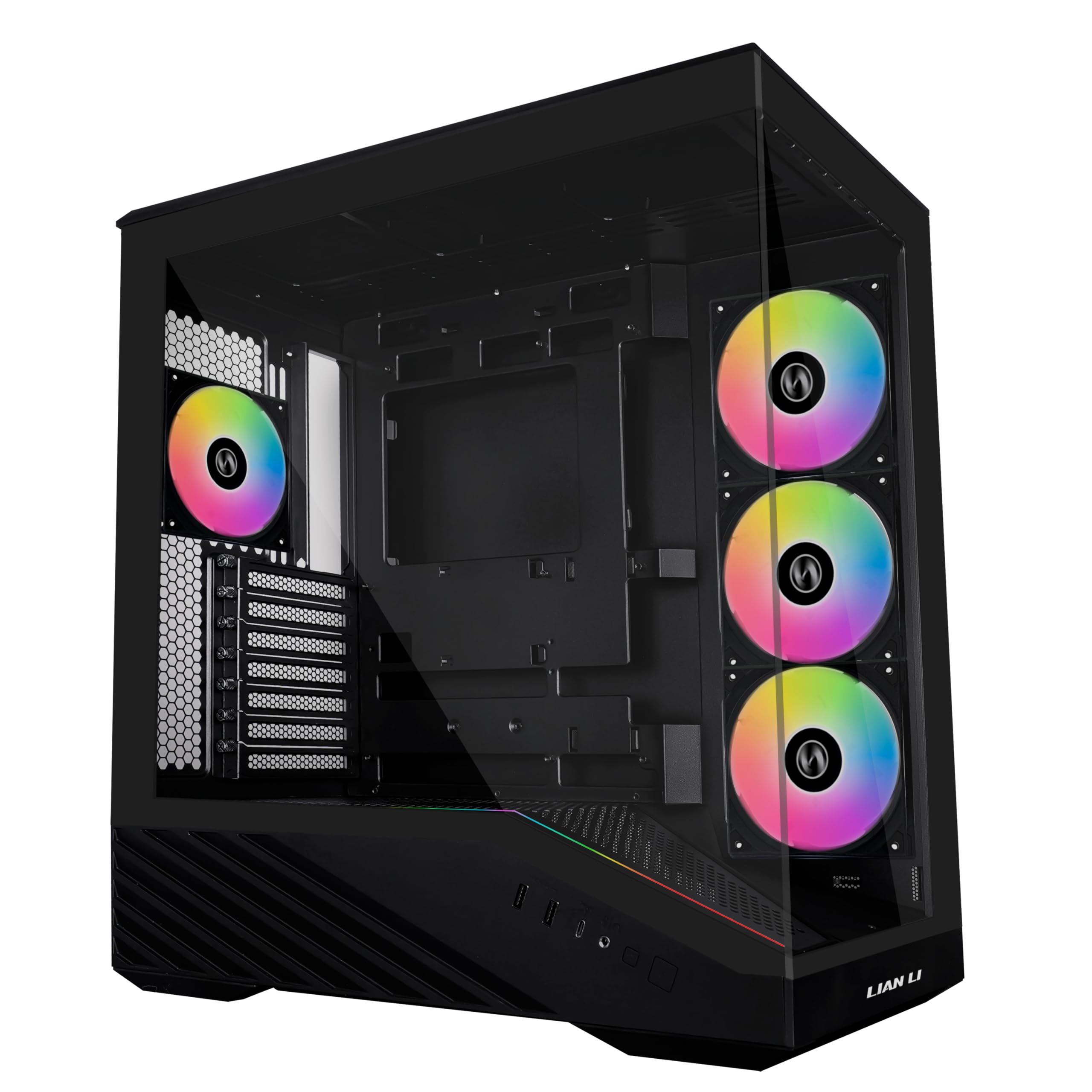
The Lian Li V100 is an ATX mid-tower that ships with four pre-installed 120mm PWM ARGB fans — three configured as intake and one as exhaust — each rated for 1800 RPM and delivering up to 61.47 CFM of airflow. The unique slanted front PSU shroud incorporates a dedicated display platform for figures or collectibles, keeping the interior clean and visually engaging when not under load. The case supports GPUs up to 420mm in length and CPU coolers up to 178mm tall, making it compatible with virtually all modern high-performance components.
Tool-less panel removal is handled by thumb screws for the tempered glass side panel, while the back-connect design supports both standard and back-connect ATX and Micro-ATX motherboards. A built-in 26-LED ARGB strip provides full-spectrum lighting that synchronizes with motherboard software, and the daisy-chain fan connectors simplify cable routing. The case includes a GPU sag bracket, dust filters on all intake surfaces, and ample storage space behind the motherboard tray for cable management.
Users consistently praise the case’s build quality relative to its price point, noting that the included fans offer bright, high-airflow performance. The pop-off panels and thumb screws make component access fast, though the bottom fan mounting location may conflict with a non-modular PSU or front-panel USB-C cable routing. For builders who want a spacious canvas with excellent pre-installed cooling and a unique display feature, the V100 offers a premium experience without the premium price.
Why it’s great
- Four pre-installed ARGB fans with high CFM and daisy-chain wiring
- Unique display platform on the PSU shroud for collectibles
- Supports GPUs up to 420mm and back-connect motherboards
Good to know
- Bottom fan mounting may conflict with non-modular PSU cables
- Mostly plastic construction feels less dense than steel alternatives
- Cable management channels are tight, requiring careful routing
4. MONTECH XR-W

The MONTECH XR-W is an ATX mid-tower case that ships with three 120mm ARGB PWM fans: two reverse-blade units on the side panel for intake and one standard-blade fan at the rear for exhaust. Each fan spins up to 1500 RPM, and the case supports up to nine fans total if you populate the remaining mounts. The full-view dual tempered glass panels showcase the internal layout from two angles, while the wood-grain design I/O interface adds a natural aesthetic to an otherwise standard front panel.
Compatibility is generous for its size: the case supports ATX, Micro-ATX, and Mini-ITX motherboards, accommodates GPUs up to 4090-class cards, and fits a 360mm radiator at the top. The top, bottom, and side panels each have dust filters, and the interior includes a PSU shroud with recessed cable access points. The unified front-panel connector simplifies wiring, and users report that the cable management space behind the motherboard tray is generous enough to hide even thick modular cables.
Feedback from builders highlights the outstanding value for the price. The case includes zip ties, screws, and tool-less GPU mounts, and the pre-installed fans are bright and quiet at low RPM. The tempered glass panels are prone to fingerprints and scratches out of the box — some units arrived with visible marks — and the side glass panel requires a firm push to seat properly. For budget-conscious builders who want spacious interior room, good airflow, and integrated RGB lighting, the XR-W delivers a polished build experience at a compelling price.
Why it’s great
- Supports 360mm radiators and high-end 40-series GPUs
- Three pre-installed ARGB fans with reverse-blade intake design
- Unified front-panel connector and good cable management routing
Good to know
- Tempered glass may arrive with scratches or fingerprints
- Side glass panel is a tight squeeze to close
- Cooling performance depends heavily on fan curve settings
5. Thermalright Frozen Edge 240 White

The Thermalright Frozen Edge 240 is a liquid CPU cooler built around a fourth-generation pump body with a copper-alloy cold plate and an all-metal pump housing rated for 40,000 hours of operation. The pump spins up to 2800 RPM, while the two included TL-B12W 120mm PWM fans reach a maximum speed of 2150 RPM with a static pressure of 2.87 mmH2O and airflow of 69 CFM. The aluminum alloy radiator measures 240mm and is paired with polymer-reinforced tubing for long-term fluid integrity.
Compatibility spans modern Intel LGA 1150/1151/1200/1700/1851 and AMD AM4/AM5 sockets, using dual-platform all-metal fasteners that simplify installation. The fans feature soft silicone corner pads to reduce vibration noise, and the PWM controller adjusts fan speed automatically based on CPU temperature. Users report that the cooler maintains an i9-14900K at safe temperatures under full rendering loads and keeps an AMD 5800X around 35°C idle and below 80°C during gaming sessions.
Reviewers consistently note the exceptional cooling performance relative to the cost, with some measurements matching larger 420mm AIOs in thermal benchmarks. The pump can emit noticeable noise at higher RPM ranges, particularly during the pump startup or under sustained load, and some users opted to replace the stock fans with Arctic P12 units for near-silent operation. For a budget-friendly entry into liquid cooling that still handles high-core-count processors effectively, the Frozen Edge 240 offers a compelling thermal envelope.
Why it’s great
- Excellent thermal performance for the price, matching larger radiators
- Wide socket compatibility with dual-platform metal fasteners
- Fans have soft silicone corners for vibration dampening
Good to know
- Pump can produce noticeable noise at high speed
- Stock fans are audible at full 2150 RPM pull
- Blue tube accents may not match all build aesthetics
FAQ
Is a 240mm AIO enough for an Intel Core Ultra 9 processor?
What does ATX 3.1 certification mean for my power supply choice?
Final Thoughts: The Verdict
For most users, the best computer parts winner is the Intel Core Ultra 9 285K because it delivers the highest multi-threaded performance with improved thermal stability over its predecessor. If you want silent and stable power delivery, grab the CORSAIR RM850e. And for a spacious case with excellent pre-installed fans and a unique platform for collectibles, nothing beats the Lian Li V100.

Mo Maruf
I created WellFizz to bridge the gap between vague wellness advice and actionable solutions. My mission is simple: to decode the research and give you practical tools you can actually use.
Beyond the data, I am a passionate traveler. I believe that stepping away from the screen to explore new environments is essential for mental clarity and physical vitality.