Our readers keep the lights on and my smoothie glass nicely filled. As an Amazon Associate, I earn from qualifying purchases.
Switching to solar for a commercial building, farm, or large off-grid workshop means looking past residential panels and into hardware designed for continuous, high-yield power generation. Commercial solar panels are built with tougher frames, higher wattage cells, and advanced busbar architectures that squeeze more energy from every square foot of roof or ground space—a critical factor when the bottom line depends on kilowatt-hours.
I’m Mohammad Maruf — the founder and writer behind WellFizz. I’ve spent countless hours dissecting manufacturer specs, efficiency ratings, warranty terms, and real-world output data to build this guide around the hardware that actually delivers for serious energy users.
Whether you’re outfitting a warehouse, a fleet of RV rental units, or a remote off-grid cabin, finding the right best commercial solar panels the first time saves you from costly performance gaps and install headaches down the line.
How To Choose The Best Commercial Solar Panels
Choosing commercial solar panels requires looking past the sticker price and focusing on metrics that drive total cost of ownership: real-world efficiency, degradation rates, and compatibility with your power architecture. Here’s what matters most.
Cell Technology: N-Type vs P-Type
N-Type monocrystalline cells resist light-induced degradation (LID) better than traditional P-Type cells, meaning they maintain higher output across their lifespan. Panels with 16BB or 18BB (busbar) architectures also improve current collection and reduce micro-crack risks, translating to more stable daily energy production.
Bifacial Design and Anti-Shading Features
Bifacial panels generate power from both sides, adding 5-30% energy yield on reflective surfaces like white roofs, sand, or snow. Anti-shading designs—where a panel is split into independent power zones—prevent a single shadow from collapsing the entire string’s output, a critical feature in partially shaded commercial lots or RV parks.
Warranty and Real-World Output
Look for a 25-year linear power warranty (guaranteeing at least 84-85% of initial output after 25 years) and a 10-12 year product warranty. Real customer tests show many premium panels deliver 90-100% of rated peak power at 77°F; panels in hot climates or suboptimal angles often yield 70-80%, so oversize your array by 20% for reliable daily harvest.
Quick Comparison
On smaller screens, swipe sideways to see the full table.
| Model | Category | Best For | Key Spec | Amazon |
|---|---|---|---|---|
| Callsun 430W Bifacial (2-Pack) | Anti-Shading | Partial shade yards & RVs | 25%+ N-Type, 4 power zones | Amazon |
| Renogy 1180W (2×590W) | N-Type Bifacial | High-output residential arrays | 25% efficiency, 16BB | Amazon |
| SUNGOLDPOWER UL500W (2-Pack) | CEC Listed | Grid-tie & tax credit setups | 21% half-cell, 5400Pa load | Amazon |
| EPOCH 800W Bifacial (2×400W) | 16BB PERC | Off-grid cabins & 12V systems | 25% efficiency, IP68 | Amazon |
| EcoFlow 500W (4×125W) | Modular Bifacial | Portable & RV camping | 25% N-Type, 30-60° stand | Amazon |
| Callsun 900W (2×450W) | Double Glass | Ground-mount high capacity | 25.4%, dual-module anti-shade | Amazon |
| DOKIO 800W (2×400W) | Monocrystalline | Yard & shed off-grid | 31V, 3m MC4 leads | Amazon |
| ECOBOSS 1200W (6×200W) | N-Type 16BB | Large 12V battery banks | 25.6% efficiency, 30yr life | Amazon |
| Renogy 1920W (6×320W) | 18BB N-Type | Home rooftop & 24V arrays | 25% cell, IP68 | Amazon |
| JJN 1100W (2×550W) | Bifacial 23% | Farm & large rooftop | 1100W total, 49.5V | Amazon |
| SUNGOLDPOWER 5600W (10×560W) | Bifacial PERC | Commercial/industrial arrays | 30% bifacial gain, 16BB | Amazon |
In‑Depth Reviews
1. Callsun 430W Anti-Shading Bifacial (2-Pack)

The Callsun 430W package (two 215W panels) uses a genuine anti-shading architecture with four independent power zones. When one zone gets shaded by a mast, tree branch, or RV rooftop obstacle, the three remaining zones keep pumping full voltage—no MPPT restart, no hot spots, and no sudden drop to zero. This is a huge advantage for commercial arrays that can’t guarantee perfect sun all day.
Built with premium A+ N-Type 16BB cells, these panels surpass 25% conversion efficiency and capture reflected light from the backside (bifacial) for an extra 7-30% daily yield. In real-world tests, users report consistent 390-405W from the pair, with one customer hitting 436W peak on a cool, clear day. The series-recommended configuration pairs perfectly with 12V/24V systems and 60V power stations like Bluetti or EcoFlow Delta series.
The 12-year product warranty and 25-year linear power guarantee (84.5% after 25 years) back up the long-term value. The only real drawbacks are slightly lower output in extreme heat (typical for all panels) and the need to run them in series for best compatibility with some portable power stations.
Why it’s great
- Anti-shading zones prevent total string collapse
- Bifacial design adds 5-30% extra energy daily
- N-Type 16BB cells resist LID and micro-cracks
Good to know
- Output drops in high heat (90°F+) like all panels
- Series connection required for some power stations
2. Renogy 1180W Bifacial (2×590W)
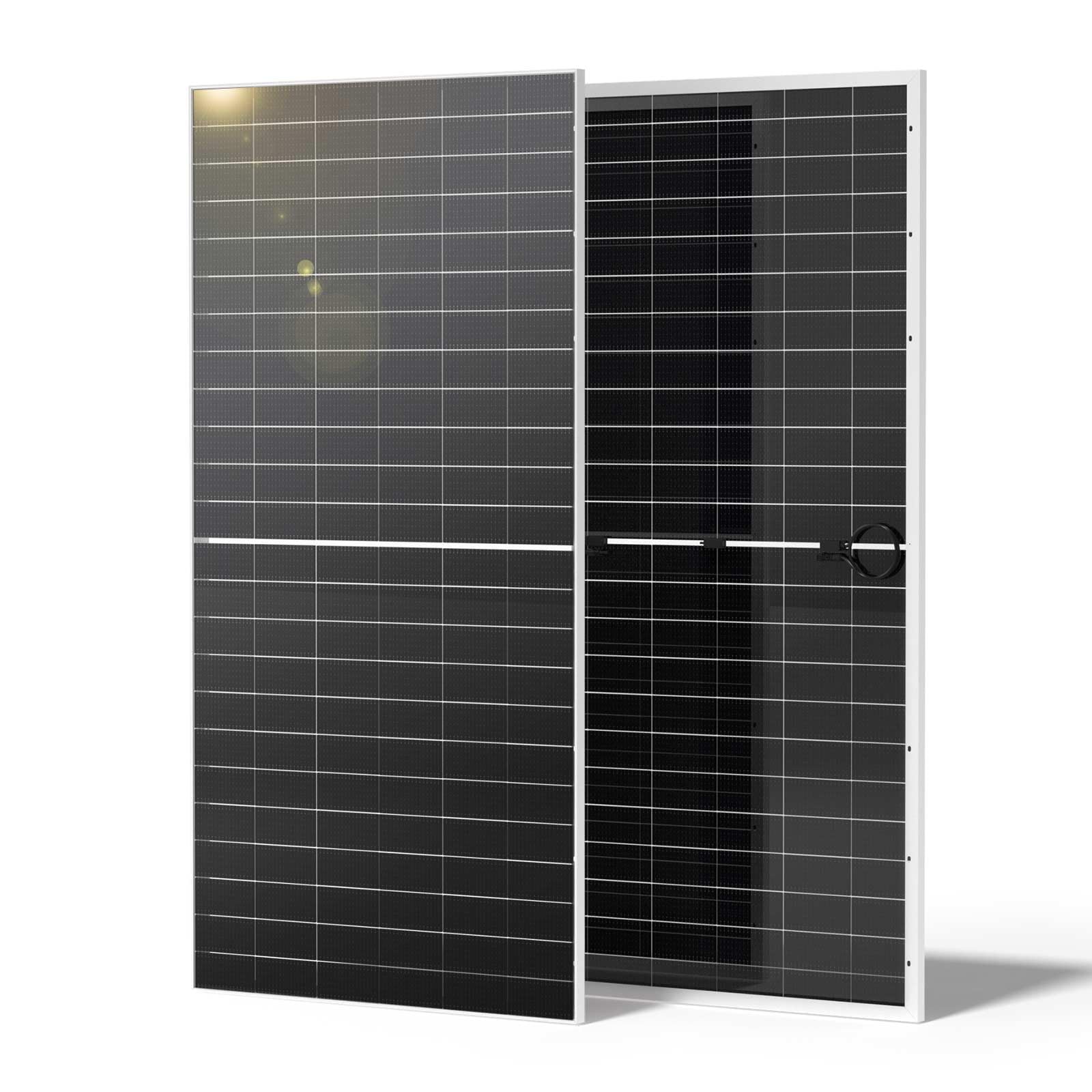
Renogy’s 590W N-Type bifacial panels deliver 1180W total across two modules, each measuring 44.6″x89.7″ with a 1.4″ frame. The A+ grade N-Type cells and 16BB busbar layout minimize hot spots and boost conversion efficiency up to 25%—a noticeable gain over older PERC designs. The transparent backsheet unlocks 5-30% extra yield from ground reflection, making these a strong choice for ground-mount or white-roof arrays.
Real-world tests in suboptimal locations (Indiana, September) show 1000W at noon from two panels in series through a 60A Rover controller and 150ft of 8AWG wire—very respectable for non-ideal conditions. The panels are built to withstand 2400Pa wind and 5400Pa snow loads, and the IP68 junction box keeps moisture out. Buyers should note the awkward size—two people minimum for installation, ideally four for safe handling.
The 25-year linear output warranty adds confidence for long-term commercial use. A small complaint: the price dropped shortly after some purchases, but the hardware itself is consistent and well-reviewed for both durability and power.
Why it’s great
- High 590W per panel reduces total array count
- Bifacial backsheet for reflection boost
- Proven Renogy reliability for 10+ years
Good to know
- Panels are large and heavy (58.4 lbs each)
- Need 4 people for safe roof installation
3. SUNGOLDPOWER UL500W (2-Pack)

SUNGOLDPOWER’s 500W UL61730-certified panels are a strong premium option for grid-tie installations where compliance and tax credits are essential. Each panel uses half-cell technology for higher shade tolerance and an all-black design for aesthetic consistency on commercial rooftops. The 132 monocrystalline cells are housed in a corrosion-resistant aluminum frame rated for 2400Pa wind and 5400Pa snow loads.
Customers running 8-panel arrays (4000W total) report peak outputs around 3500W, with consistent battery charging through summer conditions. The panels work directly with 12V/24V/48V MPPT charge controllers, and the 8 pre-drilled mounting holes plus 4 grounding holes make roof attachment straightforward. An early production dip report (3.2kW vs 4.8kW after one year) is a point of caution, though SUNGOLDPOWER’s 12-year workmanship warranty covers defect claims.
The IP68 junction box and connectors ensure storm-proof performance. For large-scale commercial builds where UL listing and federal tax credit eligibility matter, these are a solid fit.
Why it’s great
- CEC listed for US tax credit qualification
- Half-cell design handles partial shade well
- All-black aesthetic for clean rooftop look
Good to know
- Some users report output drop after 1 year
- Fragile in shipping; inspect upon arrival
4. EPOCH 800W Bifacial (2×400W)
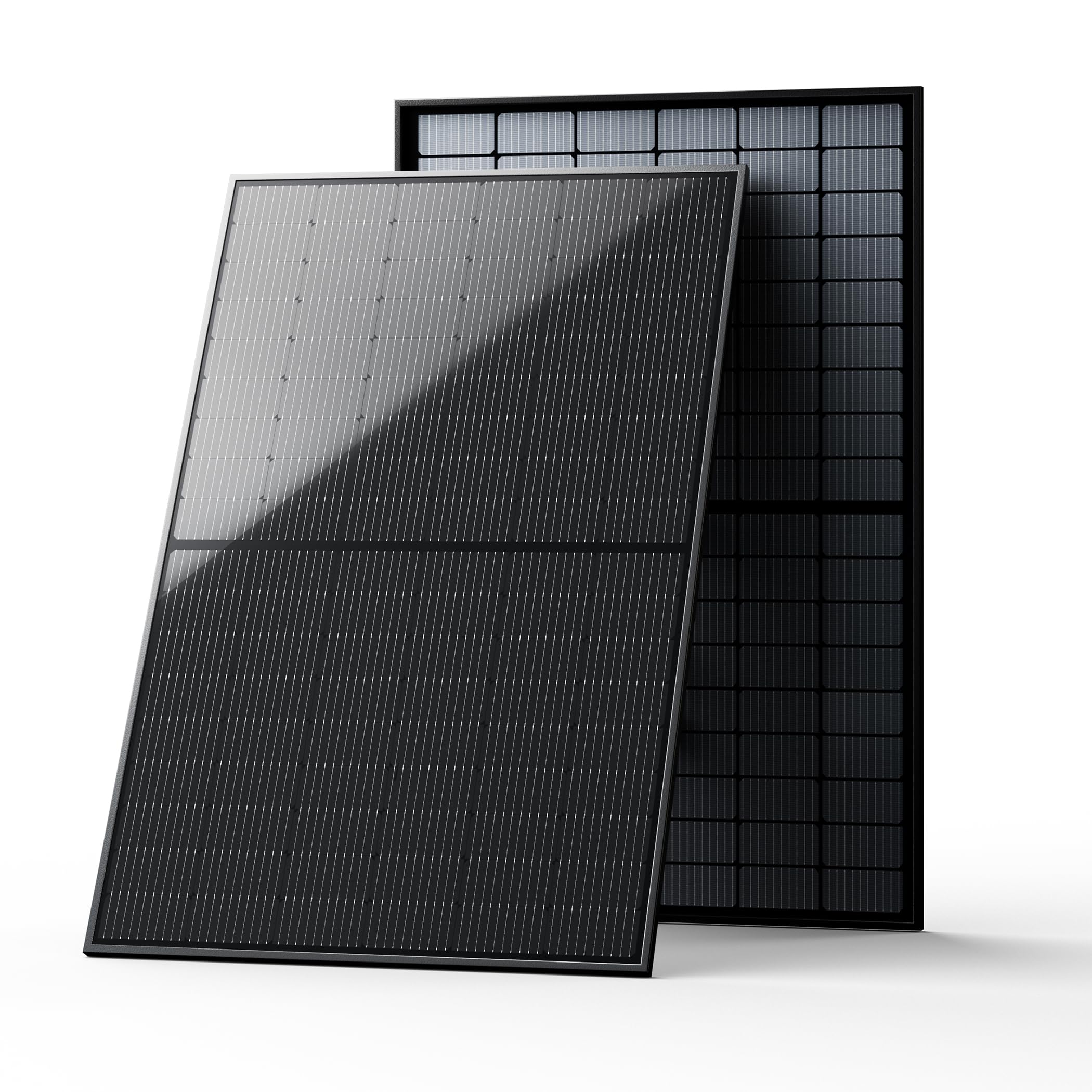
EPOCH’s 800W bifacial kit pairs two 400W panels with Class A+ 16BB cells and a 25% efficiency rating. The high transparency (91.5%) front glass and transparent backsheet allow dual-sided light capture, which users confirm yields 380+ watts per panel on ground mounts—90% of the rated peak. On cloudy days, these panels still pull 100+ watts, which is impressive for a mid-range commercial panel.
Each panel is 44.6″x67.8″ and rated to handle 5400Pa snow loads and 2400Pa wind loads, putting them in the same durability class as premium residential hardware. The IP68 junction box and IP67 MC4 connectors resist water, dirt, and debris. Users report running two sets in parallel (1200-1500W) to cover home baseload power for fridges, lights, and small appliances.
The main drawback is inconsistent packaging—multiple customers received damaged panels from shipping. EPOCH’s 12-year quality warranty covers replacements, but the extra delivery hassle is worth budgeting for. For off-grid cabins and 12V battery systems, the price-to-performance ratio is tough to beat.
Why it’s great
- 380W+ actual output per panel in good sun
- Bifacial design boosts cloudy-day yield
- IP68 junction box for wet environments
Good to know
- Shipping damage common; inspect immediately
- 12-year warranty covers replacements
5. EcoFlow 500W Bifacial (4×125W)

EcoFlow’s 125W bifacial panels (sold in a 4-pack for 500W total) bring a modular, portable approach to commercial solar. Each panel weighs only 9.26 lbs and features an integrated 30-60° adjustable kickstand with a solar angle guide—so you can orient them for maximum production without drilling into a roof. The N-Type cells deliver up to 25% efficiency, and the XT60-W waterproof connector handles wet conditions.
In practice, the 4-panel array routinely pulls 500W in good sun, with users reporting up to 507W peak. The bifacial design adds meaningful output from ground reflection, and the modular nature lets you deploy just 1-2 panels for lighter loads or a full 8-panel array (1000W) for heavier demand. The included MC4-compatible adapters connect to most power stations.
The lightweight frame is a double-edged sword—it’s easy to carry but susceptible to wind gusts without sandbags or stakes. Also, the XT60W connectors are slightly non-standard compared to typical MC4-only setups. For mobile commercial users (catering trucks, mobile medical units, events) this kit is a top pick.
Why it’s great
- Ultra-light (37 lbs total for 4 panels)
- Built-in adjustable stand for fast deployment
- Perfect for temporary commercial mobile setups
Good to know
- Light weight means wind can topple it
- XT60W connectors differ from standard MC4
6. Callsun 900W Bifacial (2×450W)
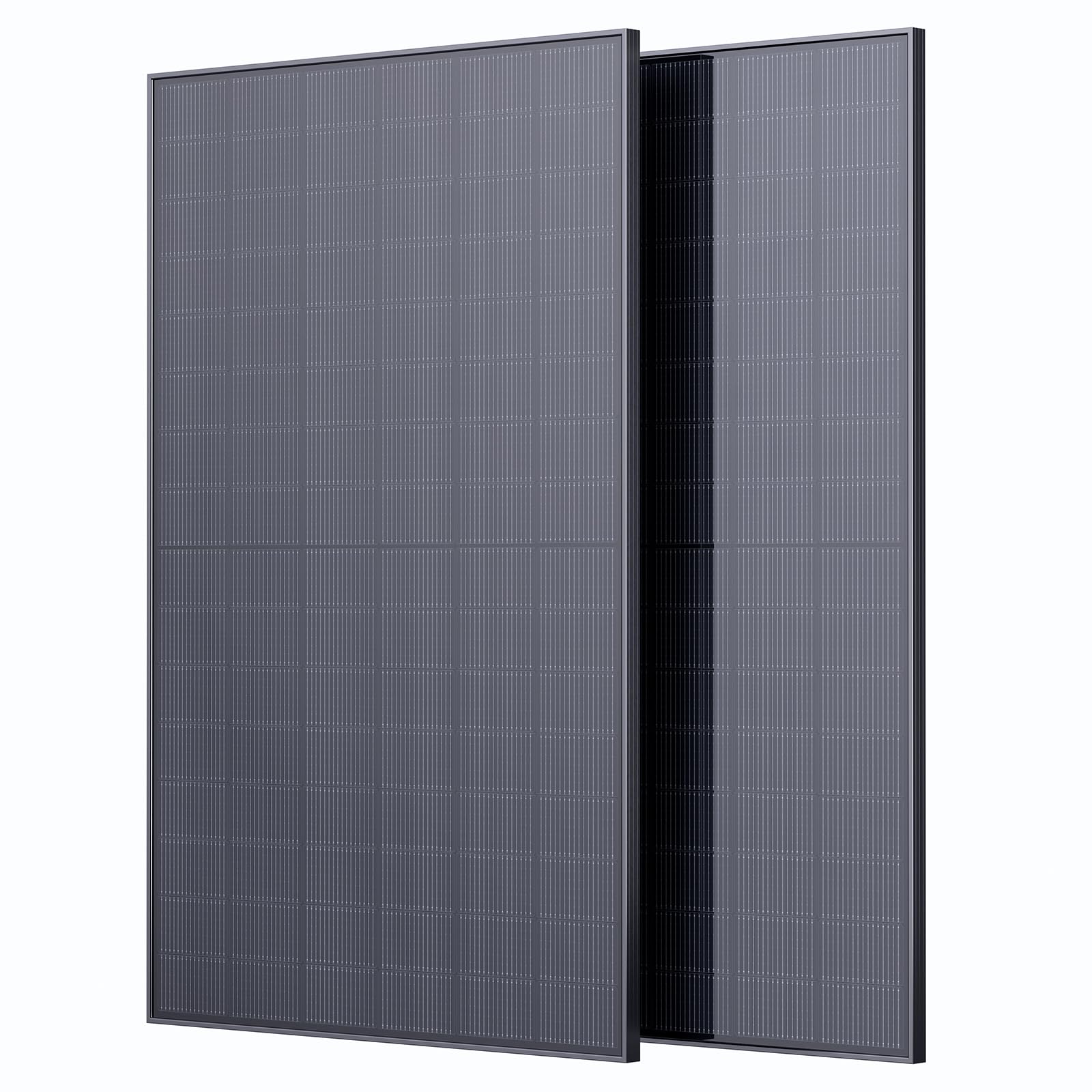
Callsun’s 450W bifacial panels use a double-glass construction with N-Type 16BB cells and a dual-module parallel anti-shade architecture. This means if one half of the panel is shaded, the other half keeps producing at full voltage—no MPPT restarts. The 69.4″x44.7″ form factor is substantial, but the 25.4% efficiency rating means fewer panels needed for your target wattage.
Real-world output from 7-panel arrays averages 275-300W per panel on sunny days, with bifacial gains pushing 420W from a single 450W panel when mounted low over reflective concrete. Users running 800W rated arrays report 915W actual output in full sun, and 1300W+ from 1200W rated panels—all benefiting from ground reflection. The panels also perform well on partly cloudy days, keeping battery banks topped off efficiently.
The dual glass design adds weight (each panel is substantial) but gives excellent resistance to micro-cracks and environmental stress. Callsun’s 10-year technical support and 25-year linear power warranty back the investment. The only real downside is the high per-panel cost, which makes sense for large arrays but may be overkill for small setups.
Why it’s great
- Dual-module anti-shade keeps half alive
- Double glass for extreme durability
- Proven 15-20% over-rated output via bifacial
Good to know
- Heavy panels require sturdy racking
- Premium price bracket for commercial use
7. DOKIO 800W Monocrystalline (2×400W)
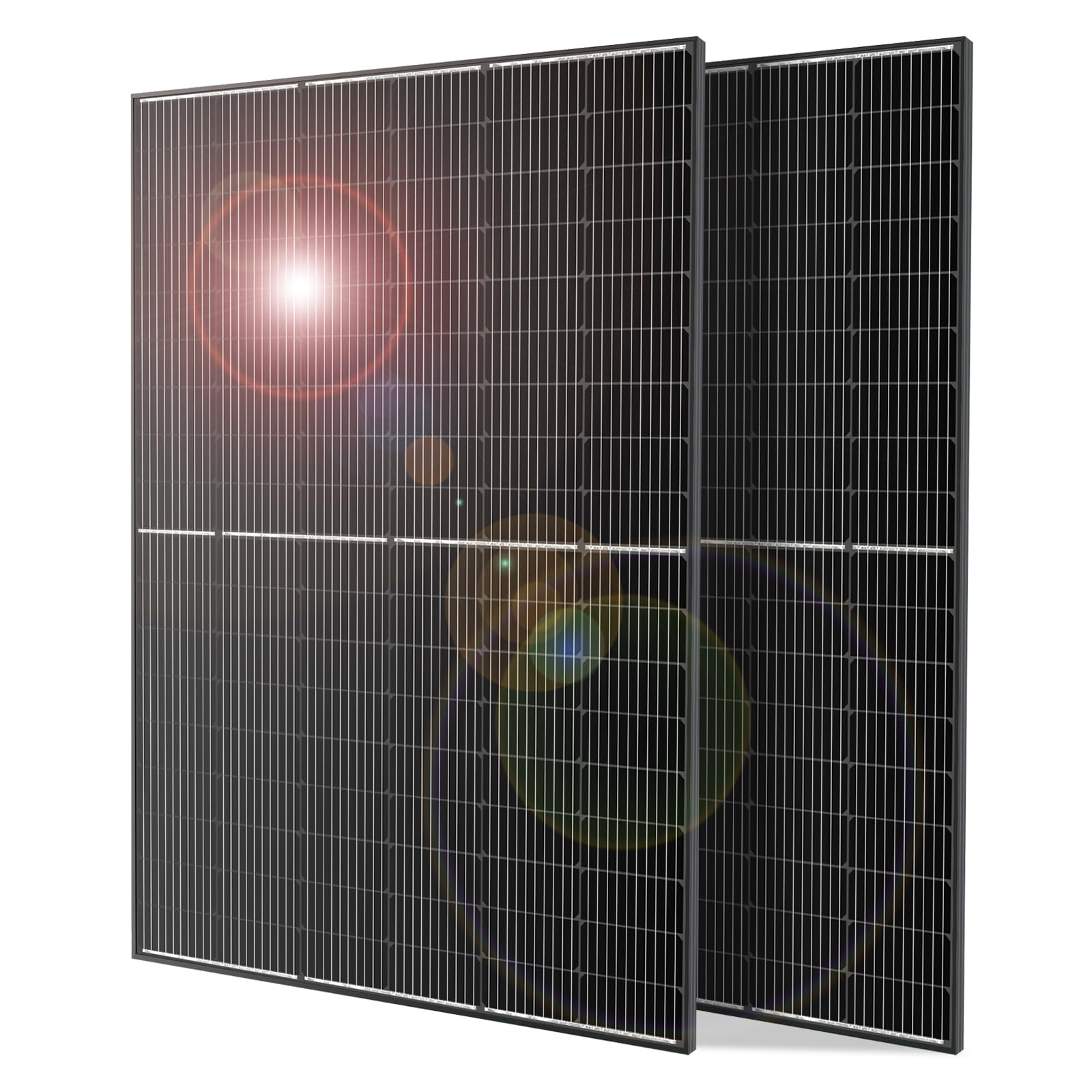
DOKIO’s 800W kit combines two 400W monocrystalline panels with a 31V operating voltage, designed for 12V/24V off-grid systems. The aluminum frame and tempered glass construction are built for outdoor yard, shed, and garden installations. Each panel comes with 3m MC4 leads, reducing the need for extension cables in typical yard runs.
Customer reports show actual output around 600W on partly cloudy days with suboptimal tilt, jumping to 700W+ in full sun—about 75-88% of the 800W STC rating. The panels are noticeably less efficient than N-Type options (standard monocrystalline cells), but the price point makes them accessible for budget-constrained commercial projects. Some users paired them with EcoFlow Delta 3 units for garage power with good results.
The main limitation is the 31V output—you’ll need an MPPT controller for best results, and series wiring is recommended to keep voltage high enough for most 24V battery banks. Build quality is decent for the price, but the aluminum frame is lighter than premium competitors, so hard-mount installations need extra care.
Why it’s great
- Low entry price for 800W total capacity
- 3m MC4 leads reduce extra cable purchases
- Lightweight frame for easy handling
Good to know
- Real-world output ~75-88% of rated (like most budget panels)
- Standard mono cells; lower efficiency than N-Type
8. ECOBOSS 1200W N-Type (6×200W)
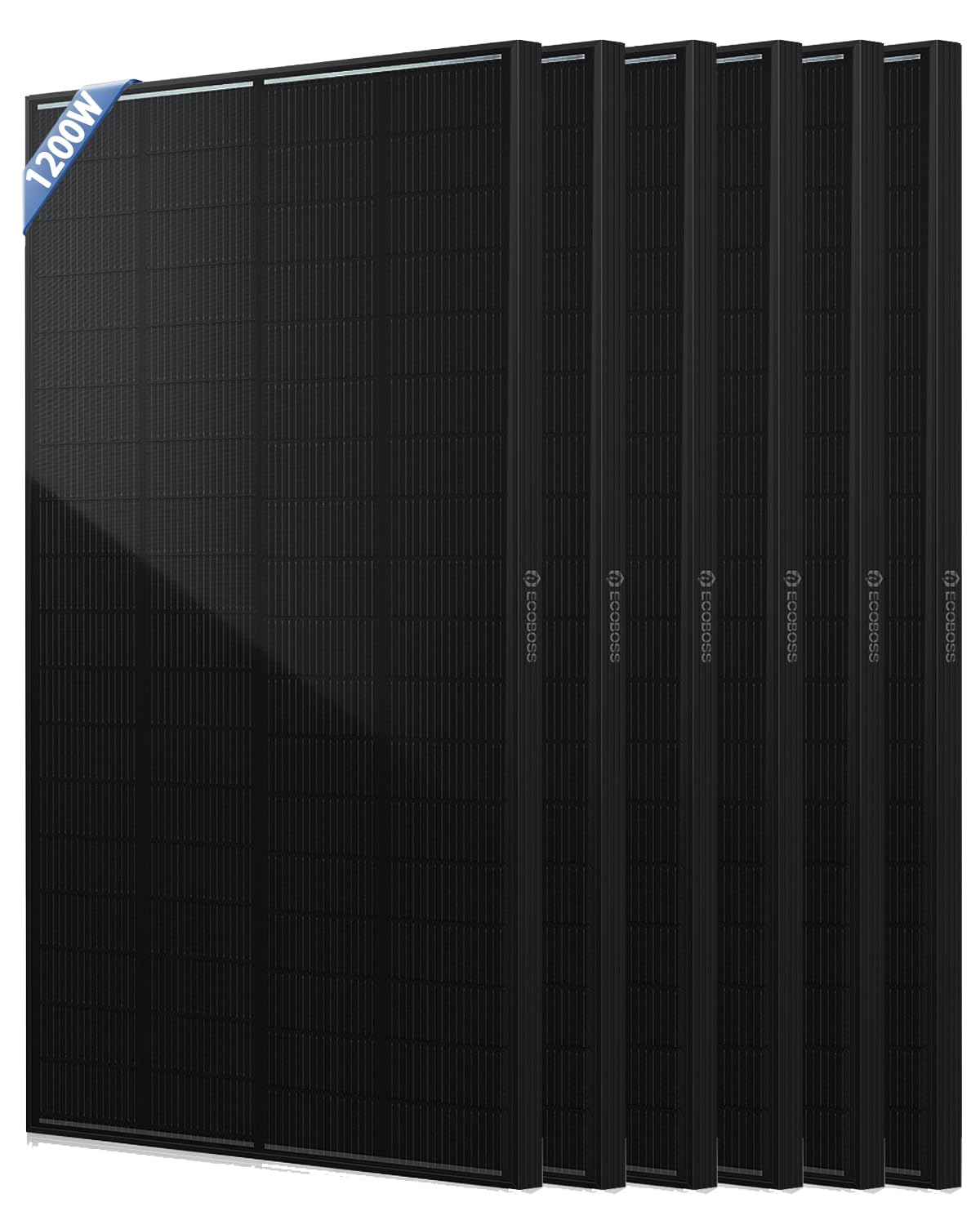
The ECOBOSS 1200W kit is a six-panel system (6×200W) using advanced N-Type 16BB monocrystalline cells that hit up to 25.6% conversion efficiency. Each panel is designed for 12V battery systems, making them compatible with most MPPT/PWM controllers. The low temperature coefficient means they hold efficiency better in hot climates—a key advantage for desert or coastal commercial installations.
Users report 170-185W per panel in real conditions (85-92% of rated), with a 2-panel pair charging an EcoFlow Delta 2 from 67% to full by 9am. The 3.2mm low-iron tempered glass and corrosion-resistant aluminum frame are rated for a 30-year outdoor life. The all-black design hides busbars and gives a clean, professional appearance.
The 200W panel size is easier to handle individually than 400W+ modules, which is a practical advantage for rooftop installations where space and maneuvering are limited. The only complaint is that corner protectors tend to loosen over time, and some customers wished for integrated tilt supports. For large 12V battery banks, this is a strong mid-range pick.
Why it’s great
- 25.6% N-Type efficiency resists heat degradation
- Smaller 200W panels are easier to roof-mount alone
- 30-year lifespan with low LID
Good to know
- Real output 85-92% of rated 200W
- Corner protectors may loosen over time
9. Renogy 1920W N-Type (6×320W)
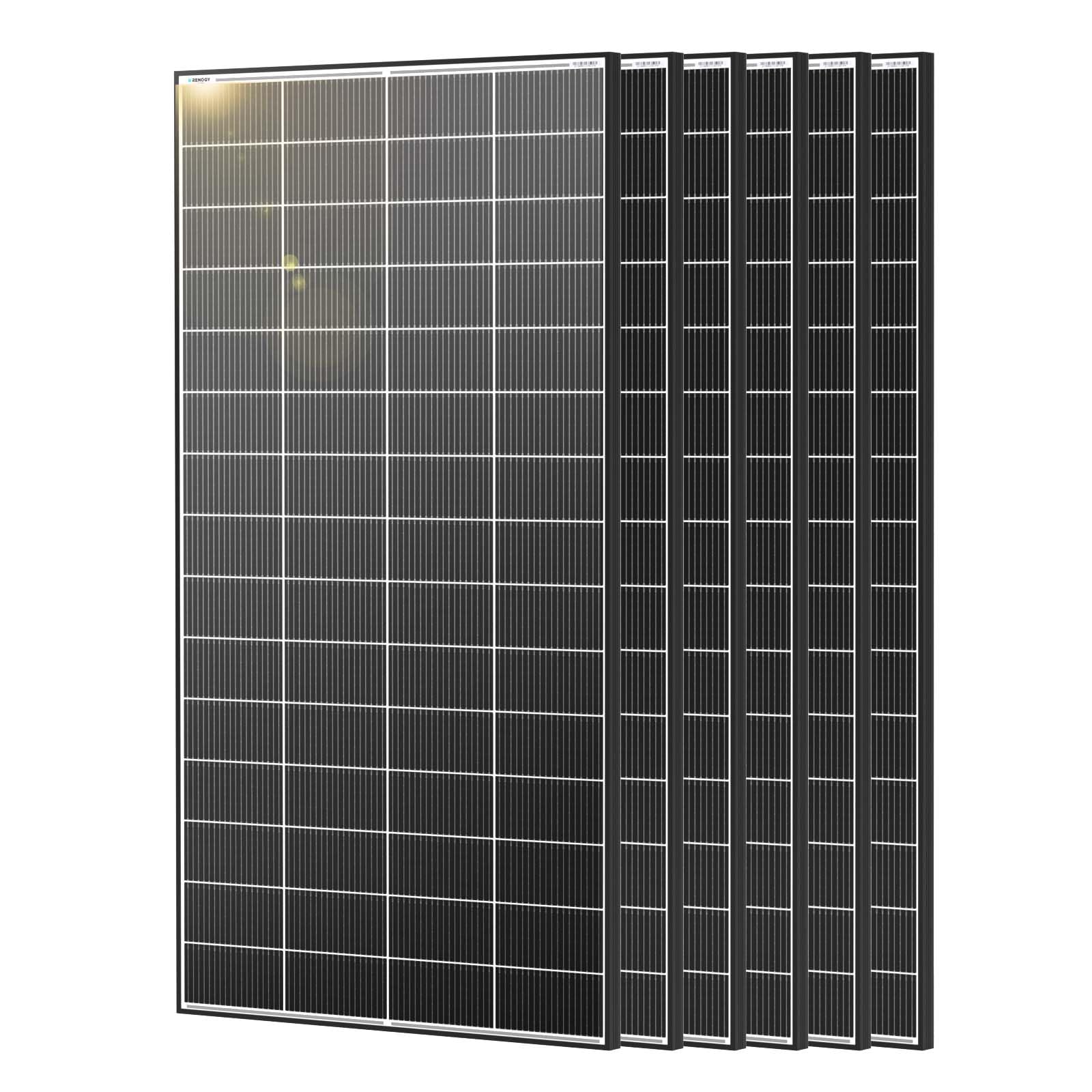
Renogy’s 1920W kit packs six 320W panels with 18BB N-Type cells—an extra busbar over the 16BB standard—reducing hot spots and improving current collection. Each panel operates at 24V nominal and includes pre-drilled holes compatible with Renogy’s ground mounts, Z brackets, corner brackets, and tilt mounts. The IP68 weatherproof rating ensures reliable performance in rain, dust, and snow.
Users running 8-panel arrays report ~2560W total, with ~1950W reaching the batteries after inverter and line losses. In van builds, 9 days off-grid with 3x 300Ah batteries are fully recharged daily, even with rain. The panels are bigger than they look—64.3″x34.7″—so plan your roof layout carefully. Shipping damage is a known risk, though Renogy replaces free of charge.
The 25-year linear power warranty and 18BB design place these at the top end of the mid-premium tier. Some customers note that actual peak output averages around 280W per panel rather than the full 320W, which is consistent with real-world conditions. For large residential or small commercial rooftops, this array delivers reliable, long-term power.
Why it’s great
- 18BB N-Type cells reduce hot spots
- Low voltage (24V) compatible with common MPPT controllers
- Renogy brand known for long-term reliability
Good to know
- Real-world output ~280W per panel (rated 320W)
- Panels are large; measure before mounting
10. JJN 1100W Bifacial (2×550W)
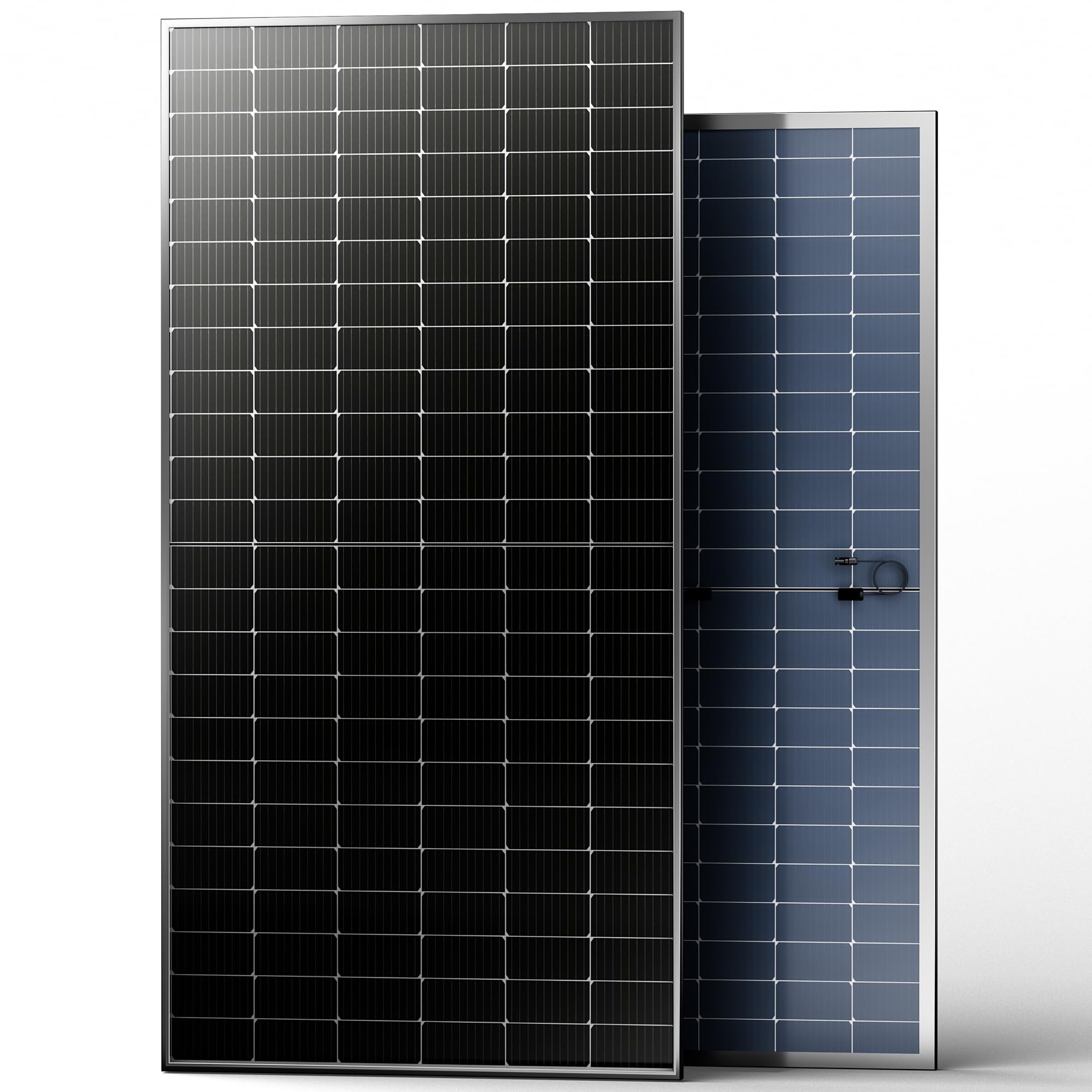
The JJN 550W bifacial panels deliver 1100W total across two modules, each measuring 89.6″x44.7″ with a 49.5V operating voltage. The transparent backsheet allows up to 30% efficiency gain from reflected light, making these effective in open-field or white-roof environments. The 23% cell efficiency is slightly lower than premium N-Type panels, but the large 550W size means fewer panels and less racking for high-capacity arrays.
Users with 4-panel setups report running a workshop entirely on solar, with summer production filling batteries by 8am and providing 6+ hours of tool power. In RV applications, 6×200W of JJN panels in a 3S2P configuration peaked at 970W. The panels are heavy (123.4 lbs for the pair) but deliver consistent power even in rain, pulling 260-300W through storms.
The main trade-off is that the per-panel cost is relatively low for the wattage, but the 23% efficiency means you need more roof space than a premium 25%+ panel. Packaging can be subpar—some panels arrive with damaged corners, but the manufacturer warranty covers replacements. For budget-conscious large arrays, this is a solid option.
Why it’s great
- High 550W per panel reduces array size
- Bifacial design adds reflection-based yield
- Works well in rainy, low-light conditions
Good to know
- 23% efficiency lower than premium N-Type panels
- Packaging quality inconsistent; inspect delivery
11. SUNGOLDPOWER 5600W Bifacial (10×560W)
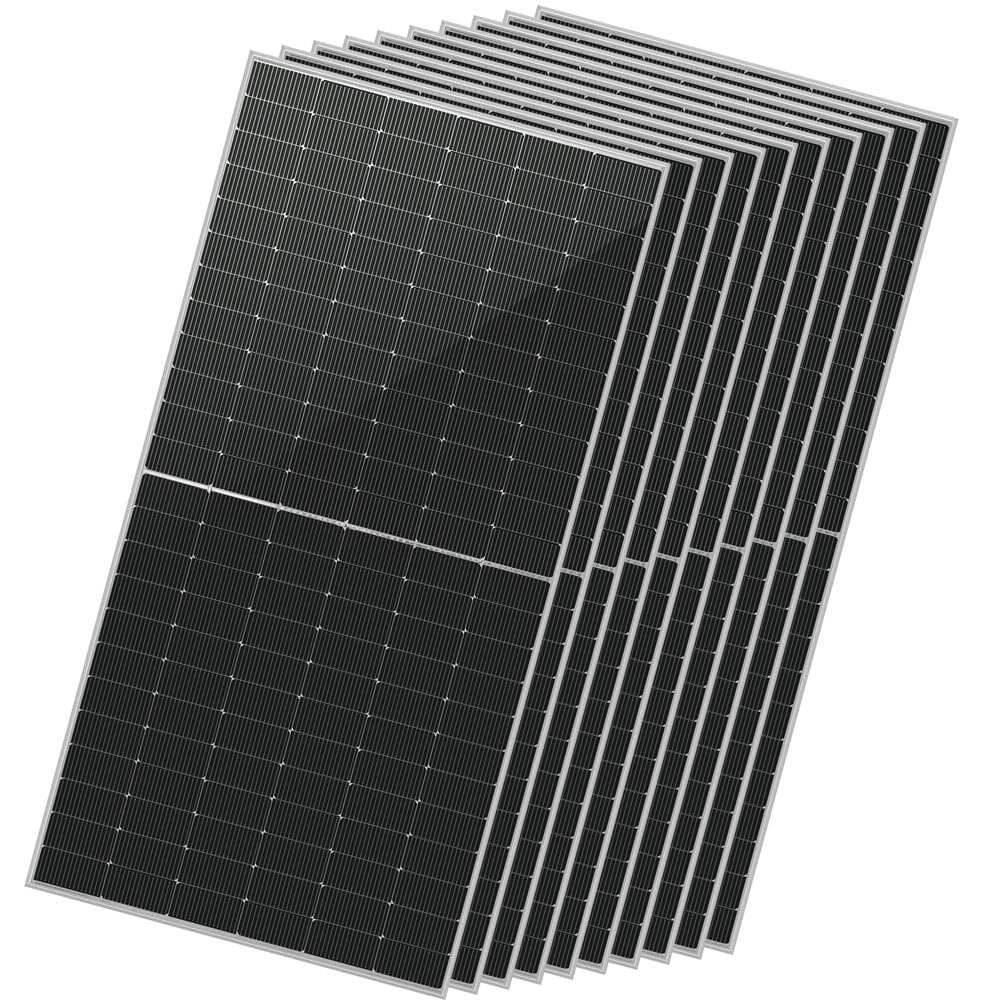
SUNGOLDPOWER’s 560W bifacial panels come in a 10-pack for a total of 5600W—enough to run a full commercial workshop or large farming operation. Each panel uses 16BB N-Type monocrystalline cells with PERC technology and a transparent backsheet for up to 30% efficiency gain. The items are large: 89.8″x44.6″x1.4″, weighing 67.9 lbs each, so delivery by lift truck is recommended.
Real-world reports show these panels exceeding their rated output—600+ watts per panel in full sun with minimal backside reflection. Users with 4-panel setups generate ~5kWh per day during California winter (5-6 hours of sun), and 6-panel arrays work seamlessly with 10,000-watt inverters for large off-grid loads. The high voltage (42.1V max power) pairs well with 48V battery banks and high-input MPPT controllers.
The 30% federal tax credit eligibility (for US installations) makes the up-front investment more manageable for commercial buyers. The panels are heavy and awkward on sloped roofs, but for ground-mount or flat-roof arrays, they deliver exceptional power density. For serious commercial solar installations where every watt counts, this is the premium choice.
Why it’s great
- Confirmed 600W+ actual output in full sun
- 5600W total reduces inverter and racking costs
- Eligible for federal solar tax credit
Good to know
- Extremely heavy; requires lift truck delivery
- Large panels need careful roof layout planning
FAQ
What is the real difference between N-Type and P-Type solar panels for commercial use?
How do I calculate how many panels I need for my daily power consumption?
Can I mix panels of different wattages in the same string?
Is the shipping damage problem common for large solar panels?
Final Thoughts: The Verdict
For most users, the best commercial solar panels winner is the Callsun 430W Anti-Shading Bifacial (2-Pack) because its four independent power zones prevent shading from killing your entire string’s output—a real-world advantage no other panel in this test offers. If you need maximum raw wattage for a ground-mount array, grab the SUNGOLDPOWER 5600W (10×560W) for its confirmed 600W+ per panel performance. And for mobile commercial setups where portability matters most, nothing beats the EcoFlow 500W Modular (4×125W) with its integrated kickstand and easy 8-panel scalability.

Mo Maruf
I created WellFizz to bridge the gap between vague wellness advice and actionable solutions. My mission is simple: to decode the research and give you practical tools you can actually use.
Beyond the data, I am a passionate traveler. I believe that stepping away from the screen to explore new environments is essential for mental clarity and physical vitality.