Our readers keep the lights on and my smoothie glass nicely filled. As an Amazon Associate, I earn from qualifying purchases.
If you have ever applied a glue to EVA foam only to watch the seam peel apart under flex, you already understand the core problem: most adhesives lack the molecular structure to bond closed-cell foam permanently. EVA foam’s slick, non-porous surface repels water-based glues, and most solvent-based options either dry brittle or melt the foam into a gummy mess. The correct solution requires a neoprene or polychloroprene contact cement formula that cures flexible, resists heat, and locks the foam fibers together without dissolving them.
I’m Mohammad Maruf — the founder and writer behind WellFizz. I have spent hundreds of hours analyzing adhesive formulations, customer use cases, and failure patterns across dozens of brands to identify which contact cements genuinely deliver reliable EVA foam bonds and which are merely repackaged general-purpose glues.
Whether you are repairing shoe soles, laminating foam for costume armor, or bonding foam insulation panels, reaching for the wrong adhesive guarantees a repeat trip to the hardware store. This guide isolates the formulations, cure times, and application methods that matter most, so you know exactly what makes a contact cement for eva foam either a permanent solution or a temporary headache.
How To Choose The Best Contact Cement For EVA Foam
EVA foam is chemically distinct from polyurethane foam or rubber. Its closed-cell structure resists moisture absorption and provides cushioning, but that same closed-cell surface repels adhesives that require a porous anchor. A successful contact cement must penetrate microscopically, flash off its solvent quickly, and leave behind a polymer layer that remains flexible at the same durometer as the surrounding foam.
Neoprene vs. Polychloroprene vs. Waterborne Formulas
Neoprene-based contact cements (also labeled polychloroprene) are the gold standard for EVA foam because they cure into a rubber-like film that stretches and compresses with the substrate. Waterborne formulas often lack the aggressive tack needed to grab closed-cell surfaces and can delaminate under shear stress. Toluene-free neoprene cements provide a solid middle ground — they still contain active solvents but with reduced respiratory hazard — while original resin formulas deliver the highest initial bond strength in exchange for stronger fumes.
Cure Time and Working Window
Contact cement bonds chemically, not mechanically. You apply a thin coat to both surfaces, allow the solvent to evaporate until the adhesive feels dry to the touch (typically 10-15 minutes), then press the parts together. That moment of contact is instantaneous and permanent — repositioning is nearly impossible. Faster-curing cements (under 2.5 hours full cure) suit quick repairs, while 24-hour full-cure formulas maximize ultimate bond strength. Always check the open time window listed on the container.
Flexibility After Cure
EVA foam is used in applications that involve bending — shoe soles, foam mats, costume pieces, and insulation panels. A brittle adhesive will crack along the seam line the first time the foam flexes. Look for cements that specify “flexible bond” or “remains pliable” in their technical descriptions. Polychloroprene films naturally retain flexibility down to approximately 20°F, making them suitable for outdoor foam projects that experience temperature swings.
Quick Comparison
On smaller screens, swipe sideways to see the full table.
| Model | Category | Best For | Key Spec | Amazon |
|---|---|---|---|---|
| Barge Contact Cement Adhesive All Purpose | Premium | Precise foam repairs with included spreader tools | Toluene-free, dries clear | Amazon |
| DAP Weldwood Original Contact Cement | Premium Multi-Pack | High-demand laminating and shoe rebuilding | Full cure in 2.5 hours | Amazon |
| Beacon Foam-Tac Powerful Glue | Mid-Range | RC foam planes and UV-exposed foam projects | Contains UV blockers | Amazon |
| S-18 All-Purpose Adhesive by RH Adhesives | Budget Tier | Indoor foam insulation and low-stress bonding | Water-resistant neoprene formula | Amazon |
| Wonshine Contact Cement with Brush Tip | Entry-Level | Small laminating and edge-band repair jobs | Integrated brush applicator | Amazon |
In‑Depth Reviews
1. Barge Contact Cement Adhesive All Purpose with Pixiss Paste Spreaders

Barge’s Original Contact Cement formula has been the default choice for cobblers and foam craftsmen for decades, and this bundle keeps the formula intact while adding Pixiss paste spreaders that let you meter a thin, even layer across EVA foam without pooling. The toluene-free composition reduces the harsh chemical smell without sacrificing the aggressive tack that neoprene contact cement is known for. The paste consistency is thick enough to stay exactly where applied, which matters when you are bonding vertical foam surfaces that gravity tends to sabotage.
Users consistently report that this cement holds shoe soles and EVA foam repairs through extended walking cycles and damp conditions. The clear drying finish avoids yellowing over time — a common problem with older neoprene formulas. At 2 ounces, the bottle is compact, but multiple tester reviews indicate the bond strength outlasts larger bottles of cheaper cement. The included spreader set makes a real difference for beginners who tend to apply too much adhesive and create weak, thick bond lines.
The main limitation is the small tube size — it is ideal for one or two repair jobs, not for laminating a full sheet of foam. Some users also note that the applicator nozzle can clog if the cap is not sealed tightly after each use. For precise, small-to-medium EVA foam repairs with professional-grade adhesion, this bundle is the most turnkey option available.
Why it’s great
- Trusted neoprene formula bonds aggressively to closed-cell EVA foam
- Paste spreaders enable thin, uniform coat without waste
- Dries clear and remains flexible through repeated flex cycles
Good to know
- Small 2-ounce bottle; not economical for large laminating projects
- Cap must be sealed properly to prevent nozzle clogging
2. DAP Weldwood Original Contact Cement (3-Pack)
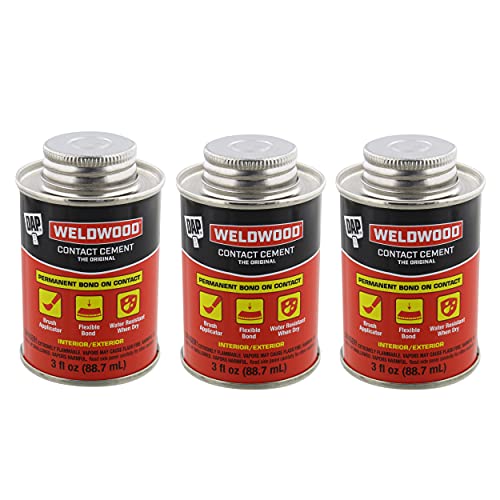
DAP’s Weldwood Original has long been the standard that other contact cements are measured against, and this three-pack of 3-ounce cans delivers that same polychloroprene formula at the lowest per-unit price of any premium contender here. The formula uses a waterborne, low-VOC carrier that still achieves the tensile strength required to bond EVA foam to wood, metal, or other foam without melting the substrate. The 2.5-hour full cure time is significantly faster than the 24-hour benchmark, making this a strong choice for jobs that need to leave the clamps the same afternoon.
Customer feedback from cobblers and furniture repairers praises the bond it creates on shoe soles and linoleum strips — both applications that demand the same flexible, shear-resistant film needed for EVA foam. The three-can pack provides redundancy for larger projects or multiple work sessions, and each can reseals well if the rim is wiped clean before closing. The low-VOC label means the solvents are less aggressive on respiratory passages compared to original red-label formulas, though adequate ventilation is still recommended.
The trade-off is that waterborne polychloroprene formulas can feel slightly less tacky than their full-solvent counterparts during the initial contact. You must wait the full 15-minute solvent evaporation window before pressing parts together, or the bond will lack strength. The metal can lid also draws criticism for being harder to open than the older glass bottle design. For repeat users who value speed and low toxicity, this pack is a reliable everyday workhorse.
Why it’s great
- Low-VOC formula reduces chemical irritation while maintaining strong bonds
- 2.5-hour full cure enables same-project completion
- Three-pack provides enough volume for multiple mid-size foam jobs
Good to know
- Metal can lids are harder to pry open than previous glass bottles
- Waterborne formulation requires exact adherence to solvent evaporation window
3. Beacon Foam-Tac Powerful Glue
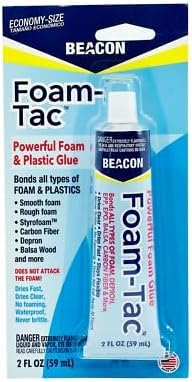
Beacon Foam-Tac occupies a unique niche: it is specifically engineered for EPP, EPO, and Depron foam — all closed-cell foams closely related to EVA — and it incorporates UV blockers that prevent the adhesive seam from yellowing or degrading after prolonged sun exposure. RC plane builders have made this their top choice because the glue maintains flexibility after curing, which is critical when a foam wing flexes during flight. The special adhesion promoter in the formula helps it wet out the foam surface more effectively than standard contact cement.
Users who repaired Cambro cooler cracks and RC plane wings note that the bond line remains intact even when the foam body flexes under load. The adhesive applies thick and snot-like straight from the bottle, which means it stays put on vertical surfaces but also makes it tricky to spread evenly without practice. The lack of a nozzle tip means you can either squeeze a bead directly onto the foam or use a disposable spreader. The open time is shorter than solvent-based cements — you have roughly two to three minutes to position the parts before the adhesive grabs permanently.
The thickness is the biggest hurdle for new users. Several reviews report frustration with stringy application and difficulty controlling the bead size. For experienced builders who already work with thick contact cements, this trade-off yields a bond that is genuinely stronger than general-purpose options. For beginners, the learning curve is steeper than with brushable neoprene cements, but the UV resistance makes Foam-Tac the best pick for outdoor foam projects that will sit in direct sunlight.
Why it’s great
- UV blockers protect the bond line from sunlight degradation over time
- Flexible cure prevents seam cracking on dynamic foam structures
- Adhesion promoter improves wet-out on slick closed-cell surfaces
Good to know
- Extremely thick, snot-like consistency makes precise application challenging
- No nozzle included; requires separate spreader tool or practice with bead application
4. S-18 All-Purpose Adhesive by RH Adhesives
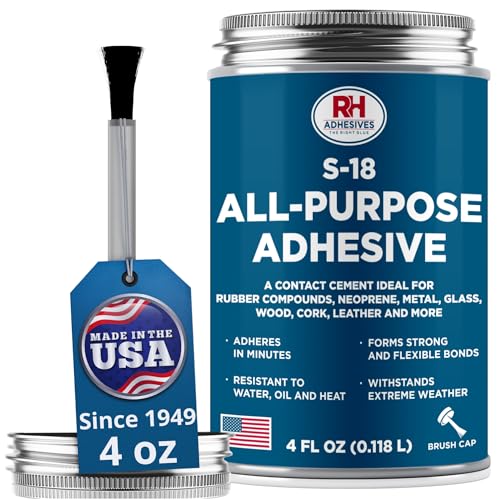
RH Adhesives’ S-18 is a neoprene-based contact cement that has been manufactured in the United States since 1949, and the formulation has remained consistent enough that craftsmen still rely on it for bonding neoprene rubber and closed-cell foam. Its 4-ounce can carries the same solvent delivery system as much more expensive options, but at the entry-level end of the price spectrum. The liquid cures into a film that delivers good peel strength and aging properties, which is precisely what EVA foam needs when the bond line will face occasional moisture or humidity.
Customer reviews highlight successful repairs on leather boots, foam pipe insulation, and yoga mats — all materials that share a closed-cell or semi-porous structure similar to EVA. The water-resistant property makes S-18 suitable for marine-adjacent projects where foam might encounter splashes, though outdoor heat exposure has caused failures in one documented review. The liquid form applies smoothly with a brush or small stick, and the off-white color dries nearly invisible on most foam surfaces.
The full 24-hour cure cycle means this is not a fast-repair adhesive. The solvent smell is noticeable but not overpowering compared to industrial-grade cements. Some users report that the glue loses bond strength if the container is stored for many months after first opening, as solvents evaporate through the cap seal. For indoor projects on a tight budget where overnight clamping is acceptable, S-18 delivers reliable neoprene bonding at the lowest entry cost.
Why it’s great
- Proven neoprene formula from a manufacturer with decades of production history
- Water-resistant film suitable for humid or splash-prone environments
- Low entry cost for budget-conscious DIY foam projects
Good to know
- 24-hour full cure slows down project turnaround
- Not recommended for outdoor heat-exposed applications
5. Wonshine Contact Cement Adhesive with Built-in Brush Tip
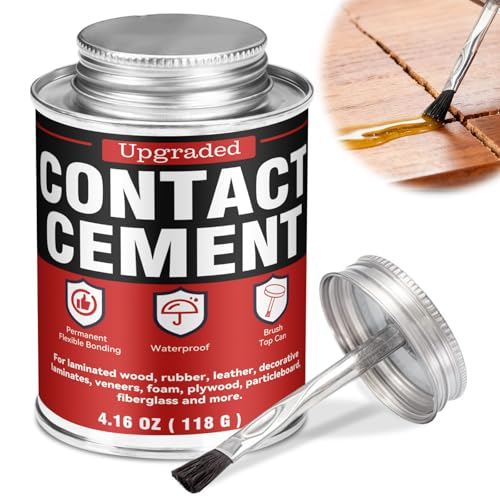
Wonshine’s entry in the contact cement category solves the most common complaint about small adhesive bottles: over-application. The built-in brush tip lets you paint the chloroprene formula directly onto EVA foam in a precise, thin layer, eliminating the goopy mess that happens when you pour from a can. The formula is waterproof and heat-resistant after curing, and it remains flexible enough to handle the natural bending of foam-backed laminates or shoe sole repairs. Compatibility includes wood, leather, rubber, foam, and fiberglass — covering the typical substrates found in EVA foam sandwich laminations.
Users who repaired laminate countertop edges and sneaker soles report that the bond held after multiple weeks of use, outperforming the general-purpose adhesives they tried previously. The 10- to 15-minute tack-time window is standard for neoprene contact cements, and the bottle volume (4.16 ounces) is generous for small laminating and edge-band repairs. The brush tip also makes it easy to apply cement into tight corners where a foam brush cannot fit.
The container design has a known vulnerability: as solvent evaporates over time, the remaining adhesive stiffens and eventually becomes unusable. Some users extend the bottle’s life by adding acetone, but that thins the formula below the intended viscosity. For a single small project or occasional touch-ups, the brush-tip convenience outweighs the longevity concern. If you need a cement that offers fast, clean application for quick repairs and small foam bonds, this is the most user-friendly option on the list.
Why it’s great
- Integrated brush tip enables controlled, mess-free application on small foam surfaces
- Waterproof and heat-resistant cure maintains bond in warm environments
- Larger 4.16-ounce volume for the application category
Good to know
- Solvent evaporates quickly; leftover adhesive stiffens in the bottle
- Not economical for large sheet-laminating projects
FAQ
Can I use contact cement on EVA foam without sanding the surface first?
Why does my contact cement feel dry and crusty after a few months in storage?
Is toluene-free contact cement strong enough for EVA foam shoe repairs?
Final Thoughts: The Verdict
For most users, the contact cement for eva foam winner is the Barge Contact Cement with Pixiss spreaders because it combines a trusted toluene-free neoprene formula with precision application tools that eliminate the most common error — uneven glue thickness. If you need fast turnaround and low-VOC handling for repeated large jobs, grab the DAP Weldwood Original 3-pack. And for outdoor foam projects exposed to sunlight, nothing beats the UV-blocking formula of the Beacon Foam-Tac.

Mo Maruf
I created WellFizz to bridge the gap between vague wellness advice and actionable solutions. My mission is simple: to decode the research and give you practical tools you can actually use.
Beyond the data, I am a passionate traveler. I believe that stepping away from the screen to explore new environments is essential for mental clarity and physical vitality.