Our readers keep the lights on and my smoothie glass nicely filled. As an Amazon Associate, I earn from qualifying purchases.
A concrete slab that looks perfect from ten feet away can betray every flaw the moment you lay down tile or vinyl. The difference between a professional-grade floor installation and a wavy, lipped disaster is almost always the preparation layer underneath — and that starts with the right compound in your trowel. Whether you are smoothing a garage floor, encapsulating old adhesive residue, or prepping a basement for new flooring, the material you choose determines whether the job looks seamless or requires expensive rework.
I’m Mohammad Maruf — the founder and writer behind WellFizz. I evaluate building materials by analyzing their real-world cure time, bond strength, shrinkage resistance, and application characteristics based on thousands of verified owner experiences and technical data sheets.
After reviewing dozens of compounds for repairing, patching, and leveling, these seven products consistently deliver reliable results for DIYers and pros alike. This guide will help you select the best concrete floor leveler for your specific project by comparing coverage, working time, and adhesion across real repair scenarios.
How To Choose The Best Concrete Floor Leveler
Selecting the right floor leveler starts with understanding the damage you are fixing. Hairline cracks, spalled garage floors, deep potholes, and uneven subfloors each demand a different material chemistry. Applying a fast-setting skim coat over a deep void or pouring a self-leveling sealant onto a dusty surface will fail — often within a single freeze-thaw cycle. Start by measuring the depth and width of your repair area.
Match the Chemistry to the Crack Depth
Cement-based feather finishes like Ardex Feather Finish handle thin applications from 1/16 inch to about 1/4 inch in a single pass. For deeper repairs up to 4 inches, pourable compounds such as Rust-Oleum Concrete Saver Pro can fill voids in one pour without layering. Self-leveling polyurethane sealants work best on cracks up to 1.5 inches wide and rely on a backer rod to prevent the material from flowing out of deeper gaps. Using the wrong depth range guarantees either excessive waste or insufficient fill.
Prioritize Bond Strength and Surface Prep
Bond strength determines whether your repair delaminates after a season of temperature swings and foot traffic. Cement-based underlayments mechanically lock into porous concrete, but they require a clean, dust-free surface. Polyurethane and MS polymer formulations chemically bond to concrete, asphalt, brick, and even metal — making them more forgiving on surfaces with old adhesive residue. Regardless of the product, power washing or wire brushing the crack before application is the single most important step for long-term adhesion.
Evaluate Working Time for Your Skill Level
Fast-setting compounds with cure times under two hours are ideal for garage floors and driveways that need vehicle traffic restored the same day. However, these products demand quick, confident troweling — a novice working on a large area may find the material hardening mid-job. Slower-curing polyurethane sealants offer 20 to 30 minutes of working time and remain slightly flexible after cure, which suits DIYers repairing expansion joints or irregular cracks where adjustment during application is helpful.
Quick Comparison
On smaller screens, swipe sideways to see the full table.
| Model | Category | Best For | Key Spec | Amazon |
|---|---|---|---|---|
| Ardex Feather Finish (4-Pack) | Cement Underlayment | Large-area subfloor prep | 40 lbs total, feather-edge to 1/16 inch | Amazon |
| Rust-Oleum Concrete Saver Pro | Pourable Repair | Deep voids up to 4 inches | Foot traffic in 30 min, vehicle in 2 hrs | Amazon |
| Ardex Feather Finish (Single) | Cement Underlayment | Thin skim coats and spot leveling | 10 lbs, tile-ready in 15 minutes | Amazon |
| Rust-Oleum EPOXYShield Patch | Epoxy Patch | Garage crack repairs before epoxy paint | 24 oz, low-odor solvent-free formula | Amazon |
| LUVBOATE Concrete Crack Filler | MS Polymer Sealant | High-flexibility expansion joints | 74 oz, self-leveling high elasticity | Amazon |
| Piukir Concrete Crack Filler (3-Pack) | Oil-Based Sealant | Outdoor driveway sealing | 3.3 lbs total, cures 24-48 hrs | Amazon |
| E-SDS Concrete Crack Filler | Polyurethane Sealant | Submerged or wet-joint sealing | 6-pack, moisture-cured elastomeric | Amazon |
In‑Depth Reviews
1. Ardex Feather Finish (4-Pack)
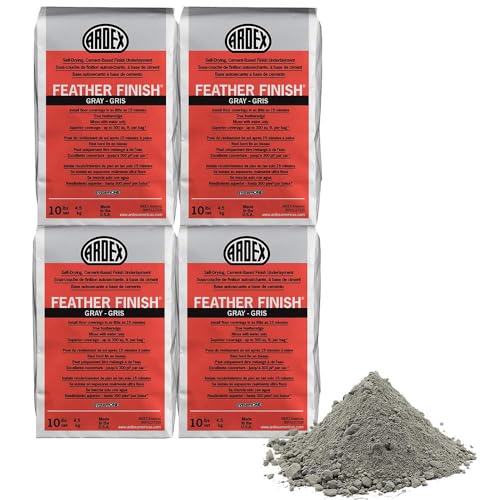
The 4-pack bundle of Ardex Feather Finish delivers 40 pounds of self-drying cement underlayment — enough to cover large subfloor areas or multiple repair zones without running short mid-project. The material bonds aggressively to concrete, plywood, OSB, terrazzo, gypsum, and old adhesive residue, which means you can apply it directly over cutback glue from asbestos tile removal without additional primer. Each bag mixes with only water, and the compound sets fast enough that tile, vinyl, or laminate can be installed in as little as 15 minutes after application.
The true feather-edge capability is the defining feature here. Unlike many cement patches that crumble at thin edges, Ardex Feather Finish spreads down to a 1/16-inch taper without cracking or delaminating. This makes it ideal for smoothing transitions between new flooring and existing slabs, especially in kitchens, bathrooms, and laundry rooms where height buildup is a concern. Owners consistently report that it sands easily between coats and leaves an ultra-smooth surface ready for finish flooring.
The main trade-off is working speed. Because the compound sets quickly, you should mix only what you can apply in a single pass — larger areas require batch mixing with a helper. The gray color dries lighter than the wet appearance, so color match for exposed repairs may not be perfect. For interior subfloor prep and skim coating, however, this bundle offers the best coverage-per-dollar in the premium category.
Why it’s great
- Bonds without primer to cutback residue and old adhesive
- Feathers to 1/16-inch without cracking
- Flooring can be installed 15 minutes after setting
Good to know
- Sets fast — mix only small batches at a time
- Dried color is lighter than wet appearance
- Not intended for deep-fill repairs over 1/4 inch per coat
2. Rust-Oleum Concrete Saver Pro

Rust-Oleum Concrete Saver Pro is a pourable cement-based repair compound engineered for speed. It supports foot traffic in 30 minutes and vehicle traffic in as little as 2 hours — making it one of the fastest return-to-service options available for driveways and garage floors. The formula can be applied up to 4 inches deep in a single pour, which eliminates the need for layering on deep potholes or sunken slabs.
Just add water, mix, and pour. The compound spreads smoothly and self-levels to a matte limestone finish that blends reasonably well with surrounding concrete. Owners appreciate that it sets up at temperatures as low as 40 degrees Fahrenheit, extending the working season in colder climates. The 10-pound bucket covers a limited area, however — enough for a few deep spot repairs but not full-slab resurfacing.
The most common owner complaint involves color accuracy. The limestone shade dries noticeably lighter than weathered gray concrete, so visible repairs near front walkways may stand out. The product also runs toward the premium side when measured per pound, making it better suited for targeted high-traffic repairs than large-area patching. For a fast-curing, deep-fill option that gets your driveway back in service the same day, this is a solid choice.
Why it’s great
- Foot traffic in 30 minutes, vehicles in 2 hours
- Single pour fills voids up to 4 inches deep
- Works down to 40°F for cold-weather projects
Good to know
- Dried color is lighter than typical gray concrete
- 10-pound bucket covers limited area
- Expensive for large-scale resurfacing jobs
3. Ardex Feather Finish (Single Bag)

The single 10-pound bag of Ardex Feather Finish offers the same self-drying cement formulation as the 4-pack bundle, making it a logical entry point for small-area skim coating and spot leveling. It bonds to concrete, plywood, OSB, masonry, and even old tile surfaces with no primer required — one owner reported applying it directly over fireplace tiles after a simple wipe-down and achieving a smooth concrete look with three thin coats.
The compound mixes to a consistency similar to heavy whipping cream or brownie batter, depending on water ratio. That flexibility lets you adjust the mix for vertical patches versus flat trowel work. Owners consistently praise its ability to encapsulate cutback residue from asbestos tile removal without sanding, creating a clean substrate for new flooring. The featheredge capability means you can taper the material to nothing at the repair edge, eliminating the lipped transition that cheaper patches leave behind.
The single bag is best for small patches up to a few square feet. The fast set time — tile-ready in 15 minutes — means you should mix conservatively and work deliberately. If your project spans an entire room or multiple rooms, the 4-pack bundle offers better value. For a single countertop resurface, fireplace makeover, or a few square feet of subfloor prep, this bag hits the sweet spot between professional results and DIY practicality.
Why it’s great
- No primer needed — bonds directly to most substrates
- Adjustable consistency for different repair depths
- Feathers to zero edge for invisible transitions
Good to know
- 10 lbs covers only a few square feet at thin coat
- Sets quickly — mix small batches
- Not suitable for deep fills over 1/4 inch per coat
4. Rust-Oleum EPOXYShield Concrete Patch
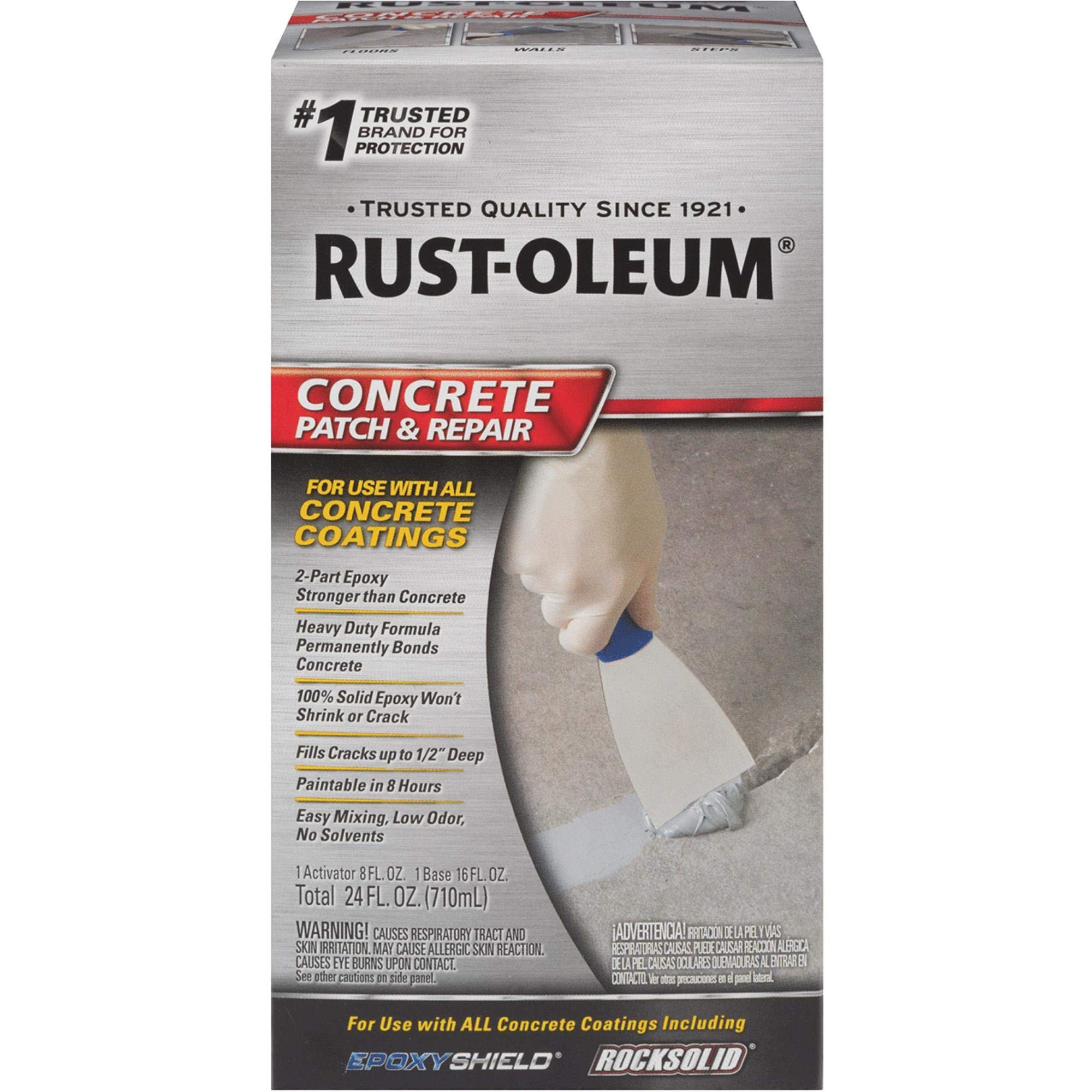
Rust-Oleum EPOXYShield Concrete Patch is a 24-ounce epoxy-based compound designed specifically for crack repair before applying epoxy paint to garage floors. The low-odor, solvent-free formula makes it suitable for indoor use where ventilation is limited. It mixes easily, applies with a trowel or pastry bag for controlled fill, and cures to a hardness that owners describe as rock-solid — one reviewer reported the patch lasted nine years without failure.
The working time runs about 20 to 25 minutes, which gives you enough flexibility to fill multiple linear feet of crack in one session. The compound does not shrink during cure, so a single application fills the crack flush with the surrounding surface. For deeper cracks, a second coat after the first cures ensures a smooth finish that accepts epoxy paint without telegraphing the underlying damage. Cleanup is straightforward with soap and water before the material cures.
The main limitation is volume. The 24-ounce container covers roughly 40 linear feet of standard crack, but wider or deeper cracks consume material quickly. The cured patch has a slightly shiny, darker appearance compared to bare concrete, which matters if the repair will be left exposed rather than painted over. For a pre-paint garage floor repair that bonds permanently and resists tire peel, this is the most targeted solution available.
Why it’s great
- Bonds permanently — one owner reported 9-year durability
- Low-odor, solvent-free formula for indoor use
- No shrinkage during cure for flush fills
Good to know
- 24-ounce container covers limited crack footage
- Cured patch is shinier and darker than bare concrete
- Deeper cracks may require two coats
5. LUVBOATE Concrete Crack Filler

LUVBOATE Concrete Crack Filler uses an MS polymer base that remains elastic after full cure, making it one of the few options specifically engineered to accommodate ground movement and thermal expansion. This flexibility is critical for driveways, sidewalks, and patios in regions with freeze-thaw cycles where rigid patches crack out within a single season. The 74-ounce container provides generous coverage for multiple joints or a single large repair.
The self-leveling characteristic works well on horizontal surfaces — simply inject the filler into the crack and smooth it with the included scraper. It bonds not only to concrete but also to brick, tile, metal, and wood, expanding its usefulness for mixed-material repairs around foundations and planter boxes. Owners report that it dries quickly enough to be durable but remains slightly rubbery, which is exactly what you want for expansion joints that need to flex without breaking bond.
The elasticity comes with a trade-off: the filler does not cure to a rock-hard solid like cement-based patches. If you need a surface that matches the hardness of the surrounding slab for grinding or polishing, this is not the right choice. The color match also is not perfect — the gray filler may look slightly different from weathered concrete until UV exposure ages it. For high-movement joints where rigid repair would fail, this MS polymer formulation outperforms cement in every metric.
Why it’s great
- Stays flexible to resist freeze-thaw cracking
- Bonds to concrete, metal, brick, tile, and wood
- Self-leveling with easy application and included tools
Good to know
- Cures rubbery — not suitable for grinding or polishing
- Color match may vary with older concrete
- Pricey for larger projects requiring multiple containers
6. Piukir Concrete Crack Filler (3-Pack)
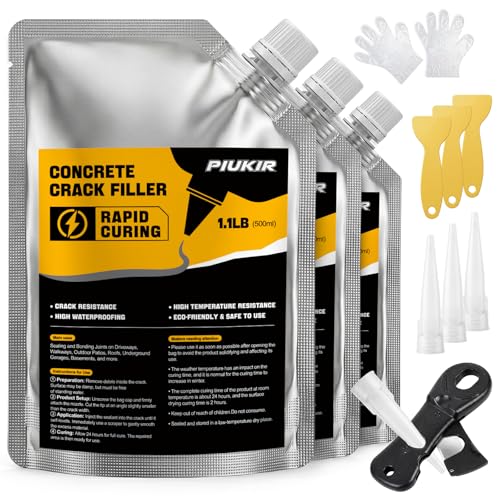
Piukir Concrete Crack Filler comes as a 3-pack of pre-mixed, oil-based polyurethane sealant designed for outdoor cracks in driveways, patios, and sidewalks. Each bag covers approximately 16 linear feet of 0.4-inch wide by 0.4-inch deep crack, bringing the total kit coverage to around 48 feet. The oil-based formula penetrates deeper into porous concrete than water-based alternatives, creating a waterproof bond that resists washout during rain.
The kit includes a nozzle cutter, scraper, and gloves — everything needed for a single-day repair without a separate trip to the hardware store. The self-leveling behavior means you simply pour the filler into the crack and let gravity do the work, producing a smooth, flush surface without troweling. Owners report that the material cures within 24 to 48 hours and holds up well under tire traffic and weather exposure.
The oil base takes longer to cure than cement or MS polymer alternatives, and the product instructions explicitly warn against applying before rain — a dry 48-hour window after application is recommended. The gray color is neutral but may not match aged concrete perfectly. For a budget-conscious homeowner with several linear feet of standard driveway cracks, this 3-pack delivers solid results at an accessible price point.
Why it’s great
- Pre-mixed with tools included — no extra purchase needed
- Oil-based formula penetrates deep for strong bond
- Self-leveling for smooth, flush finish
Good to know
- Requires 48-hour dry window after application
- Oil base cures slower than cement compounds
- Color may not match older, weathered concrete
7. E-SDS Concrete Crack Filler

E-SDS Concrete Crack Filler is a moisture-cured, polyurethane-based sealant that excels in submerged or high-moisture environments — canal joints, reservoir seals, and basement slab cracks where standing water is a concern. The paste-like consistency stays in place on horizontal surfaces and self-levels to fill cracks up to 1.5 inches wide and 0.5 inches deep. Tack-free time runs 2 to 3 hours, with full cure in 24 to 48 hours depending on humidity and temperature.
The 6-pack format provides six 10.5-ounce tubes suitable for multiple smaller repairs or one larger project. The material remains slightly pliable after cure, making it appropriate for joints subject to minor ground movement. Owners note that the self-leveling property is genuine — the filler flows into cracks and levels without manual smoothing, producing a clean finish. A foam backer rod is recommended for deeper gaps to prevent the sealant from flowing out before curing.
The primary drawbacks involve application difficulty and cure consistency. The sealant can be stubborn to start flowing — cutting the nozzle tip and puncturing the internal seal is necessary, and a sturdy caulk gun is required because the thick paste can break cheaper guns. Some owners report that the material stays tacky for days, attracting dust and debris before it fully skins over. Storage below 41 degrees Fahrenheit can cause the tube to freeze and become unusable. For wet-joint sealing where standard cement patch would wash out, this moisture-cured polyurethane is the specialized solution.
Why it’s great
- Moisture-cured formula works in submerged conditions
- Self-leveling for clean, flush finish without troweling
- 6-pack provides good value for multiple repairs
Good to know
- Thick paste requires a strong caulk gun
- Can remain tacky for days, attracting dust
- Freezes and becomes unusable below 41°F
FAQ
Can I apply concrete floor leveler over old paint or adhesive residue?
How deep can I fill a crack in a single application?
Will self-leveling concrete floor leveler work on surfaces with a slope?
Why does my concrete patch look darker or shinier than the surrounding slab?
How long should I wait before driving or walking on a repaired concrete floor?
Final Thoughts: The Verdict
For most users, the best Concrete Floor Leveler winner is the Ardex Feather Finish (4-Pack) because it combines professional-grade feather-edge capability with enough coverage for large subfloor projects at a reasonable per-bag cost. If you need fast return-to-service for a driveway repair, grab the Rust-Oleum Concrete Saver Pro. And for high-movement expansion joints where rigid patches fail every winter, nothing beats the LUVBOATE Concrete Crack Filler with its MS polymer elasticity.

Mo Maruf
I created WellFizz to bridge the gap between vague wellness advice and actionable solutions. My mission is simple: to decode the research and give you practical tools you can actually use.
Beyond the data, I am a passionate traveler. I believe that stepping away from the screen to explore new environments is essential for mental clarity and physical vitality.