Our readers keep the lights on and my smoothie glass nicely filled. As an Amazon Associate, I earn from qualifying purchases.
Chasing a phantom battery drain on your car or troubleshooting a humming motor in an HVAC unit demands a tool that reads real current, not just guesses. A clamp meter lets you measure amperage without breaking the circuit, making it essential for diagnosing everything from parasitic draws to variable frequency drives.
I’m Mohammad Maruf — the founder and writer behind WellFizz. I’ve spent hundreds of hours analyzing the technical specifications, safety ratings, and real-world performance data of the most popular clamp meters on the market to build this guide.
Whether you need to measure milliamps on a car battery or 1000 amps on an industrial panel, this deep dive into the best clamp meter options will help you pick the right tool for the job without overspending.
How To Choose The Best Clamp Meter
Selecting the right clamp meter comes down to matching the tool’s electrical safety rating and measurement capabilities to the specific environment you work in. An HVAC technician, an automotive electrician, and a home DIYer all need different specs from their primary meter.
Safety Ratings (CAT I, II, III, IV)
The CAT rating defines where a meter is safe to use, based on the transient energy (surges) present at that point in the electrical system. A CAT III meter, for example, is rated for distribution panels and fixed equipment, while a CAT IV meter is for service entrances. Ignoring the category can be dangerous—using a low-rated meter on a high-energy panel risks arcing and injury.
True RMS vs. Average Sensing
Average-sensing meters are cheap and only accurate on pure sine wave AC signals, which are rare in modern equipment with VFDs, motors, and switching power supplies. True RMS meters calculate the actual heating potential of the waveform, giving you accurate readings on distorted or noisy signals. For professional electrical work, True RMS is non-negotiable.
AC/DC Current Capability
Many entry-level meters read AC current only, which is fine for standard household circuits. But if you work on batteries, solar panels, or automotive systems, you need a meter that also measures DC current through the clamp. DC current measurement requires a Hall Effect sensor and is essential for finding parasitic battery drains.
Counts and Resolution
The count number (e.g., 2000, 6000) describes the maximum reading the display can show before it auto-ranges up. A 6000-count meter shows finer resolution on low-voltage and low-current measurements than a 2000-count model. For millivolt or milliamp level work, higher counts provide the granularity needed for precise troubleshooting.
Quick Comparison
On smaller screens, swipe sideways to see the full table.
| Model | Category | Best For | Key Spec | Amazon |
|---|---|---|---|---|
| Fieldpiece SC440 | Premium | HVAC Professional | Microamps DC (flame diode) & Temp | Amazon |
| Fluke 362 | Premium | Solar & Panel Testing | 200A AC/DC, 18mm Jaw | Amazon |
| AstroAI CM6K0R | Mid-Range | Industrial & VFD Work | 1000A AC/DC, Inrush, LoZ | Amazon |
| Intendvision HT208D | Mid-Range | General Purpose Pro | 1000A AC/DC, Color Screen | Amazon |
| UNI-T UT210E | Budget | Automotive Parasitic Draw | DC 100A, 1mA Resolution | Amazon |
In‑Depth Reviews
1. Fieldpiece SC440 True RMS Clamp Meter

The Fieldpiece SC440 is the industry standard for HVACR technicians because it packs every diagnostic parameter into one durable body: temperature, capacitance, microamps DC for flame diode tests, and True RMS AC/DC current up to 400 amps. The included K-type thermocouple was accurate right out of the box, and the silicone test leads are far superior to the stiff PVC leads found on cheaper meters.
Safety features include a high-voltage LED and beeper that warns you when you’re on a live circuit, plus a continuity warning that beeps if you accidentally connect to a live source. The inrush current function captures motor startup spikes, which is critical for diagnosing locked rotors or failing capacitors in compressors and fans.
One quirk: you must press the select button after power-on to get amp readings and continuity beep, which takes a moment to get used to. But the alligator probe tips and detachable leads make one-handed testing in cramped electrical panels much easier. For the technician who needs one meter to do everything, the SC440 is the clear choice.
Why it’s great
- Measures microamps DC for flame rod testing, a rare feature
- High-voltage warning beeper and LED add real safety
- Durable build and silicone leads designed for daily pro use
Good to know
- Requires pressing select for amp/continuity mode after startup
- Premium price reflects professional-grade capability
2. Fluke 362 200A AC/DC Clamp Meter

The Fluke 362 is engineered specifically for tight spaces where a standard clamp meter simply won’t fit. Its 18mm triangular jaw slips into crowded breaker panels and behind solar inverter wiring with ease, and the thin, light body makes one-handed operation comfortable for long sessions. This meter reads both AC and DC current up to 200 amps, making it a solid tool for transfer switch load balancing and solar panel string testing.
One important distinction: this is not a True RMS meter on AC readings—it is average-sensing. On clean sine wave circuits typical of residential and commercial mains power, this is perfectly accurate. But if you work with VFDs or switching power supplies that produce distorted waveforms, you will want a True RMS model. The DC amp function, however, is very reliable for measuring PV array output and battery bank current.
The continuity beep is not the loudest, which can be frustrating in a noisy mechanical room. But the build quality, brand reliability, and ability to measure both AC and DC current in such a small package make it a favorite for electricians and solar installers who prioritize access over raw range.
Why it’s great
- Smallest jaw (18mm) for accessing tight wiring compartments
- Measures AC and DC current with solid accuracy
- Trusted Fluke build quality and CAT III 600V safety
Good to know
- Not True RMS on AC—average-sensing only
- Continuity beep is relatively quiet in noisy areas
3. AstroAI Inrush Digital Clamp Meter CM6K0R

The AstroAI CM6K0R delivers premium features like 1000A AC/DC True RMS, inrush current measurement, VFD filtering, and LoZ (low impedance) mode at a price point that undercuts most competitors by a wide margin. The LoZ mode is particularly useful for eliminating ghost voltages—those phantom readings you get on long, unconnected wires that can trick you into thinking a circuit is live.
Inrush current capture (100ms sampling window) helps identify startup problems in motors and starting circuits, whether the issue is in the motor winding or the starting capacitor. The backlit LCD and built-in flashlight make this meter usable in dark panels and basements, and the 6000-count display provides excellent resolution for low-voltage work like control circuit troubleshooting.
A minor complaint: the temperature probe stabilizes slowly compared to dedicated thermocouple meters, and the display only shows Celsius, not Fahrenheit. But for a meter that offers CAT IV 600V / CAT III 1000V safety, auto-ranging, and a storage bag, the AstroAI is an incredible value for industrial maintenance and solar PV projects alike.
Why it’s great
- Inrush current function for motor startup diagnostics
- LoZ mode eliminates ghost voltage readings
- High 6000-count display for fine resolution
Good to know
- Temperature probe stabilizes slowly
- No Fahrenheit display option
4. Intendvision HT208D True RMS Clamp Meter
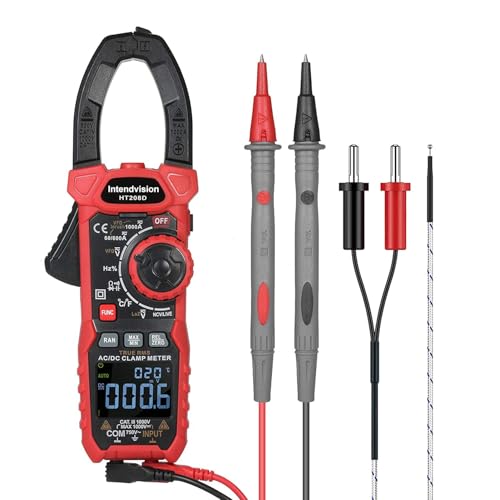
The Intendvision HT208D, also sold as the KAIWEETS HT208D, stands out with a color screen that makes reading measurements at a glance much easier than traditional monochrome LCDs. It offers True RMS AC/DC current up to 1000A, VFD filtering, LoZ mode, and inrush current, matching the feature set of meters costing much more. The large display and bright backlight are welcome in dimly lit electrical rooms.
Build quality is above average for this price tier—the rotary dial has positive detents that resist accidental switching, and the body feels solid in hand. Users report that accuracy holds up well against Fluke references even after a year of daily professional use. The included thermocouple and test leads work fine for immediate use, though the leads are standard PVC rather than silicone.
The selector switch can become finicky after extended heavy use, which is a common compromise at this price level. However, with a 36-month product service guarantee and a full set of functions including capacitance, duty cycle, and NCV detection, this meter offers exceptional depth for the money. It is a reliable option for general commercial and industrial troubleshooting.
Why it’s great
- Color screen improves readability in low light
- Includes VFD, LoZ, and Inrush functions
- 36-month warranty provides peace of mind
Good to know
- Selector switch may wear over extended daily use
- Included test leads are basic PVC type
5. UNI-T UT210E True RMS Clamp Meter

The UNI-T UT210E is the go-to tool for automotive electricians hunting parasitic battery drains, because it reads DC current down to 1 mA resolution. That level of precision lets you identify a shorted solenoid or a faulty module drawing just 50 mA—something many full-size meters miss entirely. The compact body fits into tight spaces behind glove boxes and under dashboards.
True RMS capability means accurate readings on the complex waveforms generated by modern vehicle electronics. The VFC mode (Variable Frequency Voltage/Current) helps filter out signal disturbance from variable frequency drives and PWM signals found in EV inverters and hybrid systems. It runs on two AAA batteries, which are easier to find in a pinch than the 9V cells used by larger meters.
The zero function is essential for accurate DC low-current readings—you must zero the meter after clamping onto the battery cable, as Earth’s magnetic field can offset the Hall sensor. Some users note that the ACC function drifts slightly at very low currents, but for detecting a parasitic draw that kills a battery overnight, the UT210E is more than adequate and beats expensive alternatives in this specific use case.
Why it’s great
- 1 mA DC resolution for parasitic drain detection
- Compact pocket size fits in tight automotive spaces
- Runs on AAA batteries instead of bulky 9V
Good to know
- Requires zero calibration for accurate DC low-current readings
- Display is smaller than full-size meters
FAQ
What is the difference between a clamp meter and a multimeter?
Can I use a clamp meter to measure DC current on my car battery?
What does the VFD function do on a clamp meter?
Why does my clamp meter show voltage when I hold it near a wire?
Final Thoughts: The Verdict
For most users, the best clamp meter winner is the AstroAI CM6K0R because it packs True RMS, inrush, VFD filtering, and LoZ mode into a safe, affordable package that handles the vast majority of industrial and residential tasks. If you need microamp DC measurement for flame diode testing and superior build quality, grab the Fieldpiece SC440. And for automotive parasitic draw detection with 1 mA resolution, nothing beats the compact UNI-T UT210E.

Mo Maruf
I created WellFizz to bridge the gap between vague wellness advice and actionable solutions. My mission is simple: to decode the research and give you practical tools you can actually use.
Beyond the data, I am a passionate traveler. I believe that stepping away from the screen to explore new environments is essential for mental clarity and physical vitality.