Our readers keep the lights on and my smoothie glass nicely filled. As an Amazon Associate, I earn from qualifying purchases.
Milling rough lumber into square, smooth boards is the foundation of fine woodworking, and nothing streamlines that workflow like a machine that joints an edge and then thicknesses the face without changing setups. The search for a single tool that delivers both flat reference surfaces and parallel thickness cuts without the floor footprint of separate machines is a serious research project, with decisions hinging on cutterhead type, motor torque, and table length.
I’m Mohammad Maruf — the founder and writer behind WellFizz. I’ve spent many hours analyzing cutterhead geometries, motor amperage ratings, and fence stability across hundreds of user reports to understand how each machine behaves with figured maple, reclaimed oak, and everyday pine.
Whether you are building out a compact workshop or upgrading from a benchtop planer alone, this guide matches your needs to the right machine. These recommendations focus on cutter quality, feed consistency, and dust management so you can choose the best combo jointer and planer for your projects without guesswork.
How To Choose The Best Combo Jointer And Planer
The decision starts with the cutterhead. A helical or spiral design with indexable carbide inserts will cost more upfront but delivers a quieter cut, dramatically less tearout on interlocking grain, and inserts that can be rotated four times instead of sharpening straight knives. Motor power matters most when facing wide hardwoods — a 15-amp motor with a two-speed gearbox lets you dial back feed for figured stock or increase it for dimensioning softwoods. Table length on the jointer side determines how effectively you can flatten long boards: an 8-inch benchtop jointer with 35-inch tables is very different from a 6-inch floor model with a 66-inch bed. Finally, dust collection capacity often gets overlooked — many benchtop planers eject chips with a blower that can overwhelm a shop vac, so planning for a 4-inch dust collector port early saves frustration.
Cutterhead Type and Insert Geometry
The cutterhead is the heart of the machine. Straight-knife cutterheads are the least expensive but create more noise and are prone to tearout on figured or interlocked grain. Spiral cutterheads position inserts in a staggered helix, shearing the wood rather than chopping it, which produces a smoother surface with less amp draw. Helical cutterheads take that further by using four-sided carbide inserts that can be rotated as edges dull. A true helical head with small, closely spaced inserts leaves a surface that often requires only 180-grit sanding, saving significant time in the finishing process.
Motor Power and Feed Speed Versatility
A machine’s ability to take consistent passes on dense exotics like ipe or hard maple depends on motor amperage and whether the gearbox offers multiple feed speeds. A 15-amp motor with a two-speed transmission — typically around 16 to 18 feet per minute for slow finishing passes and 26 feet per minute for rapid dimensioning — provides the flexibility to handle both tasks. Units with a single feed speed force a compromise, often leaving a surface that requires more sanding after fast cuts. The cutterhead RPM also plays a role: 10,000 RPM at the head combined with the correct feed speed yields more cuts per inch, which directly translates to a smoother finish.
Jointer Table Length and Fence Stability
On the jointer side, table length dictates how accurately you can flatten longer stock. Benchtop jointers typically offer tables between 30 and 40 inches, which works for furniture components under 48 inches but struggles with long table legs or solid-wood rails. Floor-model jointers with 50- to 70-inch tables provide the reference surface needed to flatten eight-foot boards. Fence stability is equally critical — a cast-iron fence that locks firmly at 90 and 45 degrees produces repeatable square edges, while an aluminum fence without support brackets can flex under pressure, introducing drift into joints. Look for fence enhancement brackets that lock at both ends for rigidity.
Quick Comparison
On smaller screens, swipe sideways to see the full table.
| Model | Category | Best For | Key Spec | Amazon |
|---|---|---|---|---|
| Powermatic 54HH | Floor Jointer | Fine joinery on long stock | 66″ tables / 40 carbide inserts | Amazon |
| DEWALT DW735X | Benchtop Planer | High-volume dimensioning | 96 / 179 CPI two-speed | Amazon |
| DEWALT DW735 | Benchtop Planer | Small shop workhorse | 15A motor / fan ejection | Amazon |
| Jet JWP-13BT | Benchtop Helical Planer | Quiet operation / helical cut | 26 HSS inserts / 2-speed | Amazon |
| FindBuyTool FB131H | Benchtop Helical Planer | Budget helical head upgrade | 4-row carbide head / 27.5 FPM | Amazon |
| Cutech 401120HI-IF | Benchtop Jointer | Wide 12″ capacity / cast fence | 12″ spiral / 24×6″ CI fence | Amazon |
| Cutech 401100HI | Benchtop Jointer | Portable 10″ spiral jointer | 10″ spiral / 12A motor | Amazon |
| Makita 2012NB | Portable Planer | Job site durability | 12″ capacity / 83 dB | Amazon |
| Wahuda 50110CC | Benchtop Jointer | Budget-friendly spiral jointer | 10″ spiral / 4-sided tips | Amazon |
| WEN PL1337 | Benchtop Planer | Entry-level spiral planer | 13″ spiral / 2-speed | Amazon |
In‑Depth Reviews
1. Powermatic 54HH 6-Inch Helical Cutterhead Jointer

The Powermatic 54HH is a floor-model jointer built for serious woodworkers who demand a dead-flat surface on stock up to six feet long. Its 66-inch cast-iron tables provide the reference surface needed to flatten long table legs and rails without the deflection you get from a benchtop machine. The helical cutterhead carries 40 four-sided carbide inserts that shear the wood fiber rather than chop it, producing a surface so smooth it often needs only a light sanding before finish.
Setup requires two people due to the weight of the cast-iron bed, but the factory settings on most units are impressively close true. The center-mounted fence controls and a fine/quick adjustment lever on the infeed table make depth-of-cut changes precise and repeatable. Owners consistently note that the helical head eliminates tearout on figured woods like curly cherry and quilted maple, and the lockable push-button switch adds a safety layer for shared shops.
The only meaningful limitation is the 6-inch maximum width, which rules out jointing boards wider than a standard 1×6 without an auxiliary sled. Some users also report that the fence, while stable, requires careful attention to remain perfectly square when tilted for bevel cuts. For anyone who prioritizes a long, rigid table and a helical head but does not need to joint wide panels, this machine sets the benchmark for fine joinery.
Why it’s great
- 66-inch tables provide industry-leading support for long stock
- 40 four-sided carbide inserts deliver glass-smooth surfaces with minimal tearout
- Quiet operation compared to straight-knife jointers of similar size
Good to know
- Limited to 6-inch jointing width; wider boards require alternative methods
- Fence needs careful adjustment to stay square when switched between 90° and bevel stops
- Assembly is a heavy two-person job due to the cast-iron table weight
2. DEWALT DW735X 13-Inch Thickness Planer

The DW735X is widely regarded as the gold standard benchtop planer for small to mid-size shops. Its 15-amp motor spins the three-knife cutterhead at 10,000 RPM while a two-speed gearbox lets you select 96 cuts per inch for a smooth finish or 179 CPI for a surface that often needs only 220-grit sanding. The fan-assisted chip ejection actively vacuums debris off the cutterhead and shoots it out through a 4-inch port, which keeps the machine clear but does require a capable dust collector rather than a standard shop vac.
The cast-aluminum base is notably more rigid than the stamped steel found on many benchtop competitors, and the automatic carriage lock reduces snipe without needing to manually engage a lever. The X version includes infeed and outfeed extension tables and an extra set of knives, making it a better value than the base DW735. Users consistently report that planing rough ash, cherry, or maple in 1/16-inch passes produces a finish that dramatically reduces sanding time.
On the downside, the three straight knives can dull faster than helical inserts when planing highly figured or abrasive woods, and the machine is loud enough that hearing protection is mandatory. The blower system also means the planer must be paired with a 4-inch dust collector hose — a shop vac will clog quickly. For woodworkers who already have a floor-model jointer and need a powerful, accurate planer, the DW735X is a proven choice.
Why it’s great
- Two-speed gearbox optimizes finish quality versus processing speed
- Automatic carriage lock minimizes snipe without manual intervention
- Fan ejection system keeps the cutterhead clear of chips during long runs
Good to know
- Straight knives dull faster on figured wood; a helical upgrade is possible
- Requires a 4-inch dust collector — a shop vac is insufficient
- Very loud during operation; hearing protection is essential
3. DEWALT DW735 13-Inch Thickness Planer
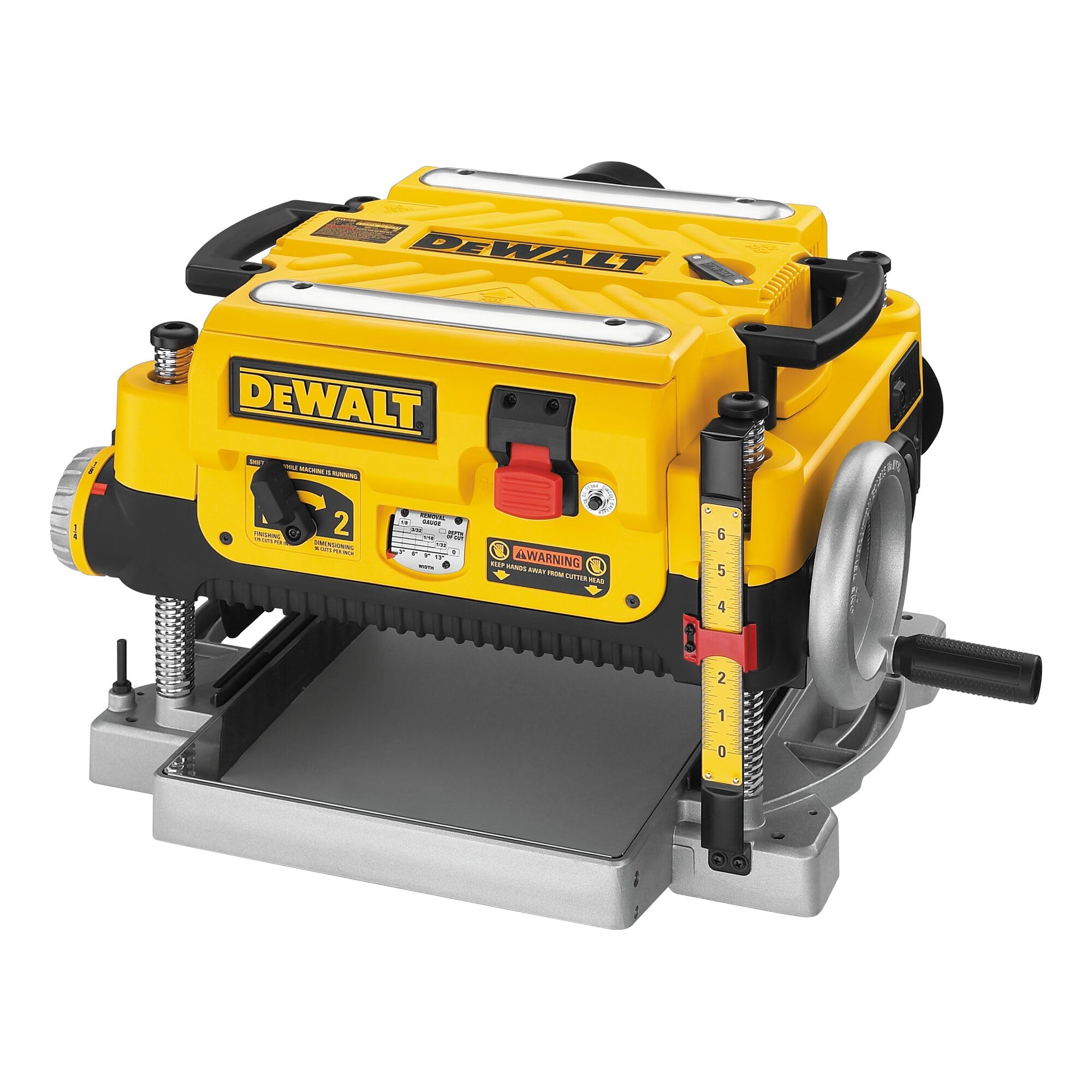
The base DW735 shares the same motor and two-speed gearbox as the DW735X but ships without the extension tables and extra knife set, making it slightly more accessible for buyers who already have infeed/outfeed support. The 15-amp motor handles softwoods and hardwoods without bogging, and the three-knife cutterhead delivers the same 96/179 CPI options that produce a finish far superior to single-speed planers. The fan-assisted chip ejection works identically to the X version, actively pulling chips away and exhausting them out the port.
Assembly is straightforward, and the automatic carriage lock is a standout feature — it engages when the carriage stops moving, preventing the snipe that plagues less sophisticated machines. The depth adjustment crank works smoothly, and the turret depth stop lets you return to frequently used thicknesses with one motion. Users upgrading from older planers often report that the finish off the DW735 requires only a pass with 220-grit paper before finishing.
The primary trade-off is the missing extension tables. Planing boards longer than about six feet will require aftermarket roller stands or a custom outfeed solution. The noise level is also significant — many users describe a jet-engine moan during operation. If your budget allows, the DW735X’s included extensions and spare knives represent better long-term value, but the base DW735 itself remains an outstanding machine for dimensional accuracy.
Why it’s great
- Identical motor and cutterhead performance to the DW735X at a lower entry cost
- Automatic carriage lock reduces snipe effectively
- Turret depth stop allows quick return to common thickness settings
Good to know
- Extension tables not included; outfeed support must be purchased separately
- Noise levels are very high — ear protection is required
- Fan ejection system demands a proper dust collector, not a shop vac
4. Jet JWP-13BT 13-Inch Benchtop Helical Planer

The Jet JWP-13BT brings a helical-style cutterhead to a benchtop planer at a price well below full-size helical machines. Six rows of 26 quick-change high-speed steel inserts create a shearing cut that produces less tearout and significantly lower noise than the straight-knife DW735. The 2-HP motor (15 amps) spins the cutterhead at 10,000 RPM, and the two-speed gearbox provides 18 and 26 FPM feed rates, allowing you to switch between rapid dimensioning and smooth finishing passes.
The precision-machined cast-iron bed and four-post design provide excellent stability for a benchtop unit, and the adjustable folding infeed and outfeed tables help support longer boards without taking up permanent floor space. The depth stop allows repeatable cuts when dimensioning multiple pieces to the same thickness. Owners consistently note that the surface finish requires minimal sanding, and the overall noise level is noticeably lower than a three-knife planer — a significant advantage in a shared or home shop.
The main drawback is that the HSS inserts dull faster on dense exotics like teak and ipe than carbide alternatives would, and carbide replacements are not available from Jet for this model. Some users also report that the feed roller can slip on heavily figured wood after prolonged use, requiring the inserts to be rotated 180 degrees to restore bite. For woodworkers who work primarily with domestic hardwoods and softwoods and value a quieter helical cut, this Jet is a compelling option.
Why it’s great
- Helical-style cutterhead reduces noise and tearout compared to straight knives
- Two-speed feed system offers flexibility for finish vs. speed
- Cast-iron bed and four-post design provide rigidity on a benchtop footprint
Good to know
- HSS inserts dull faster on exotic species; carbide not available
- Feed roller may slip on heavily figured stock after extended use
- Maximum cut depth of 1/8-inch limits aggressive dimensioning passes
5. FindBuyTool FB131H 13-Inch Benchtop Helical Planer
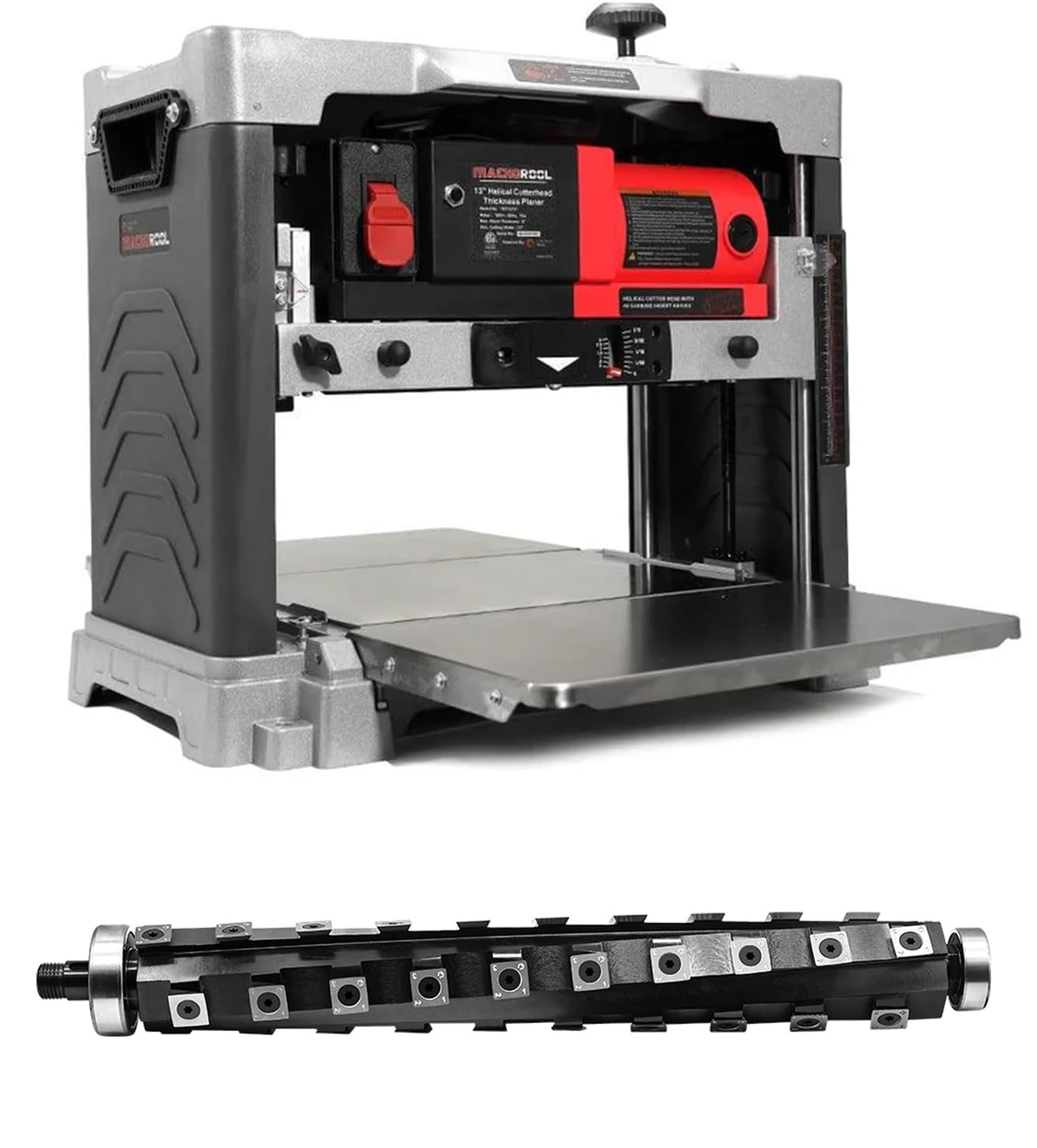
The FindBuyTool FB131H is a 13-inch benchtop planer equipped with a true helical cutterhead that uses 40 top-quality tungsten carbide inserts — a configuration normally found on machines costing significantly more. The 15-amp motor spins at 20,000 RPM with a 27.5 FPM feed rate, and the 4-column anti-wobble foundation holds thickness tolerance to under 0.1 mm. The eight-position depth stop makes it easy to dimension batches of boards to the same final thickness.
Users report that the finish from this planer rivals 180 to 220-grit sanding, even on challenging species like purpleheart, tiger wood, and sycamore, with virtually no tearout. The helical head is noticeably quieter than a three-knife cutterhead, which makes extended planing sessions less fatiguing. The machine is well-packaged and requires minimal setup out of the box.
The dust port design has a tendency to blow chips back toward the operator, and the depth gauge is considered unnecessary by some users. The height adjustment knob may come loose during shipping, though the manufacturer responds quickly to replacement requests. For budget-conscious woodworkers who want the benefits of a true helical head without paying name-brand markup, this machine delivers impressive performance.
Why it’s great
- True helical cutterhead with 40 tungsten carbide inserts at a budget-friendly price
- Finish quality often matches 180-grit sanding with minimal tearout
- Four-post design provides excellent stability for a benchtop planer
Good to know
- Dust port design can cause some blowback during operation
- Height adjustment knob may loosen in transit; check before use
- 27.5 FPM feed rate is fixed — no high/low speed options
6. Cutech 401120HI-IF 12-Inch Spiral Cutterhead Jointer
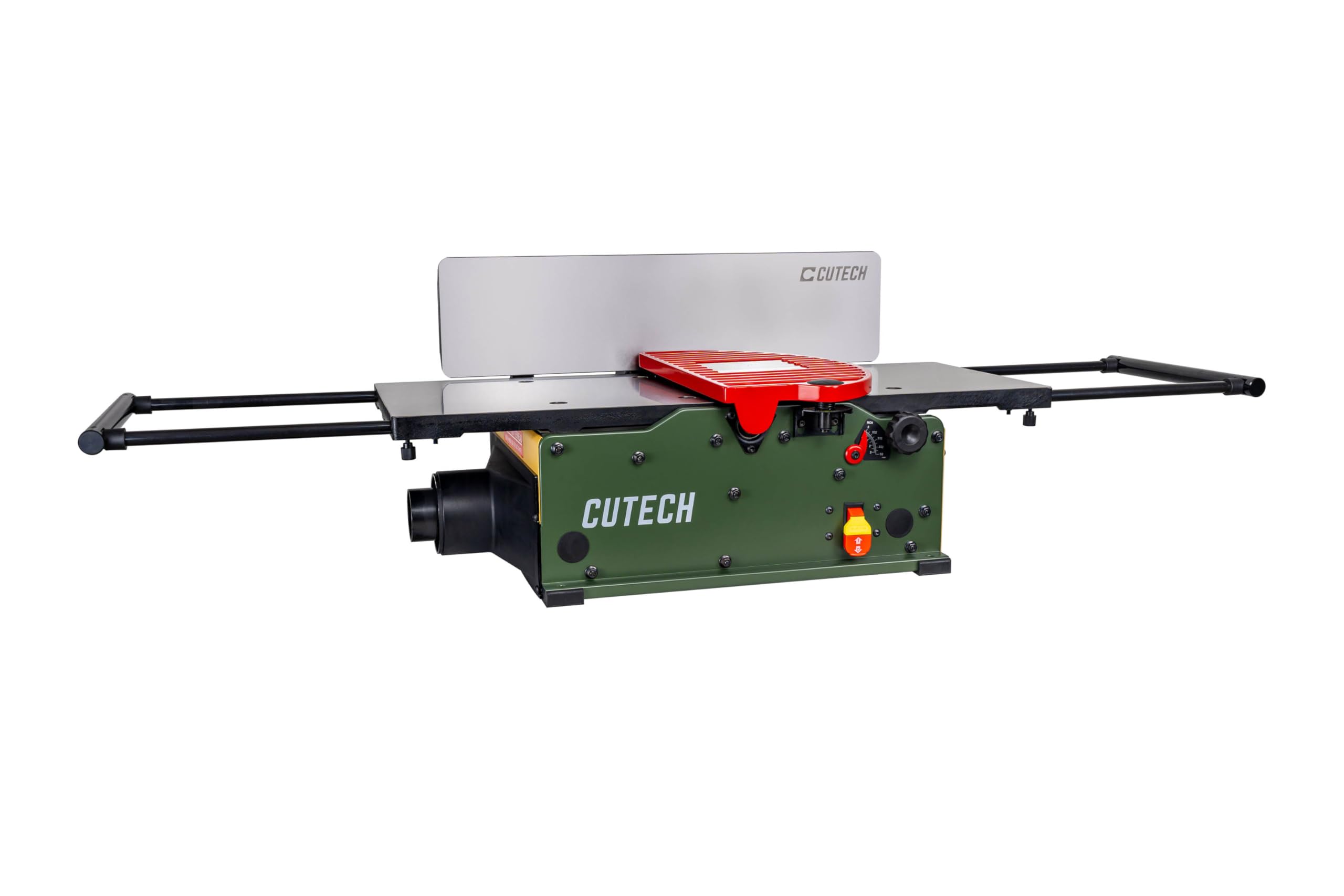
The Cutech 401120HI-IF offers a full 12-inch jointing width in a benchtop form factor, making it one of the widest portable jointers available. The spiral cutterhead uses two-sided tungsten carbide inserts arranged in six staggered rows, and the cast-iron tables are complemented by pull-out extensions for supporting longer stock. The 12-amp motor is the most powerful among benchtop jointers, and the extra-large 24-inch by 6-inch cast-iron fence stays rigid under heavy workpieces.
The fence enhancement brackets lock both ends of the fence for stability, and the quick stops at 90 and 135 degrees make angle changes fast. The support rod system maintains a strong upright frame, and the elevation control reduces table inconsistencies. Owners coming from 6-inch jointers consistently praise the 12-inch capacity for edge jointing wide panels without needing to remove the fence or use auxiliary techniques.
Packaging quality is an area of concern — some units arrive with broken foam or missing hardware. The guard mechanism has a design flaw that may require a small shim to function smoothly, and dust collection with high-pressure vac systems is not optimal. Despite these setup frustrations, the machine delivers stable, accurate jointing on hardwoods and is a strong option for anyone who needs the width capacity without a floor-model footprint.
Why it’s great
- Generous 12-inch jointing width in a benchtop package
- Cast-iron fence with enhancement brackets stays square and rigid
- Two-sided carbide inserts provide long life and smooth shearing cuts
Good to know
- Packaging quality is variable — inspect carefully upon delivery
- Guard mechanism may require minor adjustment for smooth operation
- Dust collection performance is limited with high-pressure vac setups
7. Cutech 401100HI 10-Inch Spiral Cutterhead Jointer

The Cutech 401100HI is a 10-inch benchtop jointer that combines a spiral cutterhead with a 12-amp motor — a 20 percent power boost over typical benchtop models. The cutterhead has six staggered rows holding two-sided tungsten carbide inserts that produce a smooth finish with lower amp draw than comparable jointers. The 24-inch long aluminum fence is adjustable and features quick stops at 90 and 135 degrees, and the fence enhancement brackets stabilize both ends for improved accuracy.
Assembly is relatively straightforward, and the additional guide post helps maintain parallel tables at different depth settings. The extra support rod system keeps the frame rigid when jointing dense hardwoods, and the optional cast-iron fence upgrade further reduces flex. Users report that the spiral cutterhead delivers tearout-free results on figured cherry and walnut, and the 10-inch capacity handles most furniture components without being too large for a small shop.
The aluminum fence can deflect under heavy pressure from long boards, which is why many owners recommend upgrading to the cast-iron version. The dust collection with a high-pressure shop vac is not as efficient as a dedicated dust collector. The motor can also bog when taking aggressive passes on wide pieces of hard maple. For hobbyists who prioritize a clean spiral cut and 10-inch capacity at a reasonable investment, this is a solid choice.
Why it’s great
- Spiral cutterhead with two-sided carbide inserts delivers smooth, tearout-free cuts
- 12-amp motor provides more power than most benchtop jointers
- Fence enhancement brackets improve stability during use
Good to know
- Aluminum fence may flex under heavy pressure; cast-iron upgrade recommended
- Motor can bog on wide, dense hardwoods if taking aggressive cuts
- Dust collection is limited with standard shop vacs
8. Makita 2012NB 12-Inch Portable Planer

The Makita 2012NB has earned a reputation for remarkable longevity — units from the early 2000s still run reliably in professional cabinet shops. The 12-inch capacity handles wider stock than most 12.5-inch benchtop planers, and the 4-post design with diagonal cross supports provides excellent stability. The disposable double-edge blade system allows the fastest blade changes in its class, and the 83 dB noise rating makes it quieter than the DEWALT DW735.
Users consistently praise the surface finish, which is smooth and glass-like even on demanding species like ipe and Azek. Minimal snipe is achievable with careful feeding technique, and the machine’s 22-plus-year service record in professional environments speaks to its build quality. The table extensions provide solid support for longer boards, and the blade change mechanism is genuinely tool-less and fast.
The dust port is designed for a dust collector rather than a shop vac, and the chip ejection can clog if the ductwork has sharp bends. The feed rollers occasionally lose grip on heavily figured stock, requiring a quick cleaning. The price is higher than many benchtop competitors, but the durability and cut quality justify the investment for professionals who need a planer that will outlast multiple project cycles without breakdowns.
Why it’s great
- Proven track record of two decades of reliable service in professional shops
- Fast, tool-less double-edge blade change system
- 83 dB noise level is quieter than comparable 12-inch planers
Good to know
- Dust port requires a dust collector — standard shop vacs clog quickly
- Feed rollers may need occasional cleaning to maintain grip on figured wood
- Premium price reflects professional-grade build and longevity
9. Wahuda Tools 50110CC 10-Inch Spiral Cutterhead Jointer

The Wahuda 50110CC is a 10-inch benchtop jointer featuring a spiral cutterhead loaded with 4-sided carbide inserts that can be rotated four times before replacement, extending their useful life significantly over 2-sided designs. The powerful 12-amp motor spins the cutterhead at a fixed 12,000 RPM, and the cast-iron tables incorporate pull-out extensions for longer workpieces. The tilting fence locks at 90 and 135 degrees for versatile jointing tasks.
Users report that once properly set up, the jointer produces perfectly flat surfaces and accurate 90-degree joints with a quiet, smooth shearing action. The carbide inserts handle figured and interlocking grain without tearout, and the 10-inch capacity is useful for edge jointing wider boards. Customer service receives high marks for responsiveness when replacement parts or technical advice is needed.
The table alignment process is the main hurdle — it can take several hours of iterative adjustments to achieve coplanarity, and the plastic handles can strip if over-tightened. The aluminum fence, while serviceable, benefits from frequent waxing to prevent stock from sticking, and the extensions are not true reference surfaces. For hobbyists who are willing to invest setup time in return for a spiral cutterhead at an accessible price, the Wahuda delivers results.
Why it’s great
- 4-sided carbide inserts provide four times the edge life versus 2-sided designs
- Responsive customer service with replacement parts and setup guidance
- Spiral cutterhead produces quiet, tearout-free cuts on figured wood
Good to know
- Table alignment is time-consuming and requires patience to achieve coplanarity
- Plastic handles can strip under heavy use; replacement with metal hardware is recommended
- Aluminum fence requires regular waxing to prevent stock friction
10. WEN PL1337 13-Inch Two-Speed Spiral Blade Planer

The WEN PL1337 brings a spiral cutterhead and two-speed operation to an accessible price point, making it one of the most budget-friendly ways to experience spiral planing. The 15-amp motor generates 10,000 cutterhead RPM and offers feed rates of 26 FPM for quick dimensioning and 16 FPM for finer finishing passes. The 26 staggered HSS blades are rotatable and produce up to 1,354 cuts per inch at the slow speed, yielding a surface that requires minimal sanding.
The machine is constructed mostly from metal, with cast-iron wings and steel main body, and includes a depth stop, material removal gauge, combination 2.5-inch and 4-inch dust port, onboard wrench storage, and workpiece return rollers. Users upgrading from cheaper planers consistently note the dramatically reduced snipe and smoother finish, even on dense hardwoods like cherry and walnut when taking shallow passes of 1/32 inch.
The HSS blades will dull faster than carbide if you plane significant footage of abrasive or exotic species — owners who process large volumes recommend upgrading to aftermarket carbide inserts. The dust collection design can spray shavings out the feed side if not connected to a strong dust collector. For the hobbyist who wants a spiral planer without the premium price, the WEN PL1337 is a capable choice that punches above its price class.
Why it’s great
- Spiral cutterhead delivers quiet, smooth cuts with reduced tearout
- Two-speed feed system offers flexibility between fast dimensioning and fine finish
- Mostly metal construction provides durability at an accessible investment
Good to know
- HSS blades dull faster than carbide on exotic or abrasive species
- Dust collection can blow chips out the feed side without a strong collector
- Feed rollers may lose grip on highly figured boards over time
11. Scheppach HMS 850 Dressing and Thickness Planer

The Scheppach HMS 850 is a true 2-in-1 machine that combines a jointer and thickness planer in a single compact benchtop unit, ideal for workshops with limited floor space. The 1250W induction motor drives the cutterhead at 8,000 RPM, and the hand-crank height adjustment makes thicknessing precise. The machine planes material up to 204 mm wide and 120 mm thick, with a maximum chip removal of 2 mm per pass.
The die-cast aluminum tables are paired with vibration-damping rubber feet for stability, and the dual high-speed steel planer blades deliver a smooth finish on both faces and edges. Users in Europe and North America appreciate the space-saving footprint that allows jointing and thicknessing without owning two separate machines. The included chip collection bag is adequate for small projects, and the machine handles hobbyist volumes without issue.
The changeover between jointing and thicknessing modes is not the most convenient — it requires manual reconfiguration that some users find fiddly. The tables are relatively short, making it challenging to flatten boards longer than about 60 centimeters. The blade sharpness may also decline faster than carbide alternatives. For the hobbyist who needs both functions in a single machine and is willing to accept some setup compromises, the Scheppach is a space-efficient solution.
Why it’s great
- Combines jointer and thickness planer in one compact machine for space savings
- Vibration-damping feet improve stability during operation
- Hand-crank height adjustment provides precise thickness control
Good to know
- Changeover between jointing and thicknessing requires manual reconfiguration
- Short tables limit effective jointing length to about 60 cm
- Standard HSS blades require more frequent sharpening than carbide
12. Makita 1002BA 4-3/8 Inch Curved Base Planer

The Makita 1002BA is a specialized hand-held planer with a precision-machined curved base designed for notching out logs at a 12-5/8-inch curved radius. Its 9.6-amp motor spins at 15,000 RPM, and the large ejection chute prevents clogging during heavy use. This tool is built for log home construction and timber framing, where the curved base creates a hand-hewn appearance on beams and mantels in minutes.
Users who build log homes consistently report that this planer cuts 16-foot timbers in about five minutes, creating an authentic hand-hewn look that is difficult to achieve with straight-base planers. The cast-iron base and large two-handed design provide maximum control, and the blade replacement system, while requiring some practice, allows standard blades to be ground to the correct curvature.
This is a niche tool — it will not substitute for a benchtop jointer or planer for standard flat stock. The curved base makes it unsuitable for conventional edge jointing or thicknessing, and the blades are relatively expensive. The motor amperage is also slightly lower than advertised (9.6A vs. 11A claimed). For timber framers and log home specialists, however, there is no better tool for achieving a rustic curved surface at production speed.
Why it’s great
- Curved base creates authentic hand-hewn appearance on logs and beams
- Powerful motor and large chip ejection prevent clogging during heavy use
- Cast-iron construction and two-handed grip provide excellent control
Good to know
- Curved base is unsuitable for conventional flat jointing or planing tasks
- Blades are expensive; standard blades must be ground to curved shape
- Motor amperage is slightly lower than advertised in some units
13. Festool 576258 Planer HL 850 E-F-Plus

The Festool HL 850 is a hand-held electric planer with a single-knife spiral cutterhead designed for smooth, chatter-free cuts on edges and faces. The rotary handle depth adjustment allows precise setting down to 1/256 inch, up to a maximum of 9/64 inch, making it one of the most accurate hand planers available. Multiple interchangeable head options create rustic architectural effects in beams and flooring, and the flush cutter side design permits unlimited rabbeting depth with a retractable spring-loaded guard.
Included in the Systainer are the planer, parallel side fence, hex key, rabbet depth stop, and extraction adapter — everything organized for job-site transport. The dust extraction connects to a Festool vacuum for near-zero debris, which is critical for indoor renovation work. Professional carpenters frequently describe this as the best hand planer they have used, citing the smooth finish and ease of control.
The tool is designed for edge or small-surface planing, not for dimensioning wide boards like a benchtop planer. Some users have reported that the base table may not be perfectly flat out of the box, which can introduce slight unflatness in the finished surface. The price is premium, reflecting Festool’s system approach and build quality. For finish carpenters who need precise edge planing and rabbeting with minimal tearout, this planer is a precision instrument.
Why it’s great
- Extremely precise depth adjustment down to 1/256 inch for fine control
- Spiral cutter design produces chatter-free, smooth surfaces on edges and faces
- Comprehensive system with Systainer, fence, and extraction adapter included
Good to know
- Not suitable for dimensioning wide boards — designed for edges and small surfaces
- Some units may require inspection of base flatness upon delivery
- Premium investment reflects Festool’s system ecosystem and build quality
FAQ
What is the difference between a spiral cutterhead and a helical cutterhead?
How do I minimize snipe on a benchtop planer?
Can I convert a straight-knife planer to a helical cutterhead?
What dust collector setup do I need for a benchtop planer?
Final Thoughts: The Verdict
For most users, the best combo jointer and planer winner is the DEWALT DW735X 13-Inch Planer because it combines a powerful 15-amp motor, two-speed gearbox, and fan-assisted chip ejection in a proven package that delivers consistent, smooth results across softwoods and hardwoods alike. If you want a helical cutterhead with carbide inserts for quieter, tearout-free planing, grab the FindBuyTool FB131H. And for wide jointing capacity in a benchtop footprint, nothing beats the Cutech 401120HI-IF 12-Inch Jointer with its cast-iron fence and spiral cutterhead.

Mo Maruf
I created WellFizz to bridge the gap between vague wellness advice and actionable solutions. My mission is simple: to decode the research and give you practical tools you can actually use.
Beyond the data, I am a passionate traveler. I believe that stepping away from the screen to explore new environments is essential for mental clarity and physical vitality.