Our readers keep the lights on and my smoothie glass nicely filled. As an Amazon Associate, I earn from qualifying purchases.
A corded reciprocating saw is the demolition tool that trades battery flexibility for unlimited runtime and raw, consistent torque. If you’re cutting through studs, old plumbing, thick tree limbs, or a metal shed, you need a saw that won’t bog down or leave you hunting for a charged battery pack.
I’m Mohammad Maruf — the founder and writer behind WellFizz. I’ve spent countless hours analyzing the stroke lengths, amp ratings, vibration reduction systems, and blade-change mechanisms that separate a budget tool from a genuine workhorse in the corded reciprocating saw category.
Whether you’re a weekend warrior tackling a bathroom remodel or a contractor who needs a reliable framing saw, this guide walks you through the amps, stroke, and vibration-control features that define the best corded reciprocating saw for your specific workload and budget.
How To Choose The Best Corded Reciprocating Saw
Buying a corded reciprocating saw comes down to matching the motor, stroke, weight, and vibration control to the materials you actually cut. Here are the four specs you need to understand before buying.
Amperage and Motor Torque
Higher amps mean more consistent power under load. A 7-amp saw is fine for light pruning and occasional PVC cuts, but a 12- or 13-amp motor will power through nail-embedded lumber, thick steel, and frozen roots without slowing. Don’t overlook the amp rating — it’s your best single predictor of stall resistance.
Stroke Length and Cuts Per Minute
Stroke length (the distance the blade travels back and forth) ranges from about 1-1/8 inches to 1-3/16 inches. A longer stroke removes more material per cycle, cutting faster on soft wood. Shorter strokes tend to offer finer control for metal cutting. Variable-speed triggers let you dial in RPM — start slow for metal and open up for wood.
Vibration Control Systems
Continuous vibration is the main source of hand fatigue and user complaints. Look for counterbalance mechanisms, padded grips, or branded tech like Skil’s Buzzkill. These features can reduce felt vibration by 30-40%, letting you work longer without needing a break to shake your hands out.
Blade Change Mechanism
Tool-free blade changers are now standard on most mid-range and premium models, but not all are equally easy. Twist-lock collars, lever-style clamps, and knob-based systems each require different finger strength and dexterity. If you frequently swap between wood and metal blades, prioritize a one-handed clamp that doesn’t need a second hand to hold the saw.
Quick Comparison
On smaller screens, swipe sideways to see the full table.
| Model | Category | Best For | Key Spec | Amazon |
|---|---|---|---|---|
| Bosch RS428 | Premium | Professional demolition | 14A motor, counterbalance vibration control | Amazon |
| Skil SPT44A-00 | Premium | Low-vibration cutting | 13A motor, Buzzkill Technology | Amazon |
| Makita JR3051T | Mid-Range | Versatile jobsite work | 12A motor, 1-3/16″ stroke | Amazon |
| CRAFTSMAN CMES300 | Mid-Range | Speed and control | 7.5A, 1-1/8″ stroke, 0-3,200 RPM | Amazon |
| PORTER-CABLE PCE360 | Mid-Range | Heavy pallet breakdown | 7.5A motor, variable speed trigger | Amazon |
| WEN 3630 | Entry-Level | Budget-friendly demolition | 10A motor, 8-position pivot head | Amazon |
| BLACK+DECKER BES301K | Entry-Level | Light pruning and DIY | 7A motor, removable branch holder | Amazon |
In‑Depth Reviews
1. Bosch RS428 14 Amp Reciprocating Saw

The Bosch RS428 sits at the top of the corded reciprocating saw hierarchy for a simple reason: its 14-amp motor delivers the highest continuous power in this comparison, paired with a genuine counterbalance vibration control system that minimizes handle feedback. At just over 8.6 pounds, it maintains a respectable power-to-weight ratio that outperforms many competitors in the same amp class. The anti-vibration handle is not a marketing gimmick — it uses a mechanical counterweight that physically cancels oscillation, which makes a noticeable difference during sustained cuts through thick hardwoods like maple.
Blade changes are handled by a tool-free lever, and users consistently note the soft-start feature that prevents the saw from jerking on trigger pull. The included carrying bag is a rare bonus at this tier. Several long-term reviewers reported using the RS428 for years on heavy demolition jobs — cutting through layered shingles, copper pipes, and embedded nails — without any drop in motor responsiveness. The trigger lock is positioned naturally for gloved hands, though a few users mention accidentally engaging it during storage.
The only real trade-off is weight: at 8.65 pounds with the cord, it is not a one-handed pruning saw. For overhead work or all-day trim cutting, a lighter mid-range option may cause less fatigue. But for anyone who needs a saw that will not bog down on the hardest jobsite materials, the RS428’s motor and vibration cancellation are a legitimate step above the rest.
Why it’s great
- 14-amp motor delivers the highest torque in class without stalling on nail-embedded lumber
- Counterbalance vibration control dramatically reduces hand fatigue during extended use
- Soft-start trigger and tool-free blade clamp improve control and speed on the job
Good to know
- Heavier than mid-range saws; less ideal for one-handed or overhead cutting
- Trigger lock can be accidentally engaged when handling the saw between cuts
- No speed limiter dial — variable trigger is the only RPM control
2. Skil 13 Amp Corded Reciprocating Saw with Buzzkill Technology (SPT44A-00)
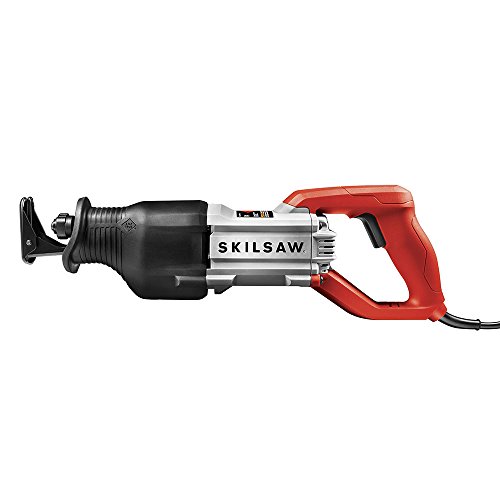
Skil’s 13-amp SPT44A-00 brings patented Buzzkill Technology to the corded reciprocating saw segment, and it is not just a foam grip — it is a mechanical counterbalance system that suppresses up to 35 percent more vibration than typical saws in this amp range. The result is a noticeably smoother feel when cutting pallets, plywood with embedded nails, or metal siding. Users who upgraded from older Ryobi or Porter-Cable models consistently report less tingling in their hands after a full demo session.
The motor is a robust 13 amps, giving it near-premium torque without quite reaching the 14-amp threshold of the Bosch. The variable-speed trigger offers good modulation from a crawl to full speed, though the saw is not the most aggressive in terms of raw cut speed — it prioritizes smooth, controlled cuts over brute force. The tool-less blade clamp uses a knob-style lock that some users find tricky with sweaty palms, but it holds blades securely during heavy side-loading on nail pulls.
The one notable drawback is weight. At 9 pounds, this is the heaviest saw in our review, and it will become fatiguing during prolonged overhead cuts. The oversized trigger gives you flexibility in grip position, which helps offset the mass somewhat. For small to medium demolition projects where vibration fatigue is your main concern, the Buzzkill technology makes the SPT44A-00 a smart pick.
Why it’s great
- Buzzkill counterbalance reduces vibration significantly, making long cuts much more comfortable
- 13-amp motor provides ample power for nail-embedded wood and metal cutting
- Oversized trigger allows multiple hand positions for better control
Good to know
- At 9 pounds, it is the heaviest saw here; overhead use will cause fatigue
- Knob-style blade lock can be hard to twist with sweaty or gloved hands
- Runs hot under sustained load, though it does not stall
3. Makita JR3051T Recipro Saw – 12 AMP

The Makita JR3051T strikes an impressive balance between power and weight, pairing a 12-amp motor with a longer 1-3/16-inch stroke length that accelerates cut speed on wood and softer materials. At 7.3 pounds, it is significantly lighter than the Skil and Bosch premium models, making it far more maneuverable for ladder work or cutting tree limbs without a second hand to stabilize. The tool-less blade change is genuinely fast — users report swapping blades in seconds without ever putting the saw down.
A standout feature is the integrated tool hook, which lets you hang the saw on a ladder rung or scaffolding when you need both hands free. This is a jobsite-oriented detail that few competitors match at this price point. The variable speed trigger gives good control, and the saw’s 3,000 strokes-per-minute top end is competitive for fast demolition. Customer reviews consistently mention cutting through 2×8 planks in under a minute and sawing through copper pipe without binding.
The primary downside is that the JR3051T does not include a carry case — you will need to buy a bag separately if you want organized storage. Some users also note that it runs hot during prolonged hardwood cuts, though it has not been reported to stall. For the money, you get a 12-amp saw with a longer stroke that cuts faster than many 10-amp alternatives, all in a lighter package that suits site work well.
Why it’s great
- 1-3/16″ stroke removes material faster than standard 1-1/8″ saws, especially in wood
- Light 7.3-pound build makes it easy to carry up ladders and use one-handed
- Integrated tool hook is a practical jobsite bonus for ladder storage
Good to know
- No carry case included — budget for a separate storage bag
- Runs hot during extended hardwood cuts; allow cooldown breaks
- Vibration control is decent but not at the level of counterbalance systems in premium models
4. CRAFTSMAN Reciprocating Saw, 7.5 Amp, 3,200 RPM, Corded (CMES300)

The CRAFTSMAN CMES300 prioritizes cut speed with a high-performance motor that delivers up to 3,200 RPM — the fastest strokes-per-minute in this lineup. Its 1-1/8-inch stroke is standard for the amp class, but the trigger response and top-end speed let it rip through framed walls, plywood, and even elk bone (as one resourceful reviewer demonstrated) much faster than its 7.5-amp rating might suggest. The contoured over-molded handle provides a secure grip, and the tool-free blade release is genuinely quick and easy to operate.
The saw comes with a single wood blade, which is standard for the price range. Reviewers praise its ability to cut through metal bathtubs and fiberglass enclosures without bogging down, though they note you will need to take breaks on larger jobs due to hand fatigue. At 7 pounds, it is not excessively heavy, but the lack of advanced vibration damping means the handle transmits more shake than a Skil or Bosch with counterbalance tech.
Where the CMES300 falls short is in sustained heavy-duty use. The 7.5-amp motor is adequate for general demolition but will not match the torque of a 12- or 13-amp saw when cutting thick treated lumber or multiple layers of roofing. It is a strong mid-range option for the DIYer who needs speed for occasional projects, but professionals cutting all day should budget for a higher-amp model.
Why it’s great
- 3,200 RPM top speed makes it one of the fastest corded saws for wood and light demolition
- Tool-free blade release is simple and reliable for quick blade swaps
- Over-molded handle improves comfort and grip control during cuts
Good to know
- 7.5-amp motor lacks torque for extended heavy cuts in thick or treated lumber
- Vibration damping is minimal; hand fatigue sets in faster than on premium saws
- Only one blade included — plan to buy a metal-cutting blade separately
5. PORTER-CABLE 7.5 AMP VAR SPD CORDED RECIP SAW (PCE360)

The PORTER-CABLE PCE360 is built around a simple philosophy: give the user a powerful 7.5-amp motor and a variable speed trigger, and get out of the way. It is a no-nonsense saw that customers consistently describe as a “beast” when breaking down pallets, cutting through 6×6 treated posts, and even slicing through cast iron with a carbide blade. The variable speed trigger provides good control, letting you start slow for metal then open up for wood without a separate dial.
The saw is heavy — at 8 pounds, it is comparable to the Skil in weight, and users note that forearm fatigue is real during longer sessions. The vibration level is noticeable and not suppressed by any counterbalance system. However, the raw power-to-weight ratio at this price point is hard to beat. One reviewer cut through the cast iron frame of a piano in 45 minutes without the motor overheating, which speaks to the thermal endurance of the 7.5-amp motor.
The PCE360 does not include any extra blades beyond the one that ships with the saw, and its handle material is basic plastic without over-molded grips. It is a tool designed for the user who prioritizes torque over comfort features. If you need a machine for occasional heavy demolition and you are willing to take breaks to shake out your hands, this saw delivers genuine power at a mid-range budget.
Why it’s great
- Punchy 7.5-amp motor handles heavy tasks like pallet breakdown and cast iron cutting without stalling
- Variable speed trigger gives good material-specific control for metal and wood
- Reliable thermal performance — no overheating during sustained heavy cuts
Good to know
- Heavy at 8 pounds and transmits significant vibration — hand fatigue is a real factor
- Basic plastic handle lacks the comfort of over-molded grips found on competitors
- Only one blade included; no carrying case or bag
6. WEN 3630 10-Amp 8-Position Variable Speed Reciprocating Saw

The WEN 3630 brings an unusual feature to the entry-level segment: an 8-position pivoting head that can be locked at 45-degree increments. This lets you cut flush against floors, walls, or ceilings without rotating your entire body or the saw — a genuine advantage for cramped workspaces. The 10-amp motor is significantly more powerful than the 7-amp saws in its price tier, offering up to 2,800 strokes per minute through a pressure-sensitive trigger that adjusts speed based on how hard you squeeze.
The twist-lock quick-release blade holder is a straightforward mechanism that works with gloved hands, and WEN includes both a wood blade and a metal blade in the box — a nice touch at this price. The soft rubber-grip front handle helps damp some vibration, though this is not a saw you would want to run for hours straight. Users report cutting tree roots, thick branches, and light demolition with no complaints about power.
The main trade-off is weight. At 7.7 pounds, it is not the heaviest saw here, but it feels dense due to its compact frame. Some users describe it as a “heavy little beast” that is surprisingly capable for its size. The pivoting head is a unique selling point, but the locking mechanism requires you to remove the blade before adjusting position — not a quick on-the-fly feature. For budget-conscious buyers who need a versatile saw that can cut flush in tight spaces, the WEN 3630 delivers impressive value.
Why it’s great
- 8-position pivoting head is a rare feature that enables flush cutting in tight spaces
- 10-amp motor outperforms most budget competitors for torque and stall resistance
- Includes both wood and metal blades and a soft rubber grip on the front handle
Good to know
- At 7.7 pounds, it feels dense and heavy for its compact size
- Pivot head requires blade removal to adjust — not a quick-change feature
- Vibration damping is basic; hand fatigue will occur during extended use
7. BLACK+DECKER 7 Amp Electric Reciprocating Saw with Removable Branch Holder (BES301K)
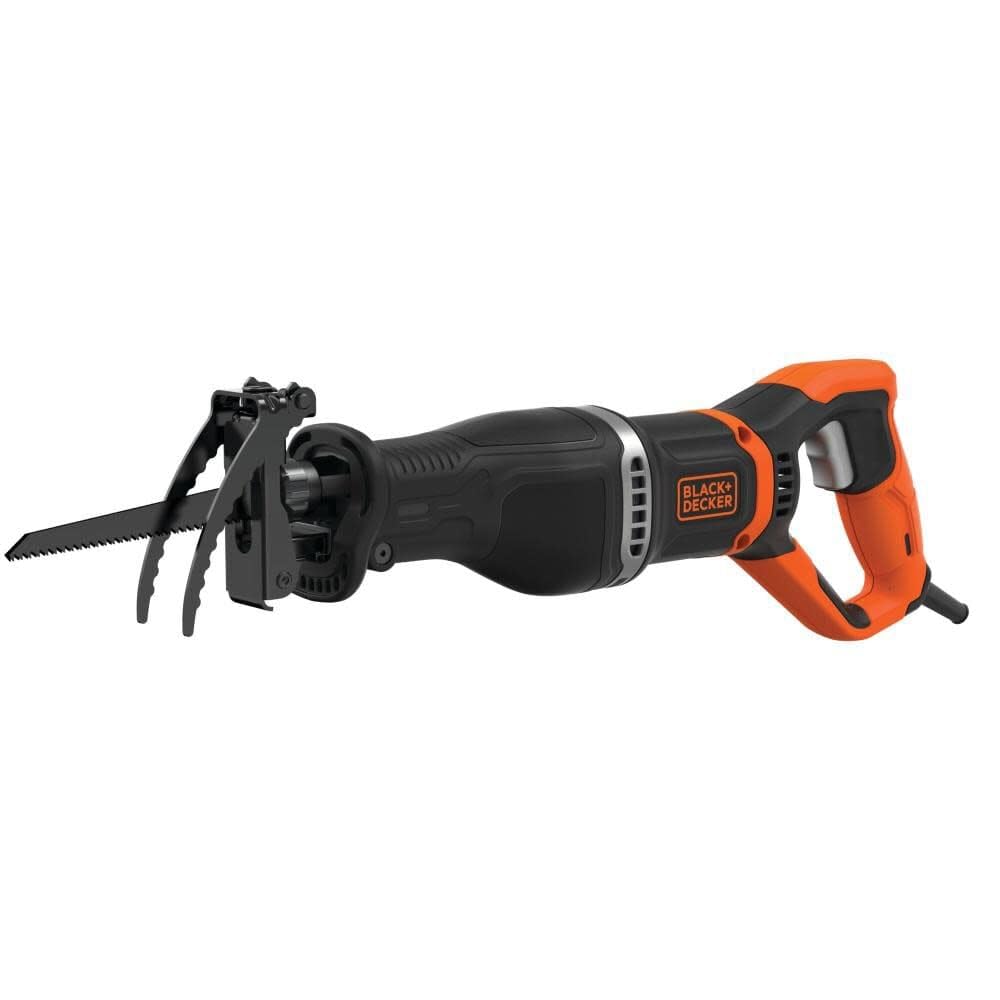
The BLACK+DECKER BES301K is purpose-built for the homeowner who needs a reciprocating saw primarily for yard work and light DIY. Its defining feature is the removable branch holder — a small curved hook that secures limbs against the saw body to reduce shaking and vibration while pruning. This is a genuinely useful add-on for cutting tree branches up to 4 inches thick, and it can be detached when you need to make flush cuts.
The 7-amp motor is the lowest power in this lineup, and it shows when cutting through thicker hardwoods or materials with embedded nails. For general-purpose cuts in wood, plastic, and thin metal, it performs adequately. The lightweight design at 6.4 pounds makes it the lightest saw here, which is a real advantage for one-handed trimming or cutting overhead branches without shoulder strain. The over-mold grip on the handle reduces vibration transmission compared to bare plastic handles.
The BES301K is not built for sustained demolition. It lacks the torque for thick pressure-treated lumber or all-day framing work. The tool-free blade release works well, and the saw includes one general-purpose blade out of the box. For anyone whose primary use case is pruning limbs, cutting PVC pipe, and occasional small projects, this saw offers a comfortable, low-fatigue experience. Just do not expect it to keep up with a 10-amp or 12-amp saw on heavy jobsite tasks.
Why it’s great
- Removable branch holder stabilizes limbs and reduces vibration during pruning cuts
- Lightest saw in the review at 6.4 pounds — easy to use one-handed or overhead
- Over-mold grip improves comfort compared to basic plastic handles
Good to know
- 7-amp motor lacks torque for heavy demolition or thick treated lumber
- Not suitable for all-day framing work; motor can bog under sustained load
- Only one general-purpose blade included; wood and metal blades sold separately
FAQ
What amp rating is best for cutting through tree roots and stumps?
Does a longer stroke length make the saw harder to control?
Can a corded reciprocating saw cut through cast iron pipes?
Final Thoughts: The Verdict
For most users, the best corded reciprocating saw winner is the Bosch RS428 because its 14-amp motor and counterbalance vibration control deliver professional-grade demolition power with significantly less hand fatigue. If you want the best vibration suppression on a tighter budget, grab the Skil SPT44A-00. And for a lighter, faster-cutting saw that balances power and portability for jobsite work, nothing beats the Makita JR3051T.

Mo Maruf
I created WellFizz to bridge the gap between vague wellness advice and actionable solutions. My mission is simple: to decode the research and give you practical tools you can actually use.
Beyond the data, I am a passionate traveler. I believe that stepping away from the screen to explore new environments is essential for mental clarity and physical vitality.