Our readers keep the lights on and my smoothie glass nicely filled. As an Amazon Associate, I earn from qualifying purchases.
Cutting an exact 1/8-inch chamfer on a cabinet door edge should be a two-second move, not a tethered dance around a dangling power cord. Cordless trim routers solve that specific friction, giving you the freedom to shape, flush-trim, and round over edges wherever the workpiece sits—on a bench, against a wall, or mid-installation. The challenge today is no longer about whether battery power can keep up; it is about selecting the right balance of RPM range, collet size, ergonomics, and battery ecosystem for the work you actually do.
I’m Mohammad Maruf — the founder and writer behind WellFizz. After analyzing the technical specifications, user reviews, and real-world performance data for seven leading cordless trim routers, I’ve identified exactly which models deliver on their promises and which ones leave you wishing you had bought a different system.
This guide breaks down what makes a best cordless trim router for edge work, flush trimming, and light joinery, covering seven models from compact palm tools to full-size plunge routers.
How To Choose The Best Cordless Trim Router
Selecting a cordless trim router means weighing portability against power, and speed control against battery life. Unlike corded models that run at a fixed maximum until you unplug them, battery-powered routers introduce variables like voltage, amp-hour capacity, and motor efficiency that directly affect how the tool feels in your hand and how long it runs before needing a recharge.
RPM Range and Motor Type
Trim routers live in the 10,000 to 30,000 RPM band. A higher top speed matters when you are working with small bits in hardwoods—if the motor stalls at 16,000 RPM under load, the cut quality drops immediately. Brushless motors deliver better torque at lower speeds and run longer per charge because they generate less heat and friction internally. Look for a variable-speed dial rather than a single-speed switch: it lets you dial down for plastics and softwoods and dial up for dense hardwoods without swapping bits.
Collet Capacity and Bit Compatibility
Most compact trim routers accept only 1/4-inch shank bits, which is fine for edge profiling, laminate trimming, and light dados. If your work involves raised-panel bits, large Roman ogee profiles, or any 1/2-inch shank carbide bit, you need a router with a collet that handles both sizes. The 1/2-inch shank provides less vibration and better concentricity at the bit tip, which directly translates to smoother surfaces and reduced burning. A 3/8-inch collet is a rare bonus—only a few models offer it, mainly for specialized inlay or hinge-mortising bits.
Dust Collection and Work Area Visibility
Trim routers eject chips directly into the cutting path, which obscures the line and recuts debris, leaving scorch marks. A dedicated dust port with a shop-vac adapter clears the line and lets you see exactly where the bit meets the material. Some models include a chip shield that directs chips away from your face, but the best solutions use a vacuum port integrated into the base. If you are working on finished cabinetry or solid-surface countertops, dust collection is not optional—it is the difference between a clean edge and a burned, chip-filled mess.
Base Design and Depth Adjustment
Fixed-base trim routers use a micro-adjust dial that moves the motor up and down in the base. The best systems combine a macro-release lever for coarse moves and a threaded micrometer for fine tuning—usually 1/64 inch per click. Plunge bases add a spring-loaded mechanism that lets you drop the bit into the work, which is essential for stopped dados, hinge mortises, and sign carving. A tool-free depth adjustment system saves time when switching between operations, but the real test is whether the depth holds under vibration without creeping.
Quick Comparison
On smaller screens, swipe sideways to see the full table.
| Model | Category | Best For | Key Spec | Amazon |
|---|---|---|---|---|
| Metabo HPT M1808DAQ4 | Mid-Range | Best overall trim router | 30,000 RPM, 2.5 lbs, 1/4″ & 3/8″ collets | Amazon |
| Bosch GKF18V-25N | Premium | Versatile palm router with dust extraction | 30,000 RPM, 1.39 HP, brushless motor | Amazon |
| DEWALT DCW620B | Premium | Full-size plunge routing | 23,000 RPM, 2.25 HP, 1/2″ & 1/4″ collets | Amazon |
| Bosch GKF12V-25N | Mid-Range | One-handed edge profiling | 13,000 RPM, 2.2 lbs, 1/4″ collet | Amazon |
| CRAFTSMAN CMCW400B | Mid-Range | DIY edging with included edge guide | 30,000 RPM, 4.1 lbs, brushless motor | Amazon |
| RYOBI PCL424B | Budget | Budget-friendly homeowner trim routing | 30,000 RPM, 3.2 lbs, fixed base | Amazon |
| NAACOO Floor Cutter | Specialty | Laminate and LVP floor cutting | 13″ width, 13mm thickness, manual cutter | Amazon |
In‑Depth Reviews
1. Metabo HPT M1808DAQ4

The Metabo HPT M1808DAQ4 hits the sweet spot between power, weight, and accessory inclusion. At 2.5 pounds and with a variable-speed range of 10,000 to 30,000 RPM, it handles everything from delicate chamfers on walnut to aggressive rabbets in plywood without bogging down. The 1/4-inch and 3/8-inch collets give you access to a wider variety of bits than typical compact routers offer, including specialty hinge-mortising bits that only come in 3/8-inch shanks.
The soft-start feature prevents the router from kicking when you pull the trigger, which matters when you are starting a cut on an exposed edge. The quick brake stops the bit in under two seconds, reducing the risk of marring the workpiece when you lift the tool away. The LED work light is positioned to cast light directly ahead of the bit, not off to the side, so you can see the cut line even in dim workshop conditions.
It comes with a trimmer guide, straight guide, template guide, and dust collection port right in the box—most competitors sell those separately. Users consistently report that the dust collection port works well with a standard shop vac, keeping chips out of the cutting path and preventing burn marks on the wood. The only compromise is that the fixed base does not plunge, so stopped cuts require a separate plunge base or a freehand approach.
Why it’s great
- Includes both 1/4-inch and 3/8-inch collets for expanded bit compatibility
- Soft start and quick brake enhance control and safety
- Comes with guide set and dust port at no extra cost
- Lightweight 2.5-pound design reduces fatigue during extended use
Good to know
- Fixed base only—no plunge capability
- Requires Metabo HPT 18V battery, not cross-platform
2. Bosch GKF18V-25N

The Bosch GKF18V-25N is the 18V evolution of the legendary Colt palm router platform, and it brings genuine innovation. The brushless motor delivers 1.39 peak horsepower with a variable speed range of 10,000 to 30,000 RPM, meaning it has enough torque to drive a 1/2-inch straight bit through solid hardwood without bogging. The depth adjustment system offers both coarse and fine adjustments in 1/64-inch increments, with a maximum cut depth of 1-11/32 inches—deep enough for most dados and hinge mortises.
What sets this model apart is the integrated dust extraction system. It ships with two vacuum adapters and a chip shield specifically designed for edge routing and surface routing. The adapters click directly into Bosch’s battery-powered vacuum without an extra fitting, creating a sealed dust path that captures nearly all airborne particles. The drop detection feature shuts off the motor instantly if the tool is dropped, and restart protection prevents accidental startups after battery changes.
Ergonomically, the low-profile grip positions your hand close to the workpiece for maximum stability, and the high grip position gives leverage for heavier cuts. The flip-and-release spindle lock makes bit changes faster than any competitor—no need to hold a button and turn a wrench simultaneously. Users note that the dust collectors work with several hose sizes, but they perform best when paired with Bosch’s cordless vacuum due to the locking adapter system.
Why it’s great
- Superior dust extraction with two included vacuum adapters and chip shield
- Drop detection and restart protection for safety on job sites
- Fast flip-and-release spindle lock for quick bit changes
- Variable speed from 10,000 to 30,000 RPM covers all trim applications
Good to know
- Batteries and charger sold separately
- Edge routing dust hood can be bulky in tight corners
3. Bosch GKF12V-25N
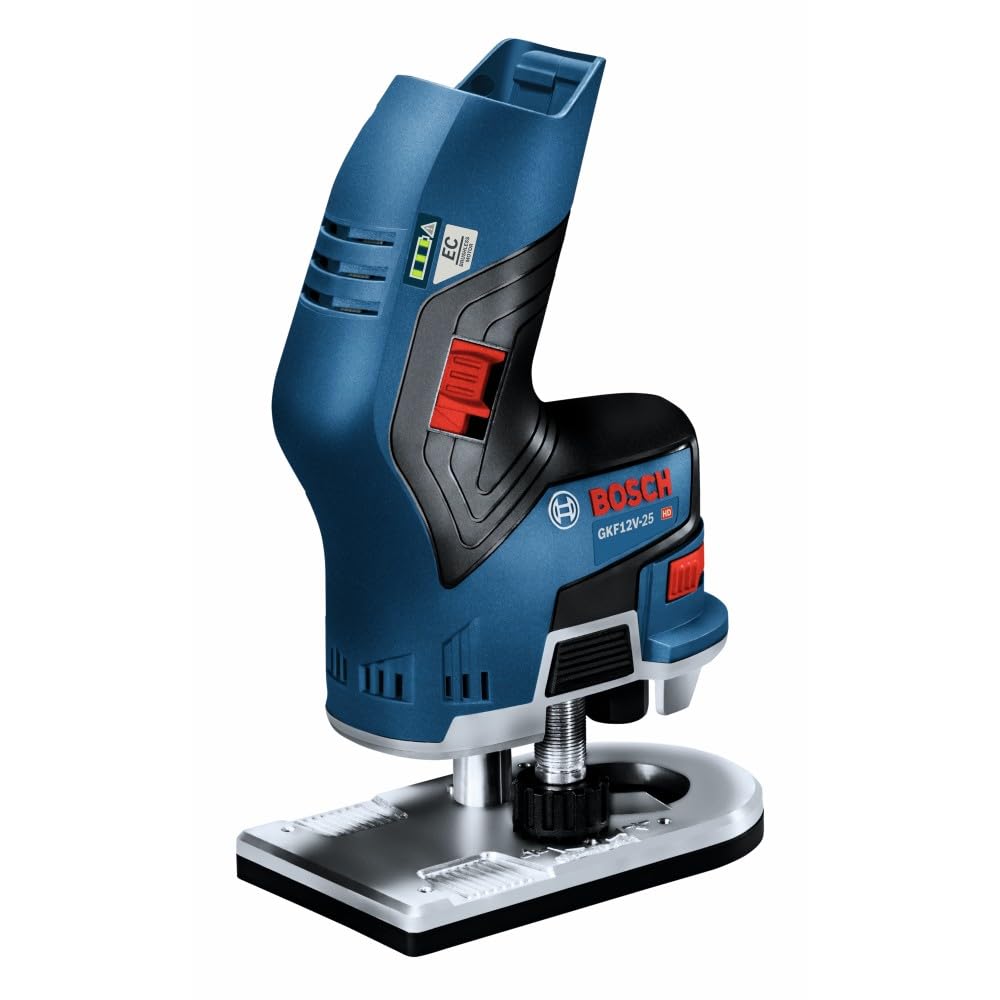
The Bosch GKF12V-25N redefines what a palm router can be by moving the battery and motor behind the collet rather than above it. This offset design places nearly all the tool’s weight directly over the workpiece, giving you exceptional stability when edge-forming and trimming. At 2.2 pounds with the battery, it is the lightest trim router in this comparison, and the compact 9.9-inch overall length means you can fit it into tight spaces between cabinet doors or inside drawer boxes.
The EC brushless motor produces a maximum of 13,000 RPM at 12 volts. That is slower than the 18V models, but the torque delivery is surprisingly linear, and the constant-speed circuitry maintains RPM under load without surging. The depth adjustment system uses a micrometer dial that moves the base 0.04 inches per revolution, making it easy to dial in repeatable depths for flush trimming laminate edges or cutting identical roundovers on multiple parts.
This router excels specifically at edge profiling and flush trimming, not at heavy material removal. Users report it handles roundovers up to 3/16 inch in hardwoods and flush trims laminate with zero chip-out. The spindle lock is a game changer compared to the traditional two-wrench setup—you can change bits with one hand. The trade-off is the lack of dust collection and the relatively high cost of Bosch 12V batteries, but if your primary work is edge routing, this tool delivers the best ergonomics in the category.
Why it’s great
- Offset design places weight over workpiece for unmatched stability
- Spindle lock enables one-wrench bit changes
- Constant-speed circuitry maintains RPM under load
- Ultra-light at 2.2 pounds for fatigue-free extended use
Good to know
- Single speed at 13,000 RPM—no variable speed dial
- No dust collection port or chip shield included
4. DEWALT DCW620B

The DEWALT DCW620B is not a trim router in the traditional sense—it is a full-size plunge router that happens to be cordless. With 2.25 peak horsepower and a variable speed range of 11,000 to 23,000 RPM, it takes the heaviest bits you can throw at it, including 1/2-inch shank raised-panel and straight bits. The plunge base is smooth and locks positively at any depth, with a tool-free depth adjustment system that includes a micro-fine adjuster for incremental changes.
The integrated dust collection system uses an AIRLOCK-compatible port that captures up to 97% of dust when paired with a DEWALT dust extractor. The anti-rotation system monitors the tool’s rotational motion and shuts it down if it senses excessive twisting—a safety feature that matters when a large bit catches an edge and tries to spin the router out of your hands. The dual LED lights illuminate the work surface from two angles, reducing shadows cast by the bit or your hands.
At 8 pounds tool-only and 11.25 pounds with a battery, this is a significant weight commitment. The ergonomics, however, are best-in-class: the handles are positioned so your wrists stay neutral, and the trigger is integrated into the right handle grip for natural activation. Users consistently report that it rivals corded routers in cut quality, especially when running 1/2-inch bits in hardwood. The main drawback is battery consumption—a 5Ah PowerStack battery is almost required to get through a full day of heavy routing.
Why it’s great
- Accepts both 1/4-inch and 1/2-inch collets for maximum bit compatibility
- Integrated AIRLOCK dust collection captures nearly all debris
- Anti-rotation system shuts down on excessive twist for safety
- Tool-free depth adjustment with micro-fine tuning
Good to know
- Heavier than typical trim routers at over 11 pounds with battery
- High battery drain; a high-capacity PowerStack battery is recommended
5. CRAFTSMAN CMCW400B

The Craftsman CMCW400B brings a brushless motor and a variable speed range of 16,000 to 30,000 RPM to the mid-range price tier, making it a strong contender for the DIYer who wants professional-level speed control without paying a premium. The included edge guide and dust port adapter add immediate value—you can start making parallel cuts and collecting chips on day one without buying additional accessories.
The depth adjustment knob is positioned on top of the motor housing and uses a threaded rod system that provides consistent, repeatable depth settings. The LED light is integrated into the base and casts light directly onto the bit contact point, which helps when you are working in corners or under overhead cabinets. At 4.1 pounds, it is heavier than the Bosch GKF12V-25N or the Ryobi PCL424B, but the weight distribution is balanced so it does not feel nose-heavy during use.
The dust collection port works with standard 1-1/4 inch and 2-1/2 inch vacuum hoses, but the included chip shield can distort visibility if it is not perfectly aligned. Several users reported removing the shield entirely for clean cuts while relying on the dust port alone. The motor provides sufficient torque for edging and light rabbeting in pine and plywood, though it struggles with sustained cuts in dense hardwoods like oak or maple at full depth.
Why it’s great
- Brushless motor delivers longer runtime and consistent power
- Edge guide and dust port included at a value price point
- Variable speed dial from 16,000 to 30,000 RPM
- LED light illuminates the cutting area
Good to know
- Chip shield can distort view and is fragile
- Heavier than some palm routers at 4.1 pounds
6. RYOBI PCL424B

The Ryobi PCL424B is the entry-level cordless trim router that makes sense if you are already invested in the Ryobi ONE+ 18V battery system. With a variable speed range of 20,000 to 30,000 RPM and a fixed base, it handles basic edge rounding, flush trimming, and light chamfering on softwoods and plywood. The micro-dial depth adjustment and quick-release lever allow for fast changes between bit heights without tools.
At 3.2 pounds, it is light enough to use one-handed for short periods, though the lack of a soft-start feature means the motor kicks on instantly when you pull the trigger. This is fine for experienced users but can cause a small jump if you are starting a cut on an exposed edge. The clear plastic base gives you a good view of the bit and the work surface, and the integrated LED light is bright enough for dim workshop corners.
The dust port is present but not as effective as the Bosch or Metabo HPT systems—it captures some chips but leaves a fair amount on the workpiece, especially during heavy cuts. Users consistently note that this router is ideal for small projects like rounding over picture frames, trimming laminate edges on countertops, or cutting shallow dados in cabinet-grade plywood. It is not designed for heavy material removal, and the brushed motor will struggle if you push it beyond light trim work.
Why it’s great
- Very affordable entry point into cordless routing
- Ultra-light at 3.2 pounds for one-handed use
- Compatible with the Ryobi ONE+ battery system
- Micro-dial depth adjustment with quick-release lever
Good to know
- Brushed motor lacks the torque of brushless competitors
- Dust collection is mediocre during heavier cuts
7. NAACOO Laminate Floor Cutter

The NAACOO Floor Cutter is a completely different tool from the rest of this list, but it deserves inclusion because it solves a specific problem that a cordless trim router cannot: cutting laminate and vinyl flooring without dust, noise, or electricity. This is a manual shear cutter with a maximum cutting width of 13 inches and a maximum thickness of 13 millimeters, and it can cut at angles of 0°, 15°, 30°, and 45° in a single pass.
The unique design integrates angle and length alignment into one step—you set the miter angle and the cut length simultaneously rather than aligning twice. The blade is made from Wolfraw steel and is replaceable, and the package includes a whetstone for maintaining sharpness between replacements. The safety chain brake bar locks the handle in the raised position, preventing accidental cuts when the tool is not in use.
For DIYers installing LVP, laminate, or engineered wood flooring, this cutter eliminates the mess of a miter saw and the cord management of a trim router. Users consistently report that it cuts LVP smoothly with no chipping or cracking, and that it is physically easier to operate than a compound miter saw. The trade-off is that it cannot do curved cuts, patterned edges, or any routing operation—it is a straight-line and miter cutter only. If your project involves installing click-lock flooring, this is the tool you reach for instead of a router.
Why it’s great
- Zero dust, zero noise, zero electricity required
- One-step angle and length alignment saves time
- Includes whetstone for blade maintenance and chain brake for safety
- Lightweight aluminum alloy construction with rubber wheels for portability
Good to know
- Cannot cut curves, inside corners, or detailed profiles
- Blade dulls over time and replacement requires contacting the manufacturer
FAQ
Can a cordless trim router replace a corded router for everyday use?
What size collet do I need for a cordless trim router?
Final Thoughts: The Verdict
For most users, the best cordless trim router winner is the Metabo HPT M1808DAQ4 because it delivers full variable speed control, lightweight handling, and a generous accessory set that includes both collets and guides at a mid-range price. If you want the most refined dust extraction system and drop-detection safety, grab the Bosch GKF18V-25N. And for heavy-duty plunge routing with 1/2-inch bits, nothing beats the DEWALT DCW620B.

Mo Maruf
I created WellFizz to bridge the gap between vague wellness advice and actionable solutions. My mission is simple: to decode the research and give you practical tools you can actually use.
Beyond the data, I am a passionate traveler. I believe that stepping away from the screen to explore new environments is essential for mental clarity and physical vitality.