Our readers keep the lights on and my smoothie glass nicely filled. As an Amazon Associate, I earn from qualifying purchases.
Selecting a CPU casing is the single most impactful decision you will make for your PC build — it determines whether your high-end components breathe freely or throttle under a blanket of trapped heat. A cramped chassis with poor airflow can choke a powerful GPU and CPU, while a well-ventilated mid-tower with intelligent fan placement silently extends the lifespan of every part inside.
I’m Mohammad Maruf — the founder and writer behind WellFizz. I’ve spent hundreds of hours analyzing thermal performance, fan configurations, material quality, and internal layouts across dozens of casings to bring you a sharply curated, data-backed comparison.
Our guide cuts through the marketing noise to deliver the most practical, spec-focused recommendations for the best cpu casing on the market right now.
How To Choose The Best CPU Casing
The right casing balances airflow, component clearance, and build quality without overspending on flashy features you will never use. Focus on layout logic — where the fans sit, how the PSU is mounted, and whether the cable management path makes sense for your specific motherboard size.
Airflow Design & Fan Configuration
Look for a mesh front panel or a ventilated design with at least 40% open area. A fully solid glass front with small side vents chokes intake. Pre-installed fan count matters only if the fans are positioned correctly — two front intake fans and one rear exhaust is the minimum effective setup. Reverse-blade fans on the side or bottom create clean intake without visible fan frames.
GPU & Radiator Compatibility
Measure your graphics card length against the case’s maximum GPU clearance — 350mm is standard for modern mid-towers, but flagships like the RTX 5090 need closer to 400mm. For cooling upgrades, ensure the top panel supports a 360mm radiator without interfering with the motherboard’s VRM heatsinks or RAM slots.
Cable Management & Access
A good casing provides at least 20mm of space behind the motherboard tray for routing cables. Rubber grommets, pre-installed Velcro straps, and multiple tie-down points dramatically reduce build time. Bottom-mounted PSU bays with removable dust filters simplify cleaning and future upgrades.
Quick Comparison
On smaller screens, swipe sideways to see the full table.
| Model | Category | Best For | Key Spec | Amazon |
|---|---|---|---|---|
| Montech AIR 903 MAX | Mid-Range | High airflow with large fans | 4x 140mm PWM fans pre-installed | Amazon |
| LIAN LI LANCOOL 207 | Premium | GPU-focused cooling layout | 2x bottom 120mm fans under GPU | Amazon |
| NZXT H7 Flow 2024 | Premium | Clean aesthetics with wide compatibility | Supports up to 420mm front radiator | Amazon |
| FOIFKIN F600 | Mid-Range | Panoramic glass with max fans | 7 pre-installed PWM ARGB fans | Amazon |
| MUSETEX Y6 | Mid-Range | Infinity mirror lighting showpiece | 7x infinity mirror ARGB PWM fans | Amazon |
| CORSAIR 3500X | Premium | Reverse connector motherboard support | EATX support with 360mm side rad | Amazon |
| MONTECH XR-B | Budget | Compact mid-tower with wood accent | 3x 120mm ARGB fans, 360mm rad support | Amazon |
In‑Depth Reviews
1. Montech AIR 903 MAX

The Montech AIR 903 MAX enters this guide as the most thermally refined mid-tower in its class. Its metal front panel achieves a 51% ventilation rate — meaning nearly half the front surface is open for air intake — which directly translates to lower CPU and GPU temperatures under sustained gaming loads. The casing ships with four 140mm PWM fans (three HP140 ARGB intake and one standard PWM exhaust), each capable of moving high volumes of air at relatively low noise levels.
Internal clearance is generous: graphics cards up to 400mm long fit without obstruction, and CPU tower coolers up to 180mm tall are supported. The top panel accommodates a 360mm radiator without interfering with the VRM area on ATX or E-ATX boards. Cable management is average — the rear chamber has enough room for a standard build, but zip-tie cutouts near the EPS cable path could be more abundant.
Real-world builds confirm that the AIR 903 MAX runs cool out of the box. A few users reported coil whine from the exhaust fan at higher RPM, but replacing that single fan is a minor expense. For a casing that delivers best-in-class airflow at a mid-range price point, this is the pick that satisfies both air-cooling purists and AIO enthusiasts.
Why it’s great
- Four large 140mm fans pre-installed provide exceptional out-of-the-box airflow
- Supports large 360mm radiators at both front and top positions
- Magnetic dust screens on all major intake areas simplify cleaning
Good to know
- Included PWM fans can be loud at default speed — adjust fan curve in BIOS
- Rear cable management depth is adequate but not generous for complex builds
2. LIAN LI LANCOOL 207

Lian Li has reinvented the standard ATX layout with the LANCOOL 207 by positioning the power supply at the front of the chassis, freeing up the bottom area for two dedicated 120mm intake fans directly under the graphics card. This design drop GPU temperatures by several degrees compared to traditional bottom-mount PSU cases because cool air is channeled straight into the GPU’s heatsink rather than being blocked by a PSU shroud.
The front pair of 140x140x30mm ARGB fans (thicker than standard 25mm fans) push more air at lower noise, reaching speeds up to 1900 RPM. GPU clearance extends to 410mm, which covers even the largest aftermarket RTX 4090 and Radeon 7900 XTX cards. A pre-installed GPU anti-sag bracket with extensive adjustability keeps heavy cards aligned without aftermarket supports.
Cable management is tight — the front PSU location requires modular cables and careful routing, and the included intake fans can produce a resonant hum that some users mitigate with rubber gaskets. Despite these minor quirks, the LANCOOL 207’s thermal performance and premium feel at a mid-range price make it a top-tier option for GPU-heavy builds.
Why it’s great
- Dual bottom 120mm fans provide direct GPU cooling for superior thermal performance
- Thick 140mm front fans move high airflow with lower noise
- Built-in adjustable GPU sag bracket adds long-term reliability
Good to know
- Front PSU mount demands a modular power supply and careful cable planning
- No bottom intake dust filter — dust buildup requires occasional cleaning
3. NZXT H7 Flow 2024

The NZXT H7 Flow 2024 builds on the brand’s reputation for clean, minimalist design while adopting a high-performance mesh front panel that significantly improves intake compared to previous H-series models. It ships with three front-mounted 120mm fans that deliver solid out-of-the-box airflow, and the top panel supports radiators up to 360mm — or a massive 420mm unit up front for extreme liquid cooling builds.
Internal spaciousness is a key strength: the H7 Flow accommodates E-ATX motherboards, graphics cards up to 400mm, and CPU coolers up to 185mm tall. Cable management is intuitive, with wide channels, built-in routing hooks, and included Velcro straps that keep the back panel tidy without struggle. The tool-less side panel and front mesh filter make maintenance quick.
The included intake fans are standard 3-pin DC models rather than PWM, which limits fan curve control. Some users also note the lack of an included dust filter over the bottom PSU intake. Despite these small omissions, the H7 Flow’s robust build quality, spacious interior, and radiator flexibility make it a premium pick for builders who value a clean, uncluttered aesthetic.
Why it’s great
- Exceptional radiator support with space for a 420mm unit up front
- Wide cable channels and pre-installed straps simplify clean cable management
- High-quality mesh front panel maximizes intake while filtering dust
Good to know
- Pre-installed fans are 3-pin DC instead of PWM — less precise speed control
- No bottom dust filter included; consider adding an aftermarket magnetic filter
4. FOIFKIN F600
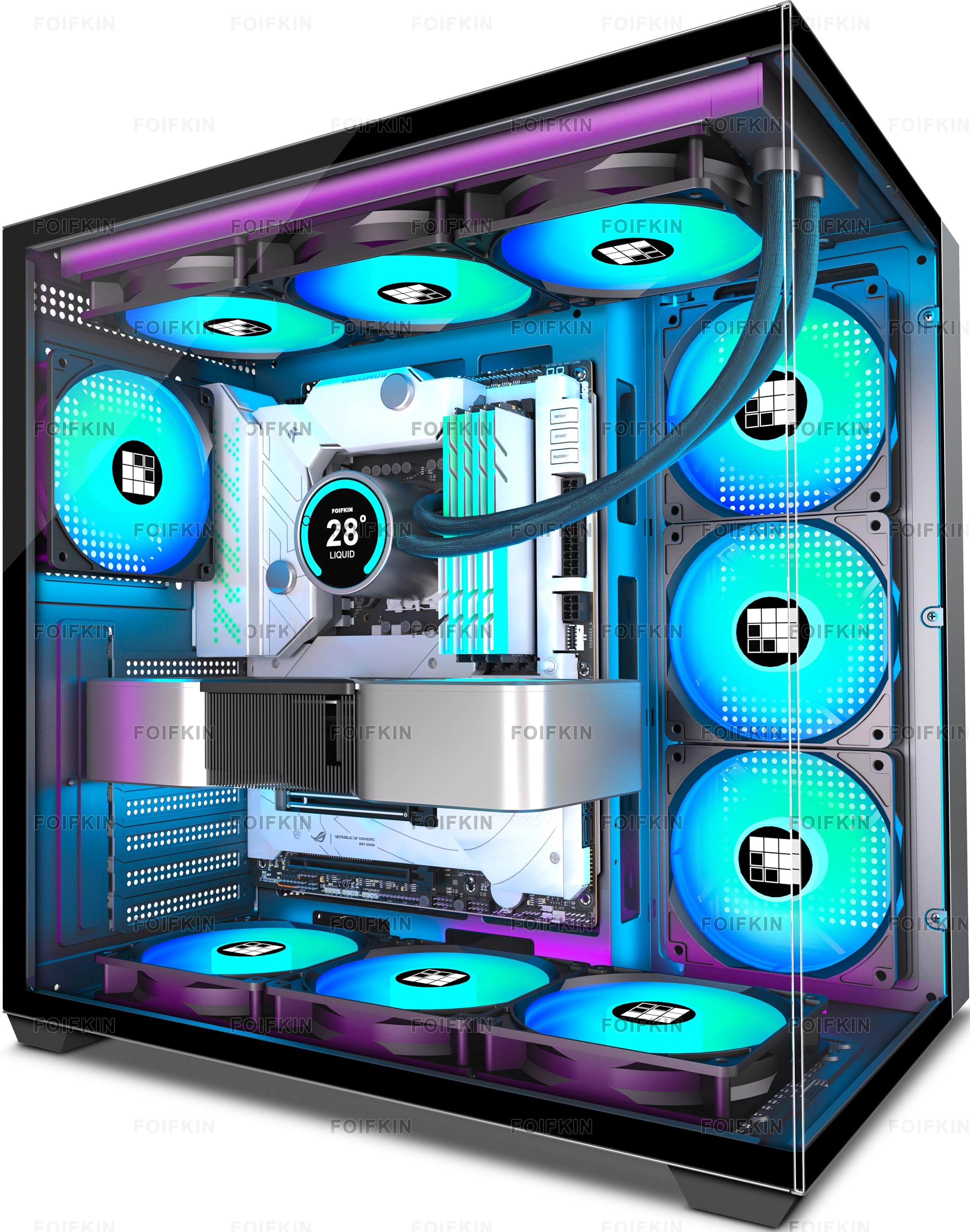
The FOIFKIN F600 enters the mid-range category with an aggressive value proposition: seven pre-installed 120mm PWM ARGB fans (six reverse-blade intake and one standard exhaust) in a dual-chamber layout that separates the PSU and drive bay from the main compartment. This design improves thermal isolation and makes cable management significantly easier because the bulk of wiring hides behind the motherboard tray.
The 270-degree panoramic tempered glass front and side panels provide a nearly unobstructed view of the interior, while the dual chamber ensures the visible side remains clutter-free. GPU clearance reaches 400mm, and the casing supports three 360mm radiators simultaneously — one on top, one on the side, and one at the bottom. The I/O panel includes a USB-C 3.0 port, which is becoming essential for modern peripherals.
Some builders note that the SSD/HDD mounting plate sits tight against the side panel, making drive cable connections tricky for larger drives. The fans, while abundant, are entry-level PWM units — functional but not silent at full speed. For builders who want a fish-tank style casing with maximum fan count and strong compatibility right out of the box, the F600 delivers impressive value.
Why it’s great
- Seven PWM ARGB fans included — more than any casing near its price tier
- Dual-chamber layout hides PSU and cables for a clean main compartment
- Supports triple 360mm radiators for extreme liquid cooling setups
Good to know
- Drive mounting plate clearance is tight — installation requires patience
- Pre-installed fans are adequate but not top-tier in acoustic performance
5. MUSETEX Y6
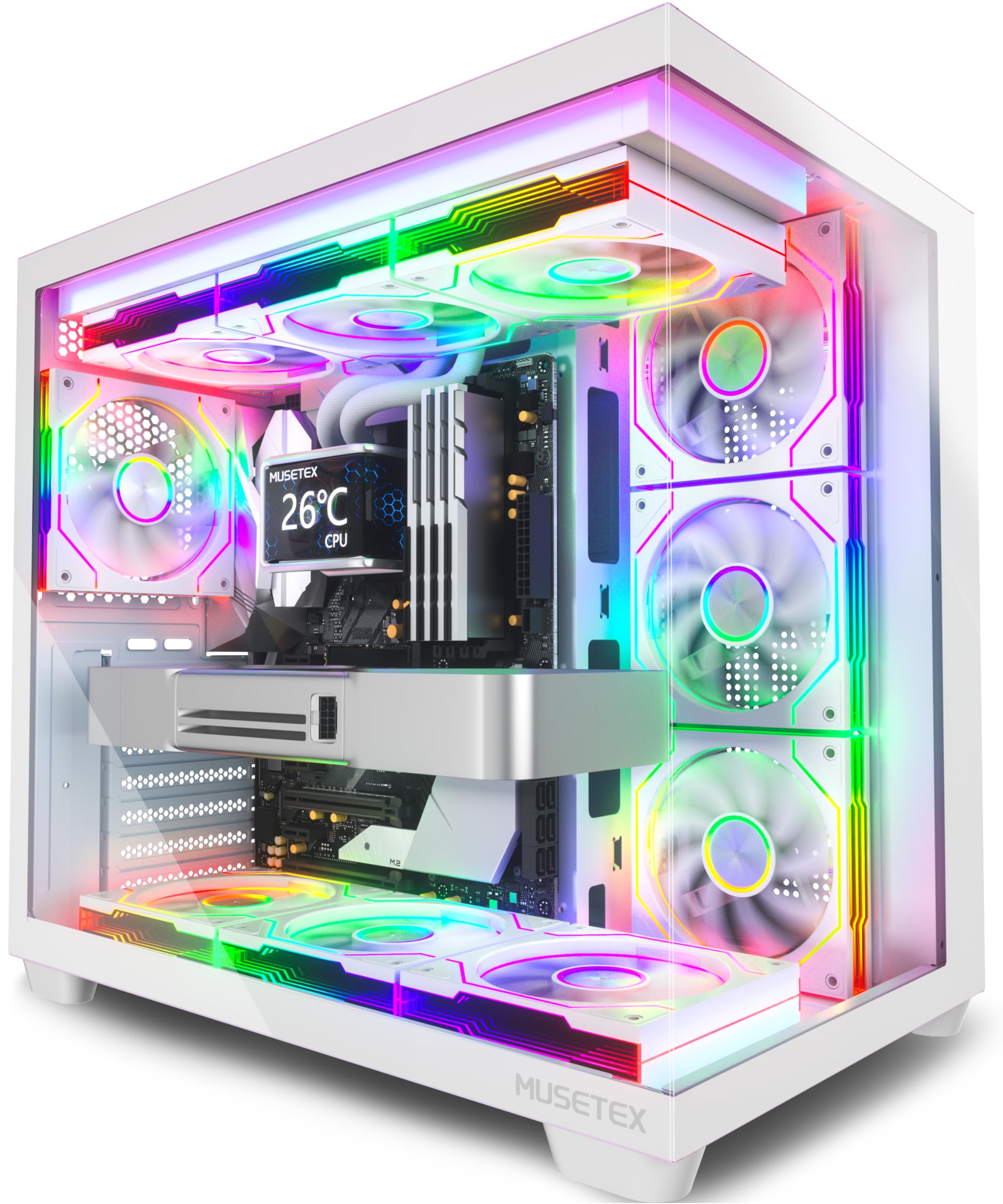
The MUSETEX Y6 is designed for builders who want a visually striking showcase without sacrificing cooling capability. It comes with seven pre-installed 120mm infinity mirror ARGB PWM fans — three reverse-blade on the side, three reverse-blade on the bottom, and one standard exhaust at the rear. The infinity mirror effect creates seamless, continuously transitioning light bands that stand out even in a market saturated with RGB casings.
Its 270-degree fully transparent dual tempered glass panels offer a panoramic view of the entire interior, making it ideal for displaying high-end hardware or collectible figures. GPU clearance extends to 410mm, CPU cooler height is capped at 160mm, and the top mount supports 360mm radiators. The fan hub included in the rear compartment simplifies cable routing, though the stock fan cables are quite short — wiring needs planning before securing the motherboard.
Some full ATX builders report that cable management channels are limited, and the lack of bottom cutouts near the motherboard tray makes routing front-panel cables tricky. The Y6 is best suited for Micro-ATX builds where the spacious interior provides cleaner cable paths. For the price, the lighting quality and included fan count make this a strong contender for RGB-focused gaming rigs.
Why it’s great
- Seven infinity mirror ARGB fans create the most distinctive lighting in its price range
- Panoramic glass offers an unobstructed 270-degree view of components
- Supports GPUs up to 410mm and 360mm top radiators for flexibility
Good to know
- Cable management is tight for full ATX builds — best paired with Micro-ATX
- Fan cables are short; plan your wiring layout before installing the motherboard
6. CORSAIR 3500X

The CORSAIR 3500X is a panoramic tempered glass mid-tower that prioritizes a clean, uncluttered view of your components. It is validated for use with reverse connection motherboards like ASUS BTF and MSI Project Zero, which place all connectors on the back of the board — effectively hiding every cable from view. This makes the 3500X one of the few mainstream options for builders chasing a truly cable-free front aesthetic.
The casing supports motherboard form factors from Mini-ITX up to EATX, and its fan mounting points accommodate up to ten 120mm fans across the side, roof, and PSU shroud areas. Multiple 360mm radiators fit — one in the roof and one on the side — providing plenty of liquid cooling potential. The glass front panel does restrict intake compared to a full mesh design, so builders should plan for sufficient side intake fans to maintain positive pressure.
Cable management behind the motherboard tray is well-designed, but the lack of included fans means you will need to budget for them separately. The removable tempered glass panels make building and access straightforward, though the case is on the heavier side at 8.6 kg. For those committed to future-proofing with reverse-connector motherboards, the 3500X is a well-engineered enclosures.
Why it’s great
- Exclusive compatibility with reverse connection motherboards for a cable-free build
- Supports EATX boards and up to ten 120mm fans for maximum cooling expansion
- Tool-less tempered glass panels simplify access and maintenance
Good to know
- No fans included — factor in the extra cost for a complete cooling setup
- Glass front panel limits airflow compared to mesh alternatives
7. MONTECH XR-B

The MONTECH XR-B proves that a budget-friendly casing does not have to skimp on features or style. It features a wood-grain design on the I/O interface that adds a natural, mature aesthetic to the typical blacked-out gaming PC. The casing ships with three 120mm ARGB PWM fans — two reverse-blade intake fans on the side and one standard exhaust at the rear — providing solid lighting and effective intake without visible fan frames.
Despite its compact dimensions (17.1 inches deep), the XR-B supports a 360mm radiator at the top and fits high-end GPUs like the RTX 40 series. Cable management is well-executed, with recessed channels, rubber grommets, and ample zip-tie points that speed up the building process. The dual tempered glass panels (front and side) create a full-view showcase, while dust filters on the top, bottom, and side panels keep the interior clean.
The main drawback is the glass side panel attachment method: it uses plastic pins and magnets rather than a hinged or screw-mounted mechanism, which feels less secure than pricier alternatives. A few units arrived with minor scratches on the glass. For budget-conscious builders who want a compact mid-tower with ARGB fans and good radiator support, the XR-B offers an impressive feature set at a low entry point.
Why it’s great
- Unique wood-grain I/O design adds a natural, refined touch to gaming builds
- 2 reverse-blade ARGB fans provide clean intake without visible fan frames
- Compact footprint still fits 360mm radiators and high-end GPUs
Good to know
- Glass side panel attaches with plastic pins and magnets — less secure than screw mounts
- Green tint or minor scratches reported on the glass panel of some units
FAQ
What is the difference between a reverse-blade fan and a standard fan?
Can I fit a 360mm radiator in any mid-tower casing?
Final Thoughts: The Verdict
For most users, the best cpu casing winner is the Montech AIR 903 MAX because it delivers class-leading airflow with four large 140mm fans, broad compatibility with high-end GPUs and radiators, and a mid-range price that undercuts rival options. If you want a dedicated GPU cooling layout, grab the LIAN LI LANCOOL 207. And for a clean, spacious build with maximum radiator flexibility, nothing beats the NZXT H7 Flow 2024.

Mo Maruf
I created WellFizz to bridge the gap between vague wellness advice and actionable solutions. My mission is simple: to decode the research and give you practical tools you can actually use.
Beyond the data, I am a passionate traveler. I believe that stepping away from the screen to explore new environments is essential for mental clarity and physical vitality.