Our readers keep the lights on and my smoothie glass nicely filled. As an Amazon Associate, I earn from qualifying purchases.
A circular polarizer is a landscape photographer’s first line of defense against washed-out skies and reflective glare on water or glass. The wrong one introduces a sickly yellow cast that ruins an otherwise perfect frame. Selecting the right glass means balancing light transmission, color neutrality, and coating durability—three specs that separate a professional tool from a cheap science project.
I’m Mohammad Maruf — the founder and writer behind WellFizz. After analyzing optical transmission curves, multi-layer coating stacks, and frame tolerances across this segment, I’ve narrowed down which CPL filters actually deliver on their promises without introducing chromatic compromises.
Whether you shoot landscapes, automotive detail, or street photography, this guide covers the technical nuances that matter when choosing the best cpl filter for your specific lens ecosystem.
How To Choose The Best CPL Filter
A CPL filter’s job sounds simple—cut reflections, deepen skies—but the engineering behind it varies wildly. The glass substrate, the coating hardness, and the frame geometry all determine whether your image stays sharp or introduces artifacts.
Optical Glass & Color Neutrality
Basic CPL filters use standard optical glass that adds a warm yellow-green tint. Premium models use optical crown glass like Schott B270 or Japanese AGC glass, which maintain a flat transmission curve across the visible spectrum. If your filter has a visible color cast before it even threads onto the lens, the glass is your culprit.
Coating Layers & Durability
Multi-layer coatings reduce internal reflections and flare. Budget filters typically use 8 to 10 coating layers (MRC). High-end models reach 16 layers (MRC16), which also add scratch resistance and hydrophobic properties. Nano-coatings improve cleaning by causing water to bead off rather than smear. The coating stack directly impacts contrast and ghosting resistance in backlit scenes.
Filter Factor & Light Loss
Every CPL reduces incoming light. Cheaper filters may lose 1.5 to 2 stops, making viewfinders dim and autofocus sluggish in low light. Premium CPLs with lower filter factors—around 1.3 to 1.7 stops—maintain brightness in the optical viewfinder and keep phase-detect autofocus responsive. This spec is often omitted from product pages, so user reviews are your best source of truth.
Quick Comparison
On smaller screens, swipe sideways to see the full table.
| Model | Category | Best For | Key Spec | Amazon |
|---|---|---|---|---|
| Breakthrough X4 67mm | Premium CPL | Ultimate color neutrality | Schott B270 glass / MRC16 | Amazon |
| Hoya NXT Plus 67mm | Mid-Range CPL | Balanced performance and value | 10-layer HMC + water-repellent top-coat | Amazon |
| Breakthrough X2 67mm | Premium CPL | Weather-sealed fieldwork | AGC glass / MRC8 + Nanotec | Amazon |
| K&F Concept 67mm Variable ND+CPL | Hybrid ND/CPL | Variable ND + CPL in one | AGC glass / 28-layer multicoat | Amazon |
| NiSi 62mm True Color CPL | True Color CPL | Entry-level true color performance | Pro Nano coating / CINE seal edge | Amazon |
| NiSi 67mm True Color CPL | True Color CPL | Mid-range color accuracy | Pro Nano coating / 35g lightweight | Amazon |
| NEEWER 2 in 1 67mm Variable ND+CPL | Budget Hybrid | Budget variable ND + CPL combo | 30-layer nano coating / self-locking | Amazon |
In‑Depth Reviews
1. Breakthrough Photography X4 CPL 67mm

The X4 CPL is engineered around Schott B270 Superwhite crown glass, an ultra-clear substrate that maintains a nearly flat transmission curve from 400nm through 700nm. This directly addresses the yellow cast that plagues most polarizers—where competitors see a transmission spike at 650nm, Breakthrough engineered a controlled decrease, preserving natural warmth without an artificial tint. The MRC16 coating stack, 16 layers deep, provides hardness exceeding the glass itself. The result is a filter that transmits roughly one stop less light, keeping the viewfinder bright and phase-detect autofast responsive even in overcast conditions.
Field tests confirm the X4’s color neutrality against a color checker: skin tones and foliage remain natural without post-processing correction. The knurled brass ring threads smoothly onto lenses without binding, and the internal blackening prevents stray light bounce. Users report minimal loss of sharpness even on high-resolution sensors like the Sony a7CR, which is the ultimate test of optical quality. The 25-year ironclad guarantee, tied to a laser-engraved serial number, adds a layer of trust that budget options cannot match.
One practical trade-off: the ultra-thin frame makes it difficult to grip during removal, especially with sweaty hands. A rubber band or filter wrench becomes a necessary accessory for quick changes. Additionally, this is a pure polarizer with no variable ND functionality, so photographers needing exposure control must stack additional filters. But for pure color fidelity and minimal light loss, no other CPL in this bracket comes close.
Why it’s great
- Industry-leading color neutrality with no visible yellow cast
- Only one stop of light loss preserves viewfinder brightness
- Brass frame prevents filter binding on metal lens threads
- 25-year warranty with serialized registration
Good to know
- Slim frame can be difficult to grip for removal without a wrench
- Premium pricing places it above mid-range alternatives
2. Hoya NXT Plus 67mm Circular Polarizer

Hoya’s NXT Plus series bridges the gap between entry-level and pro-grade optics with a 10-layer HMC (Hoya Multi-Coating) stack that suppresses ghosting and internal reflections effectively. Its 1.72 filter factor—lower than many rivals in this price tier—translates to roughly 1.5 stops of light loss, keeping the viewfinder visible and autofocus snappy in challenging light. The low-profile aluminum frame is designed specifically to avoid vignetting on wide-angle lenses, a common issue with thicker filter rings.
The standout differentiator here is the water-repellent top-coat, which makes cleaning a breeze. Smudges, dust, and rain droplets bead off with minimal effort, a real advantage for outdoor shooters who cannot stop to polish glass every few minutes. Users report strong polarization effect on water and glass surfaces, with noticeable darkening of blue skies. The filter threads smoothly onto Sony RX10 IV and similar cameras even with the factory lens hood attached, which indicates tight manufacturing tolerances.
Some buyers report that the shipping packaging is insufficient—Amazon sometimes sends this in bubble mailers rather than protective boxes, causing the case to arrive damaged. The filter itself remains intact, but the storage case may need replacement. Also, the aluminum frame, while lightweight, does not offer the same thermal stability as brass when used in extreme temperature swings. For the majority of landscape and street shooters, however, the NXT Plus delivers a compelling blend of optical quality and everyday convenience.
Why it’s great
- Water-repellent top-coat simplifies field cleaning
- Low-profile frame eliminates vignetting on ultra-wide lenses
- 10-layer HMC coatings minimize ghosting effectively
- Strong polarization effect with minimal color shift
Good to know
- Packaging often arrives damaged due to insufficient protection
- Aluminum frame less thermally stable than brass variants
3. Breakthrough Photography X2 CPL 67mm

The X2 CPL uses Japanese AGC optical glass, a high-transparency substrate that resolves critically sharp images with excellent color neutrality. Its MRC8 coating is structurally harder than the glass itself, providing scratch resistance that holds up to frequent fieldwork and lens-cleaning routines. On top of that, Breakthrough’s Nanotec technology provides a hydrophobic layer that beads away water, reducing the need for constant wiping during rainy shoots. The entire assembly is weather-sealed inside an X2 traction frame that remains grippy even when wet—a critical detail for adventure and landscape photographers who shoot in damp environments.
In real-world use, the X2 reduces glare on water and glass effectively without introducing noticeable sharpness loss. Users who shoot video with Sony A7S series bodies report that the polarizer deepens skies and enhances cloud contrast without creating color shifts in skin tones. One documented case involved the X2 shattering and bending upon impact from a tripod fall, yet the camera lens underneath remained unscathed—a testament to the filter’s role as a sacrificial protector. The 25-year ironclad warranty adds long-term value.
The main drawback is thread tightness—some users find that the X2 screws on smoothly but becomes difficult to remove after extended use, especially if dust or grit enters the threads. A filter wrench solves this, but it’s an extra tool to carry. Additionally, at roughly 4 ounces, it is heavier than comparable slim-profile filters, which may be noticeable on lightweight mirrorless rigs. For shooters who prioritize durability and sealing over weight savings, however, this trade-off is easy to accept.
Why it’s great
- Weather-sealed construction with grippy traction frame
- AGC Japanese glass delivers sharp, neutral results
- Nanotec coating repels water and dirt effectively
- Shattered on impact to protect expensive lens beneath
Good to know
- Threads can bind after extended use, requiring a filter wrench
- Heavier build adds noticeable weight to mirrorless kits
4. K&F Concept 67mm True Color Variable ND2-32 + CPL
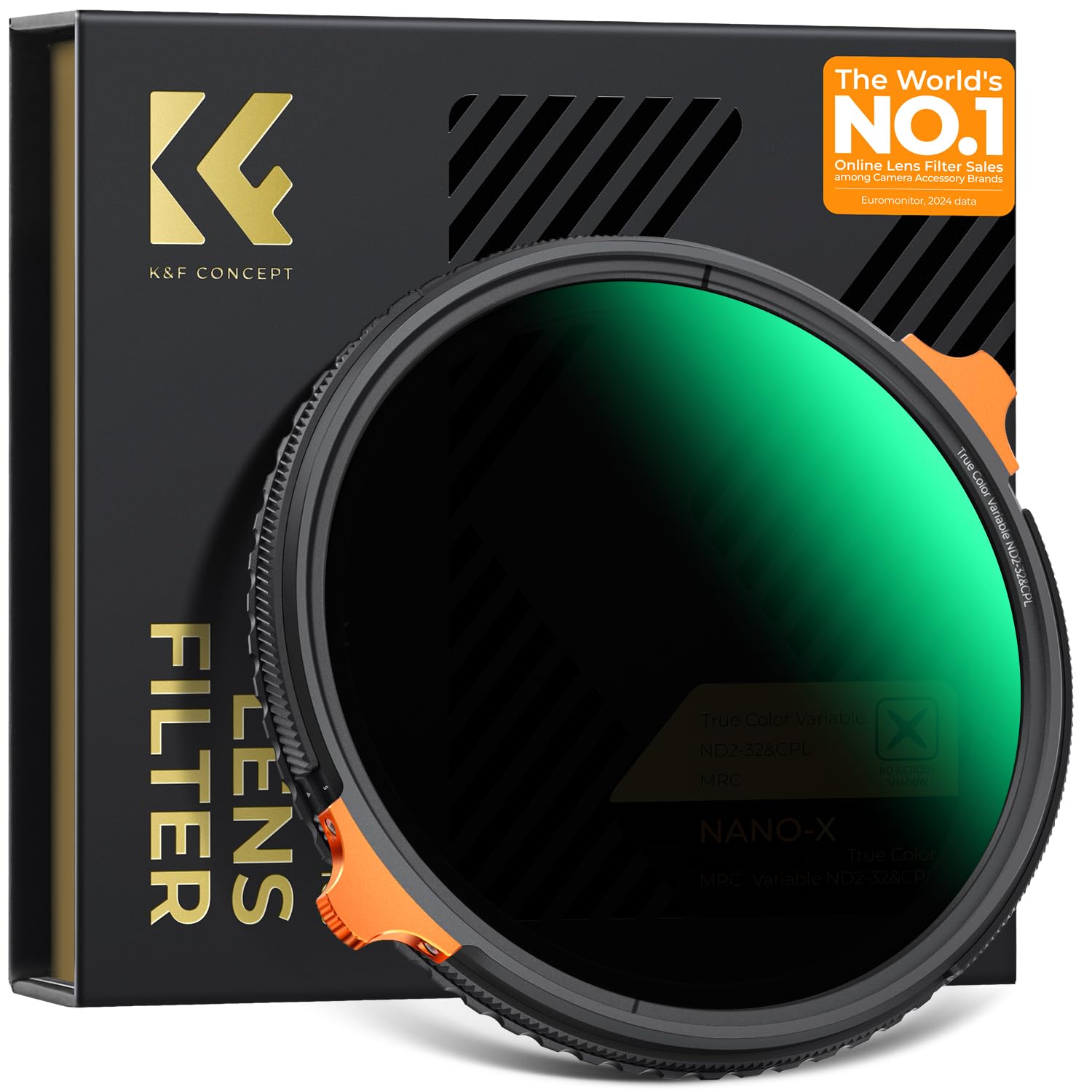
This K&F Concept filter combines variable neutral density (ND2 to ND32) with a circular polarizer in a single rotating assembly. It uses imported AGC optical glass with 28-layer multi-coatings to minimize flare and ghosting. The self-locking mechanism prevents the dreaded X cross pattern that ruins variable ND shots at high densities, and the rotation is smooth with detents for precise stop selection. The titanium coating technology addresses a common problem—partial yellowing—delivering noticeably neutral colors compared to earlier hybrid designs that introduced a warm shift.
Wedding videographers find this filter particularly useful for controlling exposure in changing light conditions while simultaneously cutting reflections on glassware and windows. One user shot an entire wedding with s-cinetone color science and reported that the CPL+ND combo eliminated the need to swap filters during critical moments. The ability to adjust from ND2 to ND32 (1 to 5 stops) provides flexible exposure control without carrying a separate CPL and ND kit. It’s also surprisingly effective on smartphone rigs with clip-on adapters for mobile filmmakers.
Two practical caveats: the filter is too wide to accommodate standard lens caps, requiring a larger cap (72mm for a 67mm thread) or complete removal to cap the lens. Also, rotating the ND ring also rotates the CPL element, making it difficult to maintain polarizer orientation when changing light reduction. This inter-dependence means you must fine-tune both parameters simultaneously—a manageable workflow after practice but not ideal for rapid composition changes.
Why it’s great
- Two-in-one design saves bag space and swap time
- Self-locking tech prevents cross pattern artifacts
- True color coating minimizes yellow cast common in hybrids
- Excellent for wedding and event videography workflows
Good to know
- Requires larger lens cap than thread size suggests
- ND and CPL adjustments are coupled, not independent
5. NiSi 62mm True Color CPL
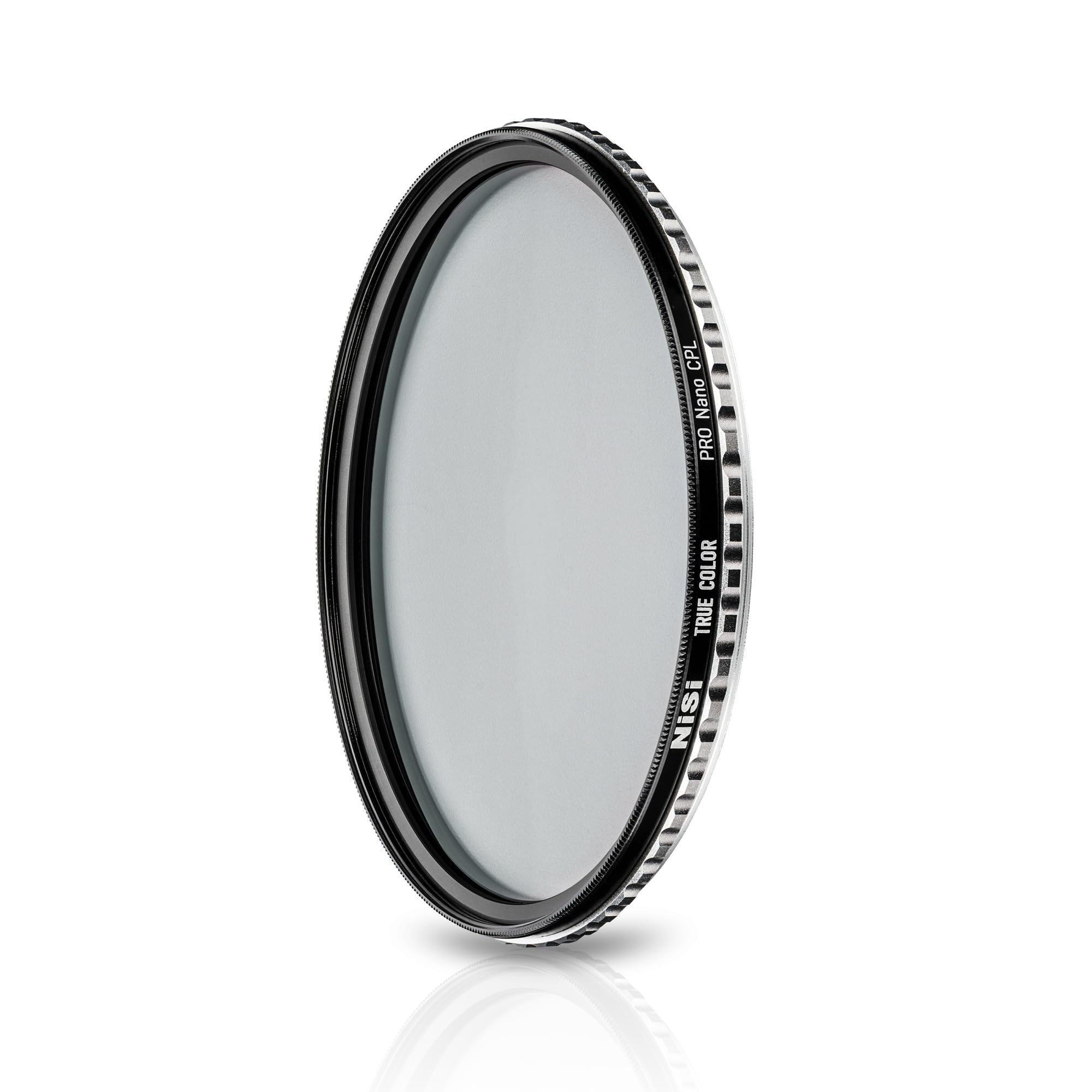
NiSi’s True Color CPL is built for photographers who need accurate color reproduction without the warm cast typically associated with budget polarizers. The Pro Nano Coating provides a waterproof, dustproof, and scratch-resistant surface that makes cleaning effortless. The CINE Seal technology blackens the edge of the polarizing film, reducing condensation and minimizing temperature fluctuations that can degrade long-term performance. At just 2.44 inches in diameter, this filter is designed for lenses with a 62mm thread, making it ideal for many mirrorless kit zooms and compact primes.
Users report that this filter eliminates reflections on storefront windows and vehicle glass effectively, with noticeably richer sky tones in landscape work. Several comparisons against cheaper alternatives confirm that the NiSi avoids the yellow-green shift that plagues entry-level CPLs. The mounting ring is smooth without wobbling, and the filter is thin enough to fit under most lens hoods—though some users note that the wider outer diameter may not sit flush with every hood design. The 35-gram weight is negligible on any setup.
The main consideration is compatibility: the 62mm thread size fits a narrower range of lenses than the universal 67mm or 77mm sizes. If you own multiple lenses with different thread diameters, you may need step-up rings or multiple filters. Additionally, while the CINE seal improves longevity, it adds a small amount of thickness that prevents some pop-on lens caps from snapping securely. For shooters who stick to one or two lenses with 62mm threads, this is a solid mid-range performer with genuine color fidelity.
Why it’s great
- CINE seal technology extends lifespan by controlling condensation
- Color neutral output with no noticeable yellow cast
- Lightweight build adds negligible weight to compact rigs
- Nano coating repels dust and water for easy maintenance
Good to know
- Limited to 62mm thread; step-up rings required for larger lenses
- Wider outer diameter may not fit all lens hoods
6. NiSi 67mm True Color CPL
This 67mm variant of NiSi’s True Color CPL shares the same optical DNA as its 62mm sibling—Pro Nano Coating, CINE seal edge treatment, and color-neutral polarization—but scales up to accommodate standard zoom lenses like the Canon 24-105mm or Sony 24-70mm f/2.8 GM II. The larger thread diameter makes this filter compatible with a much wider range of lenses, reducing the need for step-up rings. At 35 grams, it remains lightweight enough to live permanently on your lens without affecting balance or handling.
Performance in the field mirrors the 62mm version: effective glare reduction on water and glass, deepened blue skies, and foliage that appears richer without oversaturation. Users who switched from cheaper CPLs report an immediate improvement in color accuracy, with one reviewer noting that they returned a competitor’s warm-toned filter in favor of this NiSi model. The nano coating ensures that rain droplets bead off cleanly, and fingerprints wipe away without smearing—a practical advantage for outdoor event photographers who need to stay mobile.
One recurring observation across user reports is that the outer diameter is slightly wider than standard 67mm filters, which prevents it from fitting beneath some third-party lens hoods. This is especially relevant for shooters who use petal-shaped hoods with narrow clearance. Additionally, while the CINE seal improves longevity, the blackened edge treatment can make the filter appear slightly thicker when stacked with other filters, potentially introducing vignetting on ultra-wide lenses. For general landscape and portrait work, however, these limitations rarely surface.
Why it’s great
- Standard 67mm thread fits most mid-range zoom lenses
- Color-neutral output eliminates post-processing corrections
- Nano coating repels water, dust, and smudges effectively
- Ultra-lightweight design stays on the lens full-time
Good to know
- Wider diameter may not fit under all lens hoods
- Blackened edge adds thickness that can cause vignetting when stacked
7. NEEWER 2 in 1 67mm Variable ND2-32 + CPL

NEEWER’s hybrid filter bundles variable ND (ND2 through ND32, 1 to 5 stops) with a circular polarizer in a single rotating assembly, giving budget-conscious shooters a versatile tool for controlling both exposure and reflections. The HD optical glass carries 30 layers of nano-coatings that bring reflectivity below 0.1 percent, suppressing flare and ghosting to an impressive degree for its price tier. The aircraft-grade aluminum alloy frame is CNC-machined with a non-slip texture and laser-etched markings for precise stop reference. Self-locking technology prevents the dark cross shadow that typically plagues variable ND filters on wide-angle lenses.
Real-world users report solid performance as a starter hybrid. Videographers using the iPhone 15 Pro Max with a Moment cage note that the filter produces clean ProRes Log footage without the overexposure often seen in outdoor shooting. Still shooters with the Sony A7RV and 24-70mm f/2.8 GM II find no vignetting or reflections when the filter is clean. The 2-in-1 format saves space in a camera bag compared to carrying separate CPL and ND filters—a meaningful benefit for travelers who pack light.
The most common gripe is that the filter must be the last element in any stack—you cannot attach additional filters on top of it because of the rotating mechanism. Also, operating the ND adjustment without also rotating the polarizer requires two hands, which slows down composition adjustment. Some users also note that the thread tolerance is not as precise as premium brands, occasionally causing a slightly tight or gritty feel when mounting. For entry-level photographers exploring polarizing and ND effects for the first time, this is a functional and affordable starting point.
Why it’s great
- Combines variable ND and CPL in one space-saving unit
- Self-locking technology prevents dark cross artifacts
- 30-layer nano coatings effectively suppress flare
- Works well with smartphone rigs for mobile videography
Good to know
- Cannot stack additional filters on top of the rotating mechanism
- Adjusting ND without moving polarization requires two hands
FAQ
What thread size does my lens need for a CPL filter?
Do variable ND plus CPL hybrid filters reduce image sharpness?
Why does my CPL filter produce uneven polarization across the sky?
Final Thoughts: The Verdict
For most users, the best cpl filter winner is the Breakthrough Photography X4 67mm because it delivers color-neutral transmission with only one stop of light loss and industry-leading MRC16 coating durability. If you want a weather-sealed field companion, grab the Breakthrough X2 CPL. And for a budget-friendly hybrid that handles both polarization and variable ND, nothing beats the K&F Concept Variable ND2-32 + CPL.

Mo Maruf
I created WellFizz to bridge the gap between vague wellness advice and actionable solutions. My mission is simple: to decode the research and give you practical tools you can actually use.
Beyond the data, I am a passionate traveler. I believe that stepping away from the screen to explore new environments is essential for mental clarity and physical vitality.