Choosing a corded router means deciding between raw torque and finesse, between a tool that begs for a table mount and one that feels like an extension of your hand. The wrong pick vibrates through your bones, burns the edge of a workpiece, or lacks the power to finish a cut. The right one delivers clean profiles, precise dados, and repeatable depth without drama.
I’m Mohammad Maruf — the founder and writer behind WellFizz. This guide comes from hours spent cross-referencing motor specs, collet systems, base designs, and real-world user experiences across seven distinct models.
After analyzing amperage curves, rpm ranges, and depth-adjustment mechanisms, I’ve built a clear picture of what separates an average tool from a great one — and what makes the best corded router for your specific workshop needs.
How To Choose The Best Corded Router
A corded router is defined by its motor, its base system, and how it puts the bit where you want it. These three attributes determine whether your work ends up smooth or scorched, repeatable or random.
Motor Power: Amperage and Horsepower
Horsepower ratings can be misleading — look at amperage for real-world torque. A 6.5-amp motor handles edge work and light trimming in softwoods, while a 12-amp motor powers through dense hardwoods and deep passes without bogging. For table-mounted use, prioritize a motor that maintains speed under load via constant-response circuitry.
Base Type: Fixed vs. Plunge
Fixed-base routers offer stability for edge profiling and bit guide work — the depth stays locked. Plunge bases allow you to start a cut in the middle of a workpiece, essential for mortises, dados, and lettering. A combo kit gives you both, with a single motor that swaps between bases. For versatility, a two-base system beats buying separate tools.
Speed Control and RPM Range
Variable speed lets you match the bit diameter and material: larger bits need lower rpm to prevent burning, while smaller bits run faster for clean cuts. Look for a range that starts below 10,000 rpm for wide panel-raising bits and reaches at least 24,000 rpm for fine trimming. Soft-start circuitry prevents the router from jerking when you pull the trigger — it’s not a luxury, it’s a safety feature.
Quick Comparison
On smaller screens, swipe sideways to see the full table.
| Model | Category | Best For | Key Spec | Amazon |
|---|---|---|---|---|
| DEWALT DW618B3 | Premium Combo | Full-shop versatility with three bases | 12-amp, 8,000–24,000 rpm, 3-base kit | Amazon |
| Bosch 1617EVSPK | Premium Combo | Precision depth control for hardwoods | 12-amp, 8,000–25,000 rpm, microfine adjustment | Amazon |
| DEWALT DWP611 | Mid-Range Fixed | One-handed trimming and edge work | 7-amp, 1.25 HP, variable speed, dual LEDs | Amazon |
| Bosch GKF125CEK Colt | Mid-Range Palm | Compact precision with LED lighting | 7-amp, 16,000–35,000 rpm, soft-start | Amazon |
| RIDGID R24012 | Mid-Range Fixed | One-handed comfort and everyday trimming | 5.5-amp, 1.6 HP, 30,000 rpm max | Amazon |
| WORKPRO W125225AE | Budget Fixed | Entry-level trimming with included accessories | 6.5-amp, 10,000–30,000 rpm, fixed base | Amazon |
| Dobetter DBTR700B | Budget Compact | Budget kit with bits and plunge base | 6.5-amp, 10,000–32,000 rpm, rack-and-pinion | Amazon |
In‑Depth Reviews
1. DEWALT DW618B3

The DEWALT DW618B3 is the most complete corded router system in this lineup, delivering a 12-amp motor that maintains speed under load via full electronic feedback. The kit includes a fixed base, a plunge base, and a D-handle base, making it a single-motor solution for edge work, mortising, and table-mounted routing. The variable speed range from 8,000 to 24,000 rpm covers everything from wide panel raisers to fine trim bits without burning.
The plunge base uses precision machined brass bushings and case-hardened steel guide rods for a smooth, accurate stroke — crucial when cutting repeatable dados in plywood. The detachable cordset adds serviceability and makes storage easier. The through-the-column dust collection captures about 95 percent of debris, keeping your line of sight clear during heavy routing.
Reviewers consistently praise the quiet operation compared to older Porter-Cable models, the smooth soft start that prevents jerking, and the convenience of the single-wrench bit change via the spindle lock. A few note that the D-handle base alone isn’t worth a separate purchase, but as part of this kit it provides excellent stability for guide jig work.
Why it’s great
- Three interchangeable bases cover fixed, plunge, and D-handle use cases
- 12-amp motor with constant feedback doesn’t bog in hardwoods
- Through-column dust collection keeps the work area visible
- Detachable cord adds storage flexibility and repair options
Good to know
- Heavy at over 10 pounds with plunge base attached
- D-handle base is not sold separately at a reasonable price
- Some users report the plastic sub-base can warp if overtightened
2. Bosch 1617EVSPK

The Bosch 1617EVSPK pairs a 12-amp motor with both a fixed base and a plunge base, giving you full routing capability out of a single box. The standout feature is the microfine bit-depth adjustment — you can dial in depth changes with precision that matters when you’re taking 1/32-inch passes on hard maple plywood. The variable speed dial runs from 8,000 to 25,000 rpm, giving you flexibility for large-format bits without overheating the work.
The constant-response circuitry stabilizes start-up torque and maintains rpm under load, which means a steady cut from entry to exit. The rounded hardwood handles on the fixed base provide a comfortable, secure grip, and the plunge base is noted for its smooth action and easy depth-stop setting. The 2-inch sub-base opening simplifies template loading, a practical touch for pattern work.
Users highlight the tool’s build quality and consistency over hundreds of hours of use. Some note that the dust collection is not built into the base — you’ll need an external dust hood or shop-vac attachment. A few mention the plunger depth adjustment can feel granular enough for repeated mortise cuts, especially in hardwoods where bit life benefits from the motor’s torque.
Why it’s great
- Microfine depth adjustment delivers repeatable, accurate depth changes
- 12-amp motor with constant response prevents speed drop under load
- Comfortable hardwood handles reduce fatigue during long sessions
- Plunge base works well for repeatable mortise cuts
Good to know
- No built-in dust collection on either base
- Heavy kit at over 18 pounds total with case
- Some users find the fine-adjust knob feels rough until broken in
3. DEWALT DWP611

The DEWALT DWP611 is a 7-amp, 1.25 HP fixed-base router that excels at one-handed trimming and edge work. The variable speed trigger lets you dial in the exact rpm for the bit and material, and the soft-start motor ramps up smoothly instead of lurching. Dual LEDs and a clear sub-base provide good visibility into the cut area, a practical advantage when chasing a line on dark woods.
The depth adjustment ring enables controlled bit depth changes down to 1/64-inch, and the clamping mechanism locks the motor securely — no slipping during heavy passes. The spindle lock button makes single-wrench bit changes quick and comfortable. The aluminum motor housing and base construction offer long-term durability without excessive weight, coming in at about 5.5 pounds.
Reviewers praise its manageable size and power for making 1/4-inch dados in plywood in a single pass. The LEDs are described as fairly bright but not overwhelming, and the “D” base shape adds stability for freehand work. A few users note that the included carrying case would be welcome, and that the base’s width can feel awkward when clamping to a narrow jig.
Why it’s great
- Compact and lightweight for one-handed routing control
- Variable speed trigger gives on-the-fly rpm adjustment
- Dual LEDs illuminate the cut path effectively
- Depth ring adjustment down to 1/64-inch for precise work
Good to know
- No hard case or storage box included
- Base width can be awkward for some clamp setups
- Center cone may be needed to align sub-base
4. Bosch GKF125CEK Colt

The Bosch Colt is a palm router that prioritizes compactness and high-speed capability — the variable speed range of 16,000 to 35,000 rpm makes it ideal for small-diameter bits and detailed trim work. The 7-amp motor delivers 1.25 HP, and the soft-start circuitry reduces the kick that can throw off a delicate edge pass. The 360-degree non-split aluminum base adds rigidity and accepts bits up to 1-5/16 inches wide.
The ground-breaking depth-adjustment system uses a rack-and-pinion style that feels precise in hand, and the LED lighting in the bit area helps visibility in tight corners. The round translucent polycarbonate sub-base offers clear guidance along templates, making this a natural choice for pattern routing and inlay work. The spindle lock enables fast bit changes, and the finger-support pockets add control during one-handed operation.
Users describe it as a solid palm router that holds bit height accurately after multiple adjustments. The cord features a ball joint that doesn’t snag during maneuvering. Some find the fine-adjust mechanism and lock a bit rough initially, and the motor is noticeably noisier than full-size routers. The included guide rail is flimsy, but the tool’s build quality overall is classic Bosch aluminum.
Why it’s great
- High rpm range perfect for small trim and detail bits
- Excellent depth-adjustment precision for a palm router
- LED lighting improves visibility in low-angle cuts
- Non-split aluminum base for rigidity and durability
Good to know
- Motor is noisier than larger, full-size routers
- Included guide rail is not very sturdy
- Collet can be tight on first use and require extra force
5. RIDGID R24012

The RIDGID R24012 is a compact fixed-base router built around ergonomics — users consistently call it the most comfortable trim router to hold, with excellent balance and control. The 5.5-amp motor delivers 1.6 HP, a respectable power-to-weight ratio for a tool that weighs just 4 pounds. Its maximum speed of 30,000 rpm suits edge profiling and bit guide work in cabinetry and trim.
The top-mounted power switch is a point of contention: it’s easy to reach but also easy to accidentally press off during a cut, especially when gripping near the top of the motor housing. The variable speed feature allows you to match the bit to the material, and the included edge guide with extra support holes proved useful for making pocket grooves. The depth adjustment is straightforward, though some users report that the bit can loosen with heavy use on a defective unit.
The RIDGID Lifetime Service Agreement — available with online registration — adds long-term value for buyers who plan to keep this router in daily use. Reviewers who have run it for years in cabinet shops praise its reliable performance and comfortable grip. It comes with a carrying bag and a single bit, but the plunge base is not included.
Why it’s great
- Ergonomically the most comfortable trim router to hold
- Lightweight at 4 pounds for fatigue-free extended use
- Lifetime Service Agreement with registration
- Powerful enough for pocket grooves and edge work
Good to know
- Top-mounted power switch can be accidentally turned off
- No plunge base included — fixed base only
- Reported defective units with bits loosening during cuts
6. WORKPRO W125225AE

The WORKPRO fixed-base router provides a 6.5-amp motor with a variable speed range from 10,000 to 30,000 rpm, making it a solid entry-level option for DIYers tackling cabinet holes, sink cutouts, and edge profiling. The fixed base holds depth adjustment securely once locked, but the mechanism feels slightly sloppy when unclamped — users recommend using a gauge for critical depth settings rather than relying on the scale alone.
The included accessories include an edge guide and a dust hood, though the included bits are typically set aside by experienced users due to quality concerns. The WORKPRO accepts template bushings in the fixed base — a feature usually found on more expensive models. The slow-start motor prevents it from jumping on startup, and the aluminum and metal construction gives it a solid feel for its weight class.
Reviewers find it powerful for its size and appreciate the adjustable speeds, which allow clean cuts with both round and straight bits. The plunge base that comes with the kit requires oiling for smooth action out of the box. Some note that a DeWalt universal fence fits perfectly as an upgrade over the stock fence. Overall, it’s a capable router for intermittent shop use.
Why it’s great
- Variable speed provides good material flexibility
- Fixed base accepts template bushings for pattern work
- Slow-start motor reduces kick on startup
- Includes edge guide and dust hood for basic routing
Good to know
- Depth adjustment feels sloppy when unclamped
- Included bits are low quality — budget for separate bits
- Plunge base needs lubrication for smooth operation
7. Dobetter DBTR700B
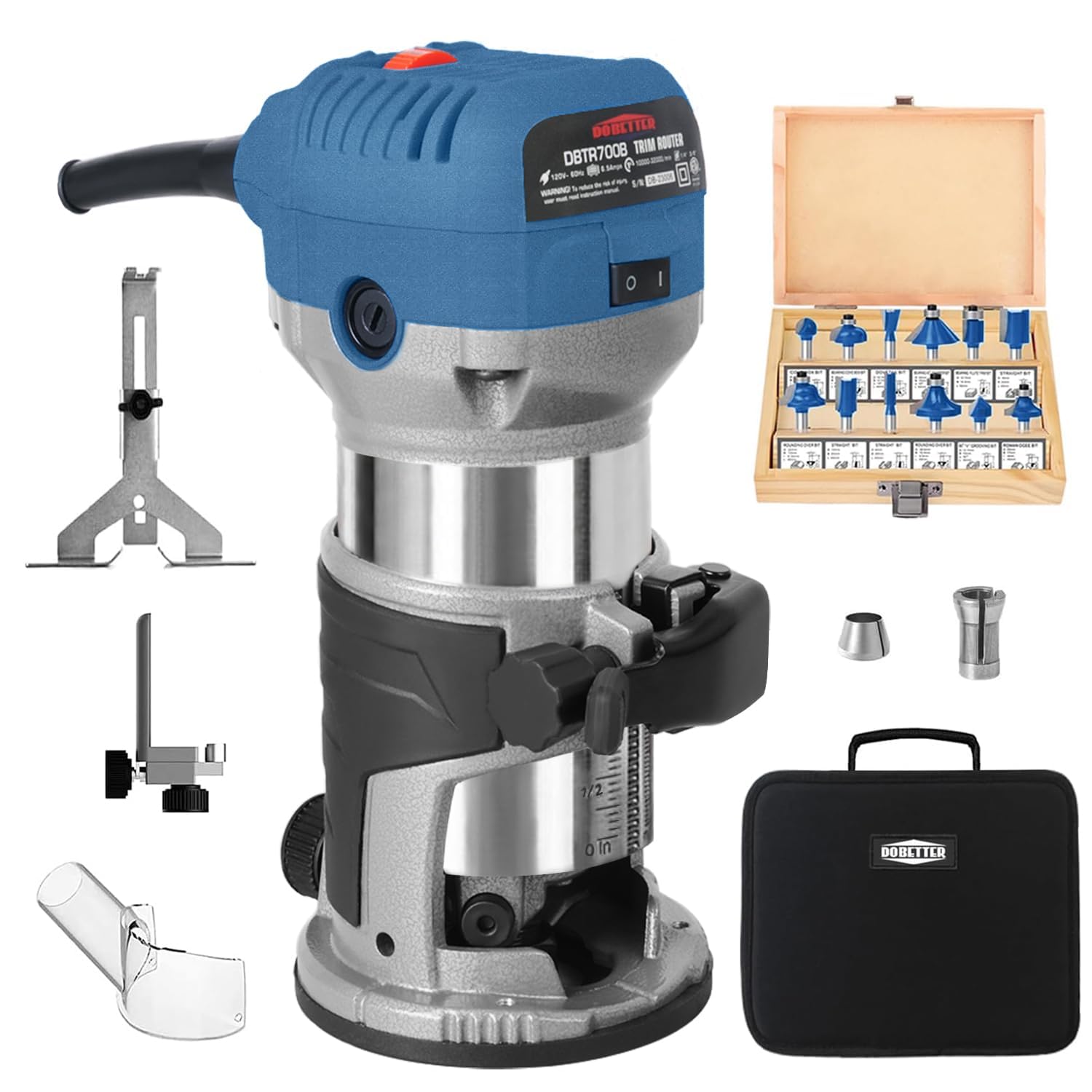
The Dobetter DBTR700B is a compact palm router that punches above its size, offering a 6.5-amp motor with a max of 1.25 HP and a variable speed range of 10,000 to 32,000 rpm. The plunge base allows you to start cuts in the middle of a workpiece — a feature usually reserved for more expensive routers. The rack-and-pinion depth adjustment system provides smooth, precise depth changes that stay locked once set.
This kit is unusually generous with accessories: it comes with 12 router bits, a portable bag, an edge guide, a roller guide, a dust hood, and spare carbon brushes. The soft-start feature prevents the router from jumping during startup, and the constant-power circuitry helps maintain cutting speed during demanding passes. The included bits are decent for softwood use, and the quick-release lock system makes base removal straightforward.
Users appreciate the low vibration and noise levels for a compact router. The bit change is slightly cumbersome due to a spring-loaded lock screw — removing the base makes the process easier. After months of use in CNC applications, reviewers report the tool holds up well, cutting cleanly through soft to hard woods. It’s not a professional-grade tool, but for home projects and hobbyist routing, it delivers solid value.
Why it’s great
- Plunge base included at a very affordable price point
- Rack-and-pinion depth adjustment holds settings reliably
- Comes with 12 bits, bag, and accessories in one kit
- Quiet operation with low vibration for a palm router
Good to know
- Bit change is awkward due to spring-loaded lock screw
- Not a professional-grade tool — better for home use
- Included bits suitable only for softwood trim work
FAQ
Is a 6.5-amp motor strong enough for hardwood routing?
Should I get a fixed base or a plunge base for my first router?
How do I prevent my router bit from burning the wood?
Can I use a 1/2-inch shank bit in a 1/4-inch collet router?
Final Thoughts: The Verdict
For most users, the best corded router winner is the DEWALT DW618B3 because its three-base system covers fixed, plunge, and D-handle use cases with a smooth 12-amp motor that doesn’t bog in hardwoods. If you want microfine depth adjustment for precise joinery, grab the Bosch 1617EVSPK. And for one-handed trimming and small-detail work, nothing beats the compact ergonomics of the DEWALT DWP611.

Mo Maruf
I created WellFizz to bridge the gap between vague wellness advice and actionable solutions. My mission is simple: to decode the research and give you practical tools you can actually use.
Beyond the data, I am a passionate traveler. I believe that stepping away from the screen to explore new environments is essential for mental clarity and physical vitality.