A single rogue crabgrass plant can produce over 150,000 seeds, turning a pristine lawn into a patchy, wiry mess within a single season. The challenge is timing: apply a pre-emergent too early and the barrier degrades before the soil temperature triggers germination; apply too late and the weed is already established with a deep taproot that shrugs off surface treatments. This guide focuses exclusively on the chemical and biological strategies that actually stop crabgrass at every stage of its lifecycle, from soil barrier to post-emergent kill.
I’m Mohammad Maruf — the founder and writer behind WellFizz.
After evaluating coverage rates, active ingredient profiles, and seasonal application flexibility across five top-rated products, this guide delivers a focused ranking of the best crabgrass fertilizer options available for homeowners seeking a thick, weed-free lawn.
How To Choose The Best Crabgrass Fertilizer
Crabgrass thrives in thin, underfed lawns where bare soil patches catch direct sunlight. The right fertilizer does double duty by feeding your desired grass species dense enough to crowd out weeds while delivering an active ingredient that prevents crabgrass seeds from germinating. Not all weed-and-feed blends are equal in this specific fight.
Active Ingredient: Dimension vs. Pendimethalin
Two pre-emergent chemistries dominate the crabgrass market. Dimension (dithiopyr) offers a unique advantage—it provides both pre-emergent and early post-emergent control, meaning it can kill crabgrass seedlings even if applied slightly after germination. Pendimethalin works strictly as a pre-emergent barrier and requires more precise soil-temperature timing. For homeowners unsure about their spring window, Dimension-based products offer a wider margin for error.
Nitrogen Release Profile
A fertilizer with high fast-release nitrogen causes a quick green-up but can burn the lawn if applied incorrectly, and the surge fades within weeks. Slow-release nitrogen (labeled as polymer-coated or sulfur-coated urea) feeds the lawn steadily for 8–12 weeks, encouraging root depth and consistent top growth that physically blocks crabgrass from establishing. Look for a 30% or higher slow-release percentage in the NPK ratio for season-long defense.
Coverage Area Per Bag
Bag weight alone is misleading—a 15-pound bag with a high-density granule might only cover 5,000 square feet, while a 33-pound bag with a lighter carrier covers 10,000 square feet. Always match the bag’s labeled square footage to your actual lawn size. Buying too-small bags leads to underdosing, which leaves gaps in the pre-emergent barrier where crabgrass will inevitably appear.
Quick Comparison
On smaller screens, swipe sideways to see the full table.
| Model | Category | Best For | Key Spec | Amazon |
|---|---|---|---|---|
| Preen Lawn Crabgrass Control | Pre-Emergent | Season-long prevention | Dithiopyr active ingredient | Amazon |
| GreenView Fairway Formula | High Nitrogen | Large lawns needing dense growth | 27-0-5, 63% slow-release N | Amazon |
| Hi-Yield Grass Stopper | Pre + Post | Late spring application windows | Dimension, 4-week late window | Amazon |
| Scotts Turf Builder Weed & Feed | Weed Control | Dandelion and clover removal | Weedgrip Technology, 5K coverage | Amazon |
| Jonathan Green Veri-Green | Weed & Feed | Feeding plus broadleaf control | 21-0-3, 3-month feed | Amazon |
In‑Depth Reviews
1. Preen Lawn Crabgrass Control

Preen’s crabgrass control uses dithiopyr, the same active ingredient found in premium Dimension formulations, offering both pre-emergent barrier protection and early post-emergent knockdown if germination has already started. This dual-action window makes it the most forgiving product for homeowners who miss the perfect soil-temperature timing. The 15-pound bag covers 5,000 square feet at labeled rates, and the granular consistency works smoothly through rotary spreaders without clumping.
User reports consistently note near-total crabgrass prevention when applied in early spring before soil temperatures reach 55°F. Warm-season grass owners on bermudagrass and zoysiagrass report strong results, though the product is also labeled for cool-season varieties like tall fescue and Kentucky bluegrass. Several verified buyers switched from Scotts to Preen specifically because they needed fewer reapplications per season.
One limitation: the post-emergent window lasts only about four weeks after germination—once crabgrass matures beyond the two-leaf stage, this product loses effectiveness as a killer. For mature weeds, a separate spot-treatment herbicide is required. Preen also does not contain fertilizer, so a separate nitrogen source must be used if lawn greening is also a goal.
Why it’s great
- Dithiopyr active ingredient works pre- and early post-emergent
- Effective on both cool and warm season grass types
- Consistent granule size for even spreader application
Good to know
- No fertilizer included—requires separate feeding
- Post-emergent window ends after the two-leaf stage
- Some users report reduced efficacy in severe drought conditions
2. GreenView Fairway Formula Lawn Fertilizer

The GreenView Fairway Formula delivers a 27-0-5 NPK ratio with 63% of its nitrogen in slow-release form, providing a steady 12-week feed cycle that promotes thick, deep-rooted grass capable of physically crowding out crabgrass. The 33-pound bag covers 10,000 square feet, making it the most cost-efficient option per square foot for medium to large lawns. The blue-dyed granules make it easy to see overlap during application, reducing the risk of fertilizer burn from double-passing.
Users in warm-season zones report that centipede grass and bermudagrass respond aggressively to this feed, with noticeable darkening within the first week after application. The zero-phosphate formula is designed for environmentally sensitive areas near waterways, which is a growing concern for many suburban homeowners. The 27-0-5 mix is heavy on nitrogen but lacks potassium—ideal for spring green-up but may require a fall potassium supplement for winter hardiness.
Because this product contains no herbicide or pre-emergent active ingredient, it works best as a lawn strengthener in a broader crabgrass management program. Pair it with a separate pre-emergent application in early spring for best results. Buyers looking for a combined weed-and-feed solution will need to look elsewhere in this list.
Why it’s great
- 63% slow-release nitrogen feeds for 12 full weeks
- Large 33-pound bag covers 10,000 sq ft
- Zero-phosphate formula protects waterways
Good to know
- No pre-emergent or weed killing ingredients
- Needs a separate potassium source for fall preparation
- Blue dye can stain concrete if granules are left wet
3. Hi-Yield Turf & Ornamental Weed & Grass Stopper

Hi-Yield’s Grass Stopper contains Dimension (dithiopyr) and carries a unique label claim: it can be applied up to four weeks later than other pre-emergent crabgrass products. This extended application window is a real advantage for homeowners in transitional climate zones where spring weather fluctuates unpredictably—if you missed the dogwood bloom signal, Hi-Yield still gives you a viable second chance. The 12-pound bag covers 5,000 square feet, and the granule size is fine enough to penetrate established turf without sitting on top of the canopy.
User reviews consistently highlight its effectiveness on both crabgrass and goosegrass, a tough relative that many pre-emergents fail to control. The product also suppresses a range of annual broadleaf weeds, though its primary strength remains grass-family weed prevention. Several verified buyers report that a single spring application followed by a fall top-up provided season-long control even in heavy-pressure lawns.
The main downside is packaging inconsistency—some orders have shipped with less product than the labeled 12 pounds, likely due to settling during transport. Check the bag weight upon arrival. Like Preen, this product does not include fertilizer, so a separate nitrogen feeding schedule must be maintained for optimal lawn density and crabgrass crowding.
Why it’s great
- Can be applied up to 4 weeks later than standard pre-emergents
- Effective against both crabgrass and goosegrass
- Fine granule size penetrates thick turf easily
Good to know
- No fertilizer included—requires separate feeding
- Packaging may settle during shipping, reducing net weight
- Not effective on mature, seed-head-stage crabgrass
4. Scotts Turf Builder Weed and Feed
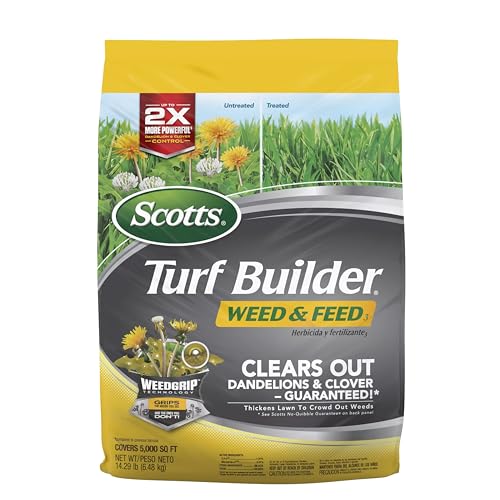
Scotts Turf Builder Weed and Feed is built around 2,4-D and mecoprop-p, a broadleaf herbicide combination that targets dandelions, clover, and chickweed while the fertilizer component (nitrogen-heavy) pushes grass green-up. The Weedgrip Technology helps granules cling to weed leaves even after the granules fall through the canopy, improving contact kill on low-growing broadleaf weeds. The 14.3-pound bag covers 5,000 square feet, and the slow-release nitrogen in the formula feeds for up to two months.
User feedback is strong for broadleaf weed elimination but notably mixed regarding crabgrass control. Several verified buyers explicitly state that this product did not control crabgrass or clover, consistent with the active ingredient profile—2,4-D is a broadleaf herbicide and does not prevent grassy weed germination or kill emerged crabgrass. For lawns where crabgrass is the primary enemy, Scotts functions best as a secondary broadleaf cleanup tool rather than a primary defense.
Application success depends heavily on timing and watering. Granules must contact wet weed leaves to stick, followed by a 48-hour no-water period. Rain within that window washes the herbicide off, requiring reapplication. This sensitivity makes the hose-end spray version a more reliable delivery method for consistent coverage, though the granular version is more budget-friendly per application.
Why it’s great
- Kills over 250 broadleaf weed types including dandelions
- Slow-release nitrogen greens lawn for up to 2 months
- Weedgrip Technology improves herbicide leaf contact
Good to know
- Not effective on crabgrass or grassy weeds
- Requires precise watering schedule for best results
- Granule application can cause burn spots if walked on
5. Jonathan Green Veri-Green Weed and Feed

Jonathan Green’s Veri-Green uses a 21-0-3 NPK analysis with a fine-particle granule designed to break down quickly in contact with soil moisture, feeding the grass while attacking over 250 broadleaf weeds. The 15-pound bag covers 5,000 square feet, and the slow-release nitrogen delivers consistent green-up for up to three months—longer than many competitors at this tier. The fine particle size means it works well in both rotary and drop spreaders without bridging or clogging.
Users notice visible improvement in lawn color within two weeks, and the broadleaf control is strongest on dandelions, chickweed, and clover. However, like the Scotts product, this weed-and-feed formula targets broadleaf weeds rather than grassy weeds—crabgrass control requires a separate pre-emergent product applied earlier in the season. Verified buyers confirm that henbit and wild onion are also effectively suppressed when applied during active growth.
The major limitation is that the weed-killing component (a combination of 2,4-D and dicamba) works only on emerged broadleaf weeds. It provides zero pre-emergent protection against crabgrass germination, so using this product alone in the spring guarantees a crabgrass problem later. Apply a pre-emergent barrier like Preen or Hi-Yield first, then follow up with Veri-Green for broadleaf cleanup and feeding.
Why it’s great
- 3-month slow-release nitrogen feed cycle
- Fine particle size prevents spreader clumping
- Effective on dandelions, clover, and henbit
Good to know
- No pre-emergent crabgrass protection
- Only controls emerged broadleaf weeds
- Cannot be used at the same time as seeding
FAQ
How close to a vegetable garden can I apply Dimension-based crabgrass fertilizer?
Can I apply crabgrass fertilizer and grass seed at the same time?
Why does my crabgrass return even after using a pre-emergent every spring?
Final Thoughts: The Verdict
For most users, the best crabgrass fertilizer winner is the Preen Lawn Crabgrass Control because its dithiopyr active ingredient provides both pre-emergent protection and a forgiving post-emergent window that covers timing errors. If you want a dense, thick lawn that physically crowds out weeds, grab the GreenView Fairway Formula for its 63% slow-release nitrogen that feeds for 12 weeks. And for late-spring applications where you missed the early window, nothing beats the Hi-Yield Grass Stopper for its four-week delayed application flexibility.

Mo Maruf
I created WellFizz to bridge the gap between vague wellness advice and actionable solutions. My mission is simple: to decode the research and give you practical tools you can actually use.
Beyond the data, I am a passionate traveler. I believe that stepping away from the screen to explore new environments is essential for mental clarity and physical vitality.