The search for the perfect shoe accessory often begins with a simple request: relief from the daily ache that settles into your arches after a long walk or a shift on your feet. Unlike generic foam pads that flatten within weeks, a well-chosen combination of materials can offer the firm, natural support your feet need to stay comfortable from morning to night.
I’m Mohammad Maruf — the founder and writer behind WellFizz. I spend my hours dissecting the material science, structural design, and real-world feedback behind every foot health product I recommend to ensure you get the truth about what actually works.
This guide cuts through the marketing noise to deliver a clear, research-backed breakdown of the best cork insoles for lasting arch support, shock absorption, and all-day wear.
How To Choose The Best Cork Insoles
Selecting the right insole goes beyond grabbing the first option with a cork label. The interplay between arch height, material density, and shoe volume determines whether your purchase brings relief or frustration. Here is what to evaluate before you buy.
Arch Height and Support Type
Your arch profile dictates the level of support you need. Low arches require a lower profile with firm medial support to prevent overpronation, while high arches need a pronounced support structure to fill the gap and distribute pressure evenly. Many premium designs offer a 3/4-length format that sits under the arch and heel, leaving room for toe splay, which is ideal for tight shoes.
Material Layering and Density
Not all cork is the same. High-density cork cores provide the rigid foundation necessary to maintain shape under repeated impact, while softer top layers like sheepskin, memory foam, or Plastazote add comfort and moisture management. A rigid TPU heel cup further stabilizes the foot and prevents the insole from shifting inside the shoe.
Durability and Break-In Period
Cork-based inserts typically require a short adaptation period. A gradual break-in of a few hours per day allows the material to mold to your foot without causing discomfort. Avoid insoles with thin cork layers that compress permanently after a few weeks; look for a minimum structural thickness that promises years of service rather than months.
Quick Comparison
On smaller screens, swipe sideways to see the full table.
| Model | Category | Best For | Key Spec | Amazon |
|---|---|---|---|---|
| Pedag Holiday | 3/4 Length Orthotic | Low-profile dress shoes & plantar fasciitis relief | Lambskin leather top, 3/4 length | Amazon |
| VALSOLE Heavy Duty | Full Length Orthotic | Heavy-duty support for users over 220 lbs | Hard TPU arch, deep heel cup | Amazon |
| OUOKK High Arch Support | 3/4 Length Orthotic | Custom arch height selection & heavy duty support | 30mm high arch, 3 arch heights | Amazon |
| 10 Seconds 3030 | Full Length Cushion | Metatarsal pain & cushioned all-day comfort | Plastazote memory foam topper | Amazon |
| DynWalker Arch Support | Full Length Cushion | Budget-friendly balance of support & cushion | Multi-layer TPU, memory foam, EVA | Amazon |
In‑Depth Reviews
1. Pedag Holiday 3/4 Length Sheepskin Orthotic

The Pedag Holiday stands apart because it solves the problem of fitting real support into low-volume shoes. Its 3/4-length design leaves the toe box free, making it the top choice for loafers, Oxfords, and ballet flats where bulky orthotics simply do not fit. The German craftsmanship is immediately apparent in the lambskin leather top layer that resists odor and outlasts synthetic alternatives by years.
The metatarsal pad and heel cushion are integrated rather than glued on, which prevents shifting and keeps the support active with every step. Multiple long-term users report a decade of daily wear with the same pair, which speaks to the rigid plastic base and high-density arch reinforcement. The APMA Seal of Acceptance adds an extra layer of trust for those with diagnosed foot conditions like plantar fasciitis or Morton’s neuroma.
Be aware that this insole is firm, not plush. It does not provide a soft step; it provides structural correction. Order one size up if you are between sizes, as the fit runs true to European sizing. The adhesive spot on the bottom holds securely but makes swapping between shoes less convenient, so consider buying a dedicated pair per shoe.
Why it’s great
- Ultra-thin profile fits dress shoes and tight footwear
- Lambskin leather top resists odor and lasts for years
- Medically recognized by the American Podiatric Medical Association
Good to know
- Permanent adhesive backing prevents easy shoe swapping
- Requires a short break-in period due to rigid arch support
2. VALSOLE Heavy Duty Support Pain Relief Orthotics

The VALSOLE Heavy Duty orthotic is engineered specifically for individuals over 220 pounds who need extra structural integrity. A hard TPU arch bridge spans the midfoot, while a deep TPU heel cup locks the foot in place to control overpronation. The dual-layer construction combines a thick Ortholite top for moisture-wicking comfort with a firm EVA base that absorbs impact without collapsing.
Users with plantar fasciitis and chronic lower back pain report significant relief after switching from custom orthotics, which often cost ten times more. The shock guard technology reduces the peak impact force transmitted to the knee and hip joints, making it a strong choice for nurses, warehouse workers, and anyone who stands all day on concrete floors.
Plan for a gradual adaptation period. The rigid arch may feel intense during the first few hours, so start with short sessions and build up over a week. The insoles are full-length and require removing the original shoe insert, but they do fit wide work boots and athletic sneakers without trimming in most sizes.
Why it’s great
- Hard TPU arch and deep heel cup provide maximum stability
- Designed for heavy users without sacrificing cushioning
- Outperforms many custom orthotics for plantar fasciitis relief
Good to know
- Firm feel requires a gradual break-in over the first week
- Not suitable for formal or tight leather shoes
3. OUOKK High Arch Support Inserts 3/4 Length

The OUOKK insole offers something rare in this category: three distinct arch heights so you can match the support intensity to your exact foot shape. The 30mm high arch version provides heavy-duty support for those with pronounced arches or leg length discrepancies, while the medium and low options cater to neutral and flat feet. This level of customization makes it a standout for buyers who found previous insoles either too aggressive or not supportive enough.
Built with a premium TPU elastic core, these 3/4-length inserts deliver support that lasts over two years without losing shape. The thin edges save critical space in tight shoes, making them compatible with hiking boots, flats, and even some high heels. The included foot massage area under the metatarsal head encourages blood circulation during long standing periods.
The single most important detail is that these insoles are rigid. They do not flex like foam inserts, and placement inside the shoe may take a few tries to settle. There is no trimming required, which removes the guesswork but means you must check the sizing chart carefully before purchase.
Why it’s great
- Three arch height options for a personalized fit
- Thin, rigid TPU core fits tight shoes without extra bulk
- Long-lasting support rated for two years of daily use
Good to know
- Rigid construction may require an adjustment period
- Placement can be tricky; may shift until fully seated
4. DynWalker Arch Support Insoles
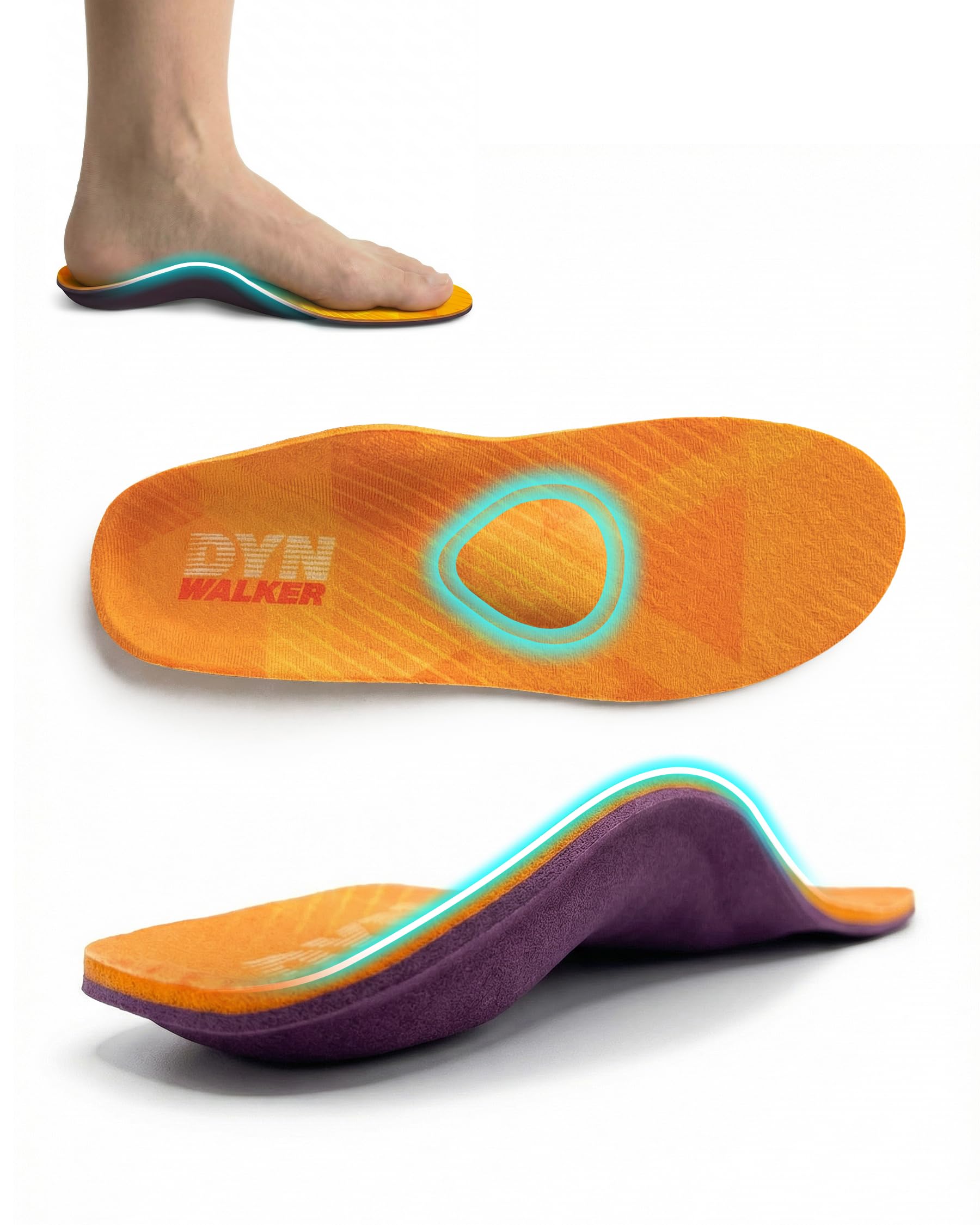
The DynWalker delivers a balanced mix of cushion and support without pushing into premium price territory. Its multi-layer construction uses high-density TPU for structural arch support, a memory foam middle layer for conformity, and a resilient EVA base for shock absorption. The 4cm 3D arch profile closely follows the foot’s natural contour, which helps distribute pressure evenly across the midfoot.
A deep U-shaped heel cup wraps the calcaneus to reduce heel slippage and stabilize the foot during walking. This design is particularly useful for those whose feet tend to roll inward, as the lateral walls guide the rearfoot into a neutral position. The latex forefoot padding adds a gentle lift under the ball of the foot that relieves pressure on the metatarsal heads.
Users note that the insole feels stiffer than expected, with a pronounced metatarsal rise that takes a few days to get used to. The fit is true to size and stays in place without adhesive, making it easy to swap between shoes. It is best for sneakers and work shoes, but the full-length build may crowd the toe box in very tight footwear.
Why it’s great
- Effective multi-layer construction for balanced support
- Deep heel cup reduces slippage and walking instability
- Good value for the combination of materials and durability
Good to know
- Stiffer feel with a pronounced metatarsal pad
- Full-length design may not fit very narrow or tight shoes
5. 10 Seconds 3030 Pressure Relief with Metatarsal Pad

The 10 Seconds 3030 redefines cushioning in the cork insole space by pairing a supportive medium-arch base with a top layer of Plastazote memory foam that molds to the exact shape of your foot. Unlike gel insoles that bottom out, the Plastazote regains its form after each wear and provides a custom fit over time. The integrated metatarsal pad sits under the ball of the foot to offload stress from the metatarsal heads, making it a targeted solution for metatarsalgia and Morton’s neuroma.
Poron strike pads embedded in the heel and forefoot absorb high-impact forces that would otherwise travel up the kinetic chain to the knees and hips. Users report being able to walk five or more miles with noticeably less discomfort compared to standard inserts, which typically fail around the three-mile mark. The cushioning is substantial without being bulky, allowing it to fit comfortably in walking shoes and slip-ons.
The medium arch height may not satisfy those who need aggressive structural support, and some users note that the cushioning effectiveness decreases slightly after several weeks of daily compression. It is an excellent everyday comfort insole for those whose primary complaint is ball-of-foot pain or general foot fatigue rather than severe overpronation.
Why it’s great
- Plastazote memory foam molds to your foot for a custom fit
- Metatarsal pad effectively reduces ball-of-foot pressure
- Poron strike pads absorb impact for long-distance walking
Good to know
- Medium arch only; not suitable for extreme pronation
- Cushioning may compress slightly after weeks of daily use
FAQ
How long do cork insoles typically last before needing replacement?
Can I use 3/4-length insoles in high heels or very flat shoes?
Final Thoughts: The Verdict
For most users, the best cork insoles winner is the Pedag Holiday because it offers the unique combination of ultra-thin, low-profile design with genuine structural support that fits dress shoes without compromise. If you need heavy-duty support for long standing and a body weight over 220 pounds, grab the VALSOLE Heavy Duty. And for premium cushioned relief targeting ball-of-foot pain, nothing beats the 10 Seconds 3030.

Mo Maruf
I created WellFizz to bridge the gap between vague wellness advice and actionable solutions. My mission is simple: to decode the research and give you practical tools you can actually use.
Beyond the data, I am a passionate traveler. I believe that stepping away from the screen to explore new environments is essential for mental clarity and physical vitality.