That patch of coarse, light-green grass spreading like a stain across your lawn isn’t just unsightly—it’s crabgrass, and it’s actively choking out your turf. Unlike dandelions you can pluck, crabgrass grows in dense clumps with thick stems that laugh at standard weed-and-feed products, making a targeted spray the only reliable path to a clean lawn.
I’m Mohammad Maruf — the founder and writer behind WellFizz. I’ve analyzed hundreds of hours of user field reports, turfgrass research, and herbicide chemistry to build this guide around the narrow category of selective post-emergent sprays that won’t destroy your existing grass while eradicating crabgrass at the root crown.
Whether you are fighting a sudden breakout or a full-blown invasion, choosing the right concentrate or ready-to-use formula determines whether your lawn recovers or stays patchy. This guide breaks down the top-performing options to help you find the best crabgrass killer spray without guesswork.
How To Choose The Best Crabgrass Killer Spray
Not all weed sprays are created equal. Crabgrass is a warm-season annual grass that develops a thick root system and tillers that spread outward. A general-purpose weed killer often misses it because crabgrass is, botanically, a grass itself. You need a selective herbicide formulated to target grassy weeds while leaving your lawn grass untouched.
Active Ingredient Matters Most
Quinclorac is the gold standard for post-emergent crabgrass control. It disrupts growth at the cellular level and typically shows results within one to two weeks. Mesotrione works both pre- and post-emergent, but it bleaches foliage white before killing the weed—a slower process. Halosulfuron-methyl is excellent for nutsedge but less effective on crabgrass. Check the label for the active ingredient before buying.
Concentrate vs Ready-to-Use
Ready-to-use sprays with a wand attachment offer unmatched convenience for spot-treating small patches, but they cost more per square foot of coverage. Concentrate formulas require a pump sprayer and surfactant mixing but deliver far more treatment per dollar—ideal for larger lawns or heavy infestations. For a single-season invasion under 200 square feet, a ready-to-use option may be simpler.
Quick Comparison
On smaller screens, swipe sideways to see the full table.
| Model | Category | Best For | Key Spec | Amazon |
|---|---|---|---|---|
| Liquid Harvest Mesotrione | Concentrate | Pre+post emergent & broadleaf | 8 fl oz concentrate, 46 species | Amazon |
| Primesource Quinclorac 1.5 | Concentrate | Stubborn mature crabgrass | 7.5 fl oz, 1.5% Quinclorac | Amazon |
| Ortho WeedClear + Comfort Wand | RTU | Spot-treating small lawns | 1 gal RTU, covers 20,480 sq ft | Amazon |
| Atticus Empero Q-Pak | Water-Dispersible | Nutsedge & grassy weed mix | 2 packets, 5% halosulfuron | Amazon |
| Ortho Grass B Gon RTU | RTU | Garden beds & non-lawn areas | 2×24 fl oz, kills grass selectively | Amazon |
In‑Depth Reviews
1. Liquid Harvest Mesotrione

Mesotrione works differently than Quinclorac—it inhibits photosynthesis, turning target weeds white before they die. This 8-ounce concentrate treats a full acre when mixed at label rates, and users report complete crabgrass death within 10 to 14 days when activated by rain or irrigation. It also targets 46 weed species including clover and wild violet, making it a versatile tool for early-season sprays.
Careful mixing is essential: too strong a solution can temporarily bleach or stunt St. Augustine and centipede grass, though these turf types recover with watering. The concentrate requires a pump sprayer and a surfactant or spray dye to avoid overlap burns. Users with Bermuda or zoysia should apply only when the turf is fully dormant to avoid damage.
This product doubles as a pre-emergent, preventing crabgrass seed germination for weeks after application. For homeowners who want one product that handles both prevention and active outbreaks without switching brands, this is the most complete package.
Why it’s great
- Broad-spectrum: kills crabgrass, clover, and 44 other species
- Pre- and post-emergent in one bottle
- Safe on cool-season turf when applied per label
Good to know
- Requires rain or watering within 10 days to activate
- Can discolor St. Augustine if over-applied
2. Primesource Quinclorac 1.5 Select Liquid

Quinclorac at 1.5% concentration is the industry standard for post-emergent crabgrass control. This 7.5-ounce bottle from Primesource is preferred by turf professionals because it penetrates the waxy cuticle of mature crabgrass—even the tough, tillered clumps that have been growing all summer. Users report visible yellowing within 5 days and full kill after a second application on heavy infestations.
The surfactant requirement is real: this formula performs best when mixed with methylated seed oil, which helps the herbicide stick to the leaf surface. A second application may be necessary if rain washes off the first treatment within 24 hours. Reviewers using it on Bermuda grass note that the second spray can stress the lawn, so timing is important.
Beyond crabgrass, this also controls foxtail and dallisgrass, two other tough grassy weeds that resist most household sprays. For a targeted, professional-grade solution that leaves cool-season grasses like fescue and bluegrass completely unharmed, this is the top pick.
Why it’s great
- Very effective on mature, established crabgrass clumps
- Safe on fescue, bluegrass, and ryegrass
- Provides up to 90 days of residual control
Good to know
- Requires surfactant for best results
- Second application can stress Bermuda grass
3. Ortho WeedClear Lawn Weed Killer + Comfort Wand
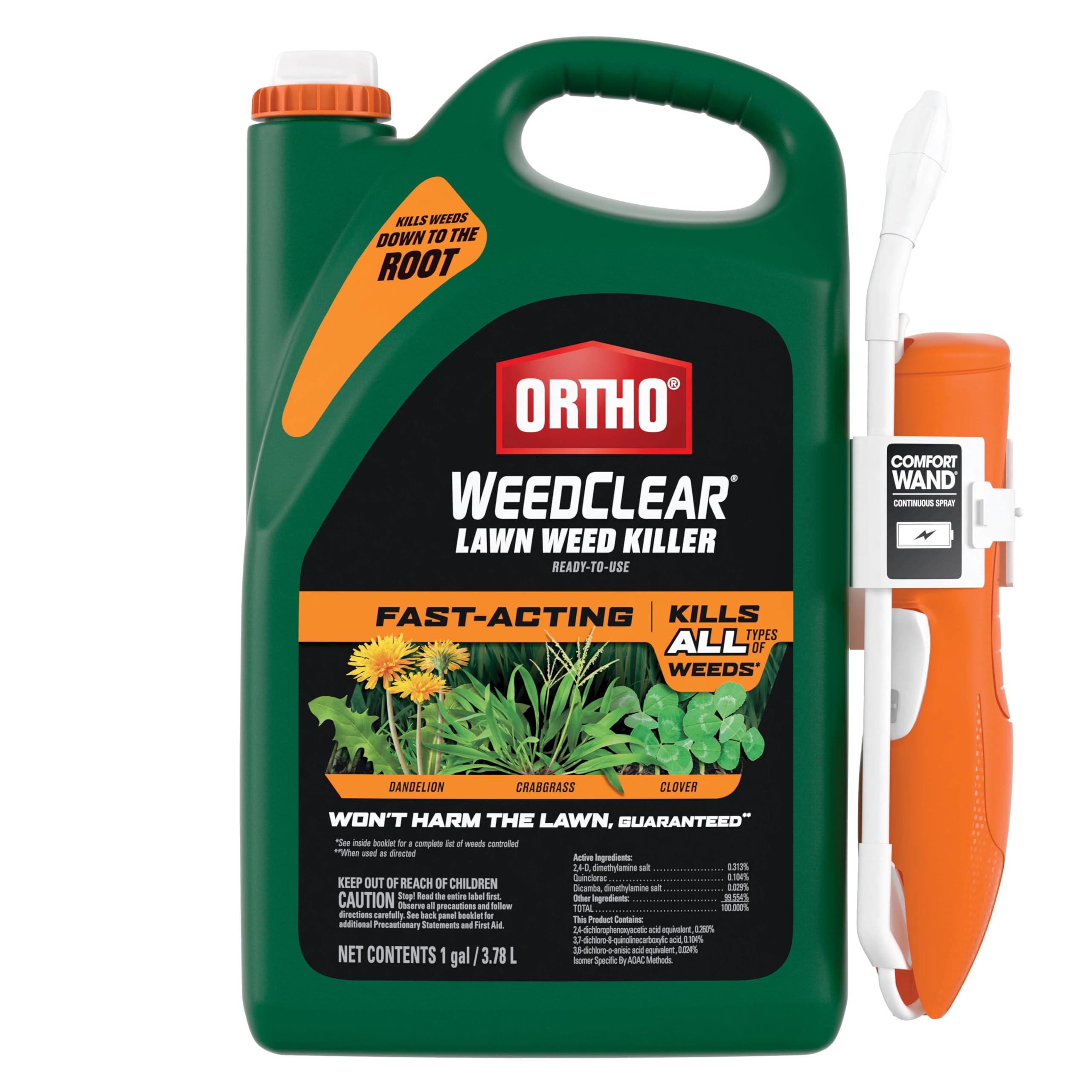
If you prefer to skip mixing and measuring, this battery-powered Comfort Wand delivers a precise spray pattern that targets individual weeds without overspray onto desired grass. The formula contains quinclorac and works on crabgrass, dandelion, clover, and creeping charlie. Users with small lawns (under 5,000 square feet) report visible wilting within 24 hours on dandelion, and full crabgrass death within 10 days.
The wand uses four AA batteries and has an ergonomic trigger, making it easy to spot-treat without bending over. One gallon covers up to 20,480 square feet when used as a spot spray, though heavy infestations may require two passes. The formula is gentle on Bermuda, fescue, bluegrass, and zoysia when used as directed.
Some users with very thick crabgrass mats note that a single application only wilts the top growth, and a second spray two weeks later is needed for complete root kill. For light to moderate invasions where convenience matters more than raw power, this wand system is the most user-friendly option.
Why it’s great
- Built-in wand eliminates mixing and bending
- Fast visible results on dandelions and clover
- Safe on multiple turf types
Good to know
- Does not kill Bermuda grass when accidentally sprayed
- Thick crabgrass may need two applications
4. Atticus Empero Q-Pak Nutsedge Killer

This two-pack of halosulfuron-methyl packets targets nutsedge—a weed often confused with crabgrass because of its similar grass-like appearance. Each packet mixes with one gallon of water and covers about 2,000 square feet. The active ingredient travels down to the root tubers, killing the plant completely rather than just burning the leaves. Users with a mix of nutsedge and crabgrass need to know this is primarily for sedges, not crabgrass.
Patience is required: most users see the first signs of yellowing at the two-week mark, and full death occurs around three to four weeks after application. The formula is gentle on bluegrass, fescue, Bermuda, and zoysia when used as directed. Because the packets are pre-measured with surfactant, you simply drop one into a sprayer tank—no measuring cups or extra additives.
For homeowners facing a yard with both crabgrass and nutsedge, this should be paired with a Quinclorac-based product for comprehensive grassy weed control. As a standalone spray, it excels at what it names, but crabgrass is not its primary target.
Why it’s great
- Kills nutsedge tubers at the root
- Pre-measured packets eliminate mixing guesswork
- Safe on warm- and cool-season turf grasses
Good to know
- Slow acting—takes up to 4 weeks for full results
- Not formulated primarily for crabgrass
5. Ortho Grass B Gon Garden Grass Killer RTU

This spray is designed specifically for non-edible garden beds and landscape areas where you want to kill invasive grass without harming your flowers and shrubs. It targets crabgrass, fescue, and Bermuda grass without damaging ornamental plants. Users with iris beds and shrub borders report that the grass dies within a week while the ornamentals stay green and healthy.
The formula is waterproof within one hour after application, so a sudden rain shower won’t wash away the treatment. Each 24-ounce bottle covers about 100 square feet when used as a direct spray. The two-pack provides enough solution for medium-sized gardens or multiple small flower beds.
Because this is not a lawn-friendly product—it kills all grass types—using it on a lawn would kill the turf. Keep it strictly for garden paths, flower beds, and around landscape rocks. For gardeners who want precision without damaging prized perennials, this is the most dependable option.
Why it’s great
- Kills grass without harming flowers and shrubs
- Rainproof in 60 minutes
- No mixing required
Good to know
- Kills all grass types, not just crabgrass
- Not for use on lawns—only garden beds
FAQ
How does Quinclorac compare to Mesotrione for crabgrass?
Can I use crabgrass killer spray on a newly seeded lawn?
Do I need to add surfactant to every crabgrass spray?
Final Thoughts: The Verdict
For most users, the crabgrass killer spray winner is the Primesource Quinclorac 1.5 Select because it targets mature crabgrass with professional-grade reliability and leaves cool-season turf undamaged. If you want a single product that handles pre-emergent prevention and kills broadleaf weeds as well, grab the Liquid Harvest Mesotrione. And for spot-treating a small lawn without mixing chemicals, nothing beats the convenience of the Ortho WeedClear with Comfort Wand.

Mo Maruf
I created WellFizz to bridge the gap between vague wellness advice and actionable solutions. My mission is simple: to decode the research and give you practical tools you can actually use.
Beyond the data, I am a passionate traveler. I believe that stepping away from the screen to explore new environments is essential for mental clarity and physical vitality.