Our readers keep the lights on and my smoothie glass nicely filled. As an Amazon Associate, I earn from qualifying purchases.
That patch of crabgrass spreading through your lawn isn’t just an eyesore — it’s a fast-moving invader that chokes out your healthy turf if you don’t hit it with the right chemistry at the right moment. Post-emergent herbicides are your only option once those ugly seed heads appear, but picking the wrong one can waste weeks and leave you with half-dead weeds that laugh at your efforts.
I’m Mohammad Maruf — the founder and writer behind WellFizz. I’ve spent hundreds of hours analyzing herbicide labels, active ingredient concentrations, and real-world user results to separate the formulas that deliver from those that just dilute your time.
This guide breaks down five proven formulas so you can confidently spot-treat or broadcast your way to a clean lawn. These are the absolute best crabgrass post emergent options available right now for homeowners who want results without guesswork.
How To Choose The Best Crabgrass Post Emergent
Post-emergent crabgrass killers are a different beast from pre-emergent barriers. You’re no longer preventing germination — you’re trying to kill an actively growing plant that’s already competing with your turf for water and nutrients. The wrong choice can harm your lawn or simply not work at all.
Active Ingredient Is Everything
Quinclorac is the gold standard for post-emergent crabgrass control — it’s a selective herbicide that targets grassy weeds without harming most cool-season lawns. Products containing quinclorac, like the Primesource Quinclorac 1.5 Select, consistently deliver the fastest results. Other formulas rely on different chemistry (like DSMA or MSMA alternatives) that may require multiple applications or work best on younger crabgrass plants.
Lawn Grass Compatibility
Not all post-emergents play nicely with every grass type. Bermuda grass, St. Augustine, and centipede grass can be damaged or discolored by certain active ingredients like the ones found in some broad-spectrum formulas. Always check the label for your specific turf species. Products like the Ortho WeedClear are explicitly safe for fescues, Kentucky bluegrass, and ryegrass, while others may cause temporary yellowing on bermudagrass.
Concentrate vs. Ready-to-Use
Ready-to-use (RTU) options like the Ortho WeedClear with Comfort Wand are perfect for small lawns or spot-treating a few patches — no mixing, no measuring. Concentrates like the Hi-Yield Grass Killer give you far more coverage per dollar and let you dial in the exact strength for your sprayer, but they require a separate sprayer and careful mixing. If you’re treating a large area with heavy crabgrass pressure, a concentrate almost always wins on value and efficacy.
Quick Comparison
On smaller screens, swipe sideways to see the full table.
| Model | Category | Best For | Key Spec | Amazon |
|---|---|---|---|---|
| Primesource Quinclorac 1.5 Select | Concentrate | Targeted crabgrass elimination | 18.92% Quinclorac | Amazon |
| Ortho WeedClear Comfort Wand | RTU Spray | Quick spot treatment | 1-gal coverage, 20480 sq ft | Amazon |
| Ortho Grass B Gon | RTU Spray | Grass in flower beds | 24-oz, selective for beds | Amazon |
| Fertilome Weed-Out with Crabgrass Killer | Concentrate | Multi-weed lawn control | 32-oz treats 5000 sq ft | Amazon |
| Hi-Yield Grass Killer | Concentrate | Garden & bed safety | 8-oz makes 8 gallons | Amazon |
In‑Depth Reviews
1. Primesource Quinclorac 1.5 Select Liquid Crabgrass Killer

This is the heavy hitter for anyone serious about eradicating crabgrass. With a quinclorac concentration of 18.92%, it’s a professional-grade selective herbicide that targets crabgrass, foxtail, and even dallisgrass without nuking your desirable cool-season turf. Users consistently report seeing results within days on young crabgrass, though mature plants or heavier infestations may need a second application spaced a couple weeks apart.
The 7.5-ounce bottle is a concentrate, so you’re mixing your own solution — that gives you precise control over the strength and allows you to treat large areas economically. Pair it with a methylated seed oil surfactant for best leaf adhesion and uptake. It’s labeled for residential turf, sod farms, and golf courses, so the performance ceiling is high.
A few users on Bermuda grass have noted some temporary yellowing after a second application, so follow the label rate carefully if you’re working with warm-season turf. Overall, this is the most directly effective option for a targeted crabgrass assault, assuming you’re comfortable with a sprayer and basic mixing.
Why it’s great
- Highest quinclorac concentration in this list for fast, reliable kill
- Makes up to 8+ gallons of spray solution, excellent coverage per dollar
- Works on tough grassy weeds like foxtail and dallisgrass as well
Good to know
- Second application may temporarily discolor Bermuda grass
- Requires a separate sprayer and careful mixing — not a grab-and-go product
2. Ortho WeedClear Lawn Weed Killer with Comfort Wand
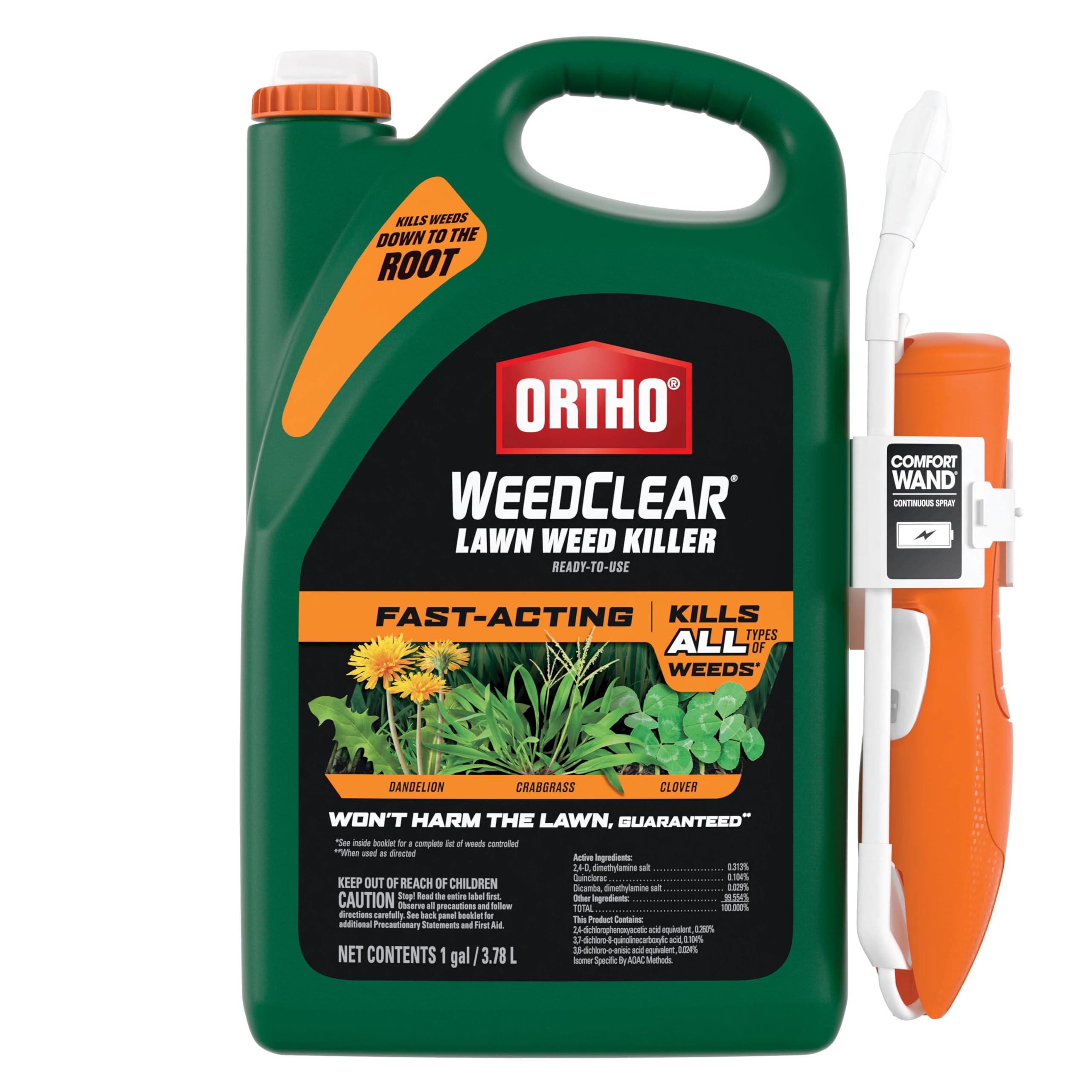
For homeowners who want dead-simple spot treatment without mixing chemicals, the Ortho WeedClear with its battery-powered Comfort Wand is a standout. The 1-gallon container includes the wand, so you just snap it on, pull the trigger, and spray directly onto the crabgrass leaves. It kills crabgrass, dandelions, clover, and creeping charlie down to the root, and most users see visible wilting within 24–48 hours.
The formula is selective to lawn grasses like fescues, Kentucky bluegrass, ryegrass, and zoysiagrass, so you can treat patches in the middle of your lawn without creating bare, dead spots. The coverage is listed at 20,480 square feet, which is generous for a RTU product. User reviews are overwhelmingly positive for ease of use and speed of results on dandelions and crabgrass alike.
One catch — it works best on young, actively growing weeds. Mature crabgrass with tough seed heads may require a second pass. A small number of users have reported inconsistent results, likely tied to spraying in hot, dry conditions when the plant isn’t actively taking up moisture. Apply in the morning when dew is present for best absorption.
Why it’s great
- Zero setup — just attach wand and spray, perfect for quick touch-ups
- Safe on most common cool-season lawn grasses
- Battery-powered wand delivers accurate, no-drip application
Good to know
- Less effective on mature, established crabgrass plants
- Batteries for the wand not included in the package
3. Ortho Grass B Gon Garden Grass Killer
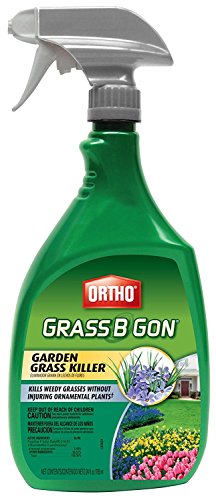
If your crabgrass problem is happening in flower beds, around shrubs, or in vegetable gardens rather than in the lawn itself, this is the product to reach for. Ortho Grass B Gon is formulated to kill grassy weeds — including crabgrass, tall fescue, and Bermuda grass — without harming your ornamentals, ground covers, or trees. It’s a ready-to-use spray, so no mixing is required.
This two-pack gives you 48 total ounces of product, which goes a long way for spot-treating garden beds. Users report that it kills the targeted grass within a few days, though some persistent varieties may need a second application. The formula is rainfast in just one hour, which is a nice advantage if you’re working around unpredictable weather.
The strong odor is a common note in reviews — this is not a pleasant-smelling product, so wear gloves and avoid breathing the spray mist. Also, like many selective herbicides, it requires direct contact with the weed leaves for best results. Avoid spraying on windy days to prevent drift onto desirable plants.
Why it’s great
- Safe for use around flowers, shrubs, and trees
- Ready-to-use with no mixing for immediate application
- Rainfast in 1 hour for flexible timing
Good to know
- Strong chemical odor during and after application
- Some users report needing multiple applications for tough grasses
4. Fertilome Weed-Out with Crabgrass Killer
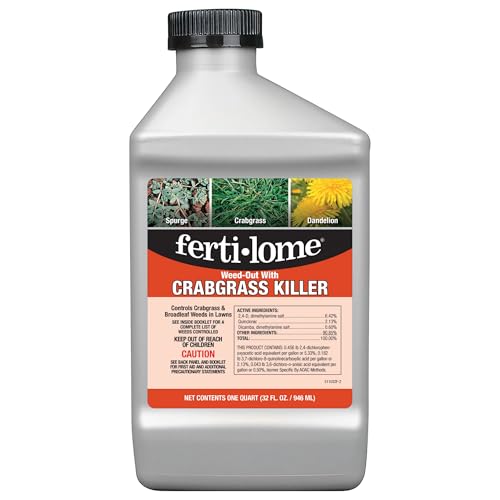
Fertilome’s Weed-Out is a liquid concentrate that punches above its price point by claiming control over more than 200 grassy and broadleaf weeds — including crabgrass and foxtail. The 32-ounce bottle treats up to 5,000 square feet, which puts it on the more affordable end of the concentrate spectrum. It’s labeled for use on established lawns including Bermuda, buffalo grass, and Kentucky bluegrass.
User feedback is largely positive, with many noting that it kills crabgrass effectively when applied at the correct rate, especially in spring or early summer when weeds are still small and actively growing. It also works on ground ivy and spurge, making it a decent multi-purpose option for lawns with a mixed weed profile. The price is hard to beat for the coverage you get.
Be aware that applying it to Bermuda grass may cause temporary yellowing or discoloration — the label warns of this, and most users confirm that the grass fully recovers. A minority of reviews report it didn’t work on their crabgrass, which may be due to applying on overly mature plants or in poor weather conditions.
Why it’s great
- Excellent coverage per ounce at a low price point
- Controls a wide range of both grassy and broadleaf weeds
- Works well on young, actively growing crabgrass in spring
Good to know
- May temporarily yellow Bermuda grass after application
- Less effective on very mature or seed-head stage crabgrass
5. Hi-Yield Grass Killer Postemergence Grass Herbicide
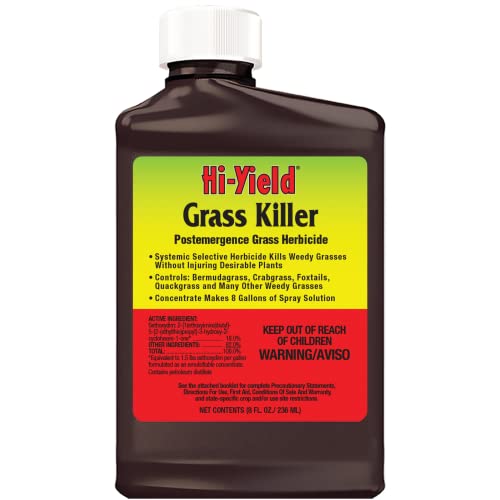
The Hi-Yield Grass Killer is a selective post-emergent formulated specifically for grassy weeds like crabgrass, tall fescue, and Bermuda grass, with the unique claim that it can be used safely around vegetables, gardens, trees, and ornamentals. Each 8-ounce bottle makes up to 8 gallons of spray solution, which is surprisingly good coverage for such a small package.
Users report visible results within two days after application on Bermuda grass and tall fescue. It’s been used effectively in vegetable gardens and flower beds without damaging the desirable plants — a rare and valuable trait for a grass killer. The small bottle is easy to store and mixes quickly with water in a standard pump sprayer.
The biggest drawback is the quantity — at 8 ounces total, heavy users will need multiple bottles for large areas or repeat applications. Some customers have noted the bottle arrives only partially filled due to the concentrate volume, which is normal but can be misleading at first glance. A few reviews report no effect on certain grass types, so follow the mixing ratio closely and apply on calm, dry days.
Why it’s great
- Safe to spray in gardens and around vegetables and flowers
- Fast visible kill in as little as two days on many grasses
- Concentrate yields 8 gallons of spray for flexible coverage
Good to know
- Very small bottle size — may not be enough for large lawns
- Some users report inconsistent results on certain grass varieties
FAQ
Can I use a post-emergent crabgrass killer in the middle of summer?
How long does it take for quinclorac to kill crabgrass?
Will post-emergent crabgrass killer hurt my Bermuda grass lawn?
Should I mow before or after applying a post-emergent herbicide?
Final Thoughts: The Verdict
For most users, the best crabgrass post emergent winner is the Primesource Quinclorac 1.5 Select because it delivers the highest concentration of the most effective active ingredient for targeted, reliable kill on crabgrass without wasting time. If you want zero-fuss spot treatment that’s ready to spray right out of the box, grab the Ortho WeedClear with Comfort Wand. And for safe application around garden beds and ornamentals, nothing beats the Hi-Yield Grass Killer.

Mo Maruf
I created WellFizz to bridge the gap between vague wellness advice and actionable solutions. My mission is simple: to decode the research and give you practical tools you can actually use.
Beyond the data, I am a passionate traveler. I believe that stepping away from the screen to explore new environments is essential for mental clarity and physical vitality.