Our readers keep the lights on and my smoothie glass nicely filled. As an Amazon Associate, I earn from qualifying purchases.
A CPU heatsink is the silent backbone of any stable PC build, quietly managing the thermal output from your processor so it can run at peak speeds without throttling or instability. Choosing the right one means understanding heat pipe counts, fin density, fan size, and how your case breathes — get it wrong and you leave performance on the table or add unnecessary noise to your desk.
I’m Mohammad Maruf — the founder and writer behind WellFizz. I’ve spent hundreds of hours analyzing thermal performance charts, socket compatibility lists, and fan curve data to separate effective CPU coolers from overhyped shelf-fillers.
This guide breaks down the top air coolers by real-world thermal capacity, noise output, and fitment, helping you find the right cpu heatsink for your build without overspending or guessing.
How To Choose The Best CPU Heatsink
Selecting a CPU heatsink involves matching its thermal capacity to your processor’s power draw, your case’s clearance, and your tolerance for noise. Air coolers vary widely in heat pipe configuration, fin surface area, and fan quality — understanding these factors will help you avoid a mismatched purchase.
Heat Pipe Count and Diameter
Heat pipes transfer thermal energy from the CPU base to the fin stack via vapor phase change. More pipes (six or seven) and larger diameters (6mm) generally handle higher wattage, but layout matters — direct-contact pipes versus a nickel-plated copper base affect heat transfer efficiency differently. For CPUs over 150W TDP, look for at least five or six heat pipes.
Tower Design and RAM Clearance
Single-tower coolers are compact and often clear tall RAM sticks, while dual-tower designs double fin surface area for better heat dissipation but can overhang memory slots. Asymmetrical coolers offset the fin stack to avoid DIMM slots entirely — crucial for builds with four sticks of RAM or RGB-lit modules.
Fan Size, Speed, and Noise
120mm and 140mm fans push more air at lower RPM than smaller fans, reducing noise while maintaining cooling. PWM control lets the fan ramp speed based on CPU temperature, keeping the system silent at idle. A cooler marketed with low decibel ratings (under 25 dB) often uses fluid-dynamic or S-FDB bearings that last longer than sleeve bearings.
Quick Comparison
On smaller screens, swipe sideways to see the full table.
| Model | Category | Best For | Key Spec | Amazon |
|---|---|---|---|---|
| Thermalright Phantom Spirit 120SE | Dual Tower | High-performance builds on a budget | 7 x 6mm Heat Pipes | Amazon |
| Noctua NH-D12L | Low-Profile Dual Tower | Compact cases and 4U rackmounts | 145mm Height | Amazon |
| ID-COOLING SE-225-XT | Mid-Range Single Tower | Quiet cooling for 65W-105W CPUs | 5 Direct-Contact Heat Pipes | Amazon |
| Noctua NH-U9DX i4 | Compact Server Cooler | Intel Xeon LGA20xx platforms | 125mm Height / 17.6 dB | Amazon |
| Noctua NH-U14S TR4-SP3 | Premium HEDT Cooler | AMD Threadripper and Epyc CPUs | 140mm Fan / sTRX4 Compatible | Amazon |
In‑Depth Reviews
1. Thermalright Phantom Spirit 120SE

The Phantom Spirit 120SE packs seven 6mm heat pipes into a dual-tower design that rivals many 240mm AIO liquid coolers in thermal performance. Its AGHP 4.0 technology minimizes gravity-related performance loss whether the cooler is mounted vertically or horizontally — a real advantage for compact or inverted cases. The twin TL-C12B V2 fans spin up to 1500 RPM, pushing 66.17 CFM while staying at or below 25.6 dB under normal loads.
At just 154mm tall, this unit fits most mid-tower cases and avoids interfering with RAM slots entirely, a detail that simplifies installation. Customer reports show it handles CPUs like the Ryzen 7800X3D at gaming temps in the 50-60°C range and undervolted i7-12700K builds peaking at 78°C in Cinebench. That’s impressive headroom for a cooler at this tier.
The stock fans perform well but some users note audible whine at sustained high RPM after several months; replacing them with premium 120mm fans is straightforward. For anyone building a high-performance rig without jumping to liquid cooling, this heatsink delivers near-flagship results at a fraction of the cost.
Why it’s great
- Seven heat pipes provide massive heat dissipation for high-TDP CPUs
- Dual-tower design with full RAM clearance simplifies installation
- Excellent value — competes with coolers costing twice as much
Good to know
- Stock fans can develop noise over extended use at max speed
- Obstructs access to top M.2 slot on some AM5 motherboards
2. Noctua NH-D12L

The NH-D12L is a low-height dual-tower cooler that stands just 145mm tall, making it one of the few high-performance air coolers that fits inside 4U rackmount chassis and compact mid-towers with tight side-panel clearance. It uses Noctua’s award-winning NF-A12x25r 120mm fan with PWM and Low-Noise Adaptors, delivering 102.1 m³/h airflow at a barely audible 22.6 dB. The asymmetrical fin stack is offset to guarantee 100% RAM clearance on AM5, LGA1700, and LGA1200 boards.
Testing shows this cooler eliminates thermal throttling on an i7-11700KF inside a prebuilt case with restricted airflow, dropping max load temps from 90°C to 84°C. For a Ryzen 7700 (65W), idle temps hover in the 30s and load stays quiet and cool. The SecuFirm2 mounting system uses fewer loose parts than typical backplate designs, reducing install friction for builders in tight spaces.
At a premium price point, the NH-D12L targets users who need strong cooling in a low-clearance envelope — 4U server builders, ITX enthusiasts, and anyone fitting a cooler behind a glass side panel. It’s overkill for low-TDP CPUs but indispensable for hot-running chips in confined chassis.
Why it’s great
- Exceptionally quiet fan performance at all load levels
- Fits cases with as little as 145mm cooler clearance
- Full RAM compatibility on modern sockets
Good to know
- Premium-tier pricing reflects Noctua’s build and warranty quality
- Single-fan configuration may require second fan for extreme CPU loads
3. ID-COOLING SE-225-XT Black

The SE-225-XT uses five direct-contact heat pipes paired with two 120mm PWM fans in a push-pull configuration to achieve a maximum airflow of 76.16 CFM. Its single-tower design keeps the heatsink at 5.9 inches tall, fitting most mid-tower and some smaller cases, while the offset fan mounting ensures it doesn’t interfere with RAM slots even on mini-ITX boards. Noise ranges from 15.2 dB at idle to 35.2 dB under full load — acceptable for mid-range builds.
On a Ryzen 5 5500 (65W TDP), this cooler keeps load temps below 56°C in Cinebench — a massive drop from the stock AMD cooler’s 80°C. With a Ryzen 7 5700X, idle sits around 28°C and gaming peaks at 52°C. Users also report success cooling an i5-14600KS in a case with 5.9-inch max height, maintaining stable temps under sustained stress tests.
The included thermal paste is adequate, but enthusiasts often swap it for a premium compound like Arctic MX6 for a few extra degrees of headroom. For budget-conscious builders targeting 65W to 105W CPUs, this heatsink offers strong cooling and low noise without pushing into dual-tower pricing territory.
Why it’s great
- Push-pull dual-fan setup improves airflow through the fin stack
- Compact height and RAM-friendly design fit tight builds
- Excellent thermal performance for the price tier
Good to know
- Stock fans can be audible at full 1800 RPM speed
- Bracket only supports AM4/AM5 — not backward compatible with AM3+
4. Noctua NH-U9DX i4
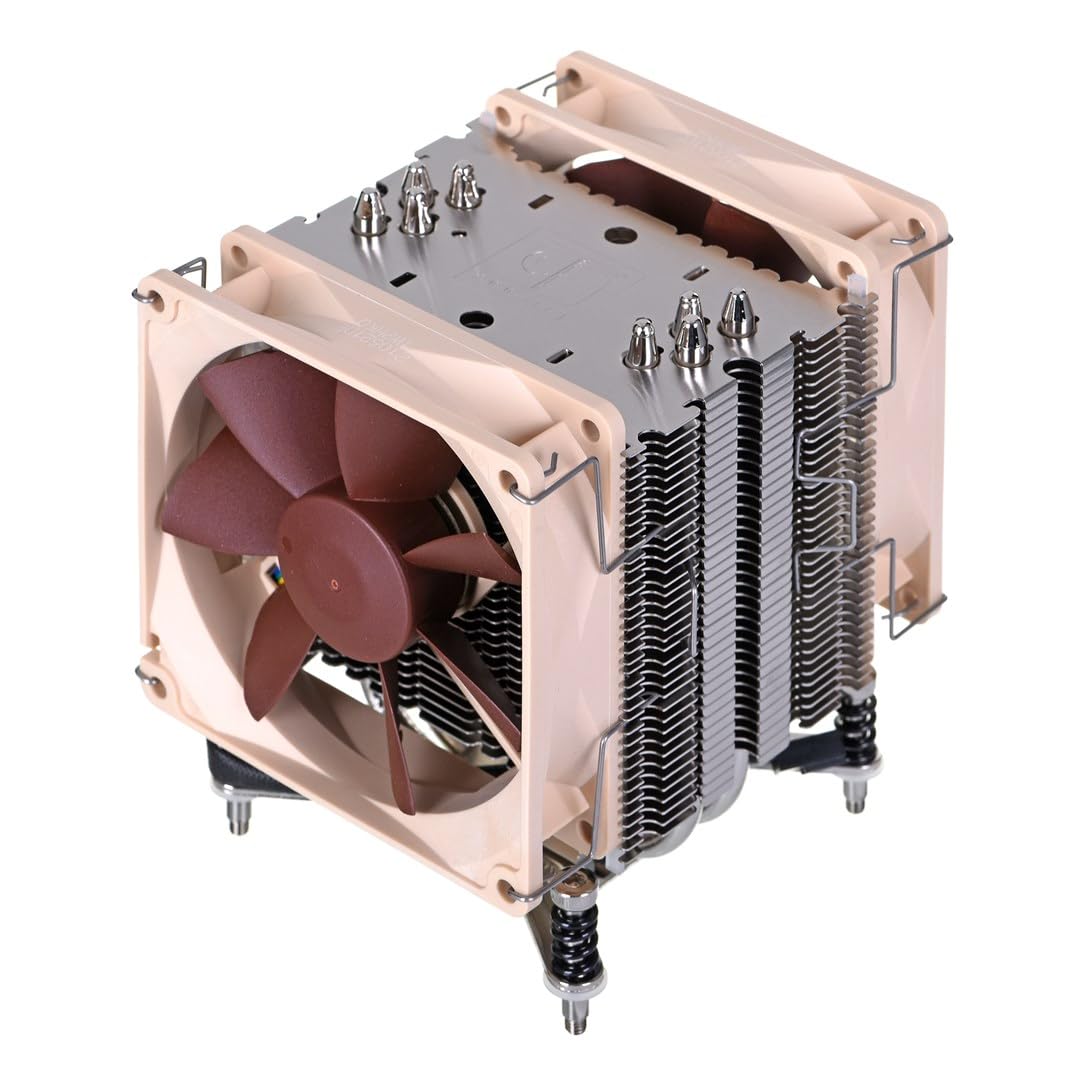
The NH-U9DX i4 is purpose-built for Intel Xeon LGA20xx platforms, supporting both Square ILM and Narrow ILM socket variants commonly found in workstations and servers. With a height of only 125mm, it fits comfortably inside 4U chassis while utilizing two NF-B9 92mm fans in a push-pull arrangement. The fans peak at just 17.6 dB — whisper-quiet even under sustained rendering loads — and include Low-Noise Adaptors for even further noise reduction.
Installed on a Dell Precision T5820 with a W-2135 Xeon, this cooler dropped full-load temps from 90°C to under 70°C while idling around 35°C. In dual-socket Supermicro boards with E5-2698v3 Xeons, two NH-U9DX i4 units keep both CPUs ice cold under heavy rendering workloads. The bundled NT-H1 thermal compound and SecuFirm2 mounting hardware make installation straightforward, though access to the backplate may require motherboard removal.
This is a niche-focused heatsink that solves a specific problem: keeping hot Xeon processors cool in server environments where standard consumer coolers don’t fit or lack the correct mounting. For home lab operators and workstation builders on LGA20xx, it’s the gold standard.
Why it’s great
- Fully compatible with Square and Narrow ILM Xeon sockets
- Remarkably quiet fan operation at 17.6 dB
- Compact 125mm height fits 4U server cases
Good to know
- Limited to Intel LGA20xx and older Xeon sockets only
- 92mm fans move less air than larger 120mm alternatives
5. Noctua NH-U14S TR4-SP3

The NH-U14S TR4-SP3 is a custom-tailored version of Noctua’s award-winning single-tower cooler, engineered specifically for AMD’s sTRX4, TR4, and SP3 sockets — the home of Ryzen Threadripper and Epyc processors. Its 140mm NF-A15 fan delivers 140.2 m³/h airflow at a modest 24.6 dB, while the large nickel-plated copper base fully covers the massive Threadripper IHS for optimal heat transfer. At 6.5 inches tall, it requires ample case clearance but rewards with class-leading thermal headroom.
On a Threadripper PRO 3955WX, this cooler keeps the CPU consistently cool under heavy game server and virtualization loads. Replacing a failed AIO on an AMD 2950X yielded idle temps around 40°C with a noticeable noise reduction. Even on the older 1900X, users report idle temps of 29°C and load temps of 43°C — outperforming the liquid cooler it replaced. The included second fan clip allows push-pull upgrade for extra headroom.
The tradeoff is that the fan overhangs the nearest DIMM slot, requiring low-profile RAM or front-to-back case airflow to avoid clearance issues. For anyone running a high-core-count Threadripper or Epyc workstation who prefers air cooling over AIO complexity, this heatsink is the definitive solution.
Why it’s great
- Custom base design matches the large IHS of Threadripper CPUs
- Quiet 140mm fan with high static pressure for dense fin stacks
- Includes second fan mounting clips for push-pull configuration
Good to know
- Fan partially blocks nearest RAM slot; may require low-profile modules
- Requires careful case height verification before purchase
FAQ
Will a large dual-tower cooler fit in my mid-tower case?
Should I replace my AIO liquid cooler with a high-end air cooler?
What does RAM clearance mean for a CPU heatsink?
Final Thoughts: The Verdict
For most users, the cpu heatsink winner is the Thermalright Phantom Spirit 120SE because it delivers dual-tower, seven-heat-pipe performance that rivals premium coolers at a mid-range price point. If you need low-profile clearance for a compact case or 4U server, grab the Noctua NH-D12L. And for AMD Threadripper or server-grade Xeon builds, nothing beats the Noctua NH-U14S TR4-SP3.

Mo Maruf
I created WellFizz to bridge the gap between vague wellness advice and actionable solutions. My mission is simple: to decode the research and give you practical tools you can actually use.
Beyond the data, I am a passionate traveler. I believe that stepping away from the screen to explore new environments is essential for mental clarity and physical vitality.