Our readers keep the lights on and my smoothie glass nicely filled. As an Amazon Associate, I earn from qualifying purchases.
Nothing ruins a stained glass session faster than copper foil that lifts during soldering. You burnish it down, apply flux, then watch the edge curl as the iron glides by. The entire category hinges on one thing: adhesive reliability under heat. Yet most hobbyists grab the cheapest roll without checking whether the glue can take 700°F without failing.
I’m Mohammad Maruf — the founder and writer behind WellFizz. My approach to this guide relies on weeks of comparing customer test results, measuring adhesive longevity reports, and cross-analyzing foil thickness consistency across multiple production batches.
This guide breaks down the adhesive chemistry, width selection, and heat resistance of each roll so you can confidently pick the right copper foil for stained glass and stop dealing with peeling edges mid-project.
How To Choose The Best Copper Foil For Stained Glass
Stained glass foil is deceptively simple — copper strip with adhesive on one side. But the wrong choice means wasted hours peeling lifted foil off your cut pieces. Three factors determine success: adhesive heat rating, copper softness, and width.
Adhesive Heat Tolerance
Soldering iron tips reach 600–800°F. Budget foils use general-purpose adhesive that releases its bond the moment heat touches the copper. Quality stained glass foil uses a thermoplastic adhesive that softens slightly under heat then re-bonds as it cools. Look for reviews mentioning “no lifting” after soldering — that’s the real test.
Dead Soft Copper vs. Stiff Copper
Dead soft copper conforms to glass edges without springing back. Stiff copper fights your burnishing tool, leaving air pockets that trap flux and cause cold solder joints. Edco’s “dead soft” formulation is the industry benchmark — it wraps compound curves without creasing.
Width Selection (7/32 vs. 3/16)
7/32 inch is the stained glass standard for single-thickness glass. It leaves enough copper to form a consistent solder bead without bridging adjacent pieces. 3/16 inch works for tiny pieces where 7/32 would overflow onto neighboring glass. Beginners should start with 7/32 for nearly every project.
Black Backing vs. Silver Backing
Black-lined foil hides the adhesive layer between solder lines, creating a cleaner finished look. Silver backing can reflect through transparent glass edges. Most professionals choose black backing for copper foil projects that will be displayed with light passing through.
Quick Comparison
On smaller screens, swipe sideways to see the full table.
| Model | Category | Best For | Key Spec | Amazon |
|---|---|---|---|---|
| Edco 7/32-inch Black Back | Premium | Professional stained glass adhesion | Dead soft copper 1.97mil | Amazon |
| Edco 3/16 Black Back | Premium | Tiny pieces & compound curves | 0.19 inch thickness | Amazon |
| Studio Pro 7/32 Black Lined | Mid-Range | Budget-conscious hobbyists | 36 yards per roll | Amazon |
| Crafted Copper Pure Tape 4-Pack | Mid-Range | Multi-craft use (guitar, garden, glass) | Double-sided adhesive | Amazon |
| BOMEI PACK 3-Roll Set | Budget | Variety width sampler pack | 66ft per roll 1.97mil | Amazon |
In‑Depth Reviews
1. Edco 7/32″ x 36 Yards Black Back Copper Foil

Edco’s 7/32-inch foil is the gold standard for stained glass artists who refuse to compromise on adhesive strength. Multiple long-term users report zero lifting after soldering, even on intricate geometric panels with dozens of solder joints. The dead soft copper wraps around tight curves without springing open, and the black backing disappears cleanly between solder lines. At 36 yards per roll, it lasts through several medium-sized panels without running short mid-project.
The thermoplastic adhesive softens just enough under the iron to form a seal, then re-bonds as the piece cools. Users who switched from generic foils mention that Edco does not leave sticky copper debris along cut edges. It also runs smoothly through table foilers, saving time on large production runs. The 7/32 width is the most versatile size for standard glass thickness around 3mm.
Consistency between rolls is the defining advantage — every batch delivers the same tack and the same thickness. No wasted pieces due to manufacturing variance. If you do one thing differently for your next project, switch to Edco 7/32 and feel the difference in how solder flows over a properly burnished foil edge.
Why it’s great
- Adhesive never lifts under soldering heat
- Dead soft copper conforms without creasing
- Runs consistently through table foilers
Good to know
- Thinner than some budget alternatives — tears if pulled too fast
- Becoming harder to find in local glass shops
2. Edco 3/16″ Black Back Copper Foil

When your pattern includes narrow glass cuts under half an inch wide, 7/32 foil overflows and bridges the gap. Edco’s 3/16 inch version solves that problem with the same industrial-grade adhesive and dead soft copper found in their wider rolls. The reduced width prevents small pieces from being completely covered by solder, maintaining the crisp glass-to-metal contrast that makes detailed stained glass work pop.
Users praise the burnish-and-forget reliability — the foil stays flat after burnishing and does not lift even during heavy soldering on intricate floral or geometric panels. The black backing looks cleaner than white when viewed through transparent glass edges, especially on opalescent pieces. Reviewers report that this foil takes patina well, darkening evenly without the spotty oxidation that plagues cheaper copper tapes.
One caution: the adhesive is so strong that repositioning requires careful peeling. Burnish thoroughly on the first pass. Some users received mislabeled 7/32 rolls when ordering 3/16, though the product itself performed perfectly. This width is essential for advanced foilists who work with complex silhouettes and tight curves.
Why it’s great
- Narrow width prevents solder overflow on tiny pieces
- Industry’s strongest adhesive with longest shelf life
- Takes patina evenly without spotty oxidation
Good to know
- Adhesive borderline too strong for quick repositioning
- Occasional mislabeling from third-party sellers
3. Studio Pro 7/32″ Black Lined Copper Foil
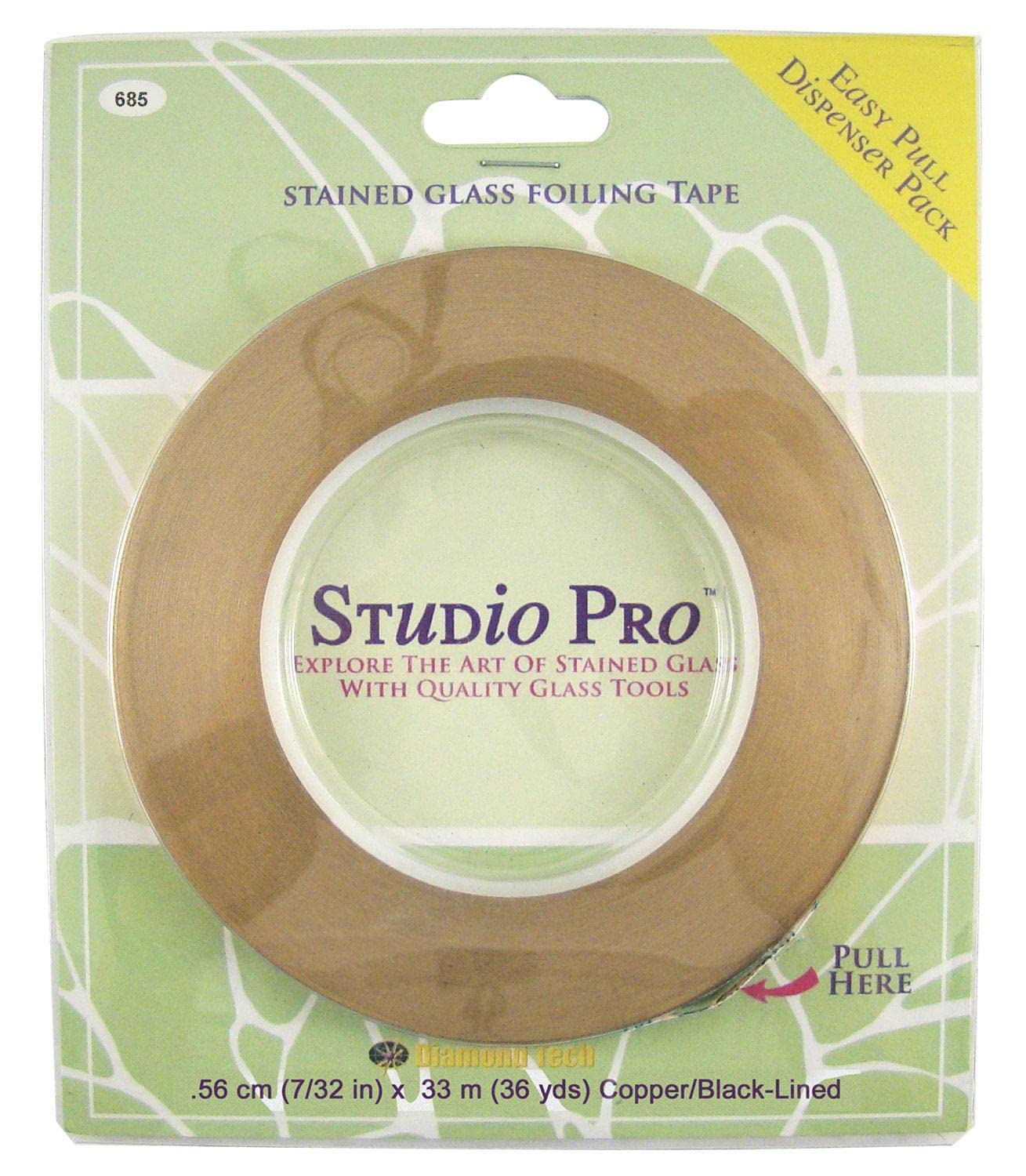
Studio Pro hits the sweet spot between price and performance for hobbyists who want reliable adhesion without paying for premium branding. The black lined foil offers the same 36-yard length as Edco at a more accessible entry point. Users report excellent tack that sticks to glass immediately and resists lifting during soldering — the core requirement that separates usable foil from frustrating foil.
The unique plastic dispenser with easy-pull design reduces tangling, though some users note that the spool unravels aggressively if you pull too fast. A separate hand dispenser solves that issue entirely. Reviews consistently mention that this foil is thinner than other options, which actually helps when bending around tight curves, but it also means less copper mass for the solder to grip onto. For standard panels with 3mm glass, the thinner gauge works perfectly fine.
Temperature resistance stands out for a mid-range product — the adhesive holds through soldering without melting through the backing. A few users on wet weather projects mention that outdoor humidity can weaken the bond over time, but for indoor stained glass pieces this foil performs reliably. It is noticeably cheaper than buying Edco per-yard, making it an excellent choice for large panels or practice pieces.
Why it’s great
- Strong adhesive at a lower per-yard cost
- Thinner copper bends easily around curves
- Plastic dispenser reduces application hassle
Good to know
- Spool unravels if pulled without a dispenser
- Thinner foil offers less solder grip mass
4. Crafted Copper Pure Tape Double Sided 4-Pack
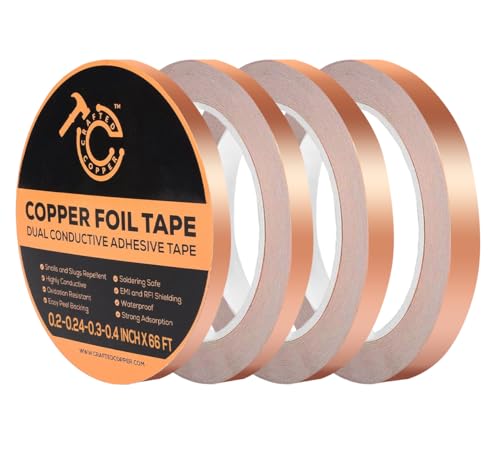
This Crafted Copper set covers four widths (0.2, 0.24, 0.3, and 0.4 inches) in one pack, making it a versatile option for stained glass artists who also do guitar shielding, EMI lining, or slug deterrent projects. The double-sided conductive adhesive means current flows through both faces — useful if you use foil for electrical continuity across joints rather than just soldering aesthetics. For pure stained glass use, the variety lets you test which width works best for your common glass thickness before committing to a single-size bulk roll.
Users report that the tape conducts through the adhesive with measured resistance around 0.4 ohms back-to-front, which is excellent for shielding applications. On stained glass specifically, the adhesive sticks well to glass edges and resists tearing if handled gently. Several reviewers note that the foil is on the thin side and tears easily when pulled at an angle, so careful handling is required during burnishing.
The range of widths makes this set ideal for mixed-media artists who move between stained glass panels, guitar cavities, and garden barriers without buying separate products. For dedicated stained glass use, the adhesive holds well under solder heat but the thin copper means less forgiving burnishing. If you primarily work in stained glass, a dedicated single-width foil from Edco or Studio Pro will serve you better — but for multi-craft households this pack delivers serious versatility.
Why it’s great
- Four widths cover ground for glass, guitar, and garden use
- Double-sided conductivity measured at 0.4 ohms
- Easy-peel backing reduces application frustration
Good to know
- Thin copper tears easily if pulled or burnished too hard
- Not the first choice for dedicated stained glass only projects
5. BOMEI PACK Copper Foil Tape 3-Roll Set

The BOMEI PACK set offers the widest variety of sizes per dollar — 1 inch, 1/2 inch, and 1/4 inch rolls, each 66 feet long, at 1.97mil thickness. The 1/4 inch width is close to the 7/32 stained glass standard, making this a usable budget option for beginners exploring copper foil without committing to premium adhesive. The double-sided conductive design works for shielding, grounding, and basic stained glass projects where perfect adhesion is not mission-critical.
Customer reviews highlight versatility across gardening, guitar shielding, and electrical repairs. Users report excellent results slug-proofing raised garden beds and lining guitar cavities — the tape generates a mild electrical barrier that pests avoid. For stained glass specifically, the adhesive holds under moderate soldering but thinner copper may lift on tight curves if not burnished aggressively. The 1.97mil thickness matches standard stained glass foil gauge, so solder flows properly over the surface.
Keep in mind that this tape is designed primarily for electrical and craft use rather than professional stained glass. The adhesive chemistry may not match the heat resistance of Edco or Studio Pro during prolonged soldering. However, for students, hobbyists testing copper foil for the first time, or multi-project households, the BOMEI PACK gives you three sizes to experiment with at a low commitment. Use the 1/4 inch for standard pieces and the wider rolls for larger glass sections or shielding work.
Why it’s great
- Three width sizes in one affordable set
- Double-sided conductive for electrical projects
- 66 feet per roll — generous length for experimentation
Good to know
- Adhesive not formulated specifically for stained glass soldering heat
- Thinner copper more prone to lifting on tight curves
FAQ
Which copper foil width should I use for standard 3mm stained glass?
Does black backed copper foil perform better than silver backed?
Why does my copper foil lift when I apply the soldering iron?
Can I use electrical copper tape for stained glass projects?
How do I store copper foil to maintain adhesive strength?
Final Thoughts: The Verdict
For most users, the copper foil for stained glass winner is the Edco 7/32-inch Black Back because its dead soft copper and heat-resistant adhesive eliminate lifting even on complex panels with dozens of solder joints. If you need narrow width for intricate small-piece work, grab the Edco 3/16-inch Black Back. And for budget-conscious hobbyists or first-time foilers, nothing beats the value of Studio Pro 7/32 — reliable adhesion at a per-yard cost that keeps your project affordable.

Mo Maruf
I created WellFizz to bridge the gap between vague wellness advice and actionable solutions. My mission is simple: to decode the research and give you practical tools you can actually use.
Beyond the data, I am a passionate traveler. I believe that stepping away from the screen to explore new environments is essential for mental clarity and physical vitality.