Our readers keep the lights on and my smoothie glass nicely filled. As an Amazon Associate, I earn from qualifying purchases.
A corded 7 1/4 circular saw is the backbone of any serious framing, decking, or sheet goods project. Unlike battery-powered siblings that fade mid-afternoon, a corded tool delivers unwavering 15-amp torque for ripping through LVL, pressure-treated 2x4s, and 3/4-inch plywood without a single drop in RPM. The trade-off is a 10-foot cord that demands an outlet or a generator, but for shop use or jobsite production, there is no substitute for continuous power.
I’m Mohammad Maruf — the founder and writer behind WellFizz. This guide is the result of hundreds of hours spent cross-referencing motor specifications, blade capacities, bevel ranges, and real-world operator feedback across the most popular corded models on the market.
Whether you are replacing a burned-out sidewinder or building your first framing kit, knowing the difference between magnesium versus aluminum base plates and electric brake versus coast-down safety is critical. This guide breaks down the honest strengths and quirks of the best corded 7 1/4 circular saw options available today.
How To Choose The Best Corded 7 1/4 Circular Saw
Choosing the right saw starts with understanding that not all 15-amp motors are built the same. Entry-level saws often use stamped steel base plates that can warp under heat and lose their square edge over time, while premium models use magnesium or cast aluminum chassis that hold their alignment. Your choice should match the material you cut most—framing lumber demands a heavy-duty motor and a large bevel range, while finish plywood work benefits from a lightweight body and a dust blower that keeps the cut line visible.
Blade Position: Left Blade vs. Right Blade
Left-blade saws (blade on the left side of the motor) give right-handed users an unobstructed view of the cut line without leaning over the tool. This is preferred for precision cuts like mitered rips on plywood. Right-blade saws, common in traditional sidewinders, throw dust and chips away from the user but require the operator to crane their neck to see the line. If you intend to use a track guide, left-blade designs also align better with the guide edge for most right-handed carpenters.
Electric Brake vs. Coast-Down Safety
An electric brake stops the blade within two to three seconds after releasing the trigger, reducing the risk of injury during blade changes and preventing the saw from walking across your workpiece. Saw without a brake spins down for up to 10 seconds, which can be disruptive on a jobsite and dangerous if you set the saw down on a sloped surface. For any production environment, or if you work with curious helpers nearby, a saw with an electric brake is the safer investment. The brake mechanism adds weight but dramatically improves control and safety.
Quick Comparison
On smaller screens, swipe sideways to see the full table.
| Model | Category | Best For | Key Spec | Amazon |
|---|---|---|---|---|
| Makita 5007MGA | Premium | Heavy framing & bevel cuts | 15A motor, 5800 RPM, 56° bevel | Check Amazon |
| BOSCH CS5 | Premium | Left-blade precision cuts | 15A motor, 9.3 lbs, left blade | Check Amazon |
| Evolution S185CCSL | Specialty | Steel & metal cutting | 15A, 40T TCT blade, dry-cut | Check Amazon |
| Makita HS7600 | Mid-Range | Lightweight general use | 10.5A motor, 8.6 lbs, 5200 RPM | Check Amazon |
| SKILSAW SPT67WL-01 | Mid-Range | Professional value & durability | 15A motor, 8.6 lbs, no brake | Check Amazon |
| Metabo HPT C7SB3 | Budget | Budget-friendly framing | 15A motor, 9.5 lbs, cast base | Check Amazon |
| DEWALT FLEXVOLT DCS575B | Cordless | Cordless corded replacement | 60V, 5800 RPM, electric brake | Check Amazon |
In-Depth Reviews
1. Makita 5007MGA 7-1/4 in. Magnesium Circular Saw
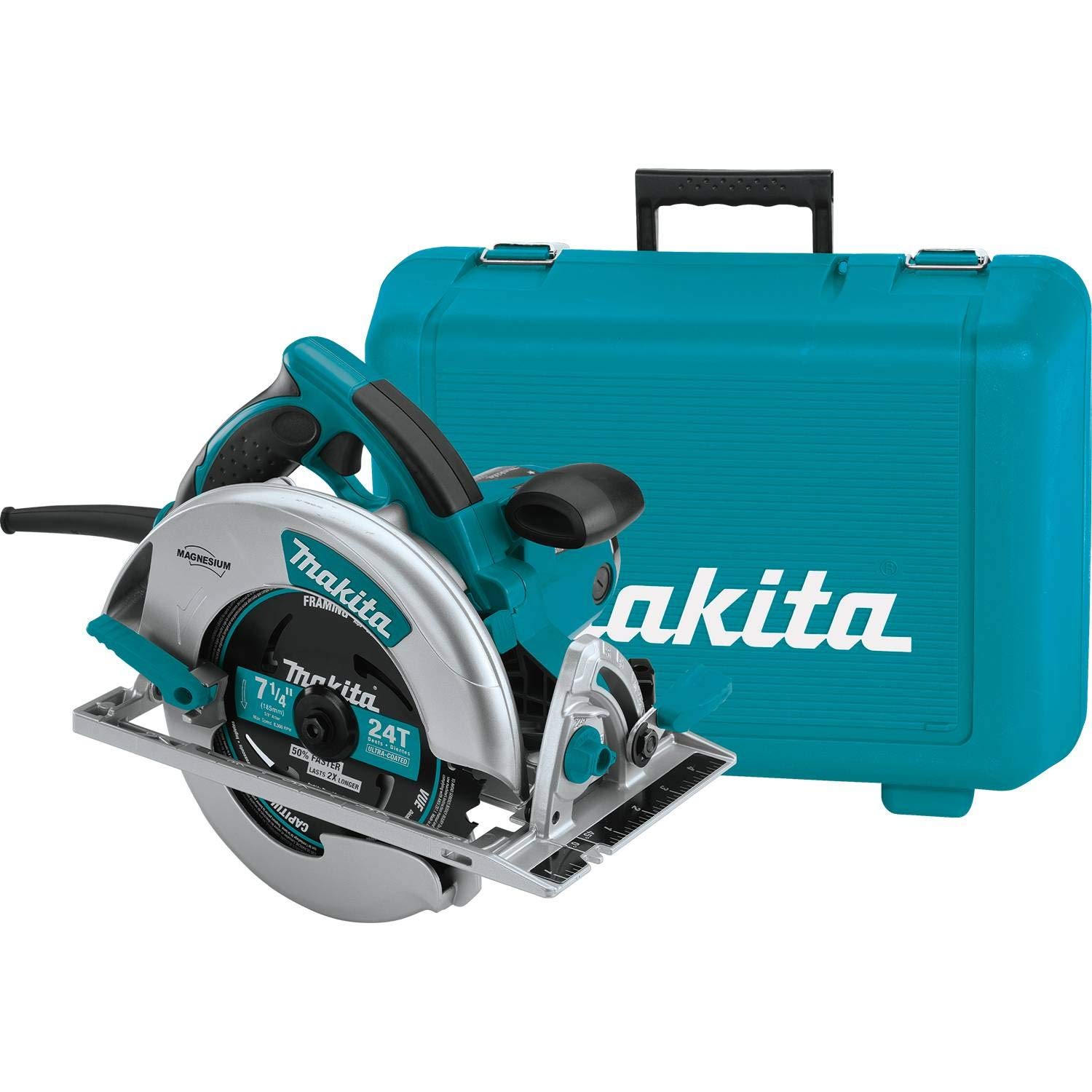
The Makita 5007MGA uses a magnesium base and housing to keep its weight at just 10.6 lbs while delivering a true 15-amp motor spinning at 5,800 RPM. The electric brake stops the blade in roughly three seconds, which eliminates the dangerous coast-down period that can catch a glove or drag the saw across a cut piece. The 56-degree bevel capacity with positive stops at 22.5, 45, and 56 degrees makes it a legitimate choice for compound angle cuts on rafters and hips.
The cast magnesium base stayed flat and square out of the box according to feedback from tradesmen, and the large rubberized levers allow one-handed depth and bevel adjustments without searching for a wrench. The LED light illuminates the cut line in dim basements or early morning starts, and the dust evacuation port clears debris effectively. The included hard case is tight—users note the cord must be coiled carefully and the case offers limited room for extra blades.
Reviewers consistently compare the 5007MGA to a luxury sedan: powerful, quiet for a sidewinder, and smooth through oak and maple. The electric brake does produce a slight torque twist on release, which is normal but surprises first-time users. This is the saw to choose if you prioritize safety and alignment over saving a few pounds.
Why it’s great
- Magnesium frame is light and stays square under heat
- Electric brake stops the blade in 3 seconds
- 56-degree bevel range with positive stops
- Large, easy-grip levers for one-handed adjustment
Good to know
- Included case is small and forces a tight cord coil
- Brake torque twist on release takes getting used to
- Stock blade is decent but serious users swap it for a Diablo
2. BOSCH CS5 120-Volt 7-1/4-Inch Circular Saw

The Bosch CS5 is a blade-left sidewinder, meaning the motor sits to the right of the cut line while the blade tracks on the left. This orientation gives a right-handed operator an unobstructed view of the kerf without leaning their head over the saw body—a major advantage for plunge cuts and plywood ripping where line accuracy matters. The 15-amp motor has enough torque to push through wet pressure-treated lumber and hard maple without bogging.
Depth and bevel adjustments are tool-less and intuitive: a single lever locks the depth, while the bevel quadrant uses a familiar turn-knob setup. The built-in spindle lock and blade wrench storage between the base plate and motor housing keep blade changes quick. Some users note that the wrench storage location can cause the base plate to twist slightly, so it is wise to check squareness after adjusting the storage slot. The saw weighs 9.3 lbs, which is heavier than some mid-range options but still comfortable for overhead work.
Customer feedback highlights the excellent line visibility as the defining reason to choose the CS5 over right-blade alternatives. The included 24-tooth blade is serviceable but produces scorch marks on dense woods; swapping to a Bosch Daredevil blade improves cut finish dramatically. The lack of an electric brake means the blade spins for a few seconds after release, and there is no dust chute—chips blow directly at the operator when cutting right-handed with the line-of-sight advantage.
Why it’s great
- Blade-left design offers best-in-class cut line visibility
- Tool-less depth and bevel adjustments
- Strong 15-amp motor handles hardwoods and wet lumber
- Built-in spindle lock and wrench storage
Good to know
- No electric brake; blade coasts for 5-6 seconds
- No dust chute—chips blow into operator’s face
- Wrench storage slot can misalign the base plate
3. Evolution S185CCSL 7.25” Metal Cutting Circular Saw
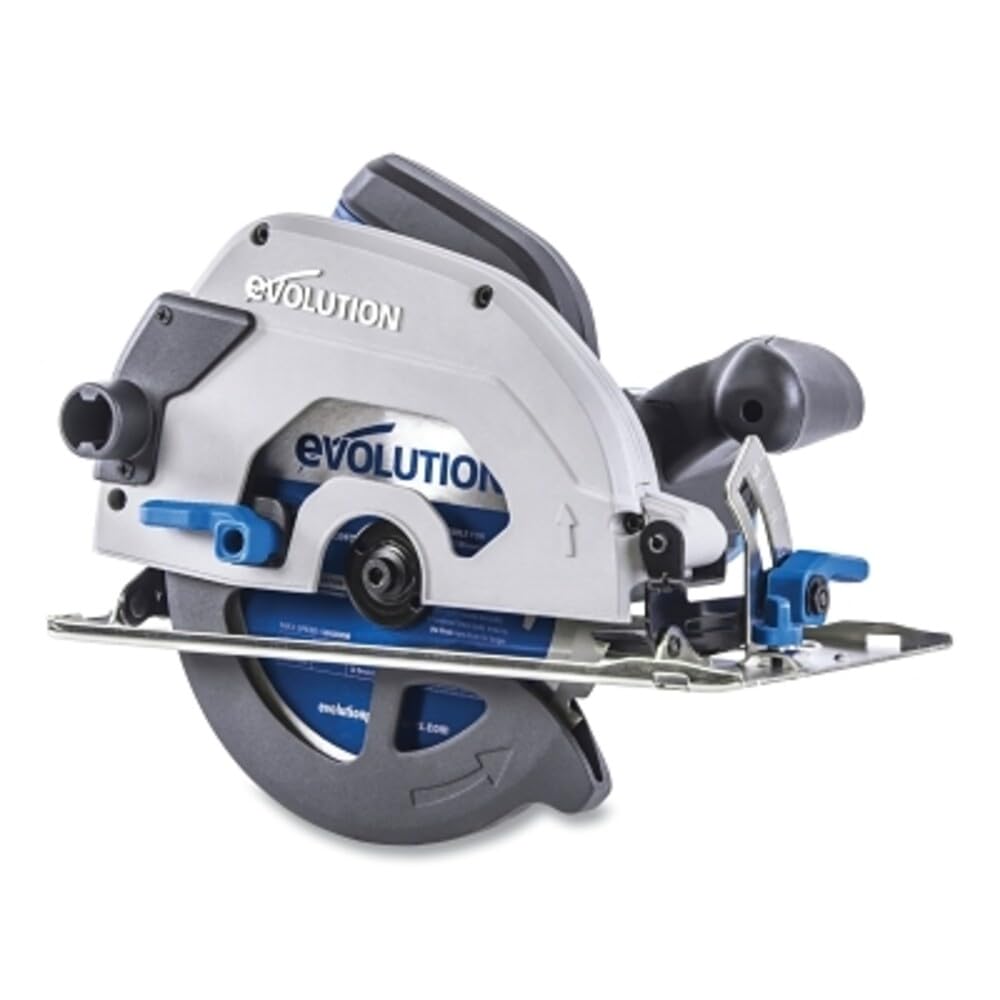
The Evolution S185CCSL is a specialized 7-1/4 saw built specifically for cutting mild steel, angle iron, square tubing, and steel plate up to 3/8-inch thick. It uses a 40-tooth TCT (Tungsten Carbide Tipped) blade that cuts dry—no coolant required—at 3,900 RPM, which is slower than a wood-cutting circular saw but optimized to prevent heat buildup and blade glazing. The result is a clean, burr-free edge that is ready for welding or fabrication with minimal grinding.
At 11.4 lbs, the Evolution is heavier than a standard wood sidewinder, but the weight helps stabilize the cut through dense metal. The paddle levers make bevel adjustments between 0 and 45 degrees straightforward, and the built-in blade viewing window keeps the cut line visible despite the sparks and metal chips. The saw throws sharp chips rather than fine dust, so full PPE—welding sleeves, a hood, and heavy gloves—is mandatory for safe operation.
Users report cutting 3/8-inch steel plate feels like cutting butter, with zero sparks and virtually no heat transferred to the material. The saw is loud, so hearing protection is essential on any job. The 20mm bore on the blade limits aftermarket blade compatibility unless you use a bushing. The visible glass port on the viewing window can shatter on heavy jobsites, and the blade mounting bolt has been known to strip under high torque if over-tightened.
Why it’s great
- Cuts 3/8-inch steel plate cleanly with no burrs
- Dry-cut system eliminates coolant mess
- TCT blade lasts significantly longer than abrasive wheels
- Lighter than most abrasive chop saws for similar capacity
Good to know
- Very loud; hearing protection is not optional
- Throws hot sharp metal chips
- Blade bolt can strip; viewing port glass may shatter on heavy use
4. Makita HS7600 Circular Saw, 7-1/4″

The Makita HS7600 is the entry point into the Makita corded family, powered by a 10.5-amp motor that reaches 5,200 RPM—lower amperage than the 15-amp competition but still capable of clean cuts through dimensional lumber and 3/4-inch plywood. The motor trade-off is noticeable only when ripping thick hardwoods or pressure-treated deck boards; for general DIY framing, sheet goods, and furniture projects, it has plenty of torque.
At 8.6 lbs, the HS7600 is among the lightest 7-1/4 saws in the market, which reduces fatigue during extended use on ladders or overhead cuts. The heavy gauge aluminum wraparound base is cast, not stamped, and holds its squareness well over time. The lower guard design is optimized for bevel cuts, reducing the chance of the guard catching on the workpiece during angled entry. The saw does not include an electric brake, so the blade spins down freely after the trigger is released.
DIYers praise the HS7600 for its balance and ease of use with a track guide—several users report it produces perfect straight cuts when paired with an aftermarket track system, eliminating the need for a table saw in small shops. The included blade is basic; upgrading to a fine-finish blade transforms the saw for cabinet work. The lack of a dust blower means sawdust accumulates on the cut line, requiring the operator to blow the line before starting the cut.
Why it’s great
- Very light at 8.6 lbs for reduced fatigue
- Cast aluminum wraparound base stays square
- Works well with aftermarket track guides
- Outstanding build quality for the price range
Good to know
- 10.5-amp motor, less torque than 15-amp competition
- No electric brake—blade coast-down is long
- No dust blower; saw dust obscures cut line
5. SKILSAW SPT67WL-01 15 Amp 7-1/4 In. Sidewinder Circular Saw

The SKILSAW SPT67WL-01 is a 15-amp sidewinder designed for durability on real jobsites. Its Dual-Field motor dissipates heat more effectively than conventional motors, which prevents the winding burnout that killed older SKIL models after heavy use. The saw weighs 8.6 lbs, making it the lightest professional corded circular saw in its class despite the full 15-amp motor, a combination that reduces arm fatigue during all-day ripping.
The 56-degree bevel capacity with a positive stop at 45 degrees covers compound miter cuts on framing and trim. The 10-foot cord is longer than average, which reduces the need for extension cords on standard sheet goods. The base is a cast aluminum unit that resists bending, and the rubber handle grip provides solid control even with wet gloves. There is no electric brake—users report the blade spins for several seconds after releasing the trigger, which is the single biggest safety trade-off on an otherwise professional-grade tool.
Long-term reviews from contractors who used the saw for over eight years report zero mechanical failures and consistent cut accuracy. The saw works well with aftermarket fence guides for ripping plywood. The plastic housing feels less premium than magnesium competitors, but the motor performance and weight savings make it a strong candidate for anyone who wants 15-amp power without carrying a heavy tool.
Why it’s great
- Only 8.6 lbs with a full 15-amp motor
- Dual-Field motor runs cooler and lasts longer
- 56-degree bevel with positive stop at 45 degrees
- Extra-long 10-foot cord improves reach
Good to know
- No electric brake; significant coast-down time
- Plastic housing not as rugged as metal chassis saws
- Stock blade is basic; upgrade recommended for fine cuts
6. Metabo HPT C7SB3 7-1/4-Inch Circular Saw Kit

The Metabo HPT C7SB3 delivers a surprising amount of professional-grade features at a price point that appeals to DIYers and budget-conscious framers. The 15-amp motor spins at 6,000 RPM, which is among the fastest in the class, producing very smooth, burn-free cuts on OSB, 2x4s, LVL, and plywood. The cast aluminum base—not stamped steel—provides a stable, wide platform that resists flexing and holds its square edge over time.
At 9.5 lbs, the saw is slightly heavier than the lightest options, but the extra weight helps guide the saw through long rip cuts with less wandering. The integrated dust blower effectively clears sawdust from the cut line, and the cord hook keeps the power cable safely out of the way to prevent accidental cord cutting. The saw includes a 24-tooth premium framing/ripping blade that reviewers consistently rate as excellent for a stock blade—many use it until it dulls before upgrading.
The depth adjustment lever loosens too easily according to multiple users, making fine-tuning frustrating on small cuts. The saw has no electric brake, and there is no dust port for vacuum attachment, which means dust blows freely across the worksite. The included carrying bag and hex bar wrench add convenience for mobile jobs, but the bag is basic and lacks padding for serious site transport.
Why it’s great
- 15-amp motor with 6,000 RPM for fast, smooth cuts
- Cast aluminum base is wide and stays square
- Excellent included 24-tooth framing blade
- Dust blower and cord hook improve usability
Good to know
- Depth adjustment lever loosens too easily
- No electric brake; blade spins down slowly
- No dust port for vacuum attachment
7. DEWALT FLEXVOLT 60V MAX 7-1/4-Inch Brushless Circular Saw (DCS575B)

The DEWALT DCS575B is a cordless circular saw that delivers power equivalent to a 15-amp corded model via the FLEXVOLT 60V battery platform. The brushless motor produces 5,800 RPM, matching the top corded saws, and the electronic brake stops the blade almost instantly when the trigger is released—a safety feature that corded saws in the mid-range tier often omit. This is a bare tool, requiring a 60V battery and charger, which adds significant upfront cost if you are not already in the DEWALT FLEXVOLT system.
The saw cuts through 2×4 pine at 339 cuts per charge according to the manufacturer, and user reports confirm it eats 3/4-inch MDF like a corded tool without bogging. The depth of cut is 2-9/16 inches at 90 degrees, slightly deeper than many corded sidewinders, and the bevel range goes to 50 degrees. The magnesium construction keeps the weight at 10.15 lbs, right in the middle of the corded range. The flip-out rafter hook is a practical addition for jobsite storage between cuts.
This saw is overkill for a hobbyist who makes occasional cuts; the battery platform investment only makes sense for professionals already using FLEXVOLT 60V tools or those who prioritize jobsite mobility over cost. The right-blade design means dust and chips blow away from the operator, but right-handed users lose some cut line visibility compared to a left-blade saw. Some users note the trigger has a long travel distance, which can contribute to hand fatigue during prolonged cutting sessions.
Why it’s great
- Matches corded 15-amp power with battery convenience
- Electric brake stops blade instantly
- Deep 2-9/16 inch cut capacity at 90 degrees
- Magnesium construction keeps weight competitive
Good to know
- Bare tool; requires expensive 60V battery and charger
- Right-blade design reduces cut line visibility compared to left-blade saws
- Trigger travel distance is long; may cause hand fatigue
FAQ
What is the real benefit of a left-blade circular saw?
Can I use a 7-1/4 metal-cutting blade in a wood saw?
How often should I replace the base plate or sole plate on a circular saw?
Final Thoughts: The Verdict
For most users, the best corded 7 1/4 circular saw winner is the Makita 5007MGA because it combines a lightweight magnesium chassis, a powerful 15-amp motor with an electric brake, and a 56-degree bevel range that covers framing and finish work without compromise. If you need absolute cut line visibility for precision track work, the BOSCH CS5 is the better call despite its lack of a brake. And for cutting mild steel on a regular basis, nothing beats the Evolution S185CCSL—it delivers clean, burr-free edges without sparks, consistent heat management, and no coolant mess. Choose based on your primary material and your tolerance for coast-down safety; every saw on this list earns its place through real-world performance, not marketing claims.

Mo Maruf
I created WellFizz to bridge the gap between vague wellness advice and actionable solutions. My mission is simple: to decode the research and give you practical tools you can actually use.
Beyond the data, I am a passionate traveler. I believe that stepping away from the screen to explore new environments is essential for mental clarity and physical vitality.