Our readers keep the lights on and my smoothie glass nicely filled. As an Amazon Associate, I earn from qualifying purchases.
A cordless phone for seniors needs to solve three specific problems that standard models ignore: tiny text that’s unreadable without reading glasses, call volume that forces constant asking for repeats, and complicated menus that turn a simple call into a puzzle. The right phone eliminates all three pains before the first call is made.
I’m Mohammad Maruf — the founder and writer behind WellFizz. I’ve spent hundreds of hours analyzing the specific hardware specs, audio amplification curves, display contrast ratios, and button geometry that separate a genuinely senior-friendly cordless phone from a standard model that simply has large print slapped on it.
The wrong phone leaves seniors frustrated, missing calls, or unable to hear conversations. Choosing the right one restores independence. This guide breaks down the narrow specs that matter most for the best cordless telephone for seniors, so you can match the phone to the specific visual, hearing, or memory needs of the user.
How To Choose The Best Cordless Telephone For Seniors
A senior’s phone isn’t about features — it’s about removing barriers. The three core barriers are visual clarity, hearing clarity, and memory simplicity. A phone that fails any one of these becomes a source of frustration rather than connection.
Display size and contrast
A 2-inch display is the minimum for comfortable reading without glasses. But size alone isn’t enough — high-contrast text (black on white or white on black) matters far more than backlight brightness. Look for displays described as “high-contrast” over those that simply advertise “large screen”.
Amplified audio with tone control
Standard phones max out around 20dB of amplification. Senior-friendly models should offer 30dB to 40dB boost. Tone control is equally critical — many users need high-frequency clarity for consonant sounds (heard as clarity) rather than just volume.
Button size and photo memory
Physical buttons should be at least 1/2 inch wide with high-contrast numbering. For users with dementia or memory challenges, photo memory buttons that dial a contact with one press eliminate the need to navigate a phonebook or remember numbers.
Quick Comparison
On smaller screens, swipe sideways to see the full table.
| Model | Category | Best For | Key Spec | Amazon |
|---|---|---|---|---|
| AT&T BL102-3 | Multi-Handset | Large home with multiple rooms | 2-inch high-contrast display, Audio Assist | Amazon |
| Panasonic KX-TGD832M | Call Blocking | Reducing robocall frustration | Illuminated keypad, 1000-number call block | Amazon |
| AT&T BL102-2 | Value 2-Handset | Good balance of features and cost | 2-inch screen, 22-min answering system | Amazon |
| Easyfone Prime-T6 | 4G Cell Phone | Seniors without landline service | 4 picture memory buttons, SOS button | Amazon |
| VTech VG232 | Full-Duplex | Clear two-way conversations | Full-duplex speakerphone, 7hr talk time | Amazon |
| Clarity D714 | Amplified | Hearing-impaired users | 40dB amplification, adjustable tone control | Amazon |
| Serene Innovations HD40P | Photo Memory | Dementia or memory decline | 9 photo speed dial buttons, 85dB ringer | Amazon |
In‑Depth Reviews
1. AT&T BL102-3 DECT 6.0 3-Handset Cordless Phone

The AT&T BL102-3 earns the top spot because it solves the two biggest senior phone frustrations in a single package: a 2-inch high-contrast display that remains readable in dim light, and a full-duplex speakerphone that lets both parties speak simultaneously without cutting out. The illuminated keypad with enlarged font handles the vision barrier directly — users can dial without searching for glasses.
The Audio Assist feature is the standout spec here. It boosts the incoming voice volume beyond standard handset levels and works in tandem with the tone adjustment to clarify speech, not just make it louder. Users with mild to moderate hearing loss report being able to hear conversations they previously strained to catch. The 22-minute digital answering machine and voice-guided setup reduce the learning curve.
Smart Call Blocker automatically stops robocalls on the first ring, and the handset announces the caller’s name — so the user decides whether to answer without reading a screen. The three-handset configuration covers multiple rooms without buying extra units. The 2.4-pound total weight is manageable for arthritic hands to hold during longer calls.
Why it’s great
- Large 2-inch high-contrast screen with big text reduces eye strain
- Audio Assist boosts call volume and clarifies speech for hearing support
- Smart Call Blocker stops robocalls on first ring automatically
- Three handsets provide whole-home coverage without extra purchases
Good to know
- Build quality feels lightweight, not premium
- Must add contacts to avoid accidentally blocking calls
- Caller ID announcement can become annoying — can be disabled
2. Panasonic KX-TGD832M Cordless Phone with Advanced Call Block

Panasonic’s KX-TGD832M targets the specific pain point that frustrates seniors the most: endless robocalls and scam calls interrupting their day. The Advanced Call Block system pre-blocks robocalls automatically, and the Telemarketing Call Block feature lets the user block announced callers with a single button press. The phone also displays a confirmation screen when returning a one-ring scam callback — a feature that prevents the common “missed call” trick.
The illuminated keypad with large characters is a strong accessibility touch — users can find the handset and dial in complete darkness. The 3-way conference call capability works well for family check-ins where a caregiver joins the conversation. Users consistently report that the handset volume runs louder than comparable VTech models, which matters for seniors who are borderline on needing a dedicated amplified phone.
The 2-way recording feature is less useful for most seniors but gives caregivers peace of mind if they want to monitor important calls remotely. The handset is lightweight at 10.6 ounces, and the wall-mountable design frees counter space. One subtle shortcoming: no charging light indicator means the user must check the screen to confirm the handset is charging.
Why it’s great
- Advanced Call Block stops robocalls before they ring through
- One-ring scam alert prevents callback scams with confirmation screen
- Illuminated keypad with large characters visible in total darkness
- Handset volume is noticeably louder than entry-level competitors
Good to know
- No charging light indicator on the handset
- Build feels lightweight — not rugged
- Some users report fewer features than older Panasonic models
3. AT&T BL102-2 DECT 6.0 2-Handset Cordless Phone
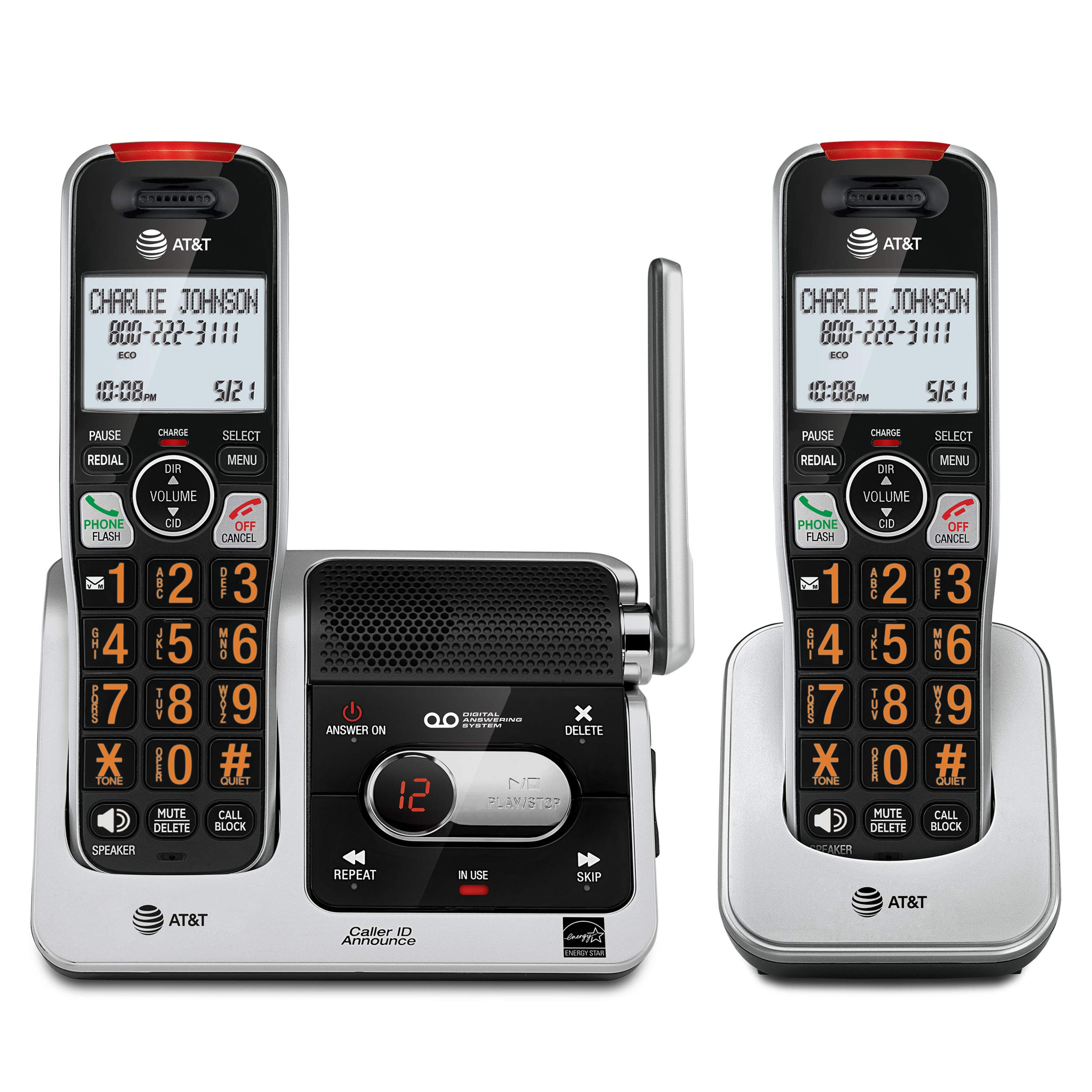
The AT&T BL102-2 brings the same core senior-friendly specs as its 3-handset sibling — the 2-inch high-contrast display, enlarged font, and illuminated keypad — but in a more budget-conscious two-handset package. For a couple living in a smaller home or apartment, two handsets are plenty to cover the living room and bedroom without extra units sitting unused.
The Caller ID Announcer feature lets the user hear who’s calling without reading the screen — a practical help for seniors with low vision or cataracts. The Smart Call Blocker stops robocalls before they ring, and the Audio Assist function boosts incoming speech clarity. The 22-minute answering machine with voice-guided setup remains one of the easiest systems to configure among models in this price tier.
The speakerphone is full-duplex, meaning both parties can speak and be heard at the same time without the choppy cutout that plagues budget models. Customer feedback points out that while the build feels slightly plasticky, the performance is reliable — call quality remains clear even on VOIP lines. The main trade-off is the 2-handset limit; users who need three or more handsets should consider the BL102-3.
Why it’s great
- Large 2-inch screen with high-contrast text and big font
- Caller ID Announcer speaks caller name aloud — no reading required
- Smart Call Blocker eliminates 98% of robocalls automatically
- Audio Assist boosts call volume and clarifies speech
Good to know
- Build quality feels lightweight and plastic
- No Bluetooth connectivity
- Must add contacts to call block directory to avoid blocking family
4. Easyfone Prime-T6 4G Picture Button Cell Phone for Seniors
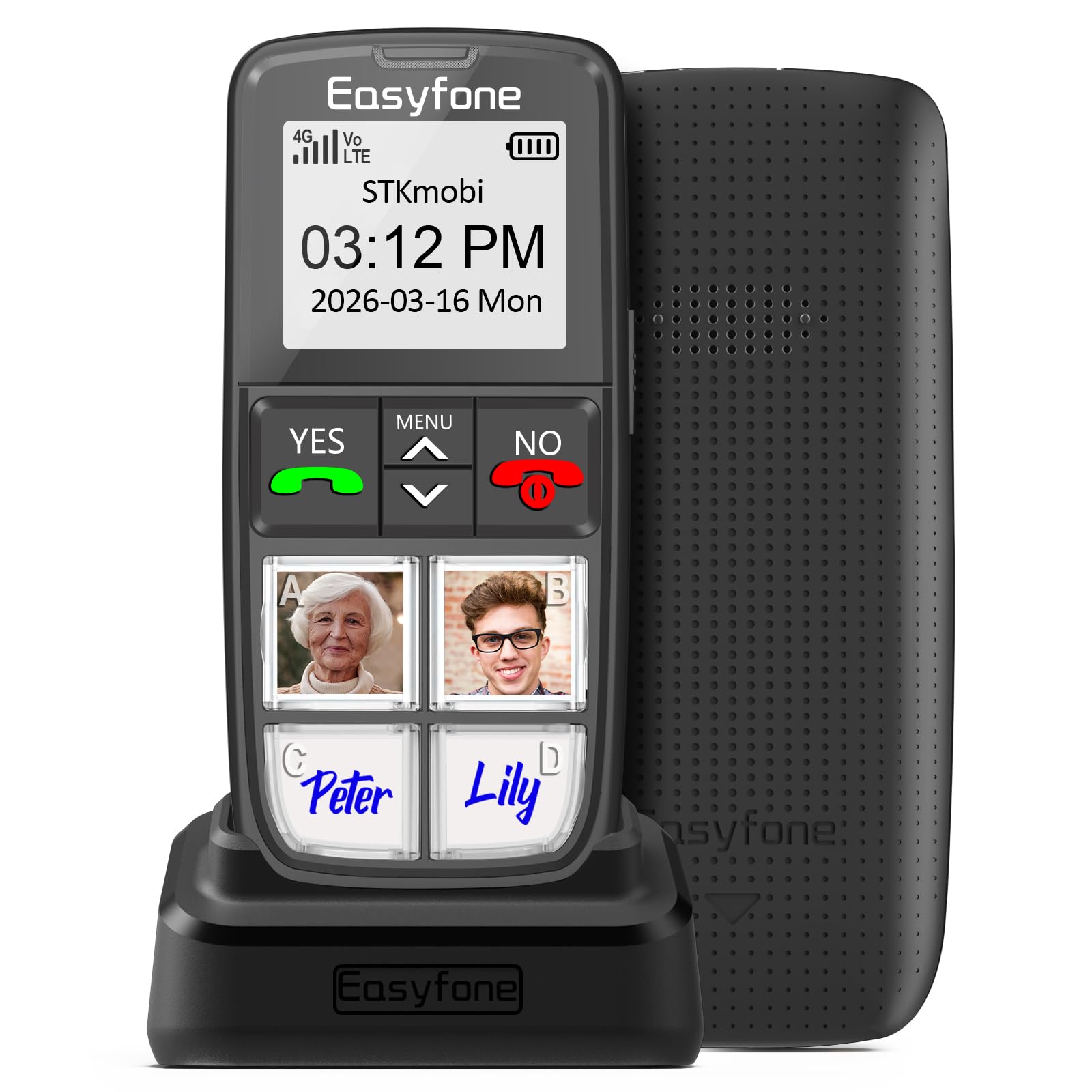
The Easyfone Prime-T6 is not a landline cordless phone — it’s a 4G cellular phone designed specifically for seniors who no longer have a landline or who need a dedicated simple phone separate from their home service. The defining feature is the four large picture memory buttons: each button holds a printed photo of the contact, and pressing it immediately dials that person. No phonebook, no scrolling, no remembering numbers.
The 1050mAh battery provides over a week of standby, and the included charging dock makes recharging simple — no fiddling with tiny cables. The SOS button, when pressed and held, triggers a loud alarm and sends sequential calls and text messages to pre-programmed emergency contacts. This is a critical safety net for seniors living alone or with conditions like dementia or Alzheimer’s.
The sound is HAC compatible and loud enough for hearing aid users. The minimalist user interface strips away everything except calling — no apps, no touchscreen, no confusing menus. One practical downside: the SOS button location on the back can be accidentally triggered during handling, causing false alarms. Some users also report that the plastic body feels less sturdy than the price suggests.
Why it’s great
- Four picture memory buttons eliminate phonebook navigation completely
- SOS emergency button with alarm and auto-dial for safety
- Included charging dock is easy to use — no plugging cables
- HAC compatible for hearing aid users with clear sound
Good to know
- Works only with T-Mobile, SpeedTalk, and Tello networks
- SOS button location can cause accidental activation
- Plastic build feels less premium than price suggests
5. VTech VG232 Cordless Home Phone with Answering Machine

The VTech VG232 prioritizes conversation quality with a true full-duplex speakerphone — both parties speak and hear simultaneously without the choppy audio cutout that budget phones introduce. For seniors who use speakerphone while cooking, doing chores, or caring for family, this eliminates the frustration of talking over each other or missing words.
The large backlit display with high-contrast text aids readability in any lighting, and the oversized buttons make dialing simple for users with reduced fine motor control. The phone is hearing-aid compatible with M4/T4 rating, meaning it works without the screeching feedback that often occurs when a hearing aid is held near a standard phone earpiece. The 7-hour talk time and 5-day standby provide reliable daily use without constant charging.
The 14-minute digital answering machine includes call screening, so the user can hear who’s leaving a message before picking up. The ECO mode automatically reduces transmitter power when the handset is near the base, extending battery life and reducing energy use. The main limitation is the single-handset configuration — users who need multiple handsets must buy expansion units separately.
Why it’s great
- True full-duplex speakerphone — no choppy audio when both talk
- Large backlit display with high-contrast text for easy reading
- M4/T4 hearing-aid compatible — no feedback screech
- ECO mode extends battery life automatically
Good to know
- Single handset included — expansion units sold separately
- Batteries are small and may need recharging sooner than expected
- Limited to 50 Caller ID and 50 phonebook entries
6. Clarity D714 Amplified Cordless Phone with Answering System

The Clarity D714 is built specifically for users with significant hearing loss. It amplifies incoming sound up to 40dB — that’s roughly double the maximum boost of a standard phone. The adjustable tone control lets the user dial in the frequency range that matches their hearing loss profile, which is critical because many seniors can hear volume but struggle with consonant clarity at certain frequencies.
The DECT 6.0 technology delivers interference-free audio across the home, and the phone works with both standard PSTN landlines and VoIP services — a flexibility that matters as more homes drop traditional phone lines. The digital answering machine stores messages and allows playback from the handset, so the user doesn’t need to walk to the base unit to hear who called.
Customer feedback consistently notes that this phone is louder than Panasonic models, making it the go-to choice when standard amplified phones aren’t enough. However, some users report that even at maximum boost, the volume is insufficient for profound hearing loss. A secondary concern: the answer and end buttons lack visual contrast, making them hard to distinguish for users with low vision.
Why it’s great
- 40dB amplification — louder than any standard cordless phone
- Adjustable tone control customizes frequency response for hearing loss
- Works with both PSTN landlines and VoIP services
- Messages playable directly from the handset
Good to know
- Answer and end buttons lack contrast — hard to see for low vision
- Some users find even 40dB boost insufficient for profound loss
- Buttons may become unresponsive after extended use
7. Serene Innovations Amplified Big Button Phone with Photo Buttons

The Serene Innovations HD40P is a corded landline phone — not cordless — but it earns a spot in this guide because it solves a problem no cordless model addresses well: dementia and memory decline. The nine photo speed dial buttons let the caregiver insert a printed photo of each contact (daughter, doctor, neighbor) behind a clear plastic tab. One press dials that person. No phonebook, no number recall, no confusion.
The ringer hits 85dB — as loud as a lawn mower — ensuring the user hears the phone even if they’ve wandered to another room. The handset has an extra amplifier switch for constant volume boost, plus separate controls for ringer loudness and tone. A red light flashes when the phone rings and stays lit when the line is in use, providing a visual cue for users who can’t hear the ringer clearly.
The phone is powered entirely through the phone line, meaning it works during power outages — a critical safety feature for seniors who may rely on the phone for emergency contact. The large buttons with high-contrast numbering make dialing possible for users with low vision, and the speakerphone option works well for hands-free calls. The programming process for photo buttons is straightforward but requires following steps carefully without audible confirmation.
Why it’s great
- Nine photo speed dial buttons — one press to call with visual picture
- 85dB ringer cuts through noise and hearing loss
- Powered by phone line — works during power outages
- Extra amplifier switch for constant volume boost
Good to know
- Corded design — limited to placement near phone jack
- No Caller ID or digital answering machine
- Some units develop speakerphone static over time
FAQ
Is a cordless phone or a corded phone better for a senior with dementia?
What decibel level is enough for a senior with moderate hearing loss?
Will a cordless phone for seniors work with VoIP or cable phone service?
How many handsets should I buy for a senior living alone?
Final Thoughts: The Verdict
For most users, the best cordless telephone for seniors winner is the AT&T BL102-3 3-Handset because it combines the three essentials — a large high-contrast display, Audio Assist for hearing support, and automated call blocking — across three handsets that cover the whole home. If you need maximum amplification for significant hearing loss, grab the Clarity D714. And for a senior with dementia who needs visual photo buttons and power-outage reliability, nothing beats the Serene Innovations HD40P.

Mo Maruf
I created WellFizz to bridge the gap between vague wellness advice and actionable solutions. My mission is simple: to decode the research and give you practical tools you can actually use.
Beyond the data, I am a passionate traveler. I believe that stepping away from the screen to explore new environments is essential for mental clarity and physical vitality.