Our readers keep the lights on and my smoothie glass nicely filled. As an Amazon Associate, I earn from qualifying purchases.
Without a dedicated backup, you wake up gasping, your therapy data resets, and your sleep quality collapses. The right portable power station eliminates that risk by delivering clean, stable DC power directly to your machine for one, two, or even three full nights.
I’m Mohammad Maruf — the founder and writer behind WellFizz. My research for this guide involved cross-referencing battery chemistry (LiFePO₄ vs. standard Li-Ion), measuring actual watt-hour draws across a dozen popular CPAP models, and analyzing verified owner reports to separate true multi-night performers from units that die before sunrise.
Below you will find a curated selection of power stations purpose-built for CPAP therapy, ranging from compact travel companions to high-capacity units that can handle humidifiers. This is your complete, category-specific guide to finding the best cpap battery for your therapy needs and lifestyle.
How To Choose The Best CPAP Battery
A CPAP battery is not a generic power bank. Your machine demands a specific voltage (typically 12V, 24V, or 48V depending on the model) and draws a consistent load for 7 to 9 hours every night. Choosing the wrong unit means waking up at 3 a.m. with a dead battery and a dejected machine. The three factors below are non-negotiable.
Match Voltage, Not Just Watt-Hours
ResMed AirSense and AirCurve series require 24V DC input. Philips DreamStation machines typically run on 12V DC, while the AirMini uses a proprietary 24V barrel connector. A battery that only outputs 12V will not power a ResMed machine without a bulky voltage converter that wastes energy and creates heat. Check your CPAP’s power brick label for the voltage and amperage rating, then confirm the battery offers a native DC output at that exact voltage. Most dedicated CPAP batteries include multiple DC cables to cover the major brands.
Calculate Your Nightly Watt-Hour Draw
Every CPAP machine has a different appetite. A ResMed AirSense 10 with the humidifier off and a pressure of 10 cmH₂O draws roughly 30 to 35 Wh per 8-hour night. Turn the heated humidifier on to a mid setting, and that number jumps to 70–90 Wh. A 300 Wh battery theoretically delivers four nights without humidification, but only two nights with it. To estimate your personal runtime, look up your CPAP’s power consumption (many manufacturers provide a spec sheet), multiply by your typical hours, then add a 20% safety margin. Never trust a battery’s “one-night” claim without doing the math.
Prioritize Battery Chemistry for Long-Term Value
Budget-friendly units use standard lithium-ion cells that degrade noticeably after 300 to 500 charge cycles. Mid-range and premium options increasingly adopt LiFePO₄ (lithium iron phosphate) chemistry, which retains 80% of its original capacity after 3,000 cycles. If you plan to use the battery as a nightly backup for years, the higher upfront cost of LiFePO₄ pays for itself in avoided replacements. For occasional camping trips twice a year, a standard Li-Ion unit at a lower price point makes sense.
Quick Comparison
On smaller screens, swipe sideways to see the full table.
| Model | Category | Best For | Key Spec | Amazon |
|---|---|---|---|---|
| BLUETTI X30 | Premium | Multi-night power backup | 297Wh / 24V native DC | Amazon |
| EASYLONGER ES720 PRO | Premium | Extended camping trips | 276.48Wh / adjustable DC | Amazon |
| EASYLONGER ES720 | Premium | Off-grid 2-night use | 266.4Wh / 4 DC cables | Amazon |
| UDPOWER C400 | Mid-Range | Compact emergency backup | 256Wh / LiFePO₄ 4000 cycles | Amazon |
| GRECELL EB300 | Mid-Range | Versatile power station | 288Wh / 330W AC outlet | Amazon |
| EASYLONGER ES400 AIR | Mid-Range | Nightly CPAP backup | 148Wh / pass-through charge | Amazon |
| Talentcell PB240B1 | Budget | Value 24V CPAP power | 155Wh / 24V DC output | Amazon |
| Medistrom Pilot-24 Lite | Premium | TSA-approved air travel | 95Wh / 1.3 lbs / 24V | Amazon |
| CAIRE Freestyle Comfort 8 Cell | Specialty | Oxygen concentrator backup | 6.6Ah / 4 hrs at setting 2 | Amazon |
In‑Depth Reviews
1. BLUETTI X30

The BLUETTI X30 delivers 297Wh of capacity with three native DC output ports specifically wired for CPAP voltages: 12V/5A, 15V/4A, and 24V/4A. That means no inverter losses — you connect directly from the battery to your ResMed AirSense 10 or AirCurve 10 and get nearly every watt-hour translated into therapy time. Verified owners report running an AirSense 10 for 4 to 5 nights with the humidifier off, drawing only about 16% of the battery per 9-hour session. The unit comes with five color-coded DC cables covering AirSense, AirMini, S9, DreamStation, and Transcend, so there is no guesswork finding the right adapter.
The X30 weighs 3.9 pounds and measures 8 x 5 x 3 inches, small enough to sit on a nightstand without interfering with your bedside lamp. Its Li-Ion cells are rated for over 2,000 charge cycles, which translates to years of weekly use before noticeable degradation. The LCD display shows remaining capacity in 10% increments and features a subtle backlight that does not disturb sleep. A padded accessory bag keeps all cables organized inside the carrying case.
The only drawback is that the X30 powers only one device at a time through its DC outputs — you cannot charge a phone and run your CPAP simultaneously from the DC ports (the USB-A port is available for small devices). Real-world weight comes in at 4.2 pounds, slightly above the advertised 3.9. But for dedicated CPAP users who want a compact, fuss-free power station that handles multiple nights effortlessly, the X30 is the most refined option in this class.
Why it’s great
- 297Wh capacity delivers 4–5 nights without humidifier
- Three native DC voltages eliminate inverter efficiency loss
- Lightweight 4 lb design fits on a nightstand
Good to know
- Only one device can draw from the DC outputs at a time
- Actual weight is slightly higher than advertised
2. EASYLONGER ES720 PRO
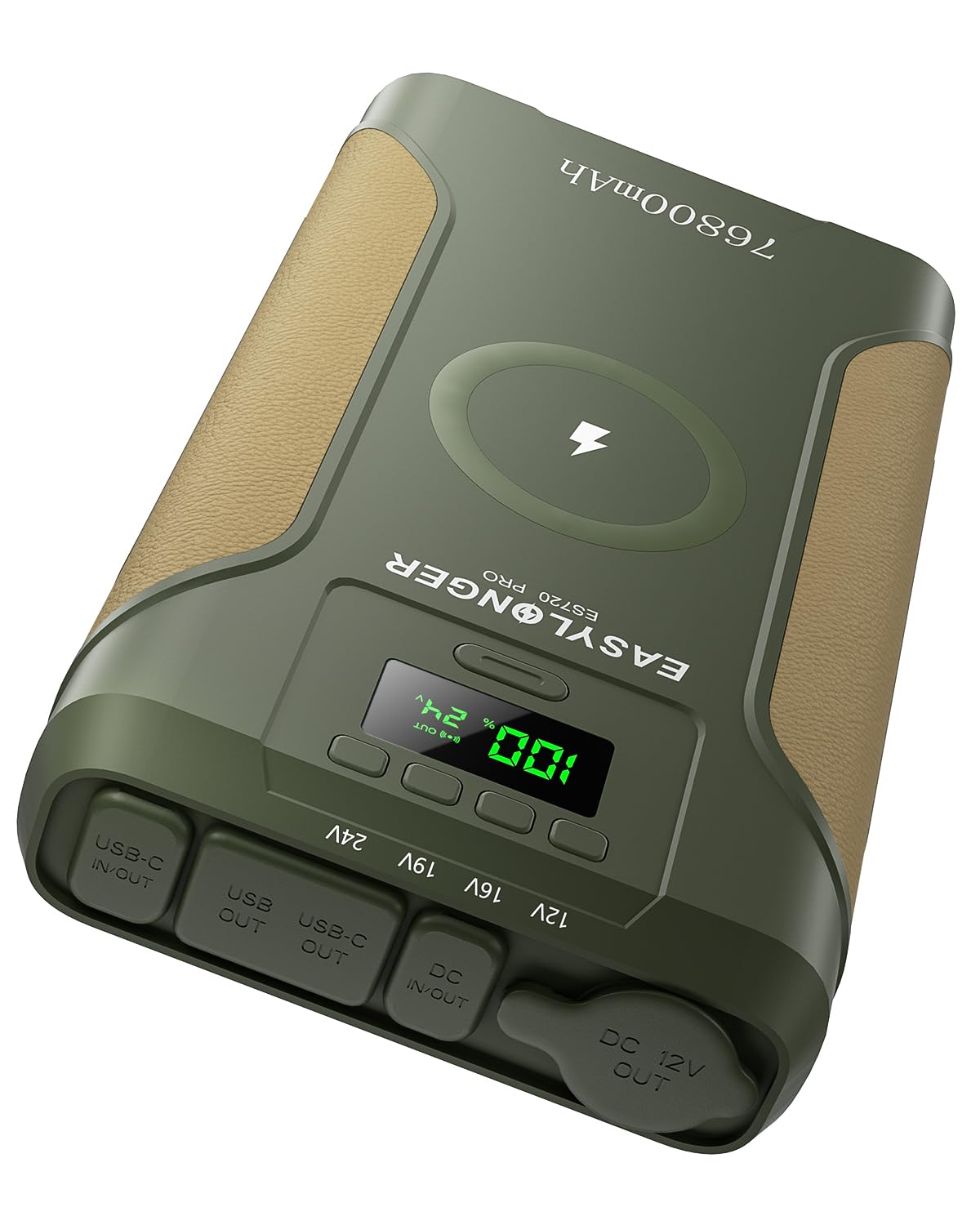
The ES720 PRO bumps capacity to 276.48Wh and adds an adjustable DC output dial that lets you switch between 12V, 16V, 19V, and 24V — a rare feature that future-proofs the battery against CPAP upgrades or different machine brands. It ships with four dedicated DC cables covering ResMed AirSense 11/AirCurve 11, AirSense 10/AirCurve 10, Philips DreamStation, and Luna TravelPAP. A 60W USB-C PD input doubles as both a charging port and a way to power a laptop, making this a genuine multi-device travel companion.
Verified owners using a ResMed AirSense 11 with humidifier and heated hose turned off report getting two full nights of sleep with over 50% charge remaining, which extrapolates to 3 to 4 nights per charge in dry mode. The integrated BMS protects against overcurrent and short circuits, and the pass-through charging feature lets you power your CPAP while the battery itself recharges — useful during a long travel day. A built-in LED light with SOS mode covers emergency signaling needs.
The ES720 PRO weighs 3.3 pounds and comes with a padded carrying bag, but it is bulkier than the BLUETTI X30 at 9.1 x 5.9 x 1.7 inches. The digital display shows voltage and remaining capacity, but the button interface is somewhat quirky and requires a few practice presses to get comfortable with. Some users report that running the heated humidifier rapidly drains the battery, so this unit is best optimized for dry-mode therapy or minimal humidity settings.
Why it’s great
- Adjustable voltage dial covers 12V to 24V machines
- Pass-through charging keeps CPAP running while battery refills
- Includes 4 CPAP-specific DC cables out of the box
Good to know
- Battery drains fast with heated humidifier or hose
- Button interface takes time to learn
3. EASYLONGER ES720

The non-Pro ES720 delivers 266.4Wh of capacity with the same 180W cigarette lighter socket and four USB ports, making it an excellent choice for car campers who want to power a CPAP and charge multiple devices from a single battery. It includes the same four DC cables as the Pro model, covering AirSense 10/11, AirMini, S9, and DreamStation. A 72W AC adapter charges the battery in 4 to 5 hours, and a 100W solar panel can replenish it in roughly the same time on a sunny day.
Owner reports consistently praise the ES720 for lasting two full nights on a ResMed AirSense 11 with humidifier off, with some users estimating they could stretch to three nights by turning off the heated hose. The pass-through charging via the cigarette lighter port works reliably, though a voltage converter is required for that specific connection. The unit weighs 3.3 pounds and includes a handy carrying bag that keeps the battery and all cables together.
The main caveat is that the ES720 does not offer built-in pass-through charging on the DC ports — you must use the cigarette lighter adapter to charge and power simultaneously. A few owners reported the power supply drains faster than expected when using a heated hose, and one customer reported a unit that underperformed and died early in the second night, so testing the battery immediately upon arrival is prudent. The LED light with SOS mode is a welcome safety addition for emergency kits.
Why it’s great
- 266.4Wh provides reliable 2-night dry-mode runtime
- Solar-ready with MPPT for off-grid recharging
- Four USB ports plus 180W car socket for device charging
Good to know
- No native DC pass-through — requires cigarette adapter
- Unit performance varies; recommend immediate runtime test
4. UDPOWER C400
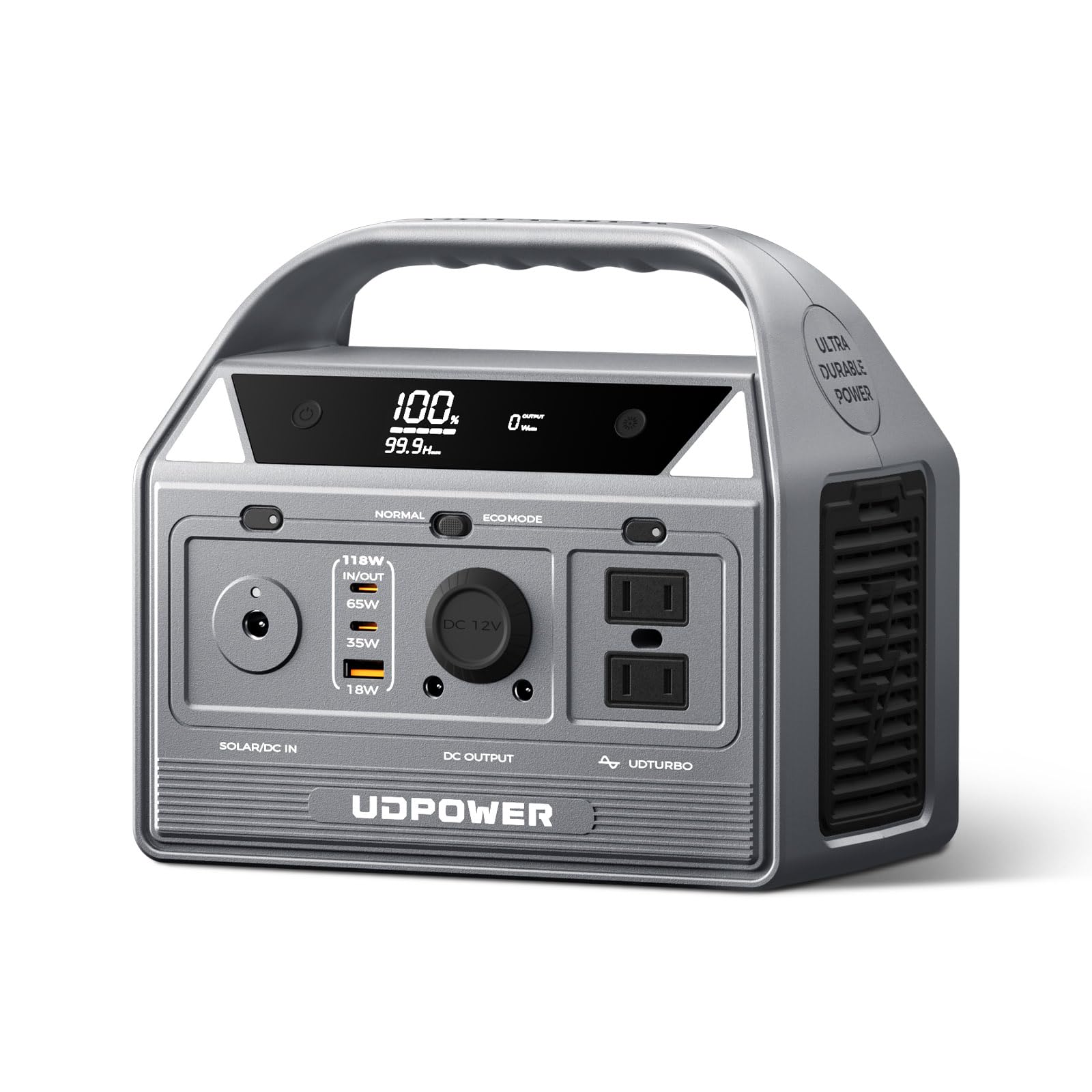
The UDPOWER C400 is the first unit in this roundup to feature LiFePO₄ battery chemistry, which offers over 4,000 charge cycles before dropping to 80% capacity — roughly 10 times the lifespan of standard Li-Ion packs. Its 256Wh capacity is paired with a 400W pure sine wave AC inverter (800W surge) that can run a CPAP with humidifier, though running through the AC outlet consumes about 15% more energy than a direct DC connection. The C400 includes a 65W USB-C PD input for fast recharging, reaching 80% in just 1.5 hours with a combined AC + USB-C charge.
The unit weighs 6.3 pounds and measures roughly the size of a lunchbox, making it backpack-friendly but noticeably heavier than dedicated CPAP batteries. The integrated jump starter can revive a dead 12V car battery in seconds, which adds significant utility for road trippers. The digital display shows both input and output wattage in real time, giving you precise visibility into how much energy your CPAP is consuming each night.
Because the C400 is a general-purpose power station, it does not ship with CPAP-specific DC cables — you will need to purchase a 24V-to-24V barrel adapter separately for ResMed machines, which adds about –15 to the total cost. The LiFePO₄ cells are heavier than Li-Ion equivalents, so this is not the lightest option for air travel. But for a home emergency backup that also jump-starts your car and powers your CPAP for two to three nights in dry mode, the C400 offers unbeatable long-term value.
Why it’s great
- LiFePO₄ chemistry lasts 4,000+ cycles vs 500 for Li-Ion
- Fast 1.5-hour recharge with combined AC + USB-C input
- Integrated car jump starter adds emergency versatility
Good to know
- No CPAP-specific DC cables included
- Heavier than dedicated CPAP batteries at 6.3 pounds
5. GRECELL EB300
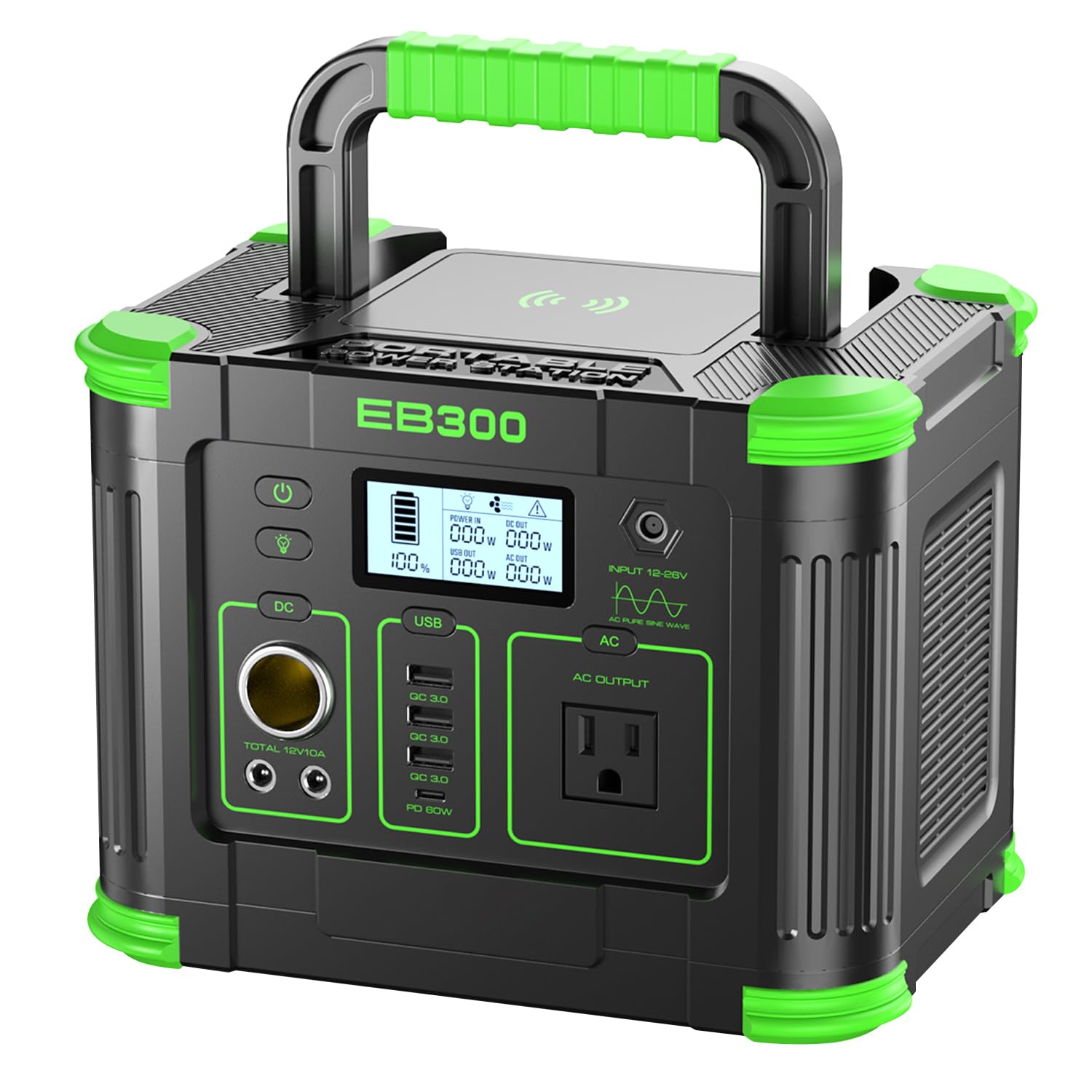
The GRECELL EB300 packs 288Wh into a 7.9-pound chassis with a 330W pure sine wave AC outlet, two DC 5521 ports, a 12V cigarette lighter port, dual USB-A outputs, a 60W USB-C PD port, and a 5W wireless charging pad on top. For CPAP users, the AC outlet provides universal compatibility with any machine using its original power brick, though the DC-to-AC-to-DC conversion loop burns about 15–20% of the battery’s energy compared to a direct DC hookup. The unit also includes a built-in LED flashlight with high, strobe, and SOS modes.
Owner reports indicate the EB300 can power a ResMed AirSense 10 through the AC outlet for roughly 1.5 nights without humidification, and about one night with the humidifier on a low setting. The dual cooling fans are quiet enough to run in a bedroom without being disruptive. The unit charges from a wall outlet in 6 to 7 hours, from a car charger in 7 to 9 hours, or from a 60–120W solar panel in 5 to 9 hours.
The EB300 lacks CPAP-specific DC cables, so you will need to use the AC outlet or buy a third-party DC adapter. The 7.9-pound weight makes it less portable than the BLUETTI X30 or the Pilot-24 Lite. The wireless charging pad is a nice bonus for topping off a phone but is slow at 5W. For users who want a single power station that runs a CPAP, charges multiple devices wirelessly, and powers a mini-fridge during a blackout, the EB300 is a solid all-rounder.
Why it’s great
- 288Wh capacity with 330W AC outlet powers most CPAPs
- Wireless charging pad and dual USB-C for modern devices
- Triple recharge modes — wall, car, and solar
Good to know
- AC-to-DC conversion wastes 15–20% of capacity
- Heavier than dedicated CPAP batteries at nearly 8 pounds
6. EASYLONGER ES400 AIR
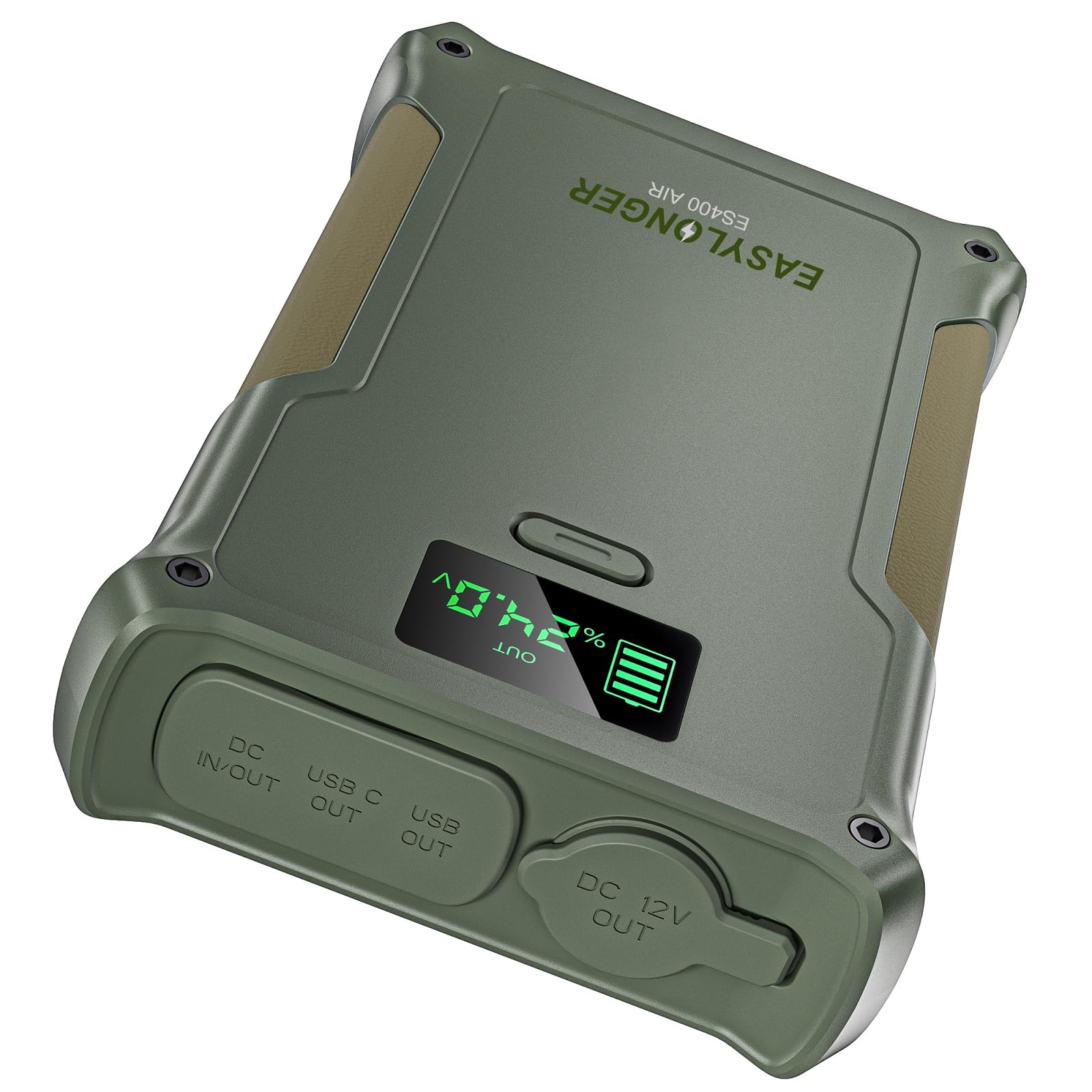
The ES400 AIR is a purpose-built CPAP backup that strikes a pragmatic balance between capacity and portability. Its 148Wh pack is not designed for multi-night off-grid trips, but it reliably powers a ResMed AirSense 10 or AirMini for a full 7- to 9-hour night when the humidifier and heated hose are turned off. The unit ships with four dedicated DC cables covering AirSense 10/11, AirCurve 10/11, AirMini, S9, and Philips DreamStation 1/2, and it also includes a 160W cigarette lighter socket and a 30W USB-C PD port.
Pass-through charging is a standout feature — you can plug the ES400 AIR into a wall outlet and run your CPAP simultaneously, so the battery remains topped off during normal use and only kicks in if the grid power cuts out. The unit weighs 2.05 pounds and measures 7.3 x 4.8 x 1.6 inches, making it one of the most travel-friendly options for a dedicated CPAP battery. An included carrying case keeps everything organized.
Some owners report a faint electronic buzzing noise from the voltage converter, which may be noticeable for light sleepers or people with sensitivity to high-frequency sounds. The 148Wh capacity is not enough for humidifier use beyond a few hours, and the unit cannot be recharged via solar without an external panel. For nightly blackout protection or short camping trips where you sleep in dry mode, the ES400 AIR delivers exactly what it promises.
Why it’s great
- Pass-through charging provides seamless blackout protection
- Includes 4 CPAP-specific DC cables and a carrying case
- Ultra-lightweight at just over 2 pounds
Good to know
- Some units produce a faint electronic buzzing sound
- 148Wh capacity limits use with humidifiers
7. Talentcell PB240B1

The Talentcell PB240B1 is a no-frills 155Wh lithium-ion pack that outputs native 24V DC via a DC5521 barrel connector — the exact voltage most ResMed machines need. It also offers a 12V/2.5A output and a 5V/2.4A USB port for phone charging. The physical on/off switch prevents parasitic battery drain when the unit is not in use, a thoughtful detail that avoids waking up to a dead backup. At 1.6 pounds and measuring 6.3 x 3.2 x 1.9 inches, it is one of the most compact options for a single-night backup.
Verified owners running ResMed AirSense 10 and AirMini machines report getting 3 to 4 nights of use by turning off the humidifier and minimizing extraneous draws. The battery capacity tests at approximately 134Wh actual, about 86% of the rated 155Wh, which is within normal range for consumer Li-Ion packs. The included AC/DC charger takes roughly 4 hours for a full recharge. The dual-voltage design (24V unregulated, 12V regulated) means the 24V output voltage fluctuates between 21V and 29V depending on charge level, but owners report no performance issues with their CPAPs.
The PB240B1 does not include CPAP-specific cables — you will need to purchase a 24V DC cable separately (Amazon stock number X0026KX7YJ works for ResMed machines). The 12V output uses an odd 4017 barrel plug that may require an adapter. There is no LED display, no pass-through charging, and no safety certification markings beyond basic overcharge protection. This is a raw battery pack, not a polished power station, but for the price it delivers reliable 24V power to compatible machines.
Why it’s great
- Native 24V DC output matches ResMed CPAP voltage
- Compact 1.6 lb design fits in any bag
- Physical on/off switch prevents standby drain
Good to know
- CPAP DC cable must be purchased separately
- No display, pass-through, or safety certifications
8. Medistrom Pilot-24 Lite

The Medistrom Pilot-24 Lite is the only battery in this review specifically designed to be TSA- and FAA-compliant at under 100Wh, making it the go-to choice for air travelers who need in-flight CPAP power. Its 95Wh capacity fits inside carry-on luggage without triggering airline restrictions, and the unit weighs just 1.3 pounds in a rugged aluminum case that protects the LG industrial-grade lithium-ion cells inside. It outputs native 24V DC through a dedicated barrel connector, and the package includes cables for both ResMed AirMini and AirSense 10.
Owners report 8 to 10 hours of runtime on a ResMed AirSense 10 with the humidifier and heated hose turned off, which covers a full night’s sleep plus some margin. On an AirMini, which draws less power, the runtime extends to 10 to 12 hours. The aluminum housing is exceptionally durable — several owners mention dropping the unit without any functional damage. The battery recharges in 2 to 3 hours via the included AC adapter, and the USB port can charge a phone simultaneously.
The Pilot-24 Lite is strictly a travel companion, not a multi-night power solution. The asking price is high for the capacity, but the combination of TSA approval, rugged build, and ultra-light weight justifies the premium for frequent fliers.
Why it’s great
- TSA/FAA-compliant for in-flight CPAP use
- Rugged aluminum case with LG industrial cells
- Ultra-light at 1.3 pounds — ideal for carry-on
Good to know
- High price-to-capacity ratio
- Only includes cables for AirMini and AirSense 10
9. CAIRE Freestyle Comfort 8 Cell

The CAIRE Freestyle Comfort 8 Cell battery is a specialized accessory for the Freestyle Comfort portable oxygen concentrator, not a general-purpose CPAP battery. It provides up to 4 hours of continuous oxygen therapy at a flow setting of 2, and the 8-cell lithium-ion pack attaches directly to the concentrator via a slide-on mount for effortless swapping during travel. The battery is FAA-certified for air travel, so you can bring it onboard without restrictions.
Owners report that the battery adds 5 to 6 hours of runtime when used at a 2 LPM setting, and the quick recharge time of approximately 3.5 hours ensures you can rotate between two batteries during a full day of outings. The 800 to 1,000 charge cycles are typical for medical-grade Li-Ion cells, and the built-in protection circuits guard against overheating and overcharging. The battery weighs 1.4 pounds, adding minimal bulk to the already portable concentrator.
This battery is not compatible with standard CPAP machines — it is specifically designed for the Freestyle Comfort oxygen concentrator system. The price reflects the medical certification and proprietary connector. If you use a CAIRE Freestyle Comfort concentrator and need extended portable runtime, this is the only OEM battery that fits. For standard CPAP users, this product is not applicable and should be ignored.
Why it’s great
- OEM-certified for CAIRE Freestyle Comfort concentrator
- FAA-approved for air travel without restrictions
- Slide-on mount enables quick battery swaps
Good to know
- Only compatible with CAIRE Freestyle Comfort concentrator
- Not a general-purpose CPAP battery backup
FAQ
Can I use any portable power station for my CPAP machine?
How do I calculate how many nights a CPAP battery will last?
Are CPAP batteries safe to take on airplanes?
What happens if I leave my CPAP battery plugged in all the time?
Can I run my CPAP humidifier from a battery?
Final Thoughts: The Verdict
For most users, the best cpap battery winner is the BLUETTI X30 because it combines 297Wh of capacity with native 24V DC output and a compact, nightstand-friendly footprint — delivering 4 to 5 nights of therapy in dry mode with no inverter losses. If you need TSA-approved travel power for in-flight CPAP use, grab the Medistrom Pilot-24 Lite for its 95Wh capacity and rugged 1.3-pound aluminum case. And for long-term value with 4,000-cycle LiFePO₄ chemistry, nothing beats the UDPOWER C400 as a multi-purpose emergency backup that also jump-starts your car.

Mo Maruf
I created WellFizz to bridge the gap between vague wellness advice and actionable solutions. My mission is simple: to decode the research and give you practical tools you can actually use.
Beyond the data, I am a passionate traveler. I believe that stepping away from the screen to explore new environments is essential for mental clarity and physical vitality.