Our readers keep the lights on and my smoothie glass nicely filled. As an Amazon Associate, I earn from qualifying purchases.
Marine environments punish ordinary epoxy — UV rays, constant moisture, and temperature swings cause standard resins to cloud, peel, or lose structural integrity within months. A deep pour formulation specifically engineered for boats, docks, and saltwater gear resists this degradation by maintaining clarity and adhesion through freeze-thaw cycles and constant wetting. Without UV stabilizers and a low-viscosity profile that penetrates fiberglass and wood grain, surface coatings fail at the hull-to-resin interface.
I’m Mohammad Maruf — the founder and writer behind WellFizz. I’ve spent hundreds of hours analyzing cure-depth specs, ASTM adhesion ratings, and real-user feedback across dozens of epoxy kits to isolate the formulations that genuinely hold up in bilge pumps, transom repairs, and livewell coatings.
Whether you’re sealing a fiberglass deck or casting a river table that will live in a coastal workshop, the right best deep pour epoxy for marine use must balance open time with ultimate hardness and zero blush characteristics.
How To Choose The Best Deep Pour Epoxy For Marine Use
Marine epoxy must survive constant humidity, salt exposure, and temperature fluctuations that would yellow or delaminate a standard tabletop resin. The key is balancing three variables: viscosity for fiberglass wet-out, hardener speed for your climate, and UV resistance for prolonged outdoor exposure. The following criteria separate a boat-ready epoxy from a craft-room resin that will fail in a saltwater environment.
Viscosity and Wet-Out Performance
A low-viscosity resin (around 500–1000 centipoise at 72°F) penetrates fiberglass roving, wood end-grain, and metal mesh without trapping air pockets. High-viscosity deep-pour formulas are fine for casting blocks or river tables, but for marine repairs you need a resin that wets out reinforcement fabrics completely before the exotherm kicks in. Water-thin epoxies also wick into delaminated areas, re-bonding layers that peeled from moisture intrusion.
Hardener Selection and Ambient Temperature
Fast hardeners cure in 9–12 minutes at room temperature and are essential for winter work in unheated boathouses. Slow hardeners offer 30–60 minutes of open time for large laminations but require ambient temperatures above 70°F. Medium hardeners split the difference, working well in the 60–80°F range typical of most marine shops. Using the wrong hardener for your climate causes either a dangerous exothermic runaway or a sticky cure that never reaches full hardness.
UV Resistance and Blush-Free Cure
Marine epoxy constantly faces UV radiation that turns standard resins amber or brittle within a year. Look for formulations explicitly labelled UV-resistant or UV-stabilized, and pair them with a marine-grade topcoat if the surface will see direct sunlight. A non-blushing hardener eliminates the waxy amine bloom that forms on the cured surface, saving you from having to sand and wash between coats — critical for multi-layer deep pours where inter-coat adhesion must be perfect.
Quick Comparison
On smaller screens, swipe sideways to see the full table.
| Model | Category | Best For | Key Spec | Amazon |
|---|---|---|---|---|
| TotalBoat High Performance Epoxy Kit | Mid-Range | Boat repairs and laminating | 2:1 mix, low viscosity, non-blushing | Amazon |
| WiseBond Deep Pour Epoxy Resin | Premium | River tables and food-safe projects | 2” per pour, UV resistant, food safe | Amazon |
| TotalBoat Thickset Deep Pour Epoxy | Premium | Thick castings and large molds | 1:1 mix, 2” per layer, UV resistant | Amazon |
| Teexpert Deep Pour Epoxy Resin | Premium | Flower preservation and dioramas | 2–4” deep pour, 85D hardness | Amazon |
| WEST SYSTEM 105A Epoxy Bundle | Premium | Structural repairs and guitar building | 5:1 mix, 9–12 min pot life | Amazon |
| Magic Resin Deep Pour Epoxy | Budget | River tables and casting art | 2” deep pour, low odor, 2:1 mix | Amazon |
| Shabebe Deep Pour Epoxy Resin | Budget | Multi-layer deep pour projects | 2–4” deep pour, 72 hr cure | Amazon |
In‑Depth Reviews
1. TotalBoat High Performance Epoxy Kit
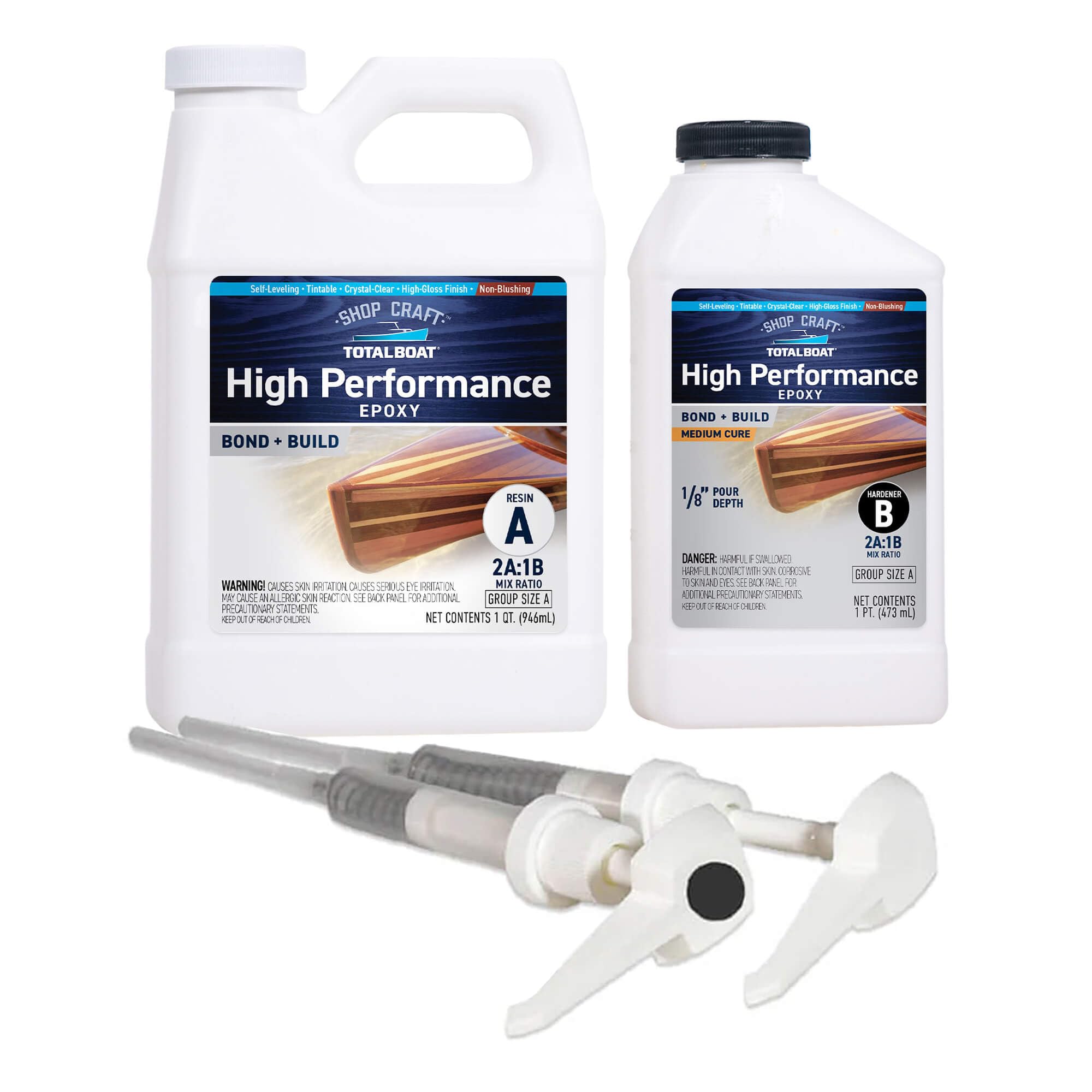
TotalBoat’s High Performance Epoxy is the benchmark for marine repair work, offering a low-viscosity formula that soaks into fiberglass and wood grain without leaving dry spots. The 2:1 mix ratio is forgiving, and the included calibrated pumps dispense exact proportions — you press the pump once for resin, once for hardener, and the ratio is locked in. Users consistently report strong bonds on transom repairs and deck laminations, with full cure in 48 hours.
The non-blushing hardener eliminates the waxy amine layer that typically forms between coats, so you can recoat without sanding between layers. This is a major time-saver for deep-pour sequences where you need multiple laminations in a single day. With Slow, Medium, and Fast hardener options, you can tune the open time to your workshop temperature — fast hardener for cold boathouses, slow for summer pours.
One drawback: the pump tubing is slightly too long for the bottle height, requiring a careful cut to avoid leaks. Some users also note the open time is shorter than advertised when mixing large batches, so start with small quantities until you dial in the working window. For structural boat repairs where adhesion strength is non-negotiable, this kit delivers professional-grade results without the premium markup.
Why it’s great
- Calibrated pumps ensure perfect 2:1 ratio every time
- Non-blushing hardener saves hours of inter-coat sanding
- Multiple hardener speeds for temperature flexibility
Good to know
- Pump tubing must be cut to fit the bottle
- Open time is short for large-volume pours
2. WEST SYSTEM 105A Epoxy Bundle

WEST SYSTEM has been the gold standard in marine epoxy since the 1970s, and the 105A bundle with 205 Fast Hardener brings that legacy into a compact kit. The 5:1 mix ratio produces a very thin resin — roughly 1000 centipoise — that wets out fiberglass cloth in seconds and penetrates hairline cracks in wood. With a pot life of only 9–12 minutes at 72°F, this is a fast system designed for experienced laminators who work quickly.
The 300 Mini Pumps included in the bundle meter the exact 5:1 ratio with one pump of each, delivering 0.8 fluid ounces of mixed epoxy per stroke. This eliminates weighing and measuring errors, which is critical when working with a fast hardener where even a 10% ratio deviation can ruin the cure. The cured epoxy reaches maximum strength in 1–4 days and bonds to wood, fiberglass, metal, and concrete with superior peel resistance.
One limitation: the 205 Fast Hardener is not intended for clear coating — it has a pale yellow tint and can blush in high humidity. For clear topcoats or river tables, you’d need the 207 Special Clear Hardener instead. But for structural marine bonding, filleting, and laminating where appearance is secondary to strength, this kit is unmatched. The brand’s reputation for consistency across decades speaks to its reliability in demanding marine environments.
Why it’s great
- Industry-standard 5:1 ratio for low-viscosity wet-out
- Mini pumps guarantee accurate metering
- Bonds to fiberglass, wood, metal, and concrete
Good to know
- Not for clear coating — tinted and may blush
- Very short pot life requires fast workflow
3. WiseBond Deep Pour Epoxy Resin

WiseBond’s Deep Pour Epoxy is the first resin on this list that balances marine-grade durability with food-safe certification (21 CFR 175.300 compliant). That matters when you’re building bar tops, cutting boards, or live-edge tables that will live in a coastal kitchen or marina bar. The 2:1 mix ratio delivers pours up to 2 inches per layer, with a full cure in 72 hours and a final hardness that resists scratches and heat.
The formula includes advanced UV resistance, which prevents the ambering that ruins clear epoxy within a year of sunlight exposure. Users consistently report crystal-clear results with no bubbles, thanks to the low viscosity that allows trapped air to escape naturally. The long open time — over an hour at 77°F — gives you room to work intricate color patterns or embed objects without rushing.
One trade-off: the slow cure means you need patience. Thin slabs can feel flexible for up to 7 days, and demolding before 72 hours risks warping. The manufacturer recommends pouring at 77–85°F in low humidity, which may require a heated workspace in cooler climates. For projects where optical clarity and UV stability are as important as structural strength, this is the premium choice.
Why it’s great
- Food-safe certification for direct food contact
- UV-stabilized resin resists yellowing
- Long open time for intricate color work
Good to know
- Full cure takes 72+ hours, 7 days for thin slabs
- Requires 77–85°F for optimal flow
4. TotalBoat Thickset Deep Pour Epoxy Resin
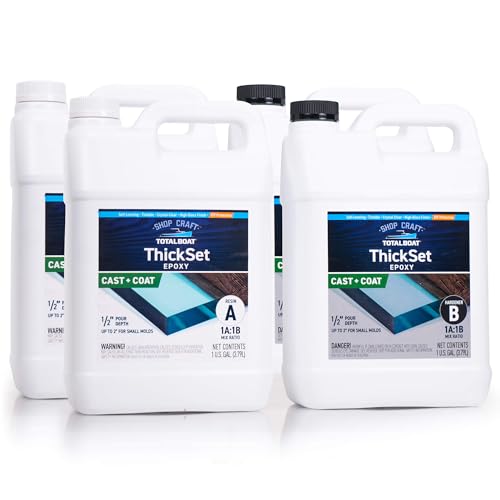
TotalBoat’s Thickset Deep Pour Epoxy shifts the mix ratio to a simple 1:1, which simplifies measuring for large-volume pours — no need for a scale or ratio calculations. The formula is designed for single-layer casts up to 2 inches thick in smaller molds, and 1/2 inch thick for large river table slabs. With a 24-hour demold time and full cure in 5 days, it’s one of the faster deep-pour options for production work.
The UV-resistant formulation prevents yellowing, and the self-leveling properties create a glass-like finish without brush strokes. Users who have built multiple river tables and cast carbon fiber parts report bubble-free results when mixed with an electric drill mixer. The 1:1 ratio also makes tinting predictable — add the same volume of colorant to both parts and the consistency stays uniform.
One consideration: the 48–72 hour cure time listed on some batches actually extends to 5 days for full hardness at 70°F. If you need to sand or machine the piece sooner, you may encounter gumming. The 4-gallon kit is a serious investment, but the per-ounce cost is among the best for a premium deep-pour resin. For high-volume casting where speed and simplicity matter, Thickset delivers consistent results.
Why it’s great
- Easy 1:1 mix ratio simplifies large batches
- 24-hour demold time for faster turnaround
- UV-resistant formula maintains clarity
Good to know
- Full hardness requires 5 days at 70°F
- Large kit size is a significant upfront investment
5. Teexpert Deep Pour Epoxy Resin

Teexpert’s Deep Pour Epoxy is engineered specifically for 2-to-4-inch pour depths, making it ideal for preserving flowers, building ocean dioramas, and casting thick decorative blocks. The proprietary 3X self-defoaming formula reduces bubbles without needing a pressure pot — a significant advantage for home users. Post-cure hardness exceeds 85D, meaning the surface resists scratches and impacts better than standard 1:1 craft resins.
The 2:1 mix ratio and 60–80 minute working time give you room to layer colors, embed objects, and degas before the exotherm sets in. Users report that the resin mixes bubble-free even when stirred vigorously, and that a brief heat-gun pass on the surface eliminates any remaining micro-bubbles. The kit includes four precise mixing cups and a sturdy mixing attachment, which add tangible value for first-time deep-pour users.
One note: the slow cure (48–72 hours to demold, longer for full hardness) makes color blending tricky — alcohol inks can bleed into unintended areas if you pour layers too soon. Users recommend waiting at least 6 hours between layers to achieve crisp color separation. For artistic projects where the resin is the star and you want a rock-hard, crystal-clear finish, this is a top-tier choice at a reasonable buy-in.
Why it’s great
- 3X self-defoaming formula reduces bubbles
- 85D hardness for scratch resistance
- Includes mixing cups and attachment
Good to know
- Slow cure complicates color layering
- Thicker than some competitors, harder to pour
6. Magic Resin Deep Pour Epoxy

Magic Resin’s Deep Pour Epoxy is the budget-conscious entry that still delivers legitimate 2-inch pour depths and a clear, bubble-free finish. The 2:1 mix ratio is standard for deep-pour resins, and the low viscosity allows it to self-level in melamine molds without manual spreading. At 70–73°F, the open time stretches to several hours, giving beginners a forgiving window to correct mistakes and embed objects.
The formula is scratch-resistant and water-resistant, with no blushing or sweating in high humidity — a critical feature for marine workshop environments. Users who have built multiple river tables and cutting boards report glass-clear results when they follow the simple instructions: mix thoroughly and cure in a room above 75°F. The 1.5-gallon size is perfect for a single river table or a series of smaller casts.
The main limitation is the thin consistency: it doesn’t hold colored ribbon patterns or mica swirls well, so it’s best for monotone pours or clear casting. Some users also note a slight yellow tint in the resin vs. hardener, though the final cure is water-clear. For dioramas, floral preservation, and clear deep-pour blocks where you don’t need complex color patterns, this value pack performs admirably without breaking the budget.
Why it’s great
- Excellent value for deep-pour clear casting
- Long open time is forgiving for beginners
- No blushing or sweating in high humidity
Good to know
- Thin consistency doesn’t hold color patterns
- Requires 75°F+ ambient for optimal cure
7. Shabebe Deep Pour Epoxy Resin
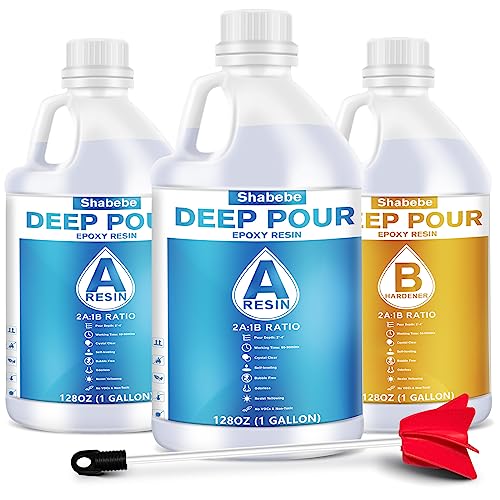
Shabebe’s 3-gallon kit is designed for 2-to-4-inch pour depths and is ideal for large river tables, bar counters, and multi-layer pyramid castings. The formula is crystal clear with a glossy, self-leveling finish that enhances the natural wood grain or embedded objects. The 60–80 minute working time gives you ample opportunity to pour and arrange complex patterns before the resin gels.
The cured hardness of 85D and UV-resistant formulation make this suitable for furniture that will see daily use near windows or in partially covered outdoor spaces. The manufacturer also claims food-grade safety — once fully cured, the surface is safe for charcuterie boards and serving trays. Users who have embedded dried flowers in deep molds report fewer bubbles than with other resins, especially when poured in 1/2-inch layers with 8-hour waits between.
One downside: the recommended ambient temperature is 68°F or lower, which is counterintuitive for many resin users accustomed to 75°F+. Pours at higher temperatures can accelerate the exotherm and cause cracking in deep sections. Also, the volume-based measurement system is prone to errors — experienced users recommend converting to weight (100ml A = 118g, B = 102.3g) for accuracy. For patient pourers who work in controlled temperatures, this kit offers the deepest single-pour capability at a budget-friendly price point.
Why it’s great
- Handles 2–4” pours in a single layer
- Food-safe certification for serving surfaces
- Low bubble formation in layered pours
Good to know
- Optimal cure temp is 68°F or lower
- Volume measurement can lead to ratio errors
FAQ
Can I use a standard tabletop epoxy for boat repairs?
How do I prevent bubbles in a 2-inch deep pour?
What is the ideal temperature for curing marine epoxy?
Is deep pour epoxy food safe after curing?
Final Thoughts: The Verdict
For most users, the best deep pour epoxy for marine use winner is the TotalBoat High Performance Epoxy Kit because its non-blushing hardener, calibrated pumps, and multiple hardener speeds make it the most versatile choice for hull repairs, laminations, and coatings. If you want UV resistance and food-safe certification for a live-edge bar top, grab the WiseBond Deep Pour Epoxy Resin. And for thick artistic pours where flawless clarity is the priority, nothing beats the Teexpert Deep Pour Epoxy Resin with its 3X self-defoaming and 85D hardness.

Mo Maruf
I created WellFizz to bridge the gap between vague wellness advice and actionable solutions. My mission is simple: to decode the research and give you practical tools you can actually use.
Beyond the data, I am a passionate traveler. I believe that stepping away from the screen to explore new environments is essential for mental clarity and physical vitality.