Our readers keep the lights on and my smoothie glass nicely filled. As an Amazon Associate, I earn from qualifying purchases.
When summer pavement in Arizona hits 160°F, a standard dash cam’s battery swells, its lens delaminates, and its recording simply stops until it cools down—leaving you blind during the very moments you need evidence most. Heat tolerance isn’t optional here; it’s the difference between a reliable witness and a paperweight.
I’m Mohammad Maruf — the founder and writer behind WellFizz. I’ve spent dozens of hours dissecting dash cam thermal specs, battery chemistry, capacitor types, and real-world user accounts from drivers in Phoenix, Tucson, and Las Vegas to build this guide specifically for extreme heat survival.
After cross-referencing maximum operating temperatures, adhesive mount ratings, and internal component quality across seven leading models, I’ve identified the ones that won’t quit when the mercury spikes. This is your definitive best dash cam for arizona heat, built to hold up inside a car that’s been baking in direct sun for eight hours.
How To Choose The Best Dash Cam For Arizona Heat
Arizona’s climate demands more than just high-resolution video. The real test is whether the camera can withstand prolonged exposure to cabin temperatures that routinely exceed 140°F. Here’s what matters most when shopping for a heat-ready dash cam.
Super Capacitor vs. Lithium-Ion Battery
Lithium-ion batteries degrade quickly above 140°F and can swell or even rupture. Super capacitors, on the other hand, handle extreme heat with no chemical degradation and recharge faster. Every recommended model in this guide uses a super capacitor or is explicitly designed to survive high heat without battery failure.
Maximum Operating Temperature Rating
Look for a rated operating range that exceeds 158°F (70°C). Many budget cameras top out at 140°F, which means they fail inside a parked car during a June afternoon. Premium models with STARVIS 2 sensors and industrial-grade components are typically rated higher and tested for desert conditions.
Adhesive Mount and Electrostatic Stickers
Standard 3M adhesive can soften and slide off a windshield that’s been sitting in direct sun. The best dash cams for Arizona heat include electrostatic stickers or high-temperature adhesive pads that maintain grip at 170°F+. A camera that falls off the windshield mid-drive is useless regardless of its video quality.
HDR for Glare and WDR for Shadows
Desert driving means facing brutal morning glare, intense overhead sun, and deep shadows from highway overpasses. HDR (High Dynamic Range) handles extreme brightness differences in a single frame, while WDR (Wide Dynamic Range) balances exposures across the whole image. For Arizona, HDR is more critical for capturing license plates in blinding light.
Quick Comparison
On smaller screens, swipe sideways to see the full table.
| Model | Category | Best For | Key Spec | Amazon |
|---|---|---|---|---|
| ROVE R2-4K Dual PRO | Premium | Day/Night Clarity & Speed | Dual STARVIS 2 IMX678+IMX675 | Amazon |
| 70mai T800E | Mid-Range | 3-Channel Rideshare Protection | Super Capacitor, 140°F Rated | Amazon |
| AZDOME M550 Max | Mid-Range | Triple Channel & Magnetic Mount | Dual STARVIS Sensors, WiFi | Amazon |
| REDTIGER F7N Pro | Mid-Range | Set-and-Forget Simplicity | STARVIS 2, 170° FOV Front | Amazon |
| Pelsee P1 Pro | Mid-Range | Full-Color Night & ADAS Alerts | STARVIS 2, HDR+WDR Front | Amazon |
| DDPAI N5 Dual | Mid-Range | Built-in eMMC Storage Reliability | 32GB eMMC + 512GB Expandable | Amazon |
| FAIMEE 4K+2K | Budget | Entry-Level Heat Survival | 4K+2K, 64GB Card Included | Amazon |
In‑Depth Reviews
1. ROVE R2-4K Dual PRO
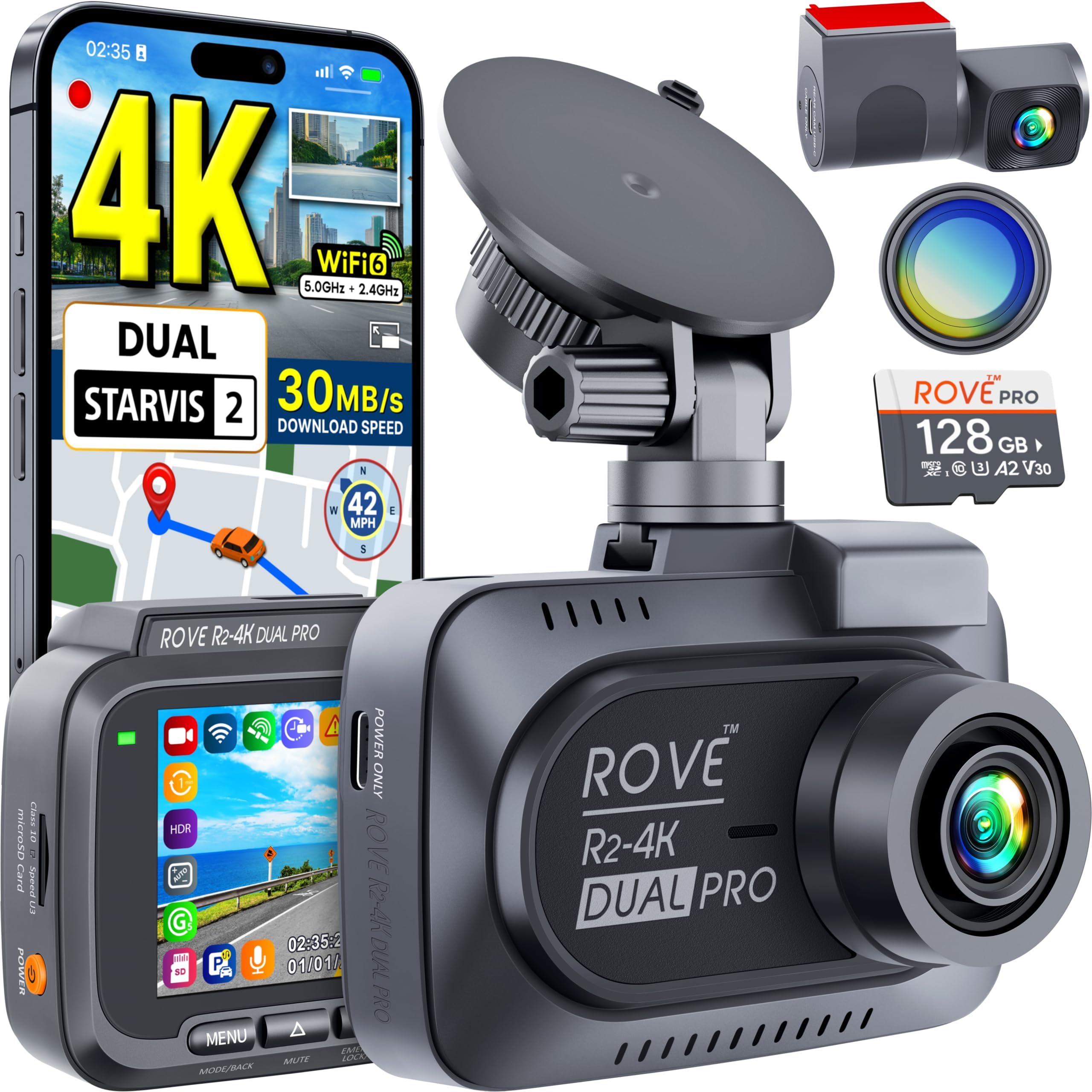
The ROVE R2-4K Dual PRO is the only model here pairing Sony’s latest STARVIS 2 IMX678 front sensor with the IMX675 rear sensor, delivering 4K front and true 2K rear recording at 30fps. This sensor combination provides exceptional light sensitivity and noise reduction in the challenging high-contrast conditions of Arizona’s midday sun and sudden tunnel shadows. The included 128GB ROVE PRO microSD card and CPL filter mean you’re ready to record immediately without buying accessories.
Built around a super capacitor power system, the ROVE handles extended heat exposure without battery swelling. The dual-band WiFi 6 module pushes download speeds up to 30MB/s, which is useful when you need to transfer a large 4K clip to your phone before leaving the scene. The quad-mode GPS (GPS, BeiDou, Galileo, GLONASS) logs precise route and speed data, viewable through the free ROVE GPS Player software.
Parking mode offers three options—time-lapse, motion detection, and collision detection—each recording a full 1-minute locked event when triggered. The app interface takes some time to learn, and the rear camera has occasionally been reported freezing after extended idle periods in cold conditions, but for punishing desert heat, this system is the most thermally capable unit tested. Its 1TB maximum storage support also outpaces every other model here.
Why it’s great
- Dual STARVIS 2 sensors for best-in-class low-light and glare handling
- Super capacitor design eliminates heat-related battery failure
- Includes 128GB card and CPL filter in the box
- WiFi 6 with 30MB/s download speeds
- Supports up to 1TB microSD for extended recording
Good to know
- App interface has a learning curve
- OCasional rear camera freeze after long idle periods
- Parking mode requires separate hardwire kit purchase
2. 70mai T800E

The 70mai T800E is the only three-channel dash cam on this list that explicitly advertises a super capacitor power system rated for temperatures from 14°F to 140°F. This makes it uniquely suited for Arizona’s heat while also covering the interior cabin—an essential feature for rideshare drivers, parents monitoring teenage drivers, or anyone who wants a full 360-degree view. The front camera captures 4K at 30fps with an F1.55 aperture, while both the interior and rear cameras record at 1080P.
The interior camera includes switchable IR night vision, which can be toggled on for dark cabin recording or off for privacy. Wi-Fi 6 support enables file transfers up to 10MB/s through the 70mai App, roughly five times faster than older Wi-Fi 4 systems. The built-in 5-mode GPS provides accurate speed, route, and location tracking that overlays onto your footage. A 64GB SD card is included, and the unit supports expansion up to 512GB.
Parking monitoring works with G-sensor collision detection and motion-triggered recording, though a hardwire kit is required for continuous 24/7 coverage. The app connection can occasionally be finicky, and the unit does not support 4G connectivity for remote alerts. But for a triple-channel setup that won’t fail in a hot parked car, the T800E is the most complete heat-tolerant option available at this price tier.
Why it’s great
- Three channels cover front, cabin, and rear simultaneously
- Super capacitor rated up to 140°F for reliable heat survival
- Switchable IR night vision for interior recording
- Wi-Fi 6 for fast file transfers through the app
- 64GB card included, supports up to 512GB
Good to know
- No 4G connectivity for remote parking alerts
- App connection can be unreliable at times
- Parking mode requires separate hardwire kit
3. AZDOME M550 Max
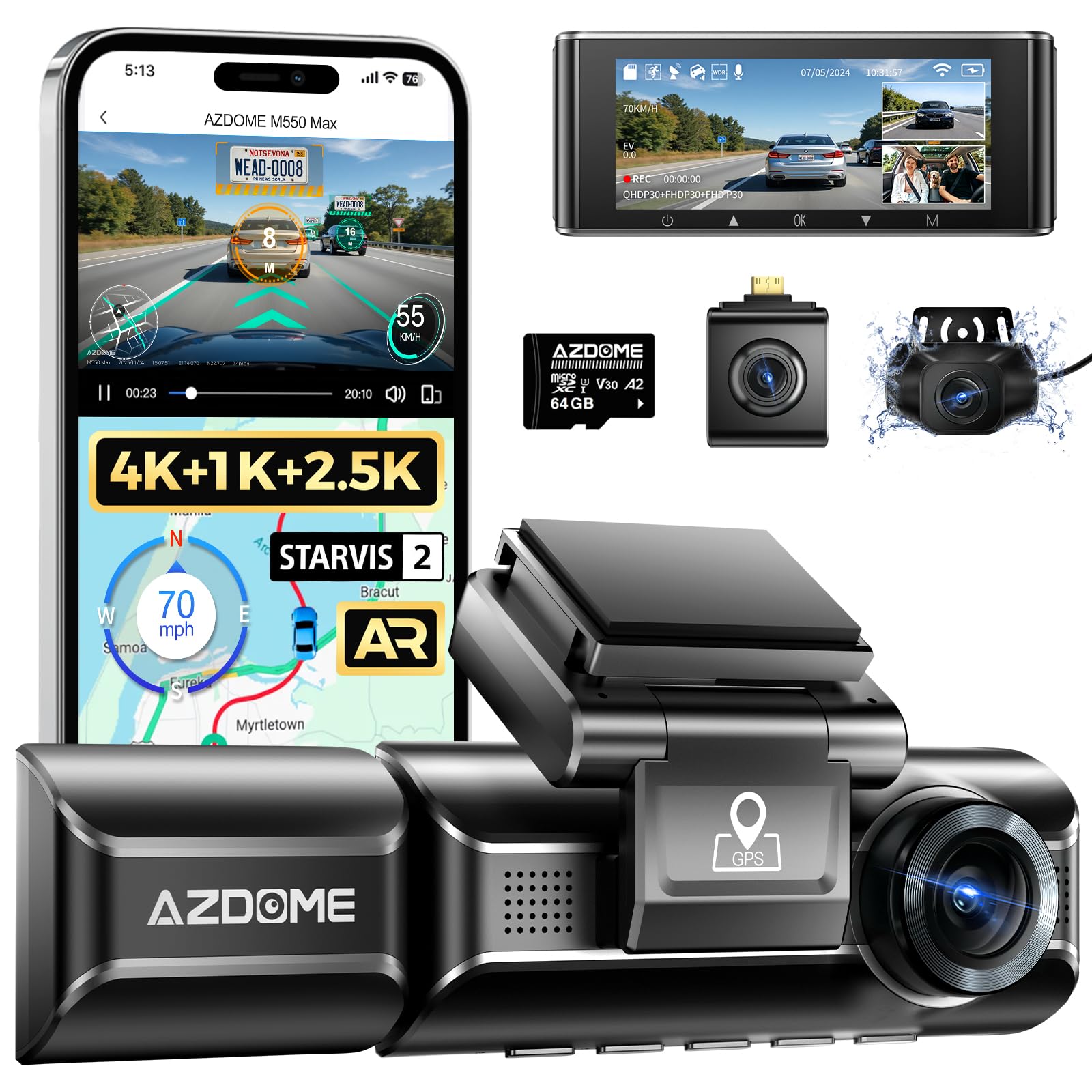
The AZDOME M550 Max distinguishes itself with a magnetic mount that makes removal and reattachment far quicker than traditional fixed mounts—useful when you need to stow the camera to prevent theft or heat exposure when parking in extreme sun. It records 4K front, 2.5K rear, and 1080P interior through three channels, with dual STARVIS sensors improving low-light and high-glare performance. The 2.5K rear capture is noticeably sharper than standard 1080P rear cameras, providing better detail in tailgating or rear-end scenarios.
The AZDOME app includes timeline playback, route map review, OTA updates, and AR-assisted playback features that make footage review more intuitive than basic dash cam apps. The interior camera includes IR night vision for cabin recording in dark conditions. A 64GB card is included, and the system supports up to 512GB expansion. The IP68-rated rear camera adds an extra layer of weather and dust resistance that is welcome in Arizona’s dusty conditions.
Parking mode offers motion detection, collision-triggered recording, and time-lapse functions, though the hardwire kit is sold separately. Some users report that the front camera angle sits too high on vehicles with steep windshields, occasionally requiring a replacement bracket from customer support. Still, for the combination of magnetic convenience, 2.5K rear detail, and triple-channel coverage, this is a strong mid-range heat contender.
Why it’s great
- Magnetic mount for quick removal and reattachment
- 2.5K rear recording gives sharper detail than typical 1080P
- Triple-channel coverage with dual STARVIS sensors
- IP68-rated rear camera resists dust and moisture
- AR-assisted playback features in the app
Good to know
- Front camera angle may be too high for steep windshields
- Parking mode requires separate hardwire kit
- App connectivity can be buggy
4. REDTIGER F7N Pro
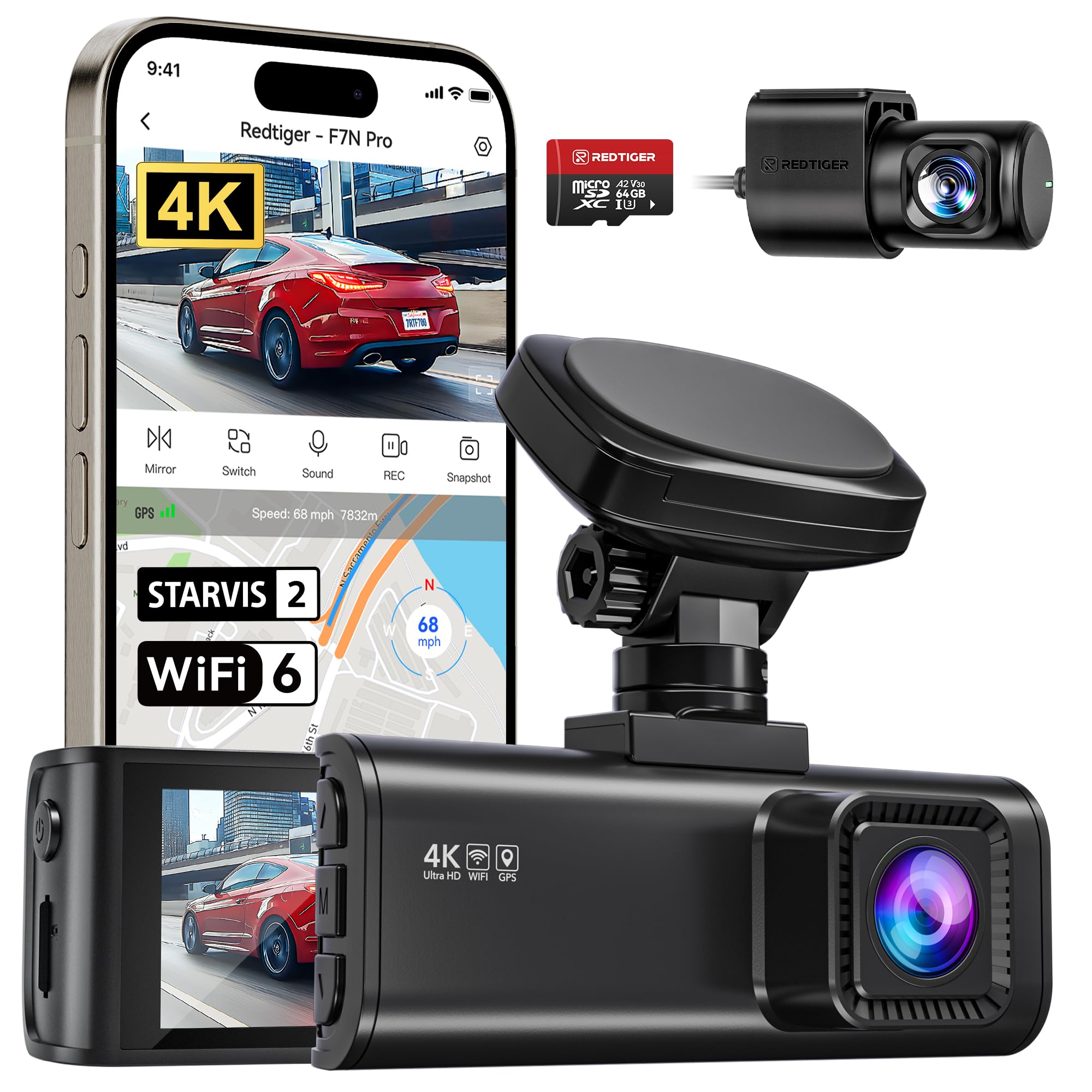
The REDTIGER F7N Pro uses a STARVIS 2 image sensor on the front camera paired with an F1.5 aperture and six-layer optical lens, providing strong glare suppression during Arizona’s intense midday sun. The front records true 4K at 3840x2160P, while the rear captures 1080P FHD at 140° wide angle. The 170° front field of view covers up to six lanes, reducing blind spots around intersections and highway merges.
A 64GB memory card is included, and the system supports expansion up to 256GB. Built-in GPS logs speed, route, and location data that overlays onto your footage. The REDTIGER app enables wireless video viewing, download, and OTA firmware updates. Voice control handles basic commands like photo capture and video lock without requiring hands-on interaction with the 3.18-inch IPS screen.
Parking monitoring triggers a 15-second event recording when the G-sensor detects impact during parking, and time-lapse mode can record continuously at low power draw. The adhesive mount is strong, and included electrostatic stickers provide extra grip on hot windshields. The app interface feels dated and the WiFi connection can be spotty, but the core video quality and heat resilience are solid for the price. This is a reliable set-and-forget option for drivers who prioritize simplicity.
Why it’s great
- STARVIS 2 sensor with F1.5 aperture for strong glare handling
- 170° front field of view covers multiple lanes
- Built-in GPS with speed and route overlay
- 64GB card included, supports up to 256GB
- Voice control for hands-free operation
Good to know
- App interface feels outdated and WiFi can be unreliable
- Small 3.18-inch screen may be hard to read at a glance
- Parking mode requires separate hardwire kit
5. Pelsee P1 Pro
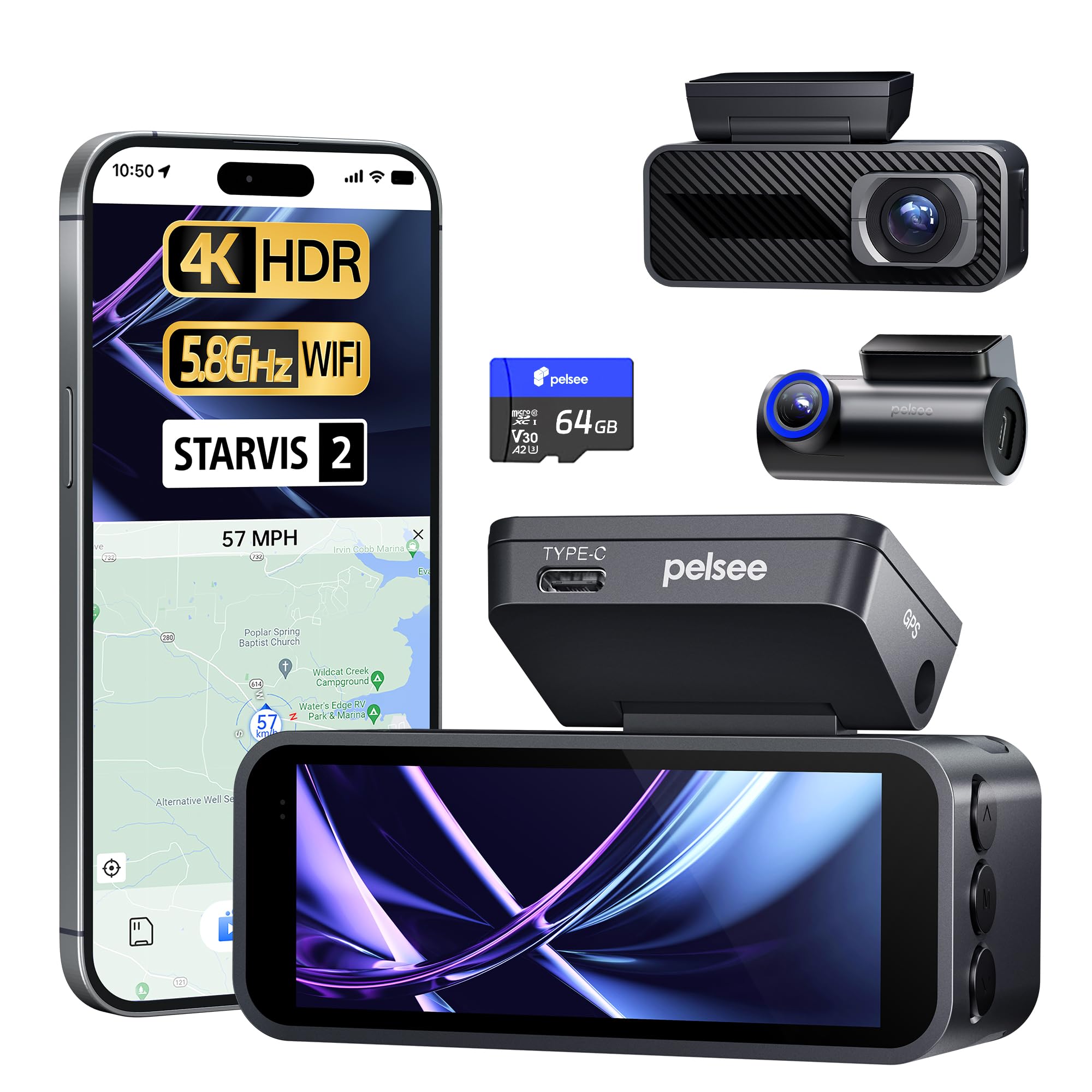
The Pelsee P1 Pro stands out for its combination of STARVIS 2 sensor technology and full-color night vision, which works in starlight conditions without switching to black-and-white infrared. This is particularly useful for Arizona’s long twilight hours and poorly lit parking lots. The front camera records 4K with HDR to cut through glare, while the rear captures 1080P with WDR to balance exposures when exiting tunnels or overpasses into bright sunlight.
The built-in ADAS (Advanced Driver Assistance System) provides forward collision warnings, pedestrian alerts, lane departure warnings, and front vehicle start reminders—visual and audible cues that trigger within 0.8 to 2 seconds. Eight voice commands allow hands-free operation, including locking video clips and snapping photos. The 5.8GHz dual-band WiFi enables real-time viewing and downloading through the Pelsee Cam app, and the GPS module embeds speed, coordinates, and timestamps into your footage.
Parking mode uses G-sensor impact detection and time-lapse recording for 24-hour surveillance, but a hardwire kit is required. The adhesive mount is secure on hot glass, though some users report the included power cable is longer than necessary for smaller vehicles, requiring extra tucking. The 3.39-inch IPS screen is generous for live previews and menu navigation. For drivers who want smart safety alerts alongside reliable recording, the P1 Pro delivers premium features at a mid-range price.
Why it’s great
- STARVIS 2 sensor with full-color night vision in starlight
- ADAS alerts for collision, pedestrian, and lane departure
- Eight voice commands for hands-free control
- 5.8GHz dual-band WiFi for fast transfers
- 3.39-inch IPS screen for easy menu navigation
Good to know
- Power cable may be longer than needed for smaller cars
- Parking mode requires separate hardwire kit
- App interface can be slow to connect initially
6. DDPAI N5 Dual
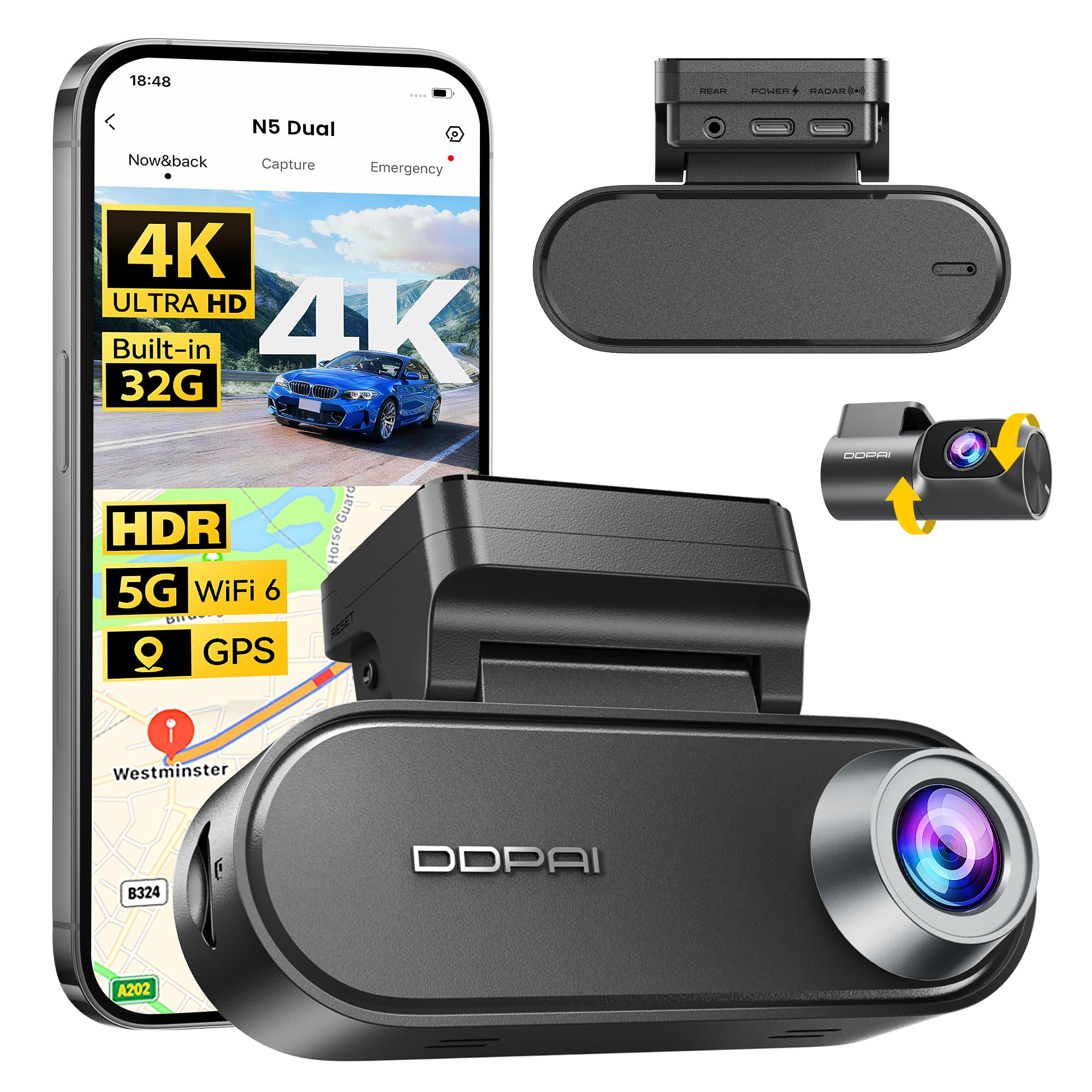
The DDPAI N5 Dual takes a different approach to reliability by including 32GB of built-in eMMC storage alongside expandable TF card support up to 512GB. This dual-storage design protects against memory card corruption—a real concern when extreme heat degrades standard microSD cards over time. The front camera records 4K at 30fps with a 150° wide-angle lens, while the rear records 1080P. AI-ISP image processing and HDR technology ensure clear footage in the harsh light transitions common in desert driving.
The screenless design keeps the unit compact and discreet behind the rearview mirror, avoiding direct sun exposure on a display that could heat up. The DDPAI app connects via WiFi 6 for fast downloads and supports SR 2.0 visual driving data, including route information, vehicle distance, acceleration, braking, and lane deviation. ADAS alerts include forward vehicle movement reminders and fatigue driving notifications. The built-in GPS logs speed, route, and location.
Parking mode offers 72-hour radar motion detection for extended surveillance while parked, but requires a hardwire kit and separate radar module. User reviews confirm the aluminum frame provides excellent heat dissipation, and multiple owners report trouble-free performance through Arizona summers. The lack of a display means you can’t review footage on the unit itself, and some users wish for a voice command to mark specific video segments. Still, for storage reliability and thermal management, this is a smart choice.
Why it’s great
- 32GB built-in eMMC prevents card corruption in high heat
- Screenless design stays cool and discreet behind mirror
- Aluminum frame provides excellent heat dissipation
- 72-hour radar parking mode for extended surveillance
- WiFi 6 for fast app downloads
Good to know
- No display for on-the-spot footage review
- Parking mode requires hardwire kit and radar module
- No voice command to mark specific video segments
7. FAIMEE 4K+2K
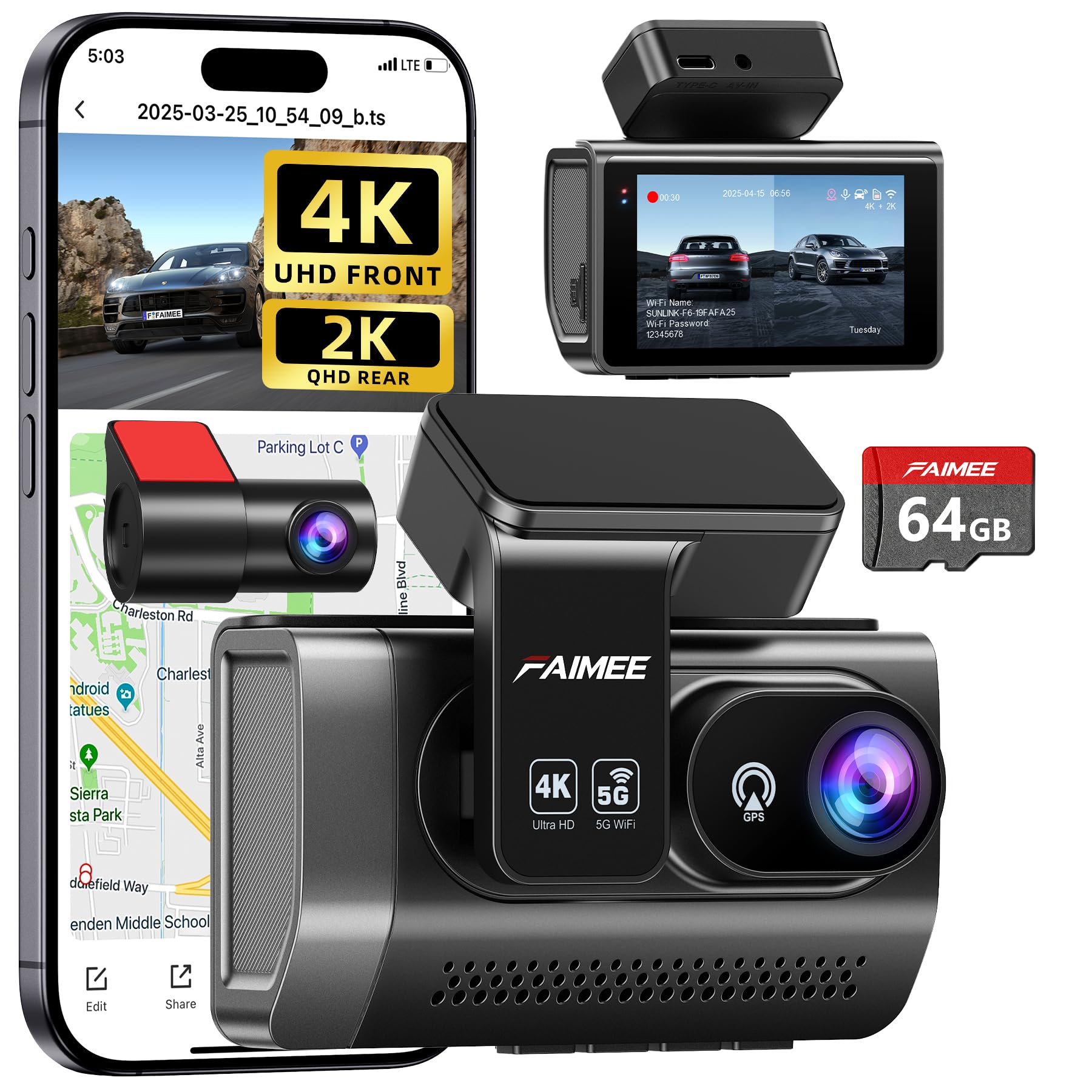
The FAIMEE 4K+2K dual dash cam delivers impressive core specs for its budget tier, including 4K front recording at 3840x2160P and 2K rear recording at 2304x1296P, both with F1.8 aperture lenses and 170° wide-angle coverage. The WDR and night vision enhancements help balance exposure in high-contrast conditions, though it lacks the dedicated HDR found in higher-tier models. A 64GB high-endurance memory card is included, with support for expansion up to 256GB.
Built-in GPS tracks speed, route, and location coordinates, while dual-band WiFi (5.8GHz and 2.4GHz) enables connection to the FAIMEE app for live viewing and downloads. The 3-inch IPS screen is smaller than some competitors but sufficient for basic menu navigation and angle adjustment. Time-lapse parking mode provides 24-hour surveillance, with G-sensor impact detection automatically locking event recordings. A hardwire kit is required for continuous parking monitoring.
This unit uses a super capacitor power system, which is critical for Arizona heat survival at this price point. The adhesive mount and included installation tool make setup straightforward, though some users note the cable length may be short for larger vehicles like vans or trucks. Rear camera installation in SUVs can be challenging, and the menu interface is somewhat confusing. For budget-conscious drivers who still need a heat-tolerant dash cam with 4K+2K resolution, this is the entry-level option to consider.
Why it’s great
- 4K front and 2K rear recording at a budget price
- Super capacitor design for heat survival
- 64GB card included with support for 256GB expansion
- Built-in GPS with speed and route logging
- Dual-band WiFi for app connectivity
Good to know
- Rear camera installation is difficult on SUVs
- Cable length may be too short for larger vehicles
- Menu interface is confusing and poorly translated
- Parking mode requires separate hardwire kit
FAQ
Can I leave a dash cam in my car during an Arizona summer?
Does HDR or WDR matter more for desert glare?
How often should I replace the adhesive mount in high heat?
Will parking mode drain my car battery in extreme heat?
Final Thoughts: The Verdict
For most users, the best dash cam for arizona heat winner is the ROVE R2-4K Dual PRO because it pairs dual STARVIS 2 sensors with a super capacitor power system and includes a 128GB card and CPL filter right out of the box—delivering unmatched heat resilience and video clarity. If you want three-channel coverage for rideshare or family monitoring, grab the 70mai T800E for its dedicated super capacitor and 140°F rating. And for budget-conscious drivers who still need 4K+2K recording that won’t fail in triple-digit heat, nothing beats the FAIMEE 4K+2K.

Mo Maruf
I created WellFizz to bridge the gap between vague wellness advice and actionable solutions. My mission is simple: to decode the research and give you practical tools you can actually use.
Beyond the data, I am a passionate traveler. I believe that stepping away from the screen to explore new environments is essential for mental clarity and physical vitality.