Our readers keep the lights on and my smoothie glass nicely filled. As an Amazon Associate, I earn from qualifying purchases.
That gut feeling you get when you drive two hours to check a trail camera only to find a memory card full of blurry, overexposed night shots or, worse, an empty card from a camera that went silent weeks ago is exactly why the right deer camera cellular matters. A cellular model eliminates that drive, sending photos straight to your phone on its own schedule. The catch is that camera reliability, image clarity, and signal strength vary wildly, and a bad choice locks you into a subscription for unusable photos.
I’m Mohammad Maruf — the founder and writer behind WellFizz. I’ve spent countless hours researching cellular camera hardware, parsing real user feedback from multi-season deployments, and analyzing the specific specs that separate a camera you forget about in the woods from one you constantly troubleshoot.
The goal of this guide is to cut through the marketing noise and help you find the most reliable best deer camera cellular for your specific hunting property, budget, and tolerance for tinkering.
How To Choose The Best Deer Camera Cellular
The cellular trail camera market has matured rapidly, but not all models deliver equal reliability. Before you buy, focus on three pillars that define real-world performance: how the camera connects, how it captures images at night, and how it powers itself through an entire season.
Cellular Connectivity and Carrier Support
A deer camera cellular is only as good as its signal. Single-carrier models (locked to AT&T or Verizon only) can fail if you place them in a zone where the other carrier has stronger coverage. Multi-carrier or dual-SIM cameras automatically switch to the strongest available network, which often means the difference between receiving photos and coming back to an offline camera. Always check which bands a camera supports and whether it allows automatic carrier switching without a SIM swap.
Flash Type and Image Quality at Night
Nighttime scouting is the primary reason to own a cellular camera. Low-glow IR produces a faint red glow that deer quickly learn to avoid, burning your spot within a few nights. No-glow (940nm) flash is invisible to both human and animal eyes, keeping the area undisturbed. Some premium cameras also offer dual-mode flash, letting you switch between no-glow and low-glow settings via the app, which gives you flexibility for security-focused placement where visible deterrence is acceptable.
Power Management and Battery Life
Battery drain is the top complaint among cellular camera owners. The cellular transmitter draws significant power every time it sends a photo. Standard AA alkalines may last 3-6 weeks in high-activity areas. Lithium AA cells extend that to 3-4 months. The real game-changer is a built-in solar panel or a separate solar panel bundle. Cameras like the SPYPOINT Flex-S-Dark include an integrated solar panel and rechargeable battery that can run 6-11 months without intervention, turning a cellular camera into a truly set-and-forget tool.
Quick Comparison
On smaller screens, swipe sideways to see the full table.
| Model | Category | Best For | Key Spec | Amazon |
|---|---|---|---|---|
| Tactacam Reveal X 3.0 | Premium | Best Overall Reliability | 6+ month battery (lithium pack) | Amazon |
| SPYPOINT Flex-S-Dark | Premium | Zero Battery Changes | Built-in solar, up to 11 months power | Amazon |
| Moultrie Edge 2 Pro | Mid-Range | Best App Integration | 8GB built-in + cloud backup | Amazon |
| Stealth Cam Revolver | Mid-Range | 360° Coverage | 360-degree panoramic field of view | Amazon |
| SPYPOINT Flex-M Solar | Premium | Solar Bundle Value | 28MP + included solar panel | Amazon |
| Tactacam Reveal X Gen 3.0 (2-Pack) | Premium | Multi-Camera Setup | 2 cameras + 2x 32GB SD cards | Amazon |
| Stealth Cam Deceptor No Glo | Mid-Range | Budget Entry Point | 0.3s trigger, 80ft no-glow range | Amazon |
In‑Depth Reviews
1. Tactacam Reveal X 3.0 Cellular Trail Camera
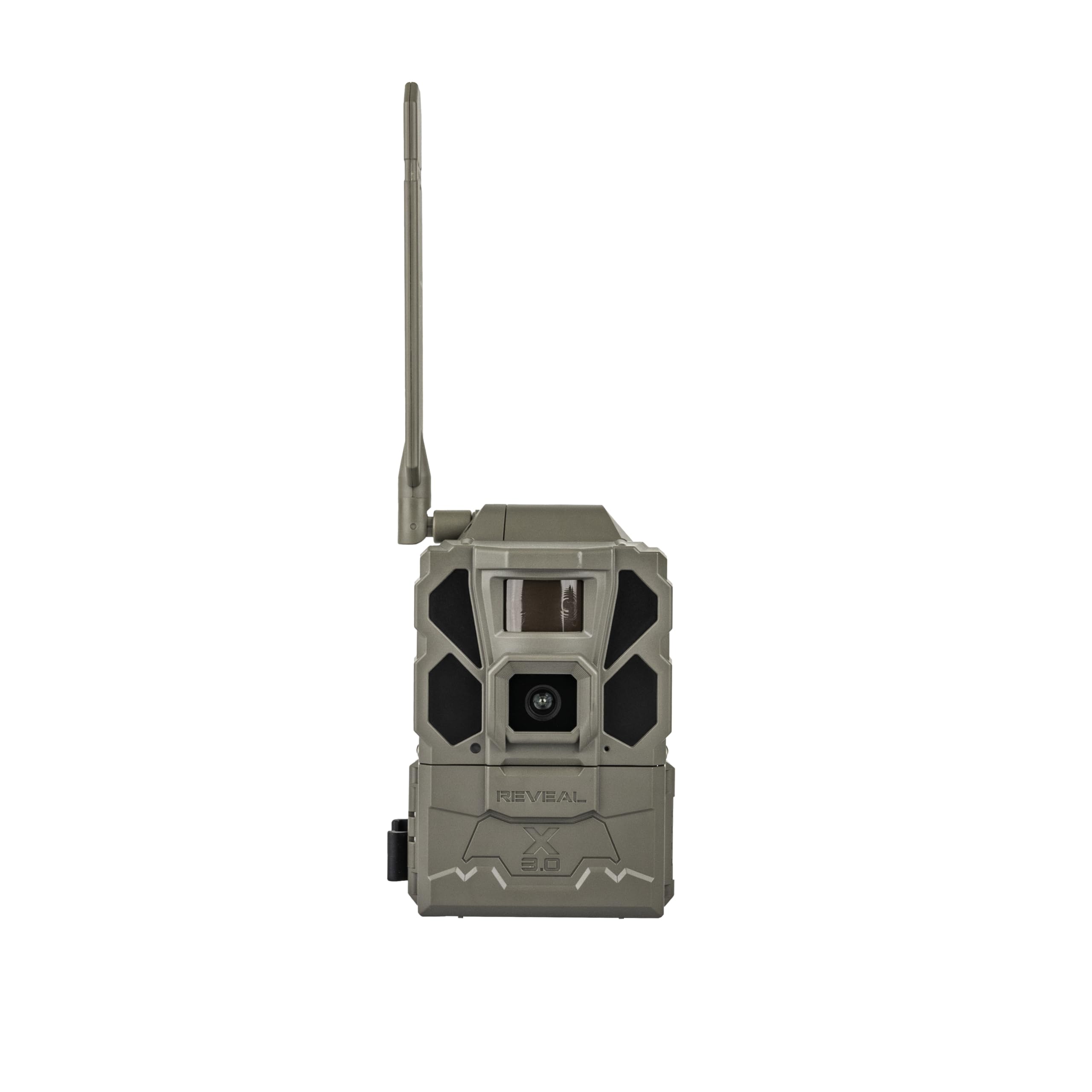
The Tactacam Reveal X 3.0 has earned a reputation as the most reliable mid-premium cellular camera on the market because it eliminates the two biggest failure points in the category: carrier lock-in and SD card dependency. The multi-carrier SIM automatically chooses between AT&T and Verizon based on whichever signal is stronger at your camera location, which matters when you place a camera in a bottom hardwood drain where a single carrier drops to one bar. Independent testing consistently shows this model delivers the longest battery life in its class, running over six months on a single set of lithium batteries paired with the optional lithium power pack.
The 0.5-second trigger speed and 3-shot burst mode increase your odds of capturing a buck that passes through the frame in under a second, which is exactly the scenario that frustrates slower cameras. Image quality at night is solid thanks to the low-glow IR flash, though it is not invisible—mature deer will notice the faint red glow over time. The REVEAL app is clean and intuitive, offering remote setting changes and on-demand photo requests without lag. The built-in GPS also helps you locate a camera that might get shifted by a bear or knocked loose by wind.
Rural landowners frequently use this model for remote property monitoring beyond hunting, such as tracking equipment or checking gates on acreage without Wi-Fi. The setup process takes under ten minutes out of the box because the antenna and SIM are pre-installed. The one real downside is the subscription cost—Tactacam plans are not the cheapest in the space, and high-resolution video downloads can be slow on weak signals. Still, for sheer field reliability and image consistency, this camera is the benchmark that other cellular cameras measure themselves against.
Why it’s great
- Multi-carrier LTE ensures connectivity even in weak-signal zones
- Best battery life in class with optional lithium pack
- No SD card needed; built-in storage simplifies setup
Good to know
- Low-glow IR is visible to deer over time; not fully covert
- Subscription costs add up, especially with multiple cameras
- HD video downloads can be slow on marginal signals
2. SPYPOINT Flex-S-Dark Solar Cellular Trail Camera
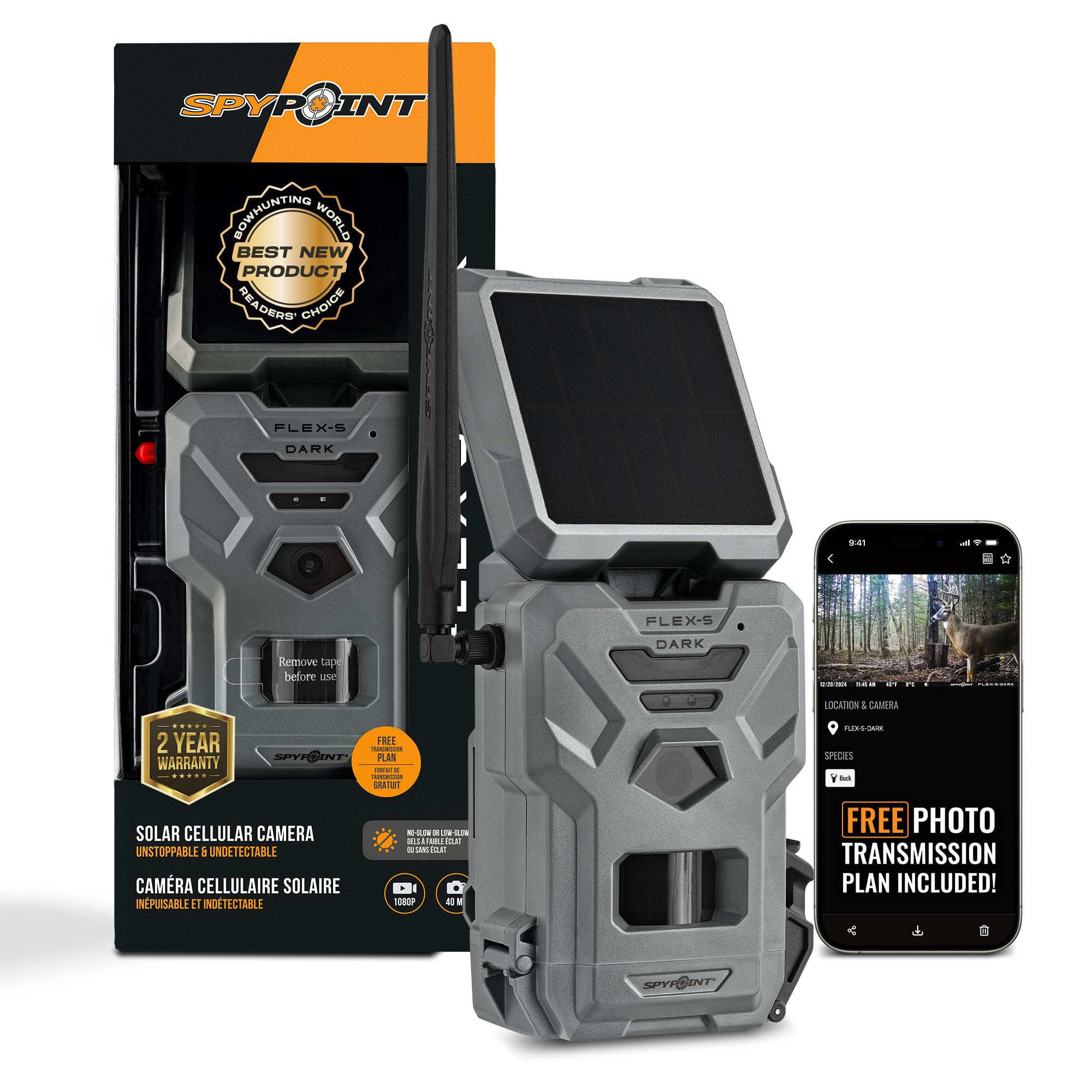
The SPYPOINT Flex-S-Dark redefines hands-off operation by integrating the solar panel directly into the camera body, eliminating the need for an external panel or extra cables. SPYPOINT claims the internal rechargeable battery replaces up to 1,000 standard AA batteries, and field reports confirm that with moderate daily traffic, the camera can run over six months without manual intervention. The no-glow IR flash is truly invisible to game, which is critical for high-pressure public land or small private parcels where deer pattern your camera locations quickly.
Image quality reaches 40MP photos and 1080p video with sound, and the camera offers both no-glow and low-glow settings that you can switch remotely via the SPYPOINT app. The app also supports live streaming video, which is a unique feature in this price tier that lets you check an area in real time before walking in for a hunt. The free plan includes 100 photos per month with no credit card required, which is enough for a low-traffic property. Paid plans scale from 250 photos to unlimited, and the SPYPOINT Insiders Club offers bundled discounts for multiple cameras.
The durable ghost-grey casing and upgraded latch designed for cold-weather use make this camera a solid choice for northern hunters. The main complaint from users is that the “Unlimited Premium” plan does not cover video transmission without an additional fee, and the camera captures either stills or video per event, not both simultaneously. The app also occasionally produces overexposed daytime images in direct sunlight. Nevertheless, for hunters who want to visit their camera once a year, this is the strongest option available.
Why it’s great
- Built-in solar panel and rechargeable battery eliminate battery changes
- True no-glow IR flash keeps your spot undisturbed
- Free 100-photo monthly plan lowers long-term cost
Good to know
- Unlimited plan has separate fee for video transmission
- Cannot capture stills and video simultaneously per trigger
- Occasional overexposed daytime images reported
3. Moultrie Edge 2 Pro Cellular Trail Camera

The Moultrie Edge 2 Pro stands out for its deep software integration rather than raw hardware specs. It integrates directly with the onX Hunt app, meaning your scouting photos automatically appear on your onX maps alongside your property pins and boundaries—a feature that digital scouting enthusiasts will find transformative. The camera captures 40MP stills and 1440p video with HD audio, and the “Live Aim” feature lets you see the camera’s exact field of view on your phone before finalizing placement, eliminating guesswork during setup.
The AI false-trigger elimination is genuinely effective in real-world use. The camera uses motion detection paired with AI classification to filter out blowing grass, heat mirages, and passing vehicles before they waste your cellular data allocation. The 8GB of built-in memory means you do not need an SD card unless you want one for local backup, and the unlimited cloud backup removes the worry of filling up storage. Moultrie data plans start at a budget-friendly level, and the camera auto-connects to nationwide 4G LTE without carrier lock-in.
Battery life is decent with Energizer Lithium AAs, but users report that the camera draws more power than the Tactacam Reveal when sending HD videos. The included two-year warranty upon activation is a strong vote of confidence. One downside: the field of view is only 50 degrees, which is narrower than many competitors, so you need to aim it more precisely to cover a food plot or trail intersection. For hunters who rely on digital mapping and app-based scouting, this camera creates an unmatched workflow.
Why it’s great
- Direct onX Hunt app integration for map-based scouting
- Live Aim feature removes field-of-view guesswork during setup
- AI false-trigger elimination saves data and battery
Good to know
- 50-degree field of view is narrower than most competitors
- Battery drains faster when sending HD video clips
- Subscription required after free trial period
4. Stealth Cam Revolver 360-Degree Cellular Trail Camera
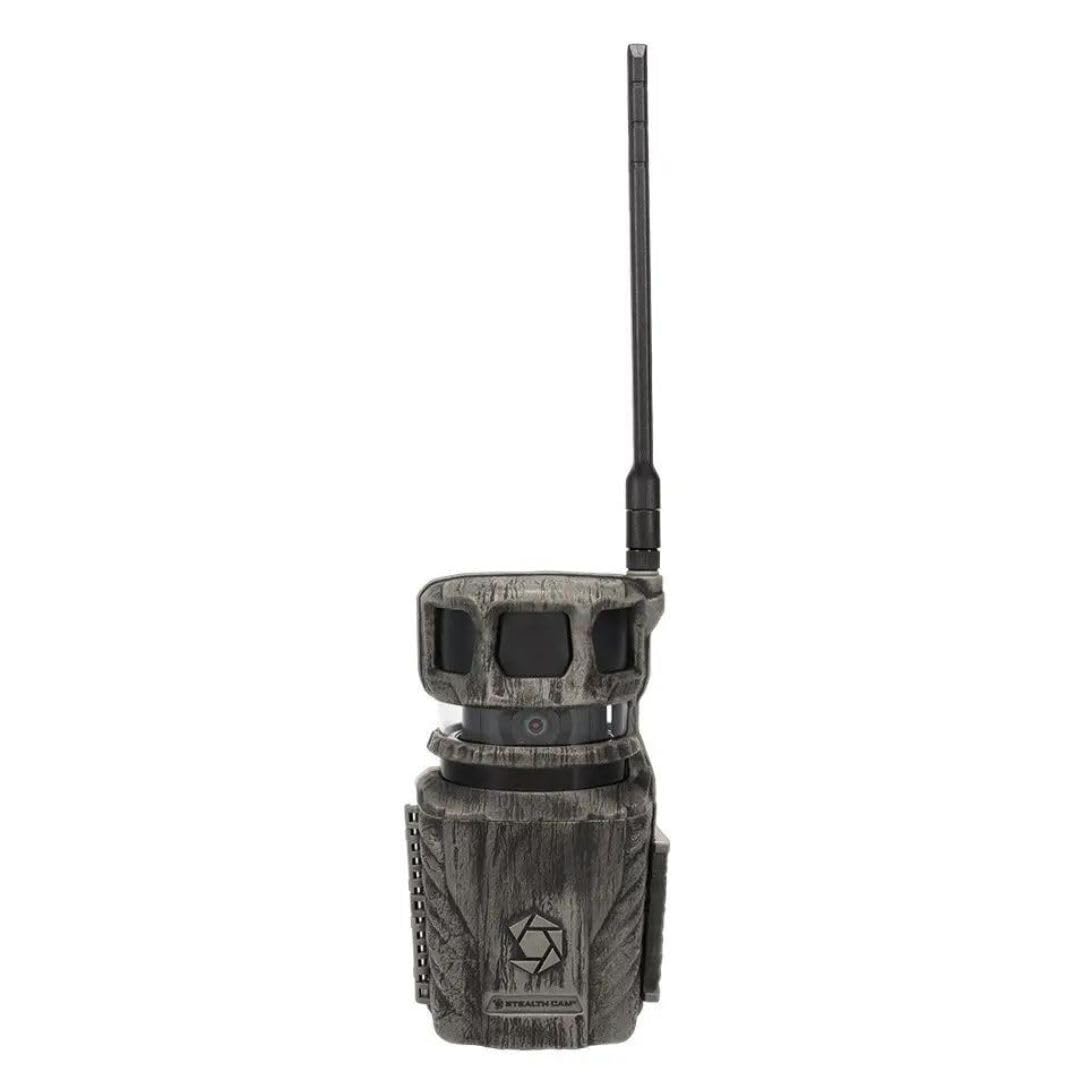
The Stealth Cam Revolver solves a unique problem: a single deer camera cellular that covers every angle around a feeder or food plot. Its pivoting motor rotates the lens across 360 degrees, capturing the equivalent of six fixed cameras worth of coverage in one unit. You can choose single-zone, 180-degree, or full 360-degree capture modes, which is ideal for properties where you need to monitor a large open area without buying five separate cameras. The 36MP stills and 1080p video at 30 FPS are decent, and the 0.4-second trigger speed is competitive.
The Command Pro app provides on-demand capture, allowing you to command the camera to rotate and take photos in real time. Built-in GPS tracks the camera’s precise location, which is helpful if you manage multiple cameras across a large lease. The camera runs on 16 AA batteries (not included), and users report around 9,000 photos per set when using rechargeable batteries. The included T-post mounting bracket makes installation straightforward, though some users find the camera is easier to mount on a tree than on a metal T-post due to weight distribution.
The most significant concern reported by owners is durability after the first season. Several users report the camera failing after 12-14 months due to moisture ingress or motor malfunction. The Stealth Cam warranty covers the first year, and customer service has been responsive for replacements, but the failure rate suggests this camera may not be ideal for permanent year-round deployment. Additionally, false triggers from sunlight and shadow movement are more common with this model than with fixed-lens cameras.
Why it’s great
- Single camera covers 360 degrees, replacing multiple fixed-lens units
- On-demand remote control lets you scout in real time
- Built-in GPS simplifies multi-camera property management
Good to know
- Long-term durability concerns; some units fail after one season
- Higher false trigger rate from moving shadows and sunlight
- Requires 16 AA batteries; no solar option in bundle
5. SPYPOINT Flex-M Solar Bundle

The SPYPOINT Flex-M Solar Bundle delivers premium-grade cellular capability with a bundled solar panel and heavy-duty mounting arm at a mid-range price point. The 28MP photo resolution is lower than the 40MP competitors in this guide, but the image quality in practice is very good for scouting purposes—you can clearly identify antler points and body features at 50 yards. The 720p video with sound is adequate for confirming buck activity, though the lower resolution is noticeable compared to 1080p or 1440p cameras when you try to zoom in on antler configuration.
The bundled SPLB-10 solar panel keeps the camera running indefinitely in areas with at least 4-5 hours of direct sunlight per day, which is a significant advantage over buying a solar panel separately. The camera supports the SPYPOINT free plan (100 photos/month), making it the most cost-effective entry point for a cellular camera if you keep data usage low. The BUCK TRACKER AI species filtering works reasonably well, sorting deer from turkeys and humans in the app, but it occasionally misclassifies cattle or large coyotes as deer.
The main drawback is that the Flex-M requires a microSD card (up to 32GB) for operation, and the internal LIT-22 rechargeable battery pack is sold separately, adding cost if you want to maximize the solar advantage without using disposable AAs. Some users in harsh winter climates report that one of their two units failed within the first year, though SPYPOINT customer service replaced it. For hunters who want a turnkey solar cellular setup without paying for built-in solar panel cost premiums, this bundle is the smartest value play.
Why it’s great
- Included solar panel and mounting arm save significant add-on cost
- Free 100-photo monthly plan is genuinely useful for low-traffic areas
- BUCK TRACKER AI simplifies photo sorting by species
Good to know
- 720p video resolution is lower than premium competitors
- Requires separate LIT-22 battery pack for optimal solar performance
- MicroSD card required (not included in bundle)
6. Tactacam REVEAL X Gen 3.0 (2-Pack with SD Cards)
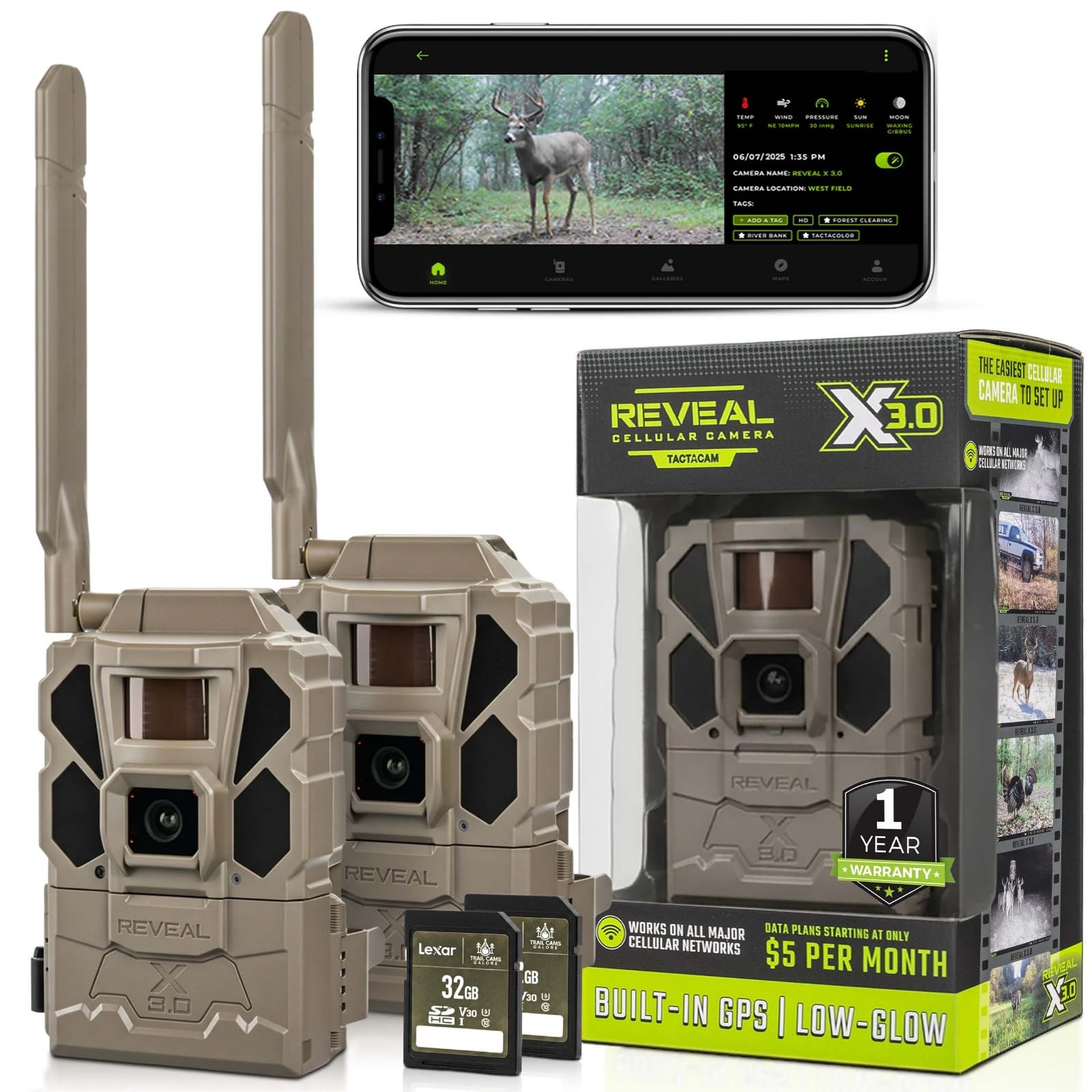
This bundle packages two Tactacam Reveal X Gen 3.0 cameras with two Lexar 32GB SDHC cards, offering the best per-camera price for hunters looking to deploy a multi-unit cellular scouting network. Each camera carries the same core specifications as the single Reveal X 3.0: multi-carrier LTE auto-connect, 4K photo resolution, 1080p video, low-glow IR flash, built-in GPS, and built-in storage that eliminates the SD card requirement (though cards are included as a backup option). The setup process is identical across both units—under ten minutes per camera from unboxing to receiving photos on your phone.
The multi-carrier SIM in each camera gives you redundancy across different parts of your property. If one camera sits in a valley where AT&T dominates and another sits on a ridge where Verizon is stronger, each unit self-configures to the best available carrier without manual intervention. The battery life remains best-in-class, with users reporting 4-6 months on Energizer Ultimate Lithium cells. The 3-shot burst mode is particularly useful for this package because you can place cameras at different angles on the same trail and get a comprehensive picture of deer movement patterns.
The low-glow flash, while effective for image clarity, is the same limitation as the single-camera version—mature deer will eventually pattern the faint red glow. The bundled SD cards are a nice touch, especially if you want to store local copies of photos as a backup to the cloud subscription. The main complaint among owners is the subscription cost scaling: activating two cameras means two monthly plans, which pushes the real cost of ownership higher than some rival systems. Still, for reliability and image consistency across multiple locations, this two-pack is hard to beat.
Why it’s great
- Two cameras at a reduced per-unit cost for multi-location scouting
- Each camera independently selects best carrier signal
- Built-in storage plus included 32GB SD cards for redundancy
Good to know
- Subscription required for each camera doubles monthly cost
- Low-glow flash visible to older, pressured deer
- No solar panel included; optional accessories add cost
7. Stealth Cam Deceptor No Glo 40MP Cellular Trail Camera
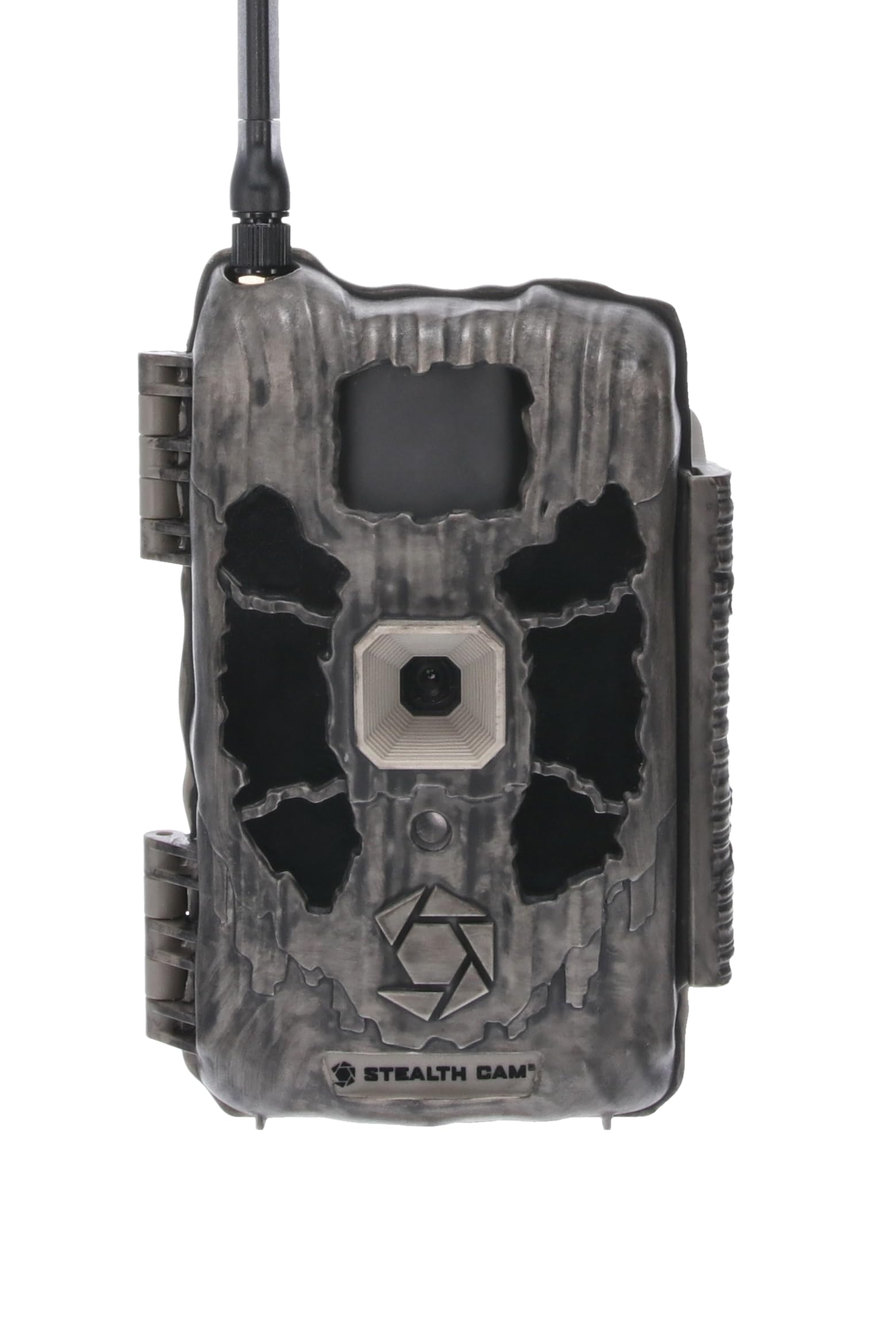
The Stealth Cam Deceptor No Glo is the entry-level champion of cellular deer cameras, offering a fully no-glow 940nm IR array that reaches 80 feet at a cost that undercuts most competitors by a significant margin. The 0.3-second trigger speed is the fastest in this lineup, which matters when you are targeting fast-moving bucks on a tight trail. The camera captures 40MP still images and 1440p video with audio, and the Command Pro app provides on-demand photo requests and remote setting adjustments. The dual-network support (AT&T and Verizon) with automatic carrier switching gives it connectivity flexibility that budget cameras often lack.
The Command Pro app includes integrated animal recognition and filtering AI software that automatically sorts photos by species. In practice, this feature works well enough to save time scrolling through hundreds of photos, but it does occasionally misclassify small deer as coyotes. The adjustable PIR sensitivity lets you fine-tune the detection zone to avoid grass and branch triggers. Battery life is the biggest weakness: the camera uses 8 AA batteries, and the cellular transmitter drains them noticeably faster than the Stealth Cam Revolver’s 16-battery system when using the on-demand feature frequently. Users report 4-6 weeks on alkaline batteries or about 3 months on lithium AAs.
The main concern with this camera is reliability inconsistency. While many users report solid performance, a notable minority describe issues with the camera failing to send photos after a few weeks, dead batteries not triggering the app alert, and customer service being unresponsive for weeks. Some owners also note that the camera generates black or no night photos when the battery drops below a certain threshold without warning. For the price, the Deceptor No Glo is a reasonable entry point into cellular scouting, but its variable QC means it works better as a second camera on a property rather than your primary scouting tool.
Why it’s great
- Fastest trigger speed (0.3s) in this guide for fast-moving game
- True no-glow 940nm flash is invisible to deer
- Lowest entry price for a fully cellular camera with auto-carrier switching
Good to know
- Battery life is short, especially with on-demand photo requests
- Reliability is inconsistent; some units fail within weeks
- App does not send alerts when camera goes offline
FAQ
How far away can a cellular deer camera reliably send photos to my phone?
Do deer camera cellular models require a subscription for every camera?
Will a deer camera cellular still work during winter in freezing conditions?
Final Thoughts: The Verdict
For most users, the best deer camera cellular winner is the Tactacam Reveal X 3.0 because it offers the most reliable balance of battery life, multi-carrier connectivity, and image quality without requiring a monthly solar panel setup. If you want to eliminate battery changes entirely and prioritize hands-off scouting, grab the SPYPOINT Flex-S-Dark. And for budget-conscious hunters entering the cellular world for the first time, the Stealth Cam Deceptor No Glo delivers surprising performance for its price point, provided you accept the reliability trade-offs.

Mo Maruf
I created WellFizz to bridge the gap between vague wellness advice and actionable solutions. My mission is simple: to decode the research and give you practical tools you can actually use.
Beyond the data, I am a passionate traveler. I believe that stepping away from the screen to explore new environments is essential for mental clarity and physical vitality.