Our readers keep the lights on and my smoothie glass nicely filled. As an Amazon Associate, I earn from qualifying purchases.
A deck primer isn’t about looks—it’s about locking a topcoat to weathered wood so it doesn’t peel, crack, or flake mid-season. Most homeowners skip this step, then wonder why their fresh stain lifts after one winter. That’s the real cost of skipping surface prep: lost time, wasted material, and a redo every year instead of every three.
I’m Mohammad Maruf — the founder and writer behind WellFizz. I’ve spent hundreds of hours analyzing adhesion chemistry, binder concentrations, and real-world moisture tests to separate primers that bond deeply from those that just sit on the surface.
After evaluating formulas from Rust-Oleum, Varathane, KILZ, and other trusted brands, this guide to the best deck primer will help you skip the trial-and-error and choose a product that actually preps exterior wood for a durable, long-lasting topcoat.
How To Choose The Best Deck Primer
Deck primer exists to solve one problem: giving a topcoat something mechanical to grip. Without it, porous, weathered wood acts like a sponge, drinking stain unevenly and eventually pushing it back off. The wrong primer fails silently—then peeling starts at the first freeze-thaw cycle.
Adhesion Technology vs. Simple Sealer
Not every product labeled as a primer actually bridges old and new coatings. Look for formulas with specific adhesion chemistry—ingredients designed to penetrate weathered fibers and create a chemical bond, not just a surface film. Rust-Oleum’s Deck Start uses this approach to eliminate sanding on weathered wood, while standard clear sealers lack the binder density to hold a solid topcoat.
Water-Based vs. Oil-Based Formulation
Modern water-based primers offer low odor, fast dry times, and easy cleanup, but not all water-based formulas are equal in outdoor UV resistance. Premium models like Varathane’s Spar Urethane add UV blockers specifically to prevent yellowing, while budget-tier water-based primers may degrade after one season in direct sun. Oil-based primers still penetrate deeper into raw wood, but their strong solvents and longer cure times make them less convenient for weekend projects.
Coverage Rate and Viscosity
A gallon covering 450 square feet sounds efficient until you realize the thin consistency means it soaks in unevenly on porous wood. Thicker primers—those in the 150–300 sq. ft. per gallon range—fill cracks and raised grain more effectively, creating a smoother base for the topcoat. Match your coverage expectation to the wood’s condition: weathered cedar needs more material per square foot than pressure-treated pine.
Quick Comparison
On smaller screens, swipe sideways to see the full table.
| Model | Category | Best For | Key Spec | Amazon |
|---|---|---|---|---|
| Rust-Oleum Deck Start Wood Primer | Adhesion Primer | Weathered decks needing no-sand prep | Covers 450 sq. ft. per gallon | Amazon |
| Varathane Water-Based Spar Urethane | Clear Topcoat | Outdoor furniture & trim | Covers 87 sq. ft. per quart | Amazon |
| Thompson’s WaterSeal Semi-Transparent Stain | Stain + Sealer | All-in-one vertical surfaces | 150–400 sq. ft. per gallon | Amazon |
| KILZ Waterproofing Semi-Transparent Stain | Acrylic Stain | UV-exposed horizontal decks | 250–500 sq. ft. per gallon | Amazon |
| Olympic WaterGuard Semi-Transparent Stain | Stain + Sealer | Budget-conscious vertical projects | 250–350 sq. ft. per gallon | Amazon |
| DEFY Extreme Composite Deck Sealer | Nano Sealer | Composite deck restoration | 100–150 sq. ft. per gallon | Amazon |
| Seal-Once Nano Wood Sealer | Penetrating Sealer | Horizontal wood with high traffic | 6-year horizontal warranty | Amazon |
In‑Depth Reviews
1. Rust-Oleum Deck Start Wood Primer

Rust-Oleum Deck Start is the only true dedicated primer in this lineup—meaning its chemistry was engineered specifically to grip weathered, worn, or previously coated exterior wood without sanding. The adhesion polymers penetrate cracked fibers and create a mechanical anchor for solid stains and paints, skipping the most labor-intensive prep step entirely. At a coverage rate of 450 square feet per gallon, it’s also the most economical option for large decks when used strictly as a bonding layer.
Its water-based, low-VOC formula applies milky white and dries clear, so you can see exactly where you’ve rolled. Reviews note that full cure can take a full day rather than the stated hour, but the trade-off is a surface that accepts topcoats uniformly—no blotchy absorption, no adhesion failure after freeze-thaw cycles. One user reported it transformed a 20-year-old weathered deck into a smooth, paintable surface with zero peeling after topcoating.
The catch is durability under mechanical stress: a reviewer with dogs noted that after six months, the primer didn’t hold up to repeated nail scratching on its own. That’s why Deck Start works best as a preparation layer beneath a proper exterior stain or paint, not as a standalone finish. For homeowners tackling a full refinish without a pressure washer and sander, this primer cuts project time dramatically.
Why it’s great
- Eliminates sanding on weathered wood
- Low-VOC, water-based cleanup
- Superior adhesion for solid topcoats
Good to know
- Full cure takes 24 hours, not the claimed 1 hour
- Not a standalone finish—requires a topcoat
2. Varathane Water-Based Spar Urethane

Varathane’s Spar Urethane is not a primer in the traditional sense—it’s a clear, UV-resistant topcoat designed for outdoor wood furniture, doors, and trim where preserving the natural grain matters. Its water-based polyurethane formula dries crystal clear and resists the yellowing that plagues oil-based clears after a season in the sun. With a 30-minute dry-to-touch time and recoat window of two hours, you can apply three coats in a single day, making it ideal for weekend projects.
The satin finish hides brush strokes well on absorbent wood surfaces, but reviewers note that on non-absorbent materials like plastic or sealed paint, strokes remain visible. Coverage is 87 square feet per quart—modest for large decks but perfect for railings, Adirondack chairs, and birdhouses. One user reported outstanding results on outdoor teak slat tables, praising the quick drying and leveling when cut slightly with water.
Where this product stands out is its UV and weather resistance: multiple five-star reviews confirm zero yellowing or fading after extended outdoor exposure, even on white-painted surfaces. The drawback for deck use is the price per square foot—covering a 300-square-foot deck would require nearly four quarts, pushing total cost well into premium territory. Use this for accent pieces, not whole-deck applications.
Why it’s great
- Non-yellowing formula stays clear in direct sun
- Fast drying—three coats in one day
- Low odor, water cleanup
Good to know
- Expensive per square foot for large decks
- Stroke marks visible on non-porous surfaces
3. KILZ Waterproofing Semi-Transparent Wood Stain

KILZ brings its 50-year reputation for adhesion to the deck category with a 100% acrylic semi-transparent stain that delivers fade-resistant color and serious waterproofing. The formula is warrantied for up to three years on decks and five on vertical surfaces—a strong statement for a product that also acts as its own sealer. Coverage is generous at 250–500 square feet per gallon, and the Cedar Naturaltone color provides a rich, natural look that deepens the wood grain without hiding it.
User feedback highlights the ease of application and excellent one-coat coverage on properly prepped wood. One reviewer who has sold KILZ products for 45 years rated this stain as consistent with the brand’s high standard. Another noted that it handled a decade-old fence beautifully, restoring it to like-new condition with a single coat. The acrylic base provides better UV resistance than oil-based alternatives, and the mildew-resistant additives help in humid climates.
The trade-off is that this is a stain, not a dedicated bonding primer. If your wood is extremely weathered or has old peeling paint, you may still need a separate adhesion primer beforehand. Shipping issues were reported in reviews—some customers received the can damaged or lost in transit. But for a straightforward refinish on moderately weathered wood, this stain-primer combo offers the best balance of protection, coverage, and cost per gallon in the mid-range tier.
Why it’s great
- 100% acrylic with UV and mildew protection
- 3-year deck warranty
- One-coat coverage saves time
Good to know
- Not a true primer for very weathered wood
- Shipping damage reported in some orders
4. Thompson’s WaterSeal Semi-Transparent Stain
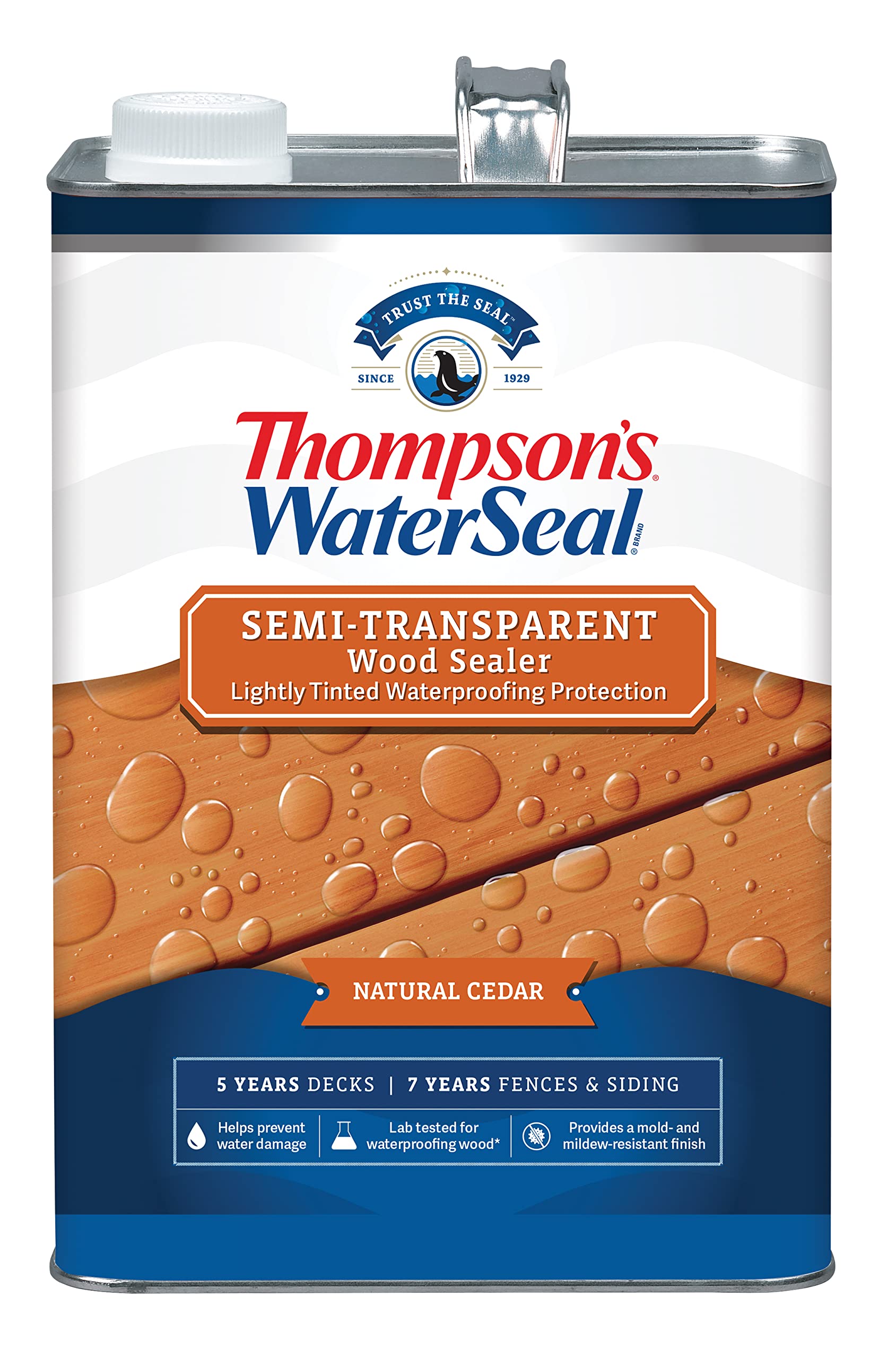
Thompson’s WaterSeal is a household name in wood protection, and this semi-transparent stain combines waterproofing and coloring in one can. Its advanced polymers claim to exceed ASTM D-4446 waterproofing standards, and user reviews confirm that water beads effectively on application—though reapplication is needed after roughly four months in hot, rainy climates like South Florida. The Natural Cedar color is slightly darker than the can suggests, which most users consider a plus.
The formula is built for convenience: it can be applied to damp wood, which is a huge time-saver after pressure washing when you can’t wait for full drying. Coverage ranges from 150 to 400 square feet per gallon depending on wood porosity. Users applying with a garden sprayer and roller reported even self-leveling with no streaks.
Where Thompson’s falls short is in adhesion to previously sealed surfaces—it works best on bare or well-weathered wood. If you’re trying to bond over an existing peeling coating, you’ll need a dedicated primer like Rust-Oleum Deck Start first. For first-time applications on new or stripped wood, this is a reliable, user-friendly stain/sealer that delivers solid waterproofing without tricky application steps.
Why it’s great
- Applies to damp wood—no drying wait
- Self-leveling with sprayer application
- Exceeds ASTM waterproofing standards
Good to know
- Requires reapplication every 4–12 months in harsh climates
- Not effective over existing peeling coatings
5. Olympic WaterGuard Semi-Transparent Stain
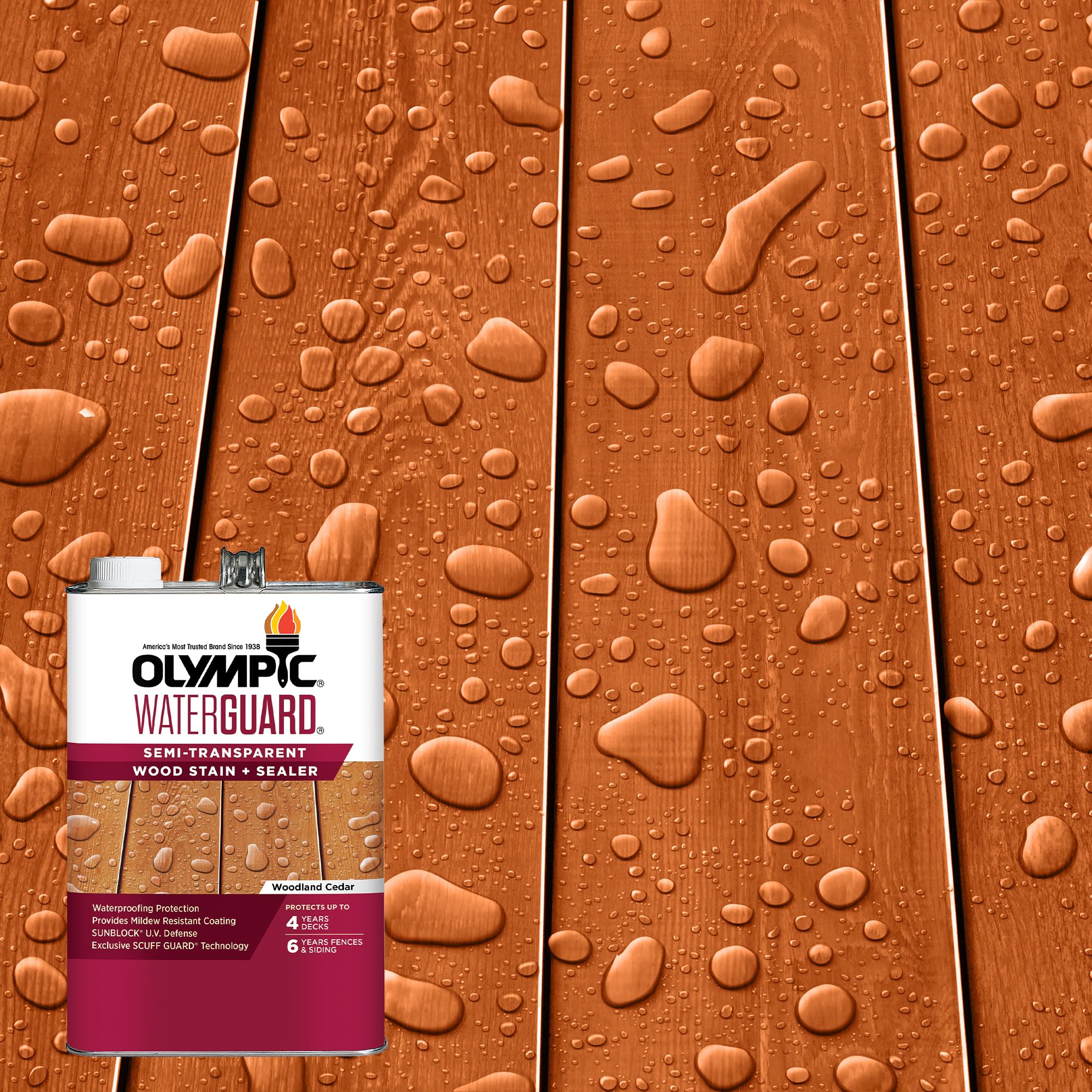
Olympic WaterGuard is the wallet-friendly entry in this lineup, offering a ready-mix semi-transparent stain and sealer all-in-one for less than many primers alone. The Woodland Cedar color delivers a warm, natural tone and includes SUNBLOCK UV defense and exclusive SCUFF GUARD Technology designed to resist abrasion in high-traffic areas. Coverage ranges from 250 to 350 square feet per gallon, and the water-based formula cleans up with soap and water.
User reviews highlight its performance on vertical surfaces: one fence application in a humid SE US climate lasted two years without maintenance. The waterproofing is legitimate—the product sheds water effectively after drying. Multiple coats (two to three) improve depth and durability, especially on pressure-washed wood. The consistency is described as watery, which makes it best suited for sprayer or brush application on vertical boards rather than horizontal deck planks where pooling can occur.
The primary limitation is durability on horizontal surfaces. The manufacturer claims protection up to three years on decks, but several users reported needing annual touch-ups in high-traffic areas. The scuff guard helps, but for a deck that sees heavy foot traffic, this is better paired with a separate topcoat. For fences, siding, and outdoor furniture on a budget, Olympic WaterGuard delivers acceptable performance at a very accessible price point.
Why it’s great
- Budget price with UV and scuff protection
- Excellent for vertical fence applications
- Water cleanup, low odor
Good to know
- Watery consistency prone to drips
- Requires 2–3 coats for even coverage
6. DEFY Extreme Composite Deck Sealer

DEFY Extreme targets a specific niche: composite decking that has oxidized, faded, or developed black stains over years of exposure. Its zinc nano-technology penetrates the porous surface of composite boards to restore color and create a waterproof barrier that also blocks UV radiation. This is not a primer for paint—it’s a clear sealant that should only be applied to bare composite or natural wood, not over existing paints or varnishes.
User experiences with aging composite decks are striking: one reviewer restored a 23-year-old Trex deck to near-new appearance, though cautioning that overspray is extremely hard to remove once set. Another applied it to a 15-year-old faded composite and reported that the product created water beads for effective rain protection. Coverage is limited—100 to 150 square feet per gallon for two coats—so a 300-square-foot deck will require at least two gallons. Application requires thick layering; the product appears purplish in grooves but dries clear.
However, some users noted a slight tackiness in direct sunlight that reduced over time, and standing water left a milky residue that disappeared when dry. The 45°F minimum application temperature restricts seasonality in colder climates. DEFY is the right choice only if you own composite decking—for natural wood, stick with the penetrating primers. For composite owners, it’s the most effective dedicated product on the market.
Why it’s great
- Revives oxidized composite decking effectively
- Zinc nano-tech for UV and water defense
- Clear finish preserves natural look
Good to know
- Low coverage—budget for 2+ gallons
- Overspray is permanent, requires careful masking
7. Seal-Once Nano Wood Sealer

Seal-Once takes a different approach: rather than forming a surface film, its nano-sized molecules penetrate below the wood surface to create a water-resistant shield from within. This makes it ideal for high-traffic horizontal surfaces like deck boards where film-forming sealers would wear off quickly. The clear finish allows wood to gray naturally while remaining protected, and the formula is ultra-low VOC and odorless—a major advantage for enclosed spaces such as log homes or screened porches.
The warranty is the strongest in this comparison: 10 years on vertical surfaces and 6 years on horizontal surfaces, backed by rigorous claims about preventing long-standing water accumulation. User reviews confirm easy application with a roller or brush, light scent, and excellent saturation. One reviewer used it on trailer boards and reported that water beaded off completely. Another sealed multiple door frames from a single quart and praised the quick-drying clear finish.
The trade-off is that penetrating sealers don’t change the wood’s appearance—if you want a richer color or grain enhancement, you’ll need to add a separate tint or stain layer. Additionally, a reviewer in a southern climate noted that a second coat was needed after six months of direct sun exposure. For budget-conscious buyers, the gallon price is higher than most primers, but the extended warranty and deep penetration may reduce long-term reapplication costs for permanent structures.
Why it’s great
- Penetrates wood fibers instead of forming a surface film
- 6-year horizontal, 10-year vertical warranty
- Low odor, safe for enclosed spaces
Good to know
- Clear finish doesn’t enhance wood color
- May need annual re-coat in full-sun southern climates
FAQ
Do I need a deck primer if I’m using a stain and sealer in one?
Can I use a clear deck sealer as a primer before painting?
How long should a deck primer dry before applying the topcoat?
What’s the difference between a deck primer and a wood conditioner?
Final Thoughts: The Verdict
For most users, the best deck primer winner is the Rust-Oleum Deck Start Wood Primer because it eliminates sanding on weathered wood and provides genuine adhesion chemistry that holds solid topcoats season after season. If you want a crystal-clear UV-resistant finish that won’t yellow on outdoor furniture, grab the Varathane Spar Urethane. And for composite deck restoration where nothing else works, nothing beats the DEFY Extreme Composite Deck Sealer with its zinc nano-technology.

Mo Maruf
I created WellFizz to bridge the gap between vague wellness advice and actionable solutions. My mission is simple: to decode the research and give you practical tools you can actually use.
Beyond the data, I am a passionate traveler. I believe that stepping away from the screen to explore new environments is essential for mental clarity and physical vitality.