Our readers keep the lights on and my smoothie glass nicely filled. As an Amazon Associate, I earn from qualifying purchases.
Detail sanders are purpose-built to solve one problem that standard palm sanders and orbital units cannot: reaching into flush corners, narrow profiles, and contoured edges without rounding them over or leaving sanding marks. Their triangular pads and finger attachments allow you to work on window mullions, cabinet face frames, and furniture spindles with surgical precision, but the category comes with trade-offs in motor power, dust management, and runtime that you need to sort through before picking one.
I’m Mohammad Maruf — the founder and writer behind WellFizz. I’ve spent hundreds of hours analyzing the mechanical specs, user reports, and durability patterns of detail sanders to identify which models actually deliver on their precision promise without breaking down mid-project.
After comparing seven of the most popular models on the market based on orbit diameter, motor amperage, dust collection efficiency, and ergonomics for prolonged use, I’ve settled on the models that form the definitive best detail sander shortlist for woodworkers, refinishers, and DIY homeowners.
How To Choose The Best Detail Sander
A detail sander’s job is to remove material from tight geometry without damaging adjacent surfaces. The wrong choice wastes time swapping pads, leaves swirl marks, or clogs after ten minutes. Focus on these four factors to match the tool to your actual work.
Orbit Diameter and Oscillation Speed
Orbit diameter determines how aggressive the sanding action is. A smaller orbit — 1.5mm or 3/32 inch — produces a finer finish with less swirl risk, ideal for final smoothing and paint prep. Larger orbits remove material faster but can leave visible scratches requiring extra sanding steps. Oscillations per minute (OPM) work together with orbit size: higher OPM at a small orbit gives fast, gentle sanding, while lower OPM with a larger orbit is for stripping finish.
Corded vs. Cordless Power
Cordless detail sanders eliminate the tangle that fights you in tight corners, but they introduce runtime limits and battery weight that can fatigue your hand during long sessions. A corded unit at 1.2 to 2 amps delivers consistent power with no downtime, making it better for refinishing a whole cabinet bank in one go. Cordless models work best for quick touch-ups and ladder work where a cord is a hazard.
Dust Collection Method
Detail sanders generate fine dust that settles immediately into crevices. A built-in dust bag or canister catches some of it, but the most effective setups use a 1-1/4 inch vacuum port that lets you connect to a shop vac. Models with poor dust collection force you to blow out the pad’s hook-and-loop holes frequently, slowing your workflow.
Pad Shape and Attachments
The triangular pad is the detail sander’s defining feature — it reaches into corners where round pads cannot. Some models include a detachable finger attachment that extends the pad into an even narrower profile for door jambs and window tracks. Hook-and-loop pad attachment makes paper swaps fast, but you must verify that replacement sheets are available in multiple grits and hole patterns that match the sander’s dust extraction holes.
Quick Comparison
On smaller screens, swipe sideways to see the full table.
| Model | Category | Best For | Key Spec | Amazon |
|---|---|---|---|---|
| BOSCH GSS20-40 | Corded | Cabinet refinishing, low vibration | 2.0 Amp motor, 12,000 OPM, 1/4-sheet pad | Amazon |
| Milwaukee M12 Fuel | Cordless | Precision woodworking, tight profiles | 1.5mm orbit, 1.3 lbs, variable speed | Amazon |
| BLACK+DECKER 20V Mouse | Cordless | Everyday touch-ups, cordless convenience | 20V Max, finger attachment, hook-and-loop pad | Amazon |
| BLACK+DECKER MOUSE Corded | Corded | Extended runtime, paint removal | 1.2 Amp motor, 14,000 OPM | Amazon |
| CRAFTSMAN 20V Max | Cordless | Variable speed, compatibility with V20 tools | 9,000-12,000 OPM, D-handle grip | Amazon |
| Proxxon PS 13 Pen Sander | Corded | Model making, 3D prints, superfine sanding | 20,000 RPM, 0.63 lbs, pen-grip | Amazon |
| Worx WX822L.9 | Cordless | Light detailing, mobility on ladders | 13,000 OPM, 3/32″ orbit, 1.8 lbs | Amazon |
In‑Depth Reviews
6. BOSCH GSS20-40 Orbital Finishing Sander

Bosch engineered the GSS20-40 with a precision-machined aluminum sanding plate that delivers even pressure across the entire 1/4-sheet surface, eliminating the uneven material removal that plagues cheaper stamped-metal pads. The 2.0 amp motor drives 12,000 oscillations per minute through a very tight orbital motion, producing a swirl-free finish that you simply cannot get from larger-stroke sanders. The micro-filter dust canister with a screw-off cap traps fine particles effectively, and when connected to a shop vac via the included adapter, dust pickup approaches near-zero levels — a critical advantage for indoor refinishing work where airborne debris settles into wet paint or fresh stain.
The soft-grip body is designed to reduce vibration transmission to your hand, which makes a noticeable difference during extended sanding sessions on cabinet doors or table leaves. Reviewers consistently mention the low vibration and quiet operation compared to other corded detail sanders at this power level. The clamping system accepts both stick-on hook-and-loop paper and traditional sheets, giving you flexibility to use whatever sandpaper you already stock. Some users note that the built-in paper punch does not align perfectly with every brand of sheet, but the hook-and-loop method sidesteps that issue entirely.
This model weighs 2.7 pounds — heavier than a cordless sander but still manageable for overhead work on crown moulding. The trade-off is unlimited runtime and consistent power that never tapers off as a battery drains. For anyone who refinishes furniture or cabinets regularly, the GSS20-40’s combination of motor torque, pad stability, and dust management makes it the most capable all-around detail sander on this list.
Why it’s great
- Aluminum pad stays flat and distributes pressure evenly
- Very low vibration for a 2-amp corded sander
- Exceptional dust collection with shop vac attachment
Good to know
- Paper punch holes do not align with all sandpaper brands
- Dust canister fills quickly without a vac connected
7. Milwaukee M12 Fuel Orbital Detail Sander

At 1.3 pounds with the battery, the Milwaukee M12 Fuel weighs less than most corded sanders’ power cords alone. This featherweight construction makes it the single best tool for overhead sanding on door casings, crown moulding, and ceiling medallions where heavy tools cause arm fatigue within minutes. The variable speed trigger and four-position speed dial give you granular control — dial down to 5,000 OPM for delicate pre-finish sanding or crank up for faster material removal on painted trim.
The 1.5mm orbit diameter is the smallest in this roundup, producing an exceptionally fine scratch pattern that reduces the need for intermediate grits. This makes the M12 Fuel ideal for woodworkers who sand between coats of finish or work with figured veneers where swirl marks ruin the appearance. The integrated LED light illuminates your work surface directly under the pad, revealing low spots and sanding ghosts that you would otherwise miss in shadowed corners.
Because it is part of Milwaukee’s M12 system, the sander shares batteries with dozens of other tools — a significant advantage if you already own M12 drills or drivers. However, the bare-tool purchase price sits at the premium end of the detail sander market, and the runtime on a standard 2.0Ah battery hovers around 30 to 40 minutes of continuous use. For project-scale work, you will likely need at least two batteries in rotation.
Why it’s great
- Extremely light — reduces fatigue on ladder and overhead work
- Tiny orbit produces nearly swirl-free finish
- Variable speed with LED light for visibility in tight areas
Good to know
- Battery and charger sold separately
- Runtime limited to about 30-40 minutes with standard M12 battery
5. BLACK+DECKER 20V MAX Mouse Sander (BDCMS20B)

The BLACK+DECKER 20V Mouse Sander occupies the sweet spot between affordability and everyday functionality. It is lightweight enough to hold in one hand for extended stretches, and the included finger attachment swaps onto the triangular pad in seconds to convert the tool into a narrow-profile sander for window tracks and door jambs. The dust collection bag keeps the most visible debris off your work surface, though it fills quickly during heavy paint stripping — about every five to ten minutes of continuous wood sanding, per user reports.
Battery compatibility is a major selling point here. If you already own any BLACK+DECKER 20V MAX tool, the same battery powers this sander, eliminating the need for an extra charger or proprietary pack. The hook-and-loop pad makes paper changes tool-free and fast, which matters when you are stepping through multiple grits on a single project. Note that the sander requires 12-hole sanding sheets for proper dust extraction — standard 8-hole sheets reduce vacuum flow noticeably.
The trade-off for the cordless freedom is that the motor is not as aggressive as a corded unit. On dense hardwoods or multiple layers of old paint, you will need to let the tool do the work rather than applying downward pressure, which can stall the pad. For light sanding between coats, touch-ups, and detail work on softwoods and MDF, the BDCMS20B performs admirably without the hassle of a trailing cord.
Why it’s great
- Shares batteries with other BLACK+DECKER 20V tools
- Quick-release finger attachment for tight spots
- Hook-and-loop pad allows fast grit changes
Good to know
- Dust bag fills rapidly on heavy sanding jobs
- Requires 12-hole sanding sheets for best dust pickup
2. BLACK+DECKER MOUSE 1.2 Amp Electric Detail Sander (BDEMS200C)
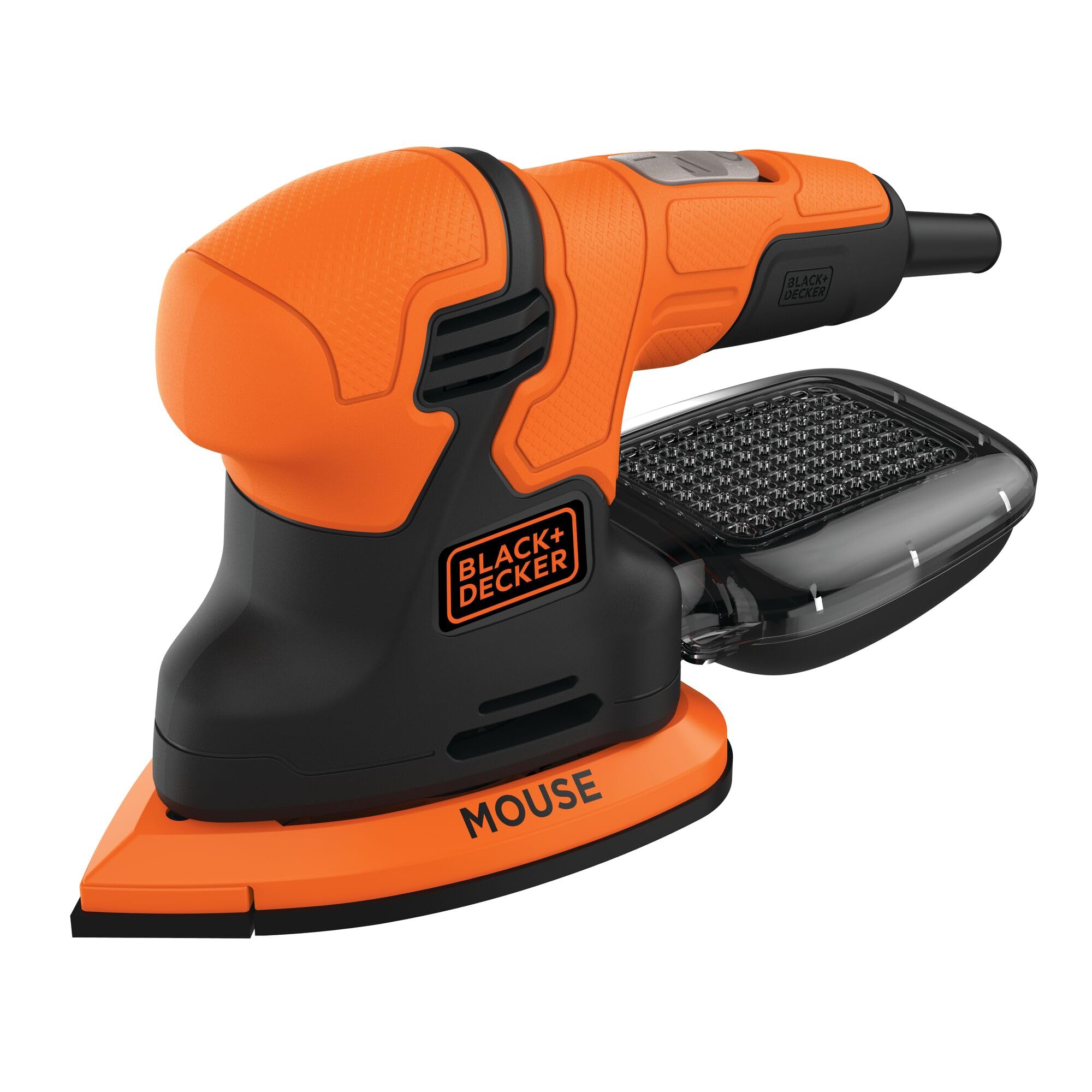
The corded BLACK+DECKER MOUSE solves the runtime anxiety that comes with every battery-powered sander. Its 1.2-amp motor runs at 14,000 orbits per minute, which is the highest OPM among all the models reviewed here. That speed translates to fast material removal on painted cabinets and varnished trim, making this a solid choice for anyone who needs to strip a room full of woodwork without waiting for batteries to recharge. The dust-sealed switch is a thoughtful addition — sanding produces extremely fine silica and wood dust that would otherwise work its way into the switch mechanism and cause early failure.
The detail finger attachment clips onto the front of the triangular pad, narrowing the sanding surface to reach into mullions and lattice work. The included three sheets of 180-grit paper get you started, but you will want to stock up on hook-and-loop sheets that match the dust collection hole pattern. Users note that the dust canister collects a visible amount of debris but does not capture everything — some fine dust escapes around the edges of the pad, especially when sanding on vertical surfaces where gravity pulls particles away from the collection ports.
Removing the dust canister for emptying is the model’s weakest point. It lacks a quick-release button, requiring you to twist and pull with some force, which can flick collected dust into the air. For the price, however, the unlimited runtime and high OPM make the BDEMS200C a reliable workhorse for large refinishing projects where cordless tools would stop mid-morning.
Why it’s great
- Highest OPM in this roundup at 14,000 — fast stripping
- Unlimited runtime with corded power
- Dust-sealed switch improves durability
Good to know
- Dust canister is difficult to remove without spilling debris
- Not all fine dust is captured by the built-in system
3. CRAFTSMAN 20V MAX Cordless Detail Sander (CMCW221B)

CRAFTSMAN’s 20V MAX detail sander brings variable speed control to the cordless category, letting you dial the OPM from 9,000 up to 12,000 depending on the material’s sensitivity. This range covers both fine finish sanding on bare wood and faster stripping on painted surfaces, giving you one tool that adapts to the task rather than forcing the tool’s fixed speed onto the workpiece. The D-handle grip is a distinctive design choice — it places your hand directly in line with the sanding pad, improving control during vertical sanding on cabinet fronts and window casings.
The dust collection system offers two pathways: a built-in dust bag for quick jobs and a 1-1/4 inch vacuum port for connecting to a shop vac. That dual-option flexibility is rare at this price tier and makes a real difference when you switch from on-ladder touch-ups to bench-level refinishing. The dust-sealed switch adds protection against particle ingress, and the bare weight with a battery installed remains light enough for comfortable one-handed use.
Battery compatibility with the CRAFTSMAN V20 system is a strong advantage if you already own their drills, saws, or trimmer. The trade-off is that the sander’s motor is less powerful than corded competitors with similar pad geometry — it excels at finish work but struggles if you bear down hard on rough-sawn lumber. For sanding between coats and detail work on assembled cabinetry, the variable speed and ergonomic grip make this a top contender.
Why it’s great
- Variable speed trigger lets you match OPM to the material
- D-handle design improves control on vertical surfaces
- Dual dust collection — bag and vacuum port included
Good to know
- Motor bogs under heavy pressure on hardwood
- Battery and charger sold separately
1. Worx WX822L.9 20V Power Share Cordless Detail Sander

The Worx WX822L.9 prioritizes mobility and ease of use above all else. At just 1.8 pounds without the battery, it is one of the lightest cordless detail sanders available, and owners frequently comment that even at 74 years old they have no trouble handling it for extended periods. The finger sanding attachment clips onto the front of the pad, converting the triangular head into a narrow profile that slips into corners and along baseboard edges without scuffing adjacent walls. The 13,000 OPM with a 3/32-inch orbit diameter strikes a balance between fast material removal and a smooth finish.
The dust collection canister attaches directly to the rear of the sander and catches a surprising amount of debris for such a small tool. Users report that it works well enough to keep the work surface largely clean during light to moderate sanding. Since the sander runs on Worx’s Power Share 20V battery platform, you can swap the same battery between the sander and any other Worx 20V tool in your collection — a long-term cost saver if you already own their yard tools or drills.
The main limitation is that the bare tool ships without a battery or charger, so you must either own a compatible Power Share pack or purchase one separately. The motor is not designed for heavy stock removal — it shines on contour sanding, paint feathering, and final smoothing where maneuverability matters more than brute force. For quick detail jobs on furniture, trim, and crafts, the Worx sander’s low weight and cord-free operation make it a near-effortless addition to any toolkit.
Why it’s great
- Very light — reduces hand fatigue during extended detail work
- Finger attachment reaches narrow crevices with ease
- Compatible with Worx Power Share battery ecosystem
Good to know
- Battery and charger must be purchased separately
- Not powerful enough for aggressive stock removal
4. Proxxon 28594 PS 13 Corded 12-Volt Pen Sander

The Proxxon PS 13 is not a conventional detail sander — it is a pen-shaped, 12-volt oscillating tool designed for superfine sanding in spaces that a standard triangular pad cannot reach. Its 20,000 RPM oscillation speed is extremely high, but the reciprocating side-to-side motion prevents heat buildup, making it safe for sanding 3D-printed PLA and ABS without melting the plastic. At 0.63 pounds, it is the lightest tool in this comparison, and users describe the pen grip as comfortable for prolonged delicate work on model parts, jewelry, and intricate wooden inlays.
The linear action produces a scratch pattern that is distinct from orbital sanders — it removes material in a single direction, which can be an advantage when sanding tight slots and grooves where rotary motion would round over the edges. The tool uses custom sanding pads that attach via a proprietary system, and the pads wear out relatively fast, especially on rough surfaces. The included sanding grit is superfine, so the PS 13 is strictly a finishing tool — it will not strip paint or level uneven joints.
The biggest drawbacks are the proprietary 12-volt power system and the three-pole connector that requires a specific AC adapter (sold separately). Users who modify a standard router adapter risk voiding the warranty, and the 12-volt limitation means the tool cannot run off a common 18V or 20V battery platform. For dedicated hobbyists and model makers who need precisely controlled linear sanding in tiny spaces, the Proxxon PS 13 is unmatched. For typical woodworking or home renovation, a standard orbital detail sander is more practical.
Why it’s great
- Pen-style grip offers unmatched control in tiny spaces
- Linear action prevents heat buildup on plastics and delicate materials
- Extremely lightweight at 0.63 pounds
Good to know
- Requires a specific 12V AC adapter — not included
- Sanding pads wear quickly and use a proprietary attachment system
FAQ
Can a detail sander replace a standard orbital palm sander for general use?
How do I prevent swirl marks when using a detail sander?
Why does my detail sander vibrate more than my regular palm sander?
Final Thoughts: The Verdict
For most users, the best detail sander winner is the BOSCH GSS20-40 because it combines a 2.0-amp motor with a precision aluminum pad and excellent dust management in a single corded package that never runs out of power. If you want cordless freedom and ultra-precise control on delicate woodworking projects, grab the Milwaukee M12 Fuel. And for budget-friendly everyday touch-ups where battery compatibility and low weight matter most, nothing beats the BLACK+DECKER 20V Mouse Sander.

Mo Maruf
I created WellFizz to bridge the gap between vague wellness advice and actionable solutions. My mission is simple: to decode the research and give you practical tools you can actually use.
Beyond the data, I am a passionate traveler. I believe that stepping away from the screen to explore new environments is essential for mental clarity and physical vitality.