Our readers keep the lights on and my smoothie glass nicely filled. As an Amazon Associate, I earn from qualifying purchases.
That grinding silence where your feeder should be spinning is the sound of a failed motor at dawn. A deer feeder motor is the small, overlooked component that determines whether your corn lands in a 30-foot radius or piles up under the spinner plate, attracting pests and wasting every pound you poured in. The difference between a reliable season and a frustrating one comes down to torque, timer accuracy, and how well the motor shrugs off weather.
I’m Mohammad Maruf — the founder and writer behind WellFizz. I’ve spent hundreds of hours cross-referencing torque ratings, battery draw, timer programmability, and housing durability across the most common feeder motor kits on the market to build this guide on solid, category-specific data.
Whether you’re upgrading an old unit or building from scratch, finding the right best deer feeder motor means matching voltage to your battery setup and prioritizing a timer that won’t scramble its memory mid-season.
How To Choose The Best Deer Feeder Motor
The wrong motor turns a feeder into an expensive bird bath base. You need a unit whose voltage matches your power source, whose torque can fling corn or protein pellets across the intended radius, and whose timer survives humidity, temperature swings, and the occasional curious raccoon.
Voltage Compatibility — 6V vs 12V
6V motors are common in pre-assembled feeder kits and pair well with single 6V batteries or small solar panels. 12V motors deliver noticeably higher torque and are better suited for larger drop funnels, heavier feed like protein pellets, and longer spin durations. If you already own a solar panel or battery setup, match the motor voltage exactly — mismatching risks underperformance or component damage.
Timer Programmability and Reliability
A motor is only as useful as the timer that controls it. Look for at least four programmable feed events per day with adjustable duration from one to 30 seconds. Digital displays with battery indicators and test buttons simplify setup. Avoid units whose timer resets after power loss unless they include battery backup — a scrambled memory mid-season means corn piles up on the ground at random hours.
Housing Material and Weather Resistance
Powder-coated galvanized steel handles rain, snow, and UV exposure far better than standard plastic housings. For plastic units, check that the seam between the motor compartment and the drop funnel seals tightly. A motor that survives a season of direct sun and afternoon thunderstorms without internal rust is worth the upfront premium.
Mounting Compatibility — Quick-Lock vs Universal
Moultrie’s Quick-Lock system lets you swap kits across compatible hoppers in seconds, while universal flange mounts require drilling or hose clamping. If you plan to switch barrels between seasons or maintain multiple sites, a Quick-Lock adapter saves substantial setup time. For permanent installations, a universal mount with metal reinforcement provides a rock-solid hold.
Quick Comparison
On smaller screens, swipe sideways to see the full table.
| Model | Category | Best For | Key Spec | Amazon |
|---|---|---|---|---|
| Highwild 12-Volt Power Control Unit | Premium | High-torque replacement | 12V motor, 8 feed events daily | Amazon |
| THE-Timer by West Texas Feeders | Premium | Reliable timer replacement | 6V/12V compatible, battery backup | Amazon |
| Moultrie All-in-One II Feeder Kit | Mid-Range | Bluetooth app control | 4 AA battery, 300ft Bluetooth | Amazon |
| Wildgame Innovations Trophy Hunter 6V Kit | Mid-Range | Simple dawn/dusk photocell | 6V motor, photocell timer | Amazon |
| Wildgame Innovations Digital Timer (Pack of 2) | Mid-Range | Multi-feeder timer upgrade | 6V/12V, 6 feed times, LCD | Amazon |
| PROLEE 85lbs Gravity Feeder | Budget | Gravity-fed protein feeding | 80lb capacity, 4 feeding trays | Amazon |
| Moultrie Gravity Feeder Kit | Budget | No-power gravity feeding | Quick-Lock, 3-trough design | Amazon |
In‑Depth Reviews
1. Highwild 12-Volt Deer Feeder Digital Power Control Unit

The Highwild 12V unit is the closest you get to a commercial-grade feeder motor in a consumer package. The alloy steel housing is noticeably thicker than budget plastic shells, and the motor shaft is larger in diameter than comparably priced units — a detail that translates into fewer stripped gears when spinning heavier protein pellets. The spinner plate includes flaps that open under centrifugal force, which keeps corn contained during spin-up and reduces scatter directly under the funnel.
Programming is straightforward: eight available feed times per day with duration adjustable from one to 30 seconds, plus a test button that runs the motor for ten seconds so you can verify the spread pattern without dumping a full cycle. The drop funnel and protective housing are included, and the universal flange mounts cleanly to standard barrel openings with the supplied hardware. Several long-term users report replacing Moultrie units that failed after one or two seasons and finding the Highwild still running strong in year three.
One trade-off is weight — at roughly eight pounds, this unit feels substantial, which is good for durability but adds mass to the top of a barrel setup. The housing is powder-coated, not stainless, so inspect the seams annually if your feeder sits in direct rain exposure. For anyone rebuilding a feeder from scratch or upgrading a weak 6V system, this kit delivers the torque reserve that keeps feed flying through wind and moisture.
Why it’s great
- Heavy-duty alloy steel housing outlasts plastic competitors
- 8 programmable feed events with 1-30 second duration range
- Spin flaps on the plate reduce corn spillage under the funnel
Good to know
- Heavier than some competitors, adding top weight to barrel setups
- Powder-coated finish needs annual seam inspection in wet climates
2. THE-Timer by West Texas Feeders

THE-Timer has developed a reputation among serious deer managers for one reason: it simply refuses to die. The compact control unit, measuring only 4 by 3 inches, runs on either 6V or 12V power, making it a universal replacement for virtually any feeder motor setup. The illuminated buttons and high-visibility display make programming at dusk possible without a headlamp, and the internal battery backup holds your schedule even if the main power source gets disconnected during a battery swap.
Longevity reports from users are remarkable — multiple owners report the same timer running daily feed cycles for three years or more without a single failure. The test button is a practical touch, allowing you to verify the motor spins and the corn flows before walking away. The included wiring harness and motor wiring kit simplify installation, and the freestanding mount works inside weatherproof boxes or directly on the barrel housing.
The primary consideration is that this unit ships as a timer and control board — you will need to pair it with a separate motor and spinner assembly unless you are replacing an existing timer-only setup. Some users note that the warranty return process can be slow if a unit does fail. For those who prioritize timer reliability above all else and want a single component that works across multiple feeders, this is the benchmark.
Why it’s great
- Battery backup prevents schedule loss during power changes
- Proven three-year plus lifespan under daily use
- Dual-voltage compatibility works with 6V or 12V systems
Good to know
- Timer only — requires separate motor and spinner plate purchase
- Warranty processing can be slow compared to larger brands
3. Moultrie All-in-One II Feeder Kit — Bluetooth App Control
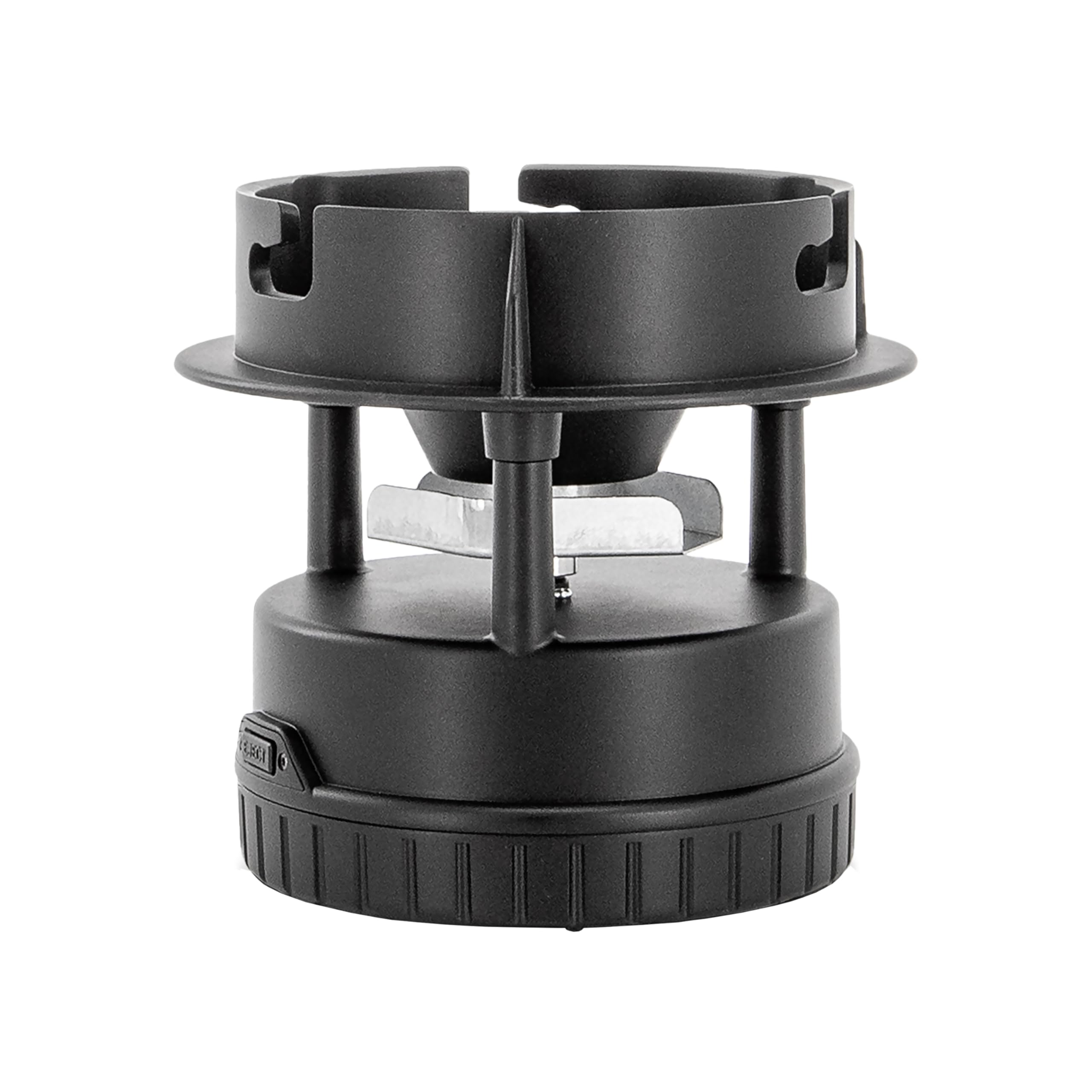
The Moultrie All-in-One II brings modern convenience to a category that often feels stuck in the 1990s. The Bluetooth connectivity via the Moultrie Connect App lets you adjust feed times and durations from up to 300 feet away, and pairing it with an Edge 3 Series camera unlocks full cellular remote control — meaning you can change feeding schedules from a deer stand or your living room without touching the unit. The Quick-Lock adapter snaps onto any flat-bottom container, from 35-gallon drums to custom bucket builds, making this one of the most versatile motor kits for DIY setups.
The broadcast spin plate delivers 360-degree coverage, pulling deer in from every direction, and you can program up to four feed events per day with durations from one to 20 seconds each. Power comes from four AA batteries for standard use or eight for extended runtime, eliminating the need for a separate 6V battery and wiring harness. Real-world reports indicate battery life that easily spans an entire season, and the slide-out battery tray makes swaps fast when they are needed.
The all-plastic housing is lighter than steel alternatives, which is a benefit for top-heavy barrel setups but means the unit is less impact-resistant if a branch falls or a deer bumps the feeder. The Bluetooth range is reliable in open fields but can drop to around 20 yards in dense timber. For hunters who want to fine-tune feed times without hiking to each feeder, this kit is the most convenient option available at its tier.
Why it’s great
- Bluetooth app control allows remote schedule adjustments
- Quick-Lock adapter fits 35 and 55-gallon drums instantly
- AA battery operation avoids separate 6V battery cost
Good to know
- Plastic housing is less durable than steel under impact
- Bluetooth range can shorten significantly in heavy cover
4. Wildgame Innovations Trophy Hunter 6V Photocell Feeder Kit

The Trophy Hunter 6V kit strips away complexity and focuses on what matters for a specific type of hunter: reliable dawn and dusk feeding with zero programming hassle. The photocell timer uses ambient light sensors to trigger feeding at sunrise and sunset, eliminating the need to calculate solar noon or adjust for daylight saving time. The plug-and-play design means you install the 6V battery, set the feed duration from one to 30 seconds, and walk away — the timer handles the rest automatically.
The power control unit uses powder-coated galvanized steel, which is a genuine upgrade over the all-plastic housings found at similar price points. The sliding door design keeps the battery compartment secure while allowing easy access for winter battery changes. The high-torque 6V motor disperses feed in a 360-degree pattern up to 30 feet, which is sufficient for most bait-site setups. The built-in fuse protection adds a layer of safety against power surges.
The trade-off for simplicity is limited scheduling flexibility — you only get two feed events per day (dawn and dusk), with no option for mid-day or multiple timed throws. The sensor also needs a clear view of the sky; placing it under dense canopy or on a north-facing slope can cause inconsistent trigger times. For hunters who want a set-it-and-forget-it feeder that runs all season without menu-diving, this kit delivers exactly that.
Why it’s great
- Photocell timer eliminates daily programming adjustments
- Powder-coated galvanized steel housing resists rust
- In-line fuse protection guards against power overloads
Good to know
- Limited to two feed events per day — no mid-day options
- Photocell sensor needs clear sky exposure for reliable triggering
5. Wildgame Innovations Trophy Hunter Digital Timer (Pack of 2)
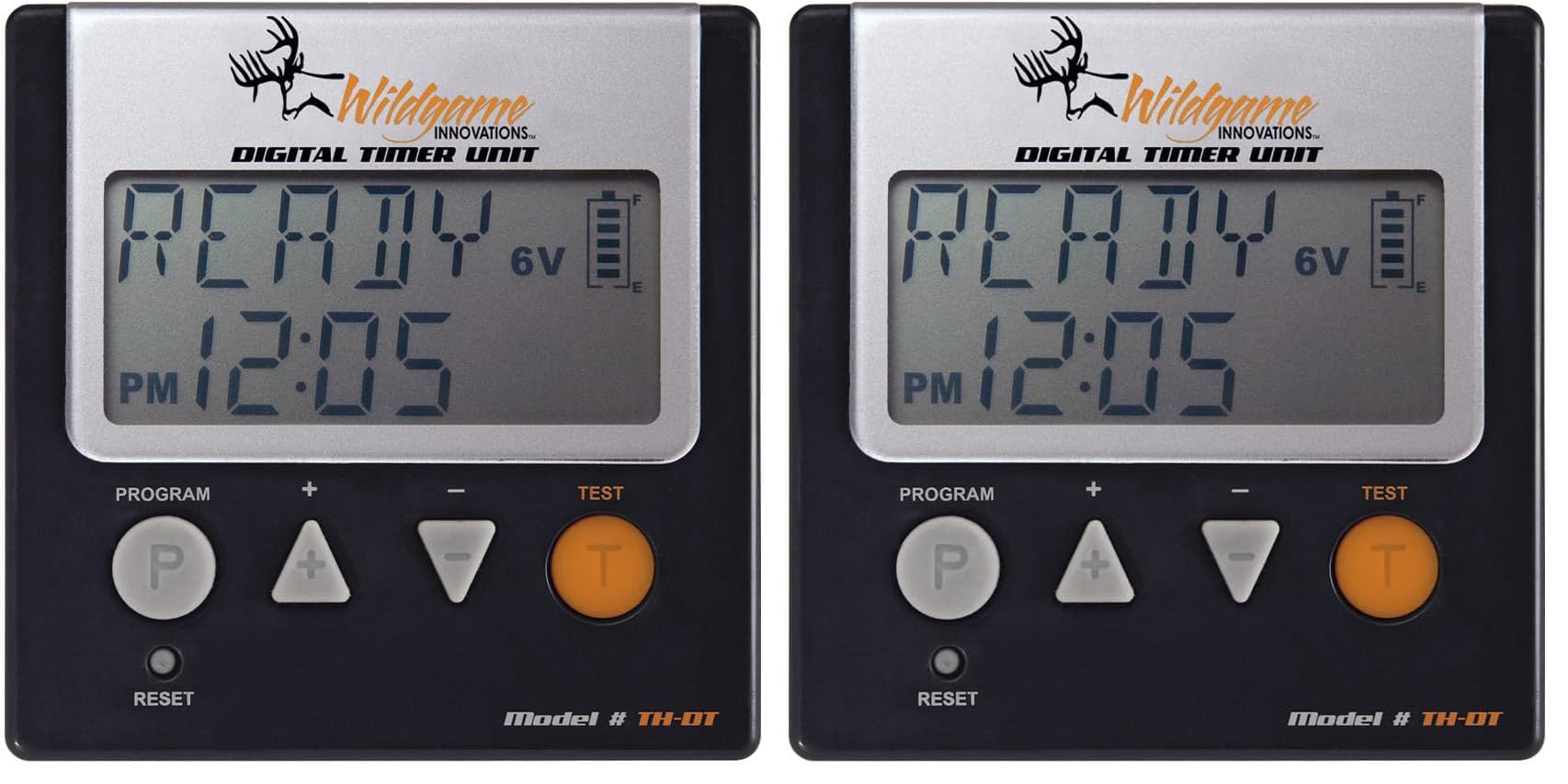
This two-pack of digital timers is the most cost-efficient way to upgrade multiple feeders to programmable control without buying complete motor assemblies. Each timer runs on either 6V or 12V power, giving you flexibility across different battery setups on your property. The LCD screen is large and readable in direct sunlight, and the buttons are sized for gloved fingers — a detail that matters when you are programming a feeder in November temperatures. Up to six feed times per day are available, each with adjustable duration from one to 30 seconds, plus a three-position motor speed switch (low, medium, high) that lets you fine-tune the spread radius.
The weather-resistant housing protects the internal electronics from rain and condensation, and the in-line fuse prevents damage from voltage spikes. The test button runs the motor for ten seconds, which is useful for verifying the feed flows before you leave the site. The compact design mounts on the feeder barrel or inside a weatherproof box, and the pack of two means you can standardize timers across multiple stands.
These are timers only — you need a separate power control unit, motor, and spinner plate to complete a functional feeder. The programming sequence takes a few minutes to learn, and the instructions could be clearer for first-time users. For landowners managing three or more feeder sites who want uniform feeding schedules and backup units on hand, this pack solves that need efficiently.
Why it’s great
- Two-pack provides matched timers for multiple feeders
- Three-speed motor control adjusts spread radius precisely
- Large LCD and buttons work well with gloves on
Good to know
- Timers only — requires separate motor and power control unit
- Programming sequence takes a few minutes to learn initially
6. PROLEE 85lbs Deer Feeder with 4 Feeding Tray and Stand
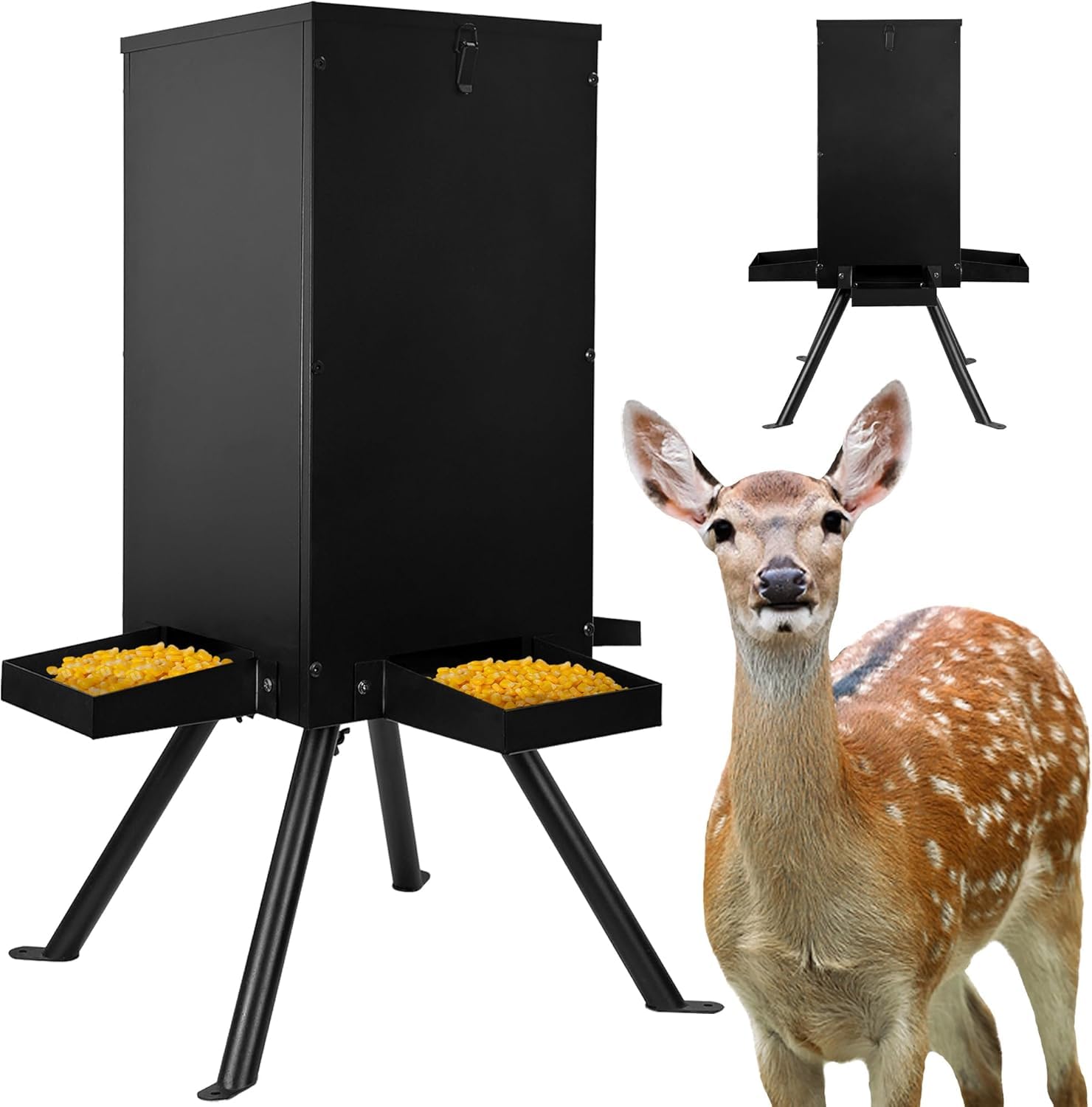
The PROLEE gravity feeder takes a fundamentally different approach — no motor, no timer, no batteries. Feed flows by gravity into four troughs, and deer access it on their own schedule. The thickened galvanized steel body holds up to 80 pounds of corn or protein pellets, and the four-port tray system allows multiple deer to feed simultaneously, which reduces competition and stress during antler-growing season. The drainage bottoms in each trough prevent water pooling, keeping feed from turning soggy after rain.
The four-leg stand with pre-drilled holes for ground stakes provides stability in high winds, and the waterproof top cover with latch lock keeps the feed dry during storms. Assembly is straightforward with all parts included, and the smooth galvanized surface cleans quickly when switching feed types. Users report that deer adapt to the gravity system faster than to timed spin feeders, likely because feed is available continuously rather than at specific hours.
The feed slot height on the troughs is fixed and some users found it too high, causing corn to spill onto the ground rather than being eaten from the tray. The included silicone sealer is extremely sticky and messy to apply. This is not a motorized feeder, so it will not fling corn across a 30-foot radius or allow timed feeding windows — it is a static, low-maintenance alternative for year-round supplemental feeding.
Why it’s great
- Galvanized steel construction withstands outdoor exposure
- Four-tray design allows multiple deer to feed at once
- No batteries, timers, or motors to fail or maintain
Good to know
- Fixed feed slot height may allow some spillage
- Silicone sealer is very messy to apply during assembly
7. Moultrie Gravity Feeder Kit with Quick-Lock Adapter

The Moultrie Gravity Feeder Kit is the simplest way to convert any Quick-Lock compatible hopper into a gravity-fed system. The twist-on Quick-Lock adapter installs in seconds without tools, and the three-trough design distributes feed evenly around the base of the barrel. The adjustable flow control handles both whole corn and protein pellets, letting you switch between summer mineral supplementation and winter energy feed without changing hardware. The reinforced locking ring and hose clamp prevent raccoons and hogs from pulling the kit loose.
Users consistently praise the ease of installation — the kit drops onto an existing Moultrie Quick-Lock feeder in under two minutes, and the gravity mechanism means zero maintenance beyond filling the hopper. The black polymer construction is UV-resistant and holds up well in direct sun, though it is less impact-resistant than steel alternatives. The three-trough design spreads deer around the feeder, reducing crowding and allowing younger bucks to access feed without competition.
This kit lacks any timed dispensing mechanism, so it is not suitable for hunting scenarios where you need precise feeding windows to pattern deer movement. The polymer material can warp if exposed to extreme heat while full of feed, though this is rare in normal use. For a budget-friendly, no-power feeding station that works reliably season after season, this is the most straightforward option available.
Why it’s great
- Quick-Lock adapter installs in seconds on compatible hoppers
- Adjustable flow handles both corn and protein pellets
- Reinforced locking ring deters varmint access
Good to know
- No timed dispensing — not ideal for hunt scheduling
- Polymer housing can warp under extreme heat when full
FAQ
Can I put a 12V motor on a 6V battery system?
How do I know if my feeder motor is compatible with my existing barrel?
What causes a feeder motor to burn out mid-season?
Final Thoughts: The Verdict
For most users, the best deer feeder motor winner is the Highwild 12-Volt Power Control Unit because its alloy steel housing, high-torque motor, and eight-event timer deliver a performance-to-price ratio that outclasses the competition in every measurable spec. If you want Bluetooth convenience and AA battery simplicity, grab the Moultrie All-in-One II. And for a set-it-and-forget-it photocell system with zero programming, nothing beats the Wildgame Innovations Trophy Hunter 6V Kit.

Mo Maruf
I created WellFizz to bridge the gap between vague wellness advice and actionable solutions. My mission is simple: to decode the research and give you practical tools you can actually use.
Beyond the data, I am a passionate traveler. I believe that stepping away from the screen to explore new environments is essential for mental clarity and physical vitality.