Our readers keep the lights on and my smoothie glass nicely filled. As an Amazon Associate, I earn from qualifying purchases.
The difference between a profitable mining rig and a money pit often comes down to one decision: the graphics card. Hash rate, power draw, memory bandwidth, and long-term stability under 24/7 load are the metrics that separate a workhorse from a wallet drain in this specific corner of the hardware world.
I’m Mohammad Maruf — the founder and writer behind WellFizz. I’ve spent countless hours analyzing hardware specifications, mining benchmarks, power efficiency data, and real-world user reports to build this guide for serious buyers.
After comparing hash rates, memory configurations, power draw, and thermal performance across dozens of cards, this deep dive into the best crypto mining gpu market cuts through the noise to present only the options that deliver real ROI for dedicated miners.
How To Choose The Best Crypto Mining GPU
Selecting a graphics card for mining is a different calculus than gaming. You are optimizing for sustained hash output per watt, memory bandwidth, and thermal resilience under constant load, not peak frame rates. A card that excels in gaming benchmarks can be a poor miner if it runs hot or draws too much power.
Memory Bandwidth and Type
For most memory-bound algorithms, the memory interface width and RAM type dictate how efficiently your card solves hashes. A 256-bit bus paired with GDDR6 or GDDR7 memory moves data faster than a narrower 128-bit interface, directly translating to higher hash rates on algorithms like Ethash (ETC) and KawPow (RVN).
Power Efficiency and Thermal Design
Hash rate per watt is the true measure of mining profitability. A card that consumes 250W to produce 60 MH/s is less efficient than one that delivers 55 MH/s at 180W. Lower power draw reduces electricity costs and places less stress on the VRM, extending the card’s life in a 24/7 mining environment. Effective cooling, such as triple-fan designs with vapor chambers, helps maintain stable core and memory temperatures, preventing thermal throttling that crushes hash rates.
VRAM Capacity and Longevity
Mining algorithms increasingly benefit from larger frame buffers. Cards with 12GB or 16GB of VRAM can handle larger DAG files and emerging algorithms more effectively than 8GB counterparts. Additionally, GDDR6X memory runs notoriously hot; active cooling on the memory modules is a crucial feature for long-term mining stability.
Quick Comparison
On smaller screens, swipe sideways to see the full table.
| Model | Category | Best For | Key Spec | Amazon |
|---|---|---|---|---|
| ASUS Prime RX 9070 XT | High-End | Efficiency & Raw Hash | 16GB GDDR6, 256-bit | Amazon |
| MSI RTX 5070 Ti 16G | High-End | High Hash, Low Power | 16GB GDDR7, 256-bit | Amazon |
| Sapphire Pulse RX 9070 XT | High-End | Thermal Stability | 16GB GDDR6, 256-bit | Amazon |
| ASRock Challenger RX 9070 XT | High-End | Triple Fan Cooling | 16GB GDDR6, 256-bit | Amazon |
| ASUS Prime RTX 5070 | Mid-Range | SFF Mining Rigs | 12GB GDDR7, 192-bit | Amazon |
| PNY RTX 5070 Epic-X | Mid-Range | DLSS Efficiency | 12GB GDDR7, 192-bit | Amazon |
| GIGABYTE RX 9060 XT Gaming OC | Mid-Range | Price-to-Hash Ratio | 16GB GDDR6, 128-bit | Amazon |
| PowerColor Reaper RX 9060 XT | Mid-Range | Compact Mining Rigs | 16GB GDDR6, 128-bit | Amazon |
| XFX Swift RX 9060 XT | Value | Budget Hash Output | 16GB GDDR6, 128-bit | Amazon |
| GIGABYTE RTX 5060 Windforce | Entry | Low Power Mining | 8GB GDDR7, 128-bit | Amazon |
In‑Depth Reviews
1. ASUS Prime AMD Radeon RX 9070 XT

The ASUS Prime RX 9070 XT OC Edition strikes a rare balance between raw hashing power and energy efficiency. Its 16GB of GDDR6 memory on a 256-bit bus delivers high memory bandwidth essential for memory-bound mining algorithms, while the dual-ball fan bearing design and phase-change GPU thermal pad ensure reliable 24/7 operation without degradation.
User reports confirm this card stays under 60°C under sustained stress loads while drawing around 180-190W, making it one of the most power-efficient high-end options for mining. The 2.5-slot design and 0dB technology also mean it can run quietly in multi-GPU rigs where thermal buildup is a major concern.
For the miner prioritizing hash per watt over peak absolute hash, the ASUS Prime RX 9070 XT delivers a compelling package. The absence of RGB lighting and its dual BIOS feature further reinforce its purpose-built mining reliability.
Why it’s great
- Excellent hash per watt ratio for 256-bit GDDR6 cards
- Dual-ball bearings and phase-change thermal pad for 24/7 mining durability
- 0dB fan mode allows silent light-load operation
Good to know
- Requires three PCIe power connectors for adequate headroom
- Some users report ASUS warranty support response times can be slow
2. MSI Gaming RTX 5070 TI 16G Shadow 3X OC

The MSI RTX 5070 Ti brings the latest GDDR7 memory and a 256-bit bus to the mining scene, offering a significant leap in memory bandwidth over previous generations. The TORX Fan 5.0 design with linked fan blades maintains high static pressure for cooling memory modules, a critical feature when running memory-intensive algorithms that heat up GDDR7 chips.
Users report this card achieves auto-boost clocks around 2800 MHz out of the box while remaining stable for video encoding and 3D rendering workloads—tasks that demand similar sustained performance to mining algorithms. The nickel-plated copper baseplate efficiently transfers heat from both the GPU die and memory, keeping junction temperatures under control.
For a premium mining card, the MSI RTX 5070 Ti offers a strong balance of raw hash rate and thermal design. Its SFF-Ready certification also makes it a viable option for compact mining rigs where space is at a premium.
Why it’s great
- 256-bit bus with GDDR7 delivers extremely high memory bandwidth
- SFF-ready form factor fits compact mining frames
- TORX Fan 5.0 provides excellent cooling for sustained loads
Good to know
- Initial fan noise may require a break-in period according to users
- Higher sticker price compared to equivalent AMD options
3. Sapphire 11348-03-20G Pulse AMD Radeon RX 9070 XT

The Sapphire Pulse series has a long-standing reputation in the mining community for thermal performance, and the RX 9070 XT continues that legacy. With a boost clock reaching 2970 MHz and a 256-bit GDDR6 memory interface, it provides ample bandwidth for most algorithms. Users consistently report idle temperatures around 32°C and gaming loads staying under 56°C, with memory temperatures maxing out at 78°C even during intensive sessions.
This card’s thermal headroom is crucial for mining, where steady core and memory temperatures directly impact hash rate consistency and card longevity. The dual HDMI and dual DisplayPort outputs offer flexibility for mining motherboards that might need display output for monitoring.
The Sapphire Pulse RX 9070 XT is built for constant, reliable operation. Its authentic Sapphire build quality and verified performance data from users running Blender and stress tests confirm its fitness for mining workloads.
Why it’s great
- Exceptional thermal performance: stays under 60°C at 120 FPS in gaming loads
- 256-bit bus with 16GB GDDR6 provides strong memory bandwidth
- Quieter and smoother than equivalent NVIDIA options per user reports
Good to know
- Larger than expected dimensions for Micro ATX builds
- Initial RDNA 4 driver setup can be more involved than NVIDIA alternatives
4. ASRock Radeon RX 9070 XT Challenger 16GB OC
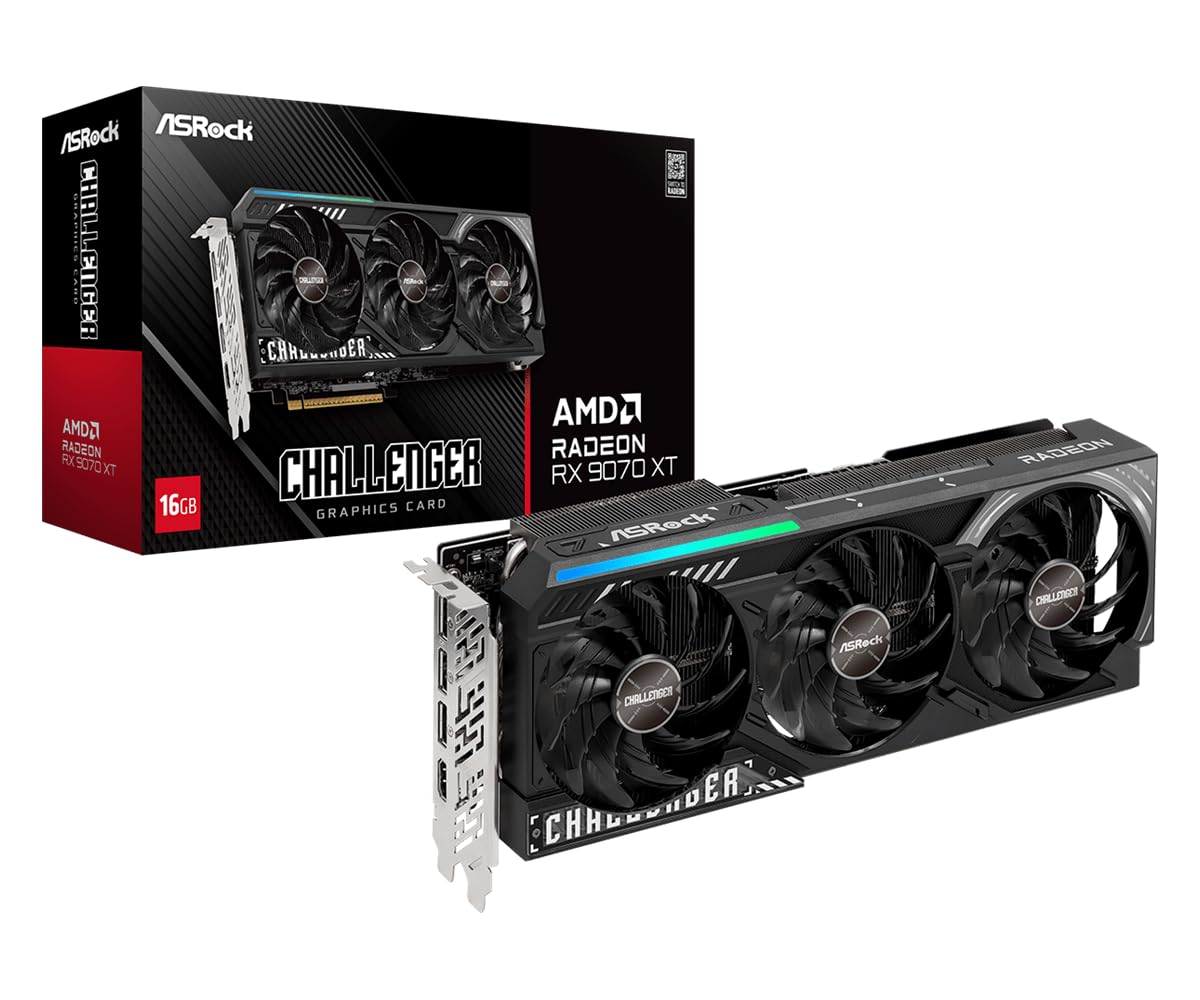
The ASRock Challenger RX 9070 XT is built for sustained, high-throughput mining. Its triple-fan design with Striped Axial Fan technology moves substantial air over the large heatsink, and the metal backplate aids heat dissipation from the PCB. The physical switch for user-controlled lighting is a practical touch, letting miners disable LEDs to reduce unnecessary power draw.
At 2970 MHz boost clock, this card pushes toward the top of the 9070 XT frequency spectrum. Users report excellent 1440p gaming performance, and the 16GB frame buffer handles large DAG files associated with coins like Ethereum Classic and Ravencoin without hitting memory limits.
The ASRock Challenger includes 0dB silent cooling, stopping fans completely during low-load scenarios, which is beneficial for mining rigs that operate in stages. Its PCIe 5.0 compatibility ensures future-proofing for next-generation mining motherboards.
Why it’s great
- Triple fan cooling with 0dB mode for silent low-load mining
- Physical LED switch eliminates unnecessary power waste from RGB
- Metal backplate improves heat dissipation and structural rigidity
Good to know
- ASRock RGB software can be buggy, though settings persist after configuration
- Requires a 750W+ power supply for stable mining operation
5. ASUS SFF-Ready Prime NVIDIA GeForce RTX 5070

The ASUS Prime RTX 5070 is purpose-built for compact mining rigs where space is a premium. Its SFF-Ready certification ensures it fits into small-form-factor cases, and the 2.5-slot Axial-tech fans with a phase-change GPU thermal pad keep temperatures in check despite the tight confines. The dual BIOS feature allows miners to switch between performance and quiet profiles.
Users report this card runs at 60-65°C under full load in an ITX chassis and produces excellent 1440p gaming results, demonstrating it can handle sustained compute loads. The 12GB GDDR7 memory offers a healthy 672 GB/s bandwidth, which is sufficient for most current algorithms.
The ASUS Prime RTX 5070 is a strategic choice for miners building a high-density rig where every inch of space counts. Its clean black design and robust thermal solution make it a reliable workhorse that won’t struggle in a multi-card setup with limited airflow.
Why it’s great
- SFF-Ready design fits compact mining cases without sacrificing cooling
- Dual BIOS allows switch between performance and quiet modes
- Phase-change thermal pad ensures consistent heat transfer under 24/7 load
Good to know
- Requires a new PSU with a 16-pin power connector for full compatibility
- At 12GB, VRAM may limit mining of algorithms with very large DAG files
6. PNY NVIDIA GeForce RTX 5070 Epic-X ARGB OC
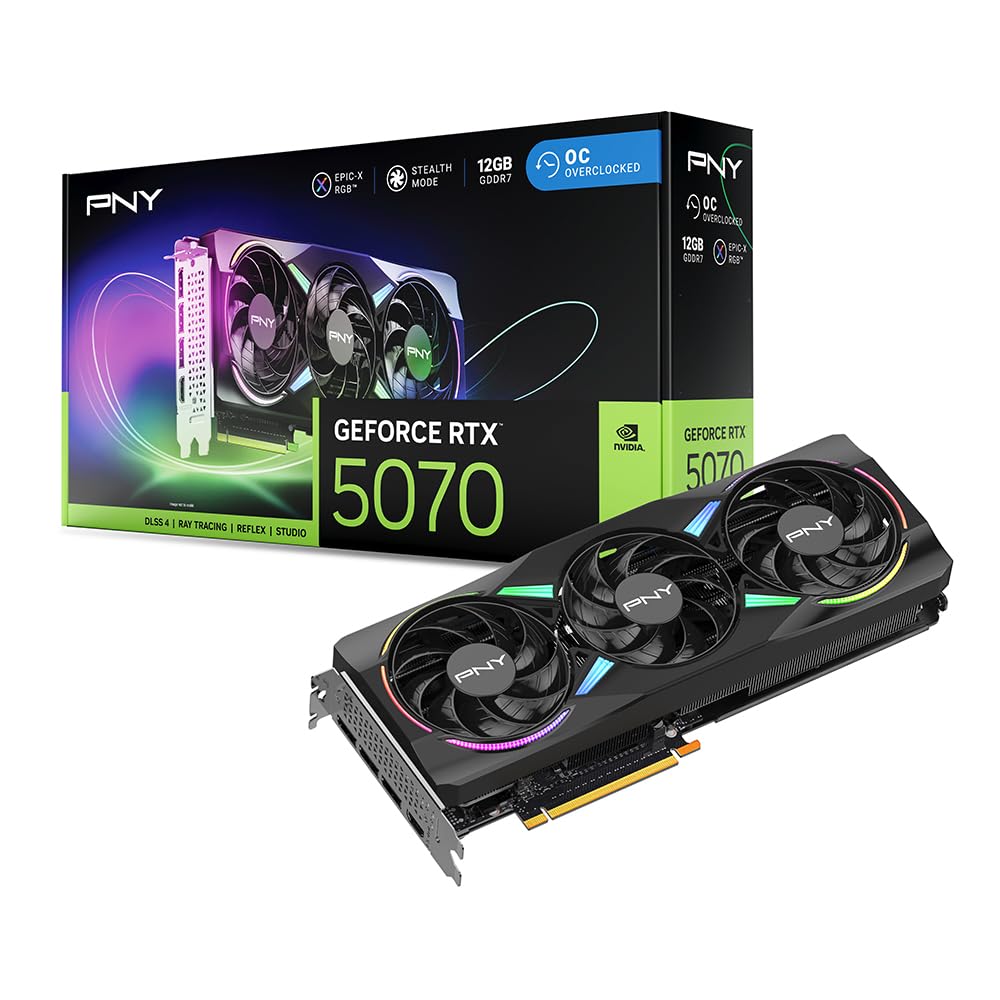
The PNY Epic-X RTX 5070 is a standout mid-range option for miners who prioritize low noise levels. Equipped with a triple-fan cooling solution, users consistently report very quiet fan profiles even under 100% load. With a boost clock of 2685 MHz and 6,144 CUDA cores, this card delivers competitive hash rates while staying acoustically discrete.
The 12GB GDDR7 memory clocked at 28 Gbps provides up to 672 GB/s of memory bandwidth, sufficient for efficient mining on most algorithms. The included 16-pin to dual 8-pin power adapter makes it compatible with a wide range of PSUs, reducing the need for custom cabling in mining rigs.
This card’s quiet operation and robust cooling make it ideal for mining setups located in shared living spaces or offices where noise levels are a concern. Its smaller footprint relative to larger premium cards also adds to its flexibility in multi-GPU configurations.
Why it’s great
- Exceptionally quiet triple-fan cooling solution under full mining loads
- 8% out-of-the-box overclock with additional headroom for tuning
- Comes with dual 8-pin to 16-pin adapter for broad PSU compatibility
Good to know
- 8GB GDDR7 may limit future algorithm choices with high memory requirements
- ARGB lighting adds a small but unnecessary power draw for mining
7. GIGABYTE Radeon RX 9060 XT Gaming OC 16G

The GIGABYTE RX 9060 XT Gaming OC provides 16GB of GDDR6 memory at a mid-range price point, making it a strong value option for miners targeting algorithms that benefit from larger frame buffers. The WINDFORCE cooling system with Hawk fans and server-grade thermal gel ensures efficient heat dissipation despite its dual-slot design.
Users report excellent 1440p ultrawide gaming performance and quiet cooling with zero-RPM mode, indicating that the card runs cool enough to avoid fan activation during lighter loads. The PCIe 5.0 support and AV1 encoding capabilities offer future-proofing for multi-purpose mining rigs used for occasional content creation or transcoding.
For miners on a budget who need 16GB of VRAM, this GIGABYTE card delivers the necessary memory capacity without the premium price tag associated with 256-bit bus cards. Its robust build quality and standard 8-pin power connector simplify integration into existing rigs.
Why it’s great
- 16GB GDDR6 memory provides excellent capacity for mining large DAG files
- WINDFORCE cooling with server-grade thermal gel ensures reliability under 24/7 load
- PCIe 5.0 support for next-generation mining motherboard compatibility
Good to know
- 128-bit memory bus limits bandwidth compared to 256-bit alternatives
- Large physical size requires a full-sized case for proper installation
8. PowerColor Reaper AMD Radeon RX 9060 XT 16GB

The PowerColor Reaper RX 9060 XT is designed for miners building rigs in limited spaces. At just 200mm in length, it is significantly shorter than most mid-range GPUs, making it an ideal fit for compact mining frames or small form factor cases. Despite its size, it packs 16GB of GDDR6 memory, which is ample for mining algorithms with sizable DAG files.
Users report that this card runs silently and remains much cooler than larger alternatives, with one user upgrading from an RX 580 noting both the smaller size and lower power draw. The single 8-pin power connector simplifies cabling in multi-GPU setups, a major advantage when building dense mining rigs with limited space for cable management.
The PowerColor Reaper proves that size does not determine mining capability. Its compact form factor, efficient power consumption, and solid 16GB memory capacity make it a strategic choice for space-constrained mining operations that still demand strong performance.
Why it’s great
- Ultra-compact 200mm length perfect for small form factor mining rigs
- Single 8-pin power connector simplifies cabling in multi-GPU setups
- Silent operation with effective cooling despite its smaller form factor
Good to know
- 128-bit memory bus, which may limit performance on bandwidth-intensive algorithms
- Requires a minimum 500W power supply for stable operation
9. XFX Swift AMD Radeon RX 9060 XT OC 16GB
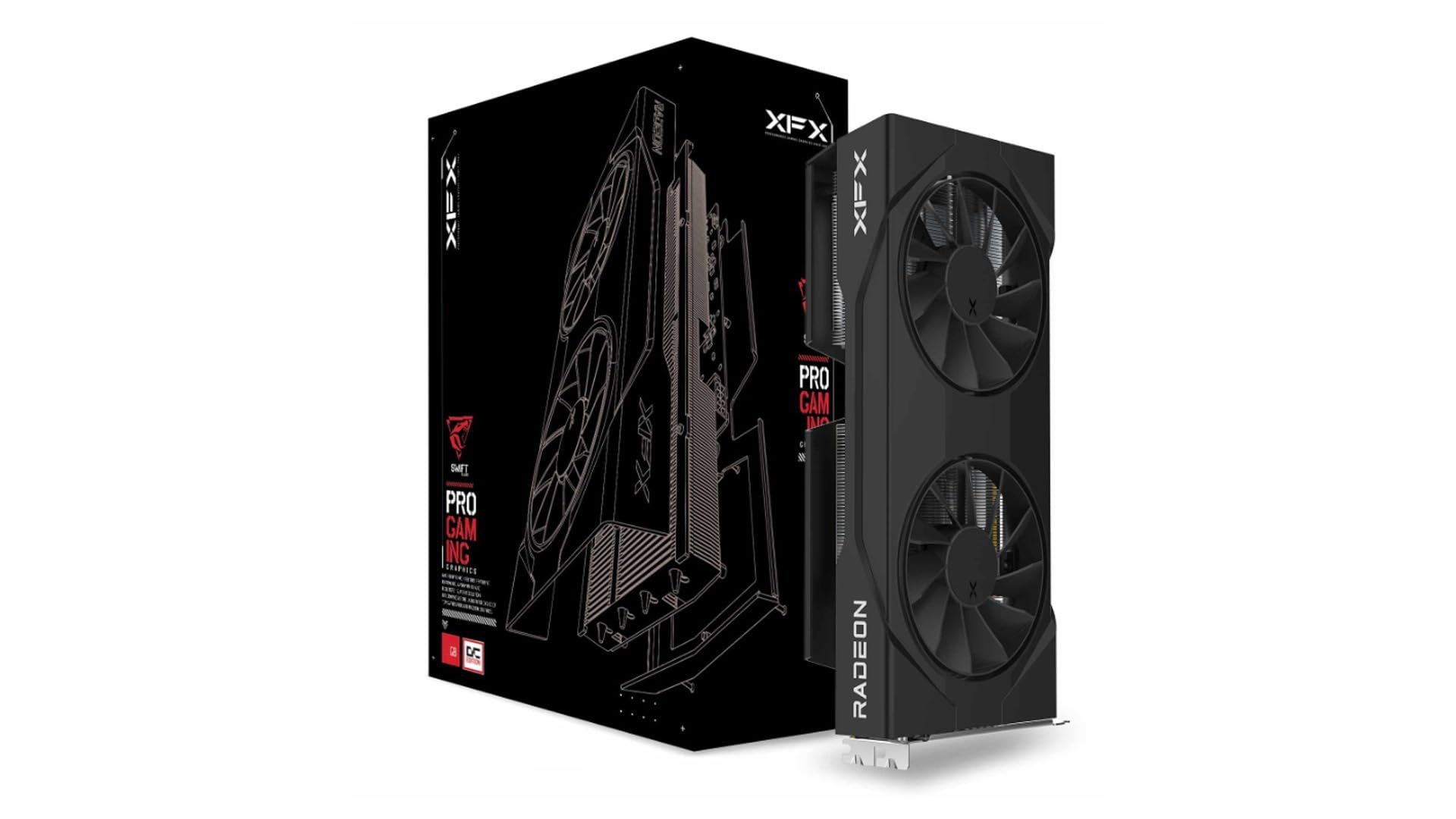
The XFX Swift RX 9060 XT OC Edition offers exceptional value for miners on a tight budget. With a boost clock of up to 3320 MHz, it punches above its weight class in terms of frequency and provides 16GB of GDDR6 memory at an entry-level price point. Users report that the dual-fan cooling solution effectively maintains temperatures around 60°C under load, which is impressive for a card in this tier.
This card delivers a Time Spy score of around 17000 points and handles 1080p maximum settings on 95% of modern AAA games, proving it can sustain demanding compute workloads. The power efficiency is notable, contributing to lower ongoing electricity costs for mining operations.
For those entering mining who want access to 16GB of VRAM without a large initial investment, the XFX Swift RX 9060 XT is a compelling entry point. Its strong boost clock and solid thermal performance make it a reliable budget workhorse for mining rigs.
Why it’s great
- High boost clock up to 3320 MHz provides excellent computational throughput
- 16GB GDDR6 memory at an entry-level price point
- Effective dual-fan cooling keeps temperatures manageable under sustained loads
Good to know
- 128-bit memory bus may bottleneck bandwidth for some algorithms
- Only three display outputs: 2 DP and 1 HDMI, limiting multi-display setups
10. GIGABYTE GeForce RTX 5060 WINDFORCE OC 8G

The GIGABYTE RTX 5060 WINDFORCE OC is the most accessible entry point for miners exploring the space. Featuring the latest GDDR7 memory and PCIe 5.0 interface, it offers modern architecture at an entry-level price. Its 8GB VRAM and 128-bit bus make it best suited for lower-complexity algorithms that do not require large memory bandwidth.
Users report that this card is an affordable upgrade from older GPUs, providing roughly double the capability of a GTX 1660 while consuming less power. The dual-fan WINDFORCE cooling system is described as cool and quiet, making it a suitable option for a low-wattage, 24/7 mining card that can also serve as a capable gaming or productivity GPU.
While not a top hash rate performer, the RTX 5060’s power efficiency and low thermal output make it a smart choice for miners who want to start small or build a low-power rig that can run continuously without generating excessive heat. It also functions well as a secondary card in a larger multi-GPU setup.
Why it’s great
- Very power efficient with low thermal output for quiet 24/7 operation
- Supports modern PCIe 5.0 interface and DLSS 4 for multi-purpose use
- Easy to install and well-packed with excellent build quality
Good to know
- 8GB VRAM and 128-bit bus limit mining algorithm compatibility
- Requires running DDU (Display Driver Uninstaller) to avoid installation issues
FAQ
Which is more important for mining: VRAM size or memory bus width?
How do I calculate a GPU’s profitability for mining?
Is it worth using an RTX 5060 for mining in 2025?
Final Thoughts: The Verdict
For most miners, the best crypto mining gpu winner is the ASUS Prime RX 9070 XT because it delivers the best balance of hash per watt, thermal management, and memory bandwidth. If you want raw memory bandwidth without the NVIDIA premium, grab the Sapphire Pulse RX 9070 XT. And for compact multi-GPU mining rigs where space is at a premium, nothing beats the ASUS Prime RTX 5070.

Mo Maruf
I created WellFizz to bridge the gap between vague wellness advice and actionable solutions. My mission is simple: to decode the research and give you practical tools you can actually use.
Beyond the data, I am a passionate traveler. I believe that stepping away from the screen to explore new environments is essential for mental clarity and physical vitality.