Our readers keep the lights on and my smoothie glass nicely filled. As an Amazon Associate, I earn from qualifying purchases.
Hunting down a phantom battery drain on your car or verifying a motor’s startup surge demands more than just a standard multimeter—you need a tool that can safely measure current without breaking the circuit. A current clamp meter lets you clamp around a single conductor and get a live reading, making it indispensable for automotive, HVAC, and industrial diagnostics.
I’m Mohammad Maruf — the founder and writer behind WellFizz. I’ve spent hundreds of hours analyzing the specifications, real user feedback, and build quality of dozens of clamp meters to separate the tools that deliver reliable readings from those that waste your time.
Whether you’re a professional electrician or a serious DIYer, finding the right best current clamp meter means balancing accuracy, safety ratings, and the specific features that match your troubleshooting workflow.
How To Choose The Best Current Clamp Meter
Selecting the right clamp meter goes beyond just looking at the number of counts. You need to match the tool’s capabilities to the specific types of circuits and environments you’ll be working on, from sensitive automotive electronics to high-power industrial panels.
AC/DC vs. AC-Only Current Measurement
If you work on automotive or solar systems, an AC/DC clamp meter is non-negotiable. AC-only models use a current transformer and cannot read the direct current flowing in a car’s electrical system. An AC/DC meter uses a Hall effect sensor to measure both, making it essential for parasitic battery drain diagnostics.
True RMS and Crest Factor
Non-linear loads like variable frequency drives, switching power supplies, and LED drivers distort the sine wave of the current. A True RMS meter accurately calculates the heating potential of these distorted waveforms, whereas an average-responding meter can be off by 30% or more. Look for a crest factor specification of 3 or higher for reliable readings on heavily distorted signals.
Safety Ratings and Build Quality
The safety rating is the most critical spec many buyers overlook. A CAT III 600V meter is built to withstand transients on distribution-level circuits, while a CAT IV 600V rating is required for service entrance work. A meter rated for a 6.6-foot drop with an over-molded case, like the Ideal 61-757, provides confidence in demanding job site conditions.
Quick Comparison
On smaller screens, swipe sideways to see the full table.
| Model | Category | Best For | Key Spec | Amazon |
|---|---|---|---|---|
| Ideal 61-757 | Premium | Professional Job Sites | 600A AC/DC, TightSight display | Amazon |
| AstroAI CM6K0R | Premium | VFD & Inrush Analysis | 1000A TRMS, Inrush function | Amazon |
| FNIRSI DMC-100 | Mid-Range | Curve Recording & Data Logging | 10000 Counts, TFT screen | Amazon |
| KAIWEETS HT206D | Mid-Range | Value-Packed Home & Shop Use | 6000 Counts, LowZ & LPF | Amazon |
| UNI-T UT210e | Entry-Level | Low-Current Parasitic Draw | 2000 Counts, 1 mA resolution | Amazon |
In‑Depth Reviews
1. Ideal 61-757 TightSight Clamp Meter
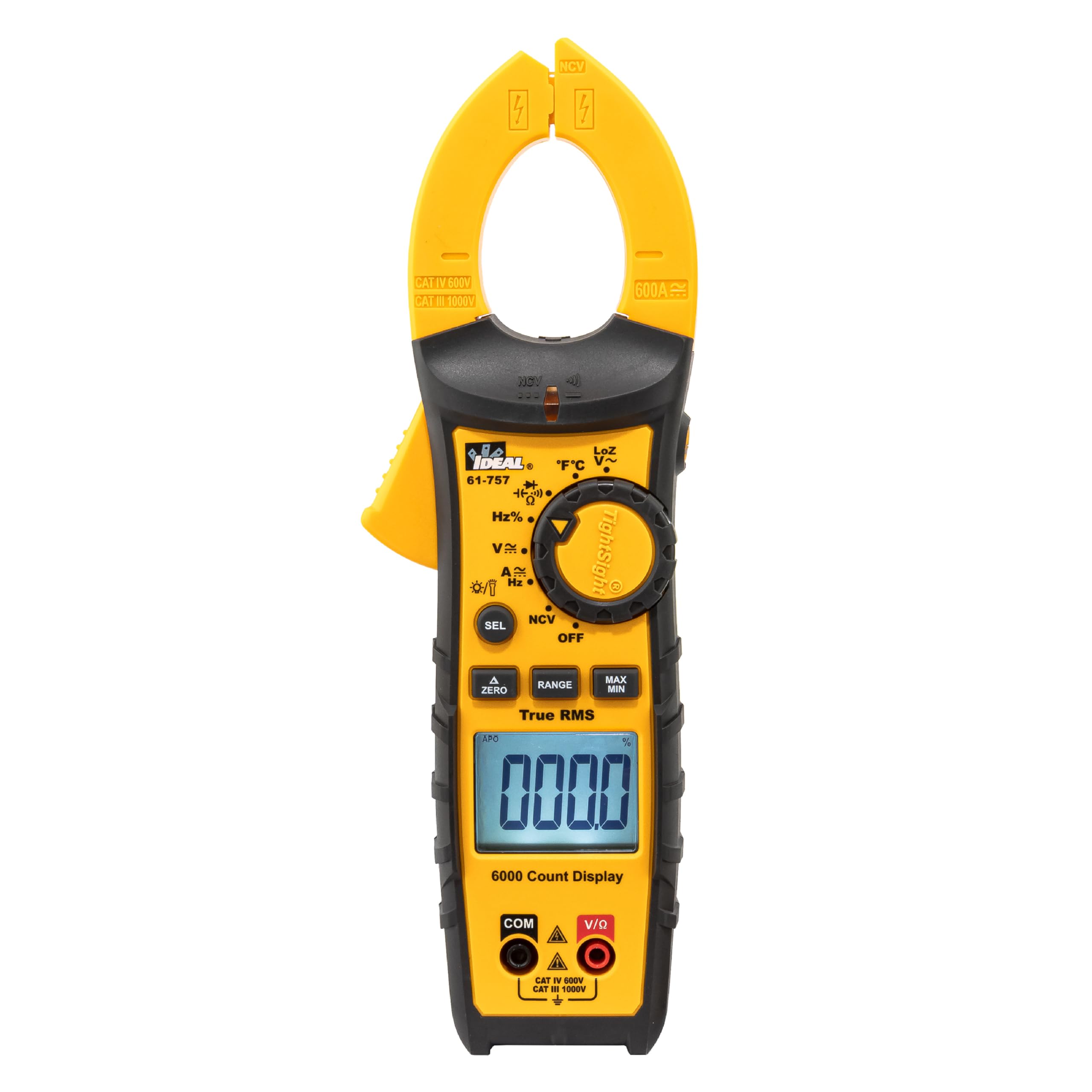
The Ideal 61-757 stands out with its patented TightSight display, which places a secondary readout at the bottom of the clamp so you can see your measurements without having to crane your neck around the panel or twist the conductor. This is a genuine safety and convenience upgrade for anyone working in crowded breaker panels or tight junction boxes.
Rated CAT IV 600V and built to survive a 6.6-foot drop, this meter is engineered for daily job site abuse. It delivers True RMS readings for AC voltage and current, measures up to 600A AC/DC, and includes LoZ mode to eliminate ghost voltage readings. The dual backlit display and built-in flashlight make it genuinely usable in dark attics and basements.
User feedback highlights its accurate low-current sensing for parasitic drain detection and rock-solid build quality. Some users note that the non-contact voltage (NCV) detection can be less reliable than the primary measurement functions, and the continuity buzzer may require a mode toggle to activate. These are minor quirks on an otherwise professional-grade tool.
Why it’s great
- TightSight display lets you read the meter without repositioning the clamp or your head
- UL-certified CAT IV 600V safety rating with a 6.6-foot drop survival spec
- Accurate DC current sensing down to low ranges for automotive parasitic draw testing
Good to know
- NCV detection can be less sensitive than dedicated testers
- Continuity buzzer requires pressing the select button to enable
- Premium price point reflects its professional build and features
2. AstroAI Inrush Clamp Meter CM6K0R

The AstroAI CM6K0R is built for professionals who need to capture the startup surge of motors, compressors, and transformers. Its dedicated inrush current function samples the initial spike with a 100ms measurement window, allowing you to quickly identify whether a starting circuit is pulling excessive current and tripping breakers.
With a 6000-count True RMS engine, a CAT IV 600V safety rating, and the ability to measure up to 1000A AC/DC, this meter is a workhorse for industrial troubleshooting. It adds VFD (Variable Frequency Drive) mode and LowZ (LoZ Volts) to suppress ghost voltages, making it particularly valuable for diagnosing motor drives and verifying dead circuits safely.
Users consistently praise the clear, oversized backlit display and the included K-type thermocouple for temperature measurement. The primary criticism is that the temperature probe can be slow to stabilize. Overall, it delivers features typically found in meters costing significantly more, making it a smart choice for budget-conscious professionals.
Why it’s great
- Dedicated inrush current function captures motor startup spikes
- VFD mode and LoZ voltage for accurate measurements on variable frequency drives
- CAT IV 600V safety rating combined with 1000A AC/DC measurement range
Good to know
- Inrush function works on AC current only, not DC
- Temperature readings from the thermocouple can be slow to settle
- Larger form factor compared to compact mini clamp meters
3. FNIRSI DMC-100 Clamp Meter
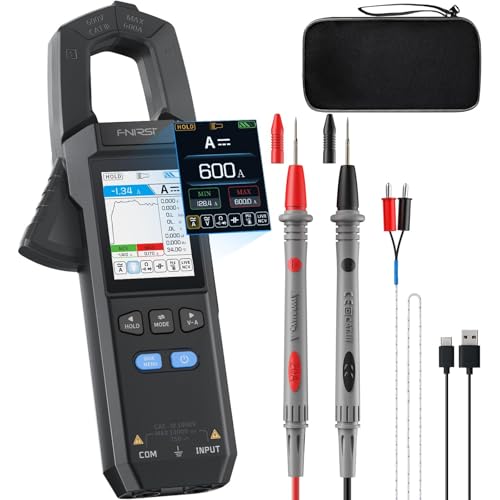
The FNIRSI DMC-100 breaks from the traditional LCD mold with a 2-inch TFT full-color display that offers 10-level brightness adjustment and a choice between dark and light themes. This screen provides a real-time curve graphing mode that visualizes signal variations over time, helping you spot intermittent faults that a static reading would miss.
It measures up to 600A AC/DC with True RMS accuracy and a 10000-count resolution. The built-in 1500mAh rechargeable battery with Type-C charging eliminates the need for disposable batteries, and the meter stores 8 sets of real-time data plus 30 sets of historical records for later analysis. The compact form factor at just 6.72 ounces is easy to carry in a tool pouch.
User reviews note that its DC current readings are very close to those of a Fluke 289 for general automotive and household work. However, the internal lithium-polymer battery is not user-replaceable, which is a long-term durability concern. The included flashlight is also relatively weak. It is an excellent backup or home-use meter, though not built to the same abuse standards as professional-grade units.
Why it’s great
- Real-time curve graphing helps identify intermittent electrical faults visually
- Rechargeable battery with Type-C charging saves on disposable battery costs
- High 10000-count resolution with a bright, adjustable TFT color display
Good to know
- Internal lithium battery is not user-replaceable, limiting long-term service life
- Build quality is more suited for light professional or DIY use than heavy job sites
- Flashlight output is dim compared to meters with dedicated high-lumen LEDs
4. KAIWEETS HT206D Clamp Meter

The KAIWEETS HT206D packs a surprising number of professional features into a mid-range price bracket. It includes True RMS measurement, a LowZ mode to prevent ghost voltage readings, and a Low Pass Filter (LPF) specifically designed for accurate measurements on variable frequency drive signals, which is uncommon at this tier.
With a 6000-count auto-ranging display, it measures AC/DC current up to 600A and voltage up to 600V. The two-color backlit LCD turns red when voltage exceeds 80V or current exceeds 3A, providing an instant visual high-voltage warning. It also includes a K-type thermocouple input for temperature measurement, NCV detection, and a built-in LED flashlight.
User feedback is overwhelmingly positive, with many noting its solid, professional feel and accurate voltage and resistance readings straight out of the box. The DC current measurement can be inconsistent at very low ranges even after zeroing, and the auto power-off feature requires turning the rotary dial to reset, which can be slightly annoying during intermittent testing sessions.
Why it’s great
- LowZ and LPF modes for accurate VFD and ghost voltage suppression
- Two-color backlit LCD provides automatic high-voltage/current warnings
- Includes K-type thermocouple, NCV, and flashlight in a well-priced package
Good to know
- DC current readings can be inconsistent at low milliampere levels
- Auto power-off requires turning the dial to reset, which is less convenient than a button press
- Manual is thorough but too large to fit inside the included carrying case
5. UNI-T UT210e Clamp Meter

The UNI-T UT210e is a pocket-sized specialist that excels in one critical area: measuring very small DC currents with high resolution. Its 2000-count display offers a 1 mA resolution on the 2.000 A range, making it one of the best tools in its class for tracking down parasitic battery drain in vehicles, a task that larger high-current clamps often struggle with.
Despite its compact size, it measures AC/DC current up to 100A and voltage up to 600V. It features True RMS, VFC mode to filter out signal noise on variable frequency drives, a continuity buzzer, and a capacitance meter. It runs on two standard AAA batteries instead of a larger 9V, and the non-slip rubber grip makes it easy to handle in cramped engine bays.
Users consistently highlight its exceptional value for automotive work, particularly for diagnosing low-current circuits that draw anywhere from a few milliamps to one amp. The meter can drift slightly at the very bottom of its range and requires zeroing for precise low-current readings. It is not designed for the highest available count or the most rugged drop protection, but within its niche, it is a standout performer.
Why it’s great
- 1 mA resolution on DC current range is excellent for automotive parasitic drain testing
- Compact and lightweight form factor fits easily in a pocket or small tool bag
- VFC filter mode reduces noise interference on variable frequency drive measurements
Good to know
- Readings can drift at the very low end of the measurement range without zeroing
- 2000-count display is lower resolution compared to 6000+ count alternatives
- Not rated for the same drop or category safety levels as professional full-size meters
FAQ
Can I measure DC current with an AC-only clamp meter?
What does the inrush current function actually capture?
Why does my clamp meter read “1” or overrange on a live wire?
Final Thoughts: The Verdict
For most users, the best current clamp meter winner is the Ideal 61-757 because its TightSight display, CAT IV safety rating, and rugged build provide the best balance of professional utility and everyday convenience. If you need inrush current analysis for motor diagnostics, grab the AstroAI CM6K0R. And for the specific task of tracking down parasitic battery drain on a budget, nothing beats the compact and precise UNI-T UT210e.

Mo Maruf
I created WellFizz to bridge the gap between vague wellness advice and actionable solutions. My mission is simple: to decode the research and give you practical tools you can actually use.
Beyond the data, I am a passionate traveler. I believe that stepping away from the screen to explore new environments is essential for mental clarity and physical vitality.